Event
Global exchange
Osram
Stuart Mucklejohn and John Stocks report on some of the key areas of discussion at the16th International Symposium on the Science and Technology of Lighting (LS16)
The International Symposium on the Science and Technology of Lighting has a 40-year history of providing a forum for scientists and engineers worldwide, in academia, national laboratories and industry, allowing them to share and exchange the latest progress on the science and technology of lighting. At the opening of the symposium, after brief introductions from the chairs of the local and international organising committees, the stage was given over to Rachel Shaw, winner of the Worshipful Company of Lightmongers’ award for the best student graduating in 2017 from UCL’s MSc in Light and Lighting. Rachel highlighted the beneficial role played by the professional and industry bodies in supporting people in their careers, providing not only support and guidance but also giving members of the profession a strong sense of purpose and community. The week started with a fascinating talk by Robert Karlicek from Rensselaer Polytechnic Institute who looked to the future, seeing a world where lighting systems are attuned to the occupants’ activities, adjusting to suit the task or atmosphere. The lighting, being linked to the Internet of Things, enables
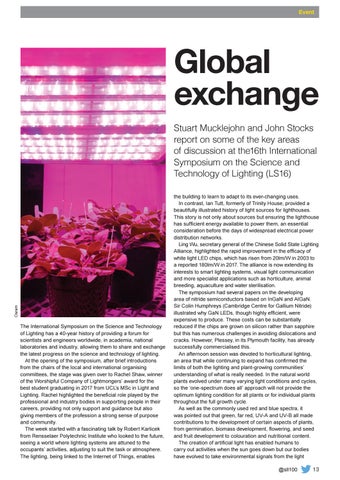
the building to learn to adapt to its ever-changing uses. In contrast, Ian Tutt, formerly of Trinity House, provided a beautifully illustrated history of light sources for lighthouses. This story is not only about sources but ensuring the lighthouse has sufficient energy available to power them, an essential consideration before the days of widespread electrical power distribution networks. Ling Wu, secretary general of the Chinese Solid State Lighting Alliance, highlighted the rapid improvement in the efficacy of white light LED chips, which has risen from 20lm/W in 2003 to a reported 180lm/W in 2017. The alliance is now extending its interests to smart lighting systems, visual light communication and more specialist applications such as horticulture, animal breeding, aquaculture and water sterilisation. The symposium had several papers on the developing area of nitride semiconductors based on InGaN and AlGaN. Sir Colin Humphreys (Cambridge Centre for Gallium Nitride) illustrated why GaN LEDs, though highly efficient, were expensive to produce. These costs can be substantially reduced if the chips are grown on silicon rather than sapphire but this has numerous challenges in avoiding dislocations and cracks. However, Plessey, in its Plymouth facility, has already successfully commercialised this. An afternoon session was devoted to horticultural lighting, an area that while continuing to expand has confirmed the limits of both the lighting and plant-growing communities’ understanding of what is really needed. In the natural world plants evolved under many varying light conditions and cycles, so the ‘one-spectrum does all’ approach will not provide the optimum lighting condition for all plants or for individual plants throughout the full growth cycle. As well as the commonly used red and blue spectra, it was pointed out that green, far red, UV-A and UV-B all made contributions to the development of certain aspects of plants, from germination, biomass development, flowering, and seed and fruit development to colouration and nutritional content. The creation of artificial light has enabled humans to carry out activities when the sun goes down but our bodies have evolved to take environmental signals from the light @sll100
13