LR&T essentials
The road ahead Street lighting and automotive headlamps are key themes in the latest issue of LR&T says Iain Carlile
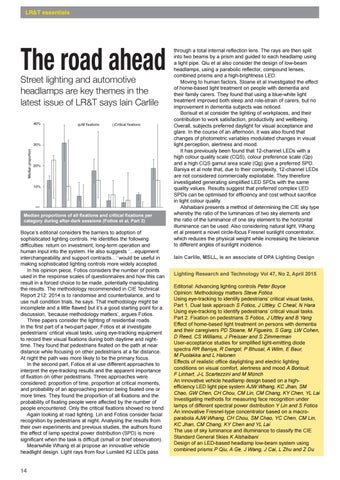
Median proportions of all fixations and critical fixations per category during after-dark sessions (Fotios et al, Part 2)
Boyce’s editorial considers the barriers to adoption of sophisticated lighting controls. He identifies the following difficulties: return on investment, long-term operation and human input into the system. He also suggests ‘…equipment interchangeability and support contracts…’ would be useful in making sophisticated lighting controls more widely accepted. In his opinion piece, Fotios considers the number of points used in the response scales of questionnaires and how this can result in a forced choice to be made, potentially manipulating the results. The methodology recommended in CIE Technical Report 212: 2014 is to randomise and counterbalance, and to use null condition trials, he says. That methodology might be incomplete and a little flawed but it’s a good starting point for a discussion, ‘because methodology matters’, argues Fotios. Three papers consider the lighting of residential roads. In the first part of a two-part paper, Fotios et al investigate pedestrians’ critical visual tasks, using eye-tracking equipment to record their visual fixations during both daytime and nighttime. They found that pedestrians fixated on the path at near distance while focusing on other pedestrians at a far distance. At night the path was more likely to be the primary focus. In the second part, Fotios et al use different approaches to interpret the eye-tracking results and the apparent importance of fixation on other pedestrians. Three approaches were considered: proportion of time, proportion at critical moments, and probability of an approaching person being fixated one or more times. They found the proportion of all fixations and the probability of fixating people were affected by the number of people encountered. Only the critical fixations showed no trend. Again looking at road lighting, Lin and Fotios consider facial recognition by pedestrians at night. Analysing the results from their own experiments and previous studies, the authors found the effect of lamp spectral power distribution (SPD) is more significant when the task is difficult (small or brief observation). Meanwhile Whang et al propose an innovative vehicle headlight design. Light rays from four Lumiled K2 LEDs pass
14
through a total internal reflection lens. The rays are then split into two beams by a prism and guided to each headlamp using a light pipe. Qiu et al also consider the design of low-beam headlamps, using a parabolic reflector, compound lenses, combined prisms and a high-brightness LED. Moving to human factors, Sloane et al investigated the effect of home-based light treatment on people with dementia and their family carers. They found that using a blue-white light treatment improved both sleep and role-strain of carers, but no improvement in dementia subjects was noticed. Borisuit et al consider the lighting of workplaces, and their contribution to work satisfaction, productivity and wellbeing. Overall, subjects preferred daylight for visual acceptance and glare. In the course of an afternoon, it was also found that changes of photometric variables modulated changes in visual light perception, alertness and mood. It has previously been found that 12-channel LEDs with a high colour quality scale (CQS), colour preference scale (Qp) and a high CQS gamut area scale (Qg) give a preferred SPD. Baniya et al note that, due to their complexity, 12-channel LEDs are not considered commercially exploitable. They therefore investigated generating simplified LED SPDs with the same quality values. Results suggest that preferred complex LED SPDs can be optimised for efficiency and cost without sacrifice in light colour quality. Alshaibani presents a method of determining the CIE sky type whereby the ratio of the luminances of two sky elements and the ratio of the luminance of one sky element to the horizontal illuminance can be used. Also considering natural light, Whang et al present a novel circle-focus Fresnel sunlight concentrator, which reduces the physical weight while increasing the tolerance to different angles of sunlight incidence. Iain Carlile, MSLL, is an associate of DPA Lighting Design Lighting Research and Technology Vol 47, No 2, April 2015 Editorial: Advancing lighting controls Peter Boyce Opinion: Methodology matters Steve Fotios Using eye-tracking to identify pedestrians’ critical visual tasks, Part 1. Dual task approach S Fotios, J Uttley, C Cheal, N Hara Using eye-tracking to identify pedestrians’ critical visual tasks. Part 2. Fixation on pedestrians S Fotios, J Uttley and B Yang Effect of home-based light treatment on persons with dementia and their caregivers PD Sloane, M Figueiro, S Garg, LW Cohen, D Reed, CS Williams, J Preisser and S Zimmerman User-acceptance studies for simplified light-emitting diode spectra RR Baniya, R Dangol, P Bhusal, A Wilm, E Baur, M Puolakka and L Halonen Effects of realistic office daylighting and electric lighting conditions on visual comfort, alertness and mood A Borisuit, F Linhart, J-L Scartezzini and M Münch An innovative vehicle headlamp design based on a highefficiency LED light pipe system AJW Whang, KC Jhan, SM Chao, GW Chen, CH Chou, CM Lin, CM Chang, KY Chen, YL Lai Investigating methods for measuring face recognition under lamps of different spectral power distribution Y Lin and S Fotios An innovative Fresnel-type concentrator based on a macroparabola AJW Whang, CH Chou, SM Chao, YC Chen, CM Lin, KC Jhan, CM Chang, KY Chen and YL Lai The use of sky luminance and illuminance to classify the CIE Standard General Skies K Alshaibani Design of an LED-based headlamp low-beam system using combined prisms P Qiu, A Ge, J Wang, J Cai, L Zhu and Z Du