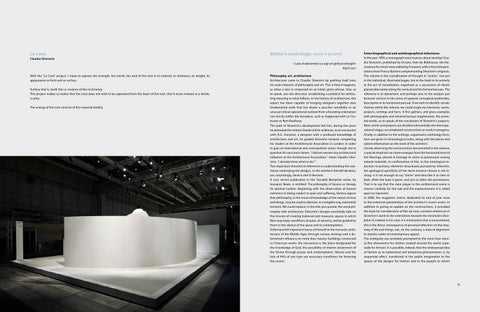
La Cava
Matter’s symbology: stone is ground
Claudio Silvestrin «Lack of adornment is a sign of spiritual strength» Adolf Loos1
With the “La Cava” project, I mean to express the strength, the worth, the soul of the rock in its entirety, its thickness, its weight, its appearance as form and as surface. Surface that is, itself, the co-essence of the rock being. This project makes us realise that the crust does not wish to be separated from the heart of the rock, that it exists instead as a whole, a unity. The energy of the rock consists of this material totality.
74
Philosophy, art, architecture Architecture came to Claudio Silvestrin by grafting itself onto his main interests of philosophy and art. This is how it happens, as when a text is composed on an initial, given phrase, that, so to speak, sets the direction, establishing a yardstick for attributing meaning to what follows. In the history of architecture, this aspect has been capable of bringing designers together over fundamental work that has drawn a peculiar sensibility or an unusual critical-operational outlook from a founding orientation not strictly within the discipline, such as happened with Le Corbusier or Rem Koolhaas. The path of Silvestrin’s development led him, during the years he attended the Istituto Statale d’Arte at Monza, to an encounter with A.G. Fronzoni, a designer with a profound knowledge of architecture and art; he guided Silvestrin towards completing his studies at the Architectural Association in London in order to gain an international and cosmopolitan vision, though not to question his own basic tenets. “I did not receive any architectural influence at the Architectural Association,” states Claudio Silvestrin, ”I already knew what to do.”2 Two important theoretical references in understanding the substance underlying the designs, as the architect himself declares, are, surprisingly, Seneca and St Bernard. A very recent publication in the Tascabili Bompiani series, by Giovanni Reale, is entitled: The philosophy of Seneca as therapy for spiritual malaise. Beginning with the observation of human existence as being subject to pain and suffering, Seneca argues that philosophy, in the sense of knowledge of the nature of man and things, may be used to alleviate, in a tangible way, existential torment. We could replace, in the title just quoted, the word philosophy with architecture: Silvestrin’s designs essentially take on the mission of creating balanced and measures spaces in which Man may enjoy conditions of quiet, of serenity, and be guided by them to the silence of the space and to contemplation. St Bernard left important traces of himself in the monastic architecture of the Middle Ages through various writings and a determinant influence on more than twenty buildings connected to Cistercian works: the monastery is the place designated for the knowledge of God, the possibility of interior attainment of the Divine through prayer and contemplation. Silence and the lack of frills of any type are necessary conditions for fostering the ascent.
Some biographical and autobiographical milestones In the year 1999, a monograph went to press about (and by) Claudio Silvestrin, published by Octavo, then by Birkhauser, the illustrations for which were edited by Fronzoni, with critical interpretations from Franco Bertoni complementing Silvestrin’s originals. The volume is the crystallisation of thought in “action,” not just in the individual, illustrated pages, but in the book in its entirety at the act of consultation, organised as a succession of sheets placed alternately along the vertical and the horizontal axes. The reference is to dynamism, and perhaps also to the analysis put forward: vertical, in the sense of upward, conceptual profundity, descriptive in its horizontal perusal. If we wish to identify certain themes within the volume, we could single out elements, works, projects, writings and facts. It first gathers, and gives examples with photographs and minimal textual supplements, the essential words, so to speak, of the vocabulary of Silvestrin’s projects. Next, works and projects are divided substantially into their operational stages, as completed constructions or works in progress. Finally, in addition to the writings, organised in anthology form, facts are given in chronological order, along with the places and salient information on the work of the architect. Closely observing the constructions documented in the volume, a special emphasis on stone emerges from the horizontal level of the floorings, placed in homage to stone as paramount among natural materials. In confirmation of this, in the ontological reduction to primary elements tenaciously pursued by Silvestrin, the geological specificity of the stone essence chosen is not lacking: is it not enough to say “stone” and describe it as clear or dark, often the type is given, and just as often the provenance. That is to say that the main player in the architectural scene is chosen carefully for the role and the expressiveness it is called upon to represent. In 2006, the magazine, Interni, dedicated its end of year issue to the extensive presentation of the architect‘s recent works. In addition to giving an update on the constructions, it provided the basis for consideration of the, by now, constant references in Silvestrin’s work to the orientation towards the minimalist discipline. If, indeed, in his case, it is minimalism that is encountered, this is the direct consequence of personal reflection on the meaning of life and things, not, on the contrary, a state of alignment to stylistic codes of contemporary appeal. The ambiguity was probably prompted by the more than twenty-five showrooms for clothes created around the world, especially for Armani. It is possible, indeed, that the widespread idea of fashion as an ephemeral and temporary phenomenon, is, by sequential effect, transferred in the public imagination to the spaces of the designs for fashion and to the people to whom
75