Seed Co breaks records in Mpongwe by Du Preez de Villiers
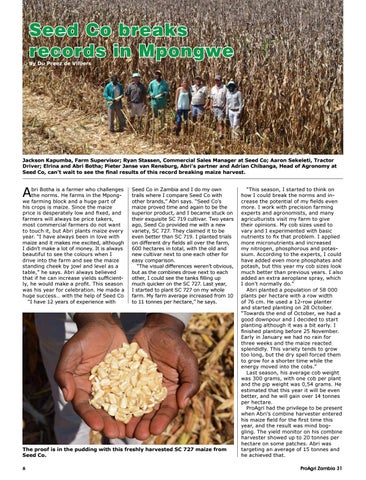
Jackson Kapumba, Farm Supervisor; Ryan Stassen, Commercial Sales Manager at Seed Co; Aaron Sekeleti, Tractor Driver; Elrina and Abri Botha; Pieter Janse van Rensburg, Abri’s partner and Adrian Chibanga, Head of Agronomy at Seed Co, can’t wait to see the final results of this record breaking maize harvest.
A
bri Botha is a farmer who challenges the norms. He farms in the Mpongwe farming block and a huge part of his crops is maize. Since the maize price is desperately low and fixed, and farmers will always be price takers, most commercial farmers do not want to touch it, but Abri plants maize every year. “I have always been in love with maize and it makes me excited, although I didn’t make a lot of money. It is always beautiful to see the colours when I drive into the farm and see the maize standing cheek by jowl and level as a table,” he says. Abri always believed that if he can increase yields sufficiently, he would make a profit. This season was his year for celebration. He made a huge success… with the help of Seed Co “I have 12 years of experience with
Seed Co in Zambia and I do my own trails where I compare Seed Co with other brands,” Abri says. “Seed Co’s maize proved time and again to be the superior product, and I became stuck on their exquisite SC 719 cultivar. Two years ago, Seed Co provided me with a new variety, SC 727. They claimed it to be even better than SC 719. I planted trials on different dry fields all over the farm, 600 hectares in total, with the old and new cultivar next to one each other for easy comparison. “The visual differences weren’t obvious, but as the combines drove next to each other, I could see the tanks filling up much quicker on the SC 727. Last year, I started to plant SC 727 on my whole farm. My farm average increased from 10 to 11 tonnes per hectare,” he says.
The proof is in the pudding with this freshly harvested SC 727 maize from Seed Co. 6
“This season, I started to think on how I could break the norms and increase the potential of my fields even more. I work with precision farming experts and agronomists, and many agriculturists visit my farm to give their opinions. My cob sizes used to vary and I experimented with basic nutrients to fix that problem. I applied more micronutrients and increased my nitrogen, phosphorous and potassium. According to the experts, I could have added even more phosphates and potash, but this year my cob sizes look much better than previous years. I also added an extra aeroplane spray, which I don’t normally do.” Abri planted a population of 58 000 plants per hectare with a row width of 76 cm. He used a 12-row planter and started planting on 28 October. “Towards the end of October, we had a good downpour and I decided to start planting although it was a bit early. I finished planting before 25 November. Early in January we had no rain for three weeks and the maize reacted splendidly. This variety tends to grow too long, but the dry spell forced them to grow for a shorter time while the energy moved into the cobs.” Last season, his average cob weight was 300 grams, with one cob per plant and the pip weight was 0,54 grams. He estimated that this year it will be even better, and he will gain over 14 tonnes per hectare. ProAgri had the privilege to be present when Abri’s combine harvester entered his maize field for the first time this year, and the result was mind boggling. The yield monitor on his combine harvester showed up to 20 tonnes per hectare on some patches. Abri was targeting an average of 15 tonnes and he achieved that.
ProAgri Zambia 31