Organic Broadcaster | Fall 2025 | Volume 33, Issue 4
Farmers standing with immigrants is aBout more than dollars and Cents the organiC researCh huB
Bison in the upper midwest
WHO WE ARE
Marbleseed is a nonprofit committed to supporting the Midwest’s organic and sustainable farmers through farmer-led events and educational resources that help your farm grow.
The Organic Broadcaster is a quarterly magazine published by Marbleseed. Opinions expressed by the authors do not necessarily reflect those of the publisher. Inclusion of an advertisement does not imply endorsement of a product. Content may be reprinted with permission.
Subscription: Manage your subscription by emailing info@marbleseed.org
IN THIS ISSUE
in the Upper Midwest: A Modern Approach to Recreating
How Strong Environmental
Fruit with the Savanna Institute’s Wisconsin Agroforestry Demonstration Farm Network
Lakes:
Conservation Planning for Organic Transition: How CPA 138 and DIA 140 Help Farmers Succeed
Abundance Grows in Solidarity: Notes from the Conference Manager
From Flowers to Farrow-to-Finish Hogs: Over the Moon Uses Financial Tools to Make Tough Decisions
Book Review: The Wisdom of the Hive: What Honeybees Can Teach Us About Collective Wellbeing by Michelle Cassandra Johnson & Amy Burtaine
“Just a Farmer?”
From The execuTive DirecTor
Before congress left for summer recess in August they passed One Big Beautiful Bill Act (OBBB, P.L. 119-21). This act utilized budget reconciliation, requiring a simple majority, to address a backlog of issues that had resulted from an almost three year wait on a new comprehensive Farm Bill. Farm Bills are inherently bi-partisan, relying on a two-thirds majority for passage. Utilizing budget reconciliation, congress passed a spending bill that sacrificed many local food and nutrition programs to preserve the tax cuts for the wealthy that were doled out in 2017.
Cuts to child nutrition and food stamps have definitely captured the headlines since the July passage of the bill. However, other aspects of OBBB are troubling indicators of who is considered a farmer worthy of taxpayer support by the current administration and those in control of congress. On the heels of announcing USDA’s “Farmers First: Small Family Farms Policy Agenda” in March, the OBBB funds subsidies to the largest farms without regards to formerly bipartisan supported income caps and means testing that uphold a value that the wealthiest farms do not need the myriad of farm subsidy programs we fund with our tax dollars.
These are not small amounts of money paid to the top 10% of farms. These are $155,000 payments, almost double that for married couples. And the OBBB goes further to expand the definition of who could automatically be considered “actively engaged” on a “family” farm to large extended family. The price tag for increasing these taxpayer supported subsidies to the top 10% of farms was estimated by the Congressional Budget Office to be $54 billion dollars over ten years. Who does not get subsidies are again small farmers who do not have base acres enrolled in commodity programs, who grow specialty crops, sell directly to consumers, and raise what feeds us.
According to USDA, the average farm receives 77% of their total household income from off-farm sources. Even farms earning profits over $350,000 earn 74% of their total income off the farm. The OBBB removed the income limits on receiving tax payer funded conservation cost share and disaster assistance, enabling the wealthiest farms that earn at least 75% of their income from farming access to these programs. Even with conservation program funding maintained (good news), staffing cuts in local NRCS and FSA offices may result in larger payments to fewer farms. Again, only benefiting the largest of operations.
Choosing to fund the largest commodity farms through cuts to nutrition programs that feed
communities, provide markets for local food, and contribute economically to small rural grocery stores and businesses, simply hastens the consolidation of farmland and the gutting of rural communities. Grants that funded efforts to establish community-based urban farms, supported local food systems through expanded market access, and enabled historically underserved farmers to thrive have also been terminated.
Cutting the food and nutrition programs that made up 75% of the farm bill spending, to fund subsidies for the largest farms, sends a louder message than a press release espousing support for small family farms. Who “counts as a farmer” is who the myriad of USDA programs are designed to support. Yet, we are likely the farmers that consumers conjure when asked the same question. We are feeding communities, stewarding the land, caring for livestock and complex ecosystems. We are neighbors that live in their communities. The food we grow and raise is not taxpayer subsidized. And if we are lucky, we have someone in our household that can earn enough for us off the farm to provide us with health care, and make the mortgage on the farm, despite impossibly inflated land prices and health insurance costs; all so we can keep farming.
The Farm Bill, with all twelve titles that include nutrition programs has gathered a broad, cross sector coalition. Utilizing budget reconciliation to cherry pick funding of Farm Bill programs has threatened our collective work.
Watching this unfold over the summer, erasing gains made in local food and transitioning more land to organic led to a reluctant acceptance that the current agricultural system (at least in the near term) will not acknowledge the role of small to mid-sized farms in a resilient food system. However, if we were honest, the consolidated, ‘get big or get out’ mindset was not serving us BEFORE either.
The murmurings of solidarity and circular economies, mutual aid, and communities of care have grown louder and come to the forefront. I have been in several meetings and communities suggesting that the strength of these ideas have brought us exactly to this moment. Our collective energy has threatened the status quo. And in some of these spaces, there is excitement that we are witnesses and participants in this moment.
And maybe the passage of OBBB presents an opportunity to build a broader coalition. This bill makes sweeping changes to the Affordable Care Act (ACA), a source of health care access for many farmers. In a study by the Robert Wood Johnson Foundation, the rate of those uninsured in the top ten agricultural states dropped 25% due to access to the ACA exchange, also
Farmers standing with immigrants is aBout more than dollars and Cents
By Anthony Pahnke
“NO
SOy UN TRACTOR”
The words - “no soy un tractor” (I am not a tractor)appear below a mural that covers a wall of the Coalition of Immokalee Workers’ (CIW) office in Immokalee, Florida. When asked why those words are etched next to a painting of a tractor, a CIW leader told me that that was how a tomato grower referred to some farmworkers. The story goes that on one occasion when workers were demanding the chance to speak with their employer about improving their work conditions, the grower said, “why would I talk to you? I don’t talk to my tractors, so I am not going to talk to you.”
We were listening to that story, myself, along with another leader of Family Farm Defenders (FFD), a representative of the group Food for Maine’s Future, and someone from the non-profit, WhyHunger, as part of a trip to Immokalee in 2012. We went to learn about the group’s Fair Food Program, which assures workers a pay
increase and improvements to work conditions. While considering how the program could perhaps be adapted to the dairy industry to assist small-scale producers, we also toured a series of mobile homes where a dozen or so workers sleep and heard about the CIW’s ongoing disputes with some growers over slavery
Other than the research part of the trip – which remains ongoing – we went to Florida to strengthen our relationship with CIW because farmworkers and farmers have more in common than what the press, and perhaps our politicians, would have us believe. Whether it’s experiencing the negative effects of trade deals, knowing the value of hard work, or caring for one’s families and loved ones, farmers and rural people in this country share values and hopes with immigrants who may not look like the typical Wisconsin dairy farmer. Now more than ever is the time to realize this fact, and work together in community to not only protect immigrants, regardless of their immigration status, but also create a better food system that benefits all of us.
Photo Credit: John Peck, Family Farm Defenders
That trip to Florida was just one experience for many of us in FFD who have been working with farmworkers about how to make a more just food, farm, and fiber system.
As a member of La Via Campesina, FFD members have had many chances to travel abroad and see firsthand the negative effects of trade deals that have driven rural people from their homes. At various meetings, we have discussed how international institutions like the World Trade Organization (WTO) and international agreements like the North American Free Trade Agreement (NAFTA) had removed farmers’ abilities to influence domestic agricultural policy, forcing our prices down. When we held our annual meeting in Oaxaca, Mexico, in 2007, we met some farmers who had stayed after NAFTA was implemented, hearing stories about their relatives who chose to leave, give up their lands, and try to make a living “en el norte.” We learned that such a choice is not like what many of us citizens have ever had to make.
More like being forced, the over 12 million people who came from when NAFTA was passed in 1994 until 2008, when the financial crisis brought the economy to a screeching halt, Mexico struggled to compete with the flood of cheap corn and other agricultural goods that came from the US. That most people who came north at this time were from rural areas is proof of this fact.
Additionally, many migrants from Mexico had relatives who were Braceros. This program, which initially was intended to serve the US food system that saw its workforce leave for World War II, continued until 1964. With pay fixed for the 4 million or so workers who came over the span of the program’s duration, the Braceros were used by growers around the US to break strikes and stamp out unionization efforts. Workers also were abused and humiliated, as famous photos of individuals being deloused with DDT are testament to. Despite the program’s political use and cruelty, some workers managed to save some money and build homes in Mexico. Their descendants, also wanting a home for themselves and their families, but with no legal pathway, would also trek north with the idea of making some money and returning.
People who came during Biden’s time in government have a similar trajectory. Not so much from Mexico, but Cuba, Nicaragua, and Venezuela, migrants from these countries came to the US because their home countries’ economies and political systems made eking out a living next to possible. Biden, after attempting to pass immigration reform and failing to get his bill to move forward, created a variety of temporary programs that gave workers from these countries work permits. Now, the Trump administration is taking them away, removing the legal carpet from under the feet of individuals who work in places like meat and dairy processing plants.
As such, for immigrants to return home, whether that’s Mexico, or elsewhere, is hard for many reasons.
First, our immigration laws capped the number of people who can receive visas from countries in the Western Hemisphere at 120,000. Where that quota comes from is not the Trump, Biden, Obama, or even Bush administrations, but Lyndon Baines Johnson (LBJ) and his Immigration and Nationality Act of 1965. Making matters worse was Bill Clinton’s Illegal Immigration Reform and Immigration Responsibility Act in 1996. Passed to make the Democrat’s appear “tough on crime,” this law banned people who come without authorization to the US from the ability to change their status for ten years, and creating a permanent ban if they came, left, and then returned. Imagine if someone came without status, then returned home to care for a sick relative, then returned to the US without authorization. That person would then be permanently banned from ever adjusting their status. The deterrent effect of that legislative provision has failed miserably, as passed during the height of NAFTA, millions upon millions kept arriving.
When people came north, they did so with the intention to work. That studies show how undocumented immigrants commit crimes at a lower rate than citizens is evidence of this fact. Furthermore, when people came to the US, many had children who automatically were citizens. This is why the vast majority of the millions of people who have come to the US and are undocumented, have been in the country for over 10 years and live in mixed status families.
The legislation governing immigration in agriculture specifically is just as flawed.
The single most important law here is Reagan’s Immigration Reform and Control Act of 1986. This law created the H2A guestworker program, granted amnesty to individuals who were illegally present in the country at the time, and established workplace enforcement measures.
The impact of Reagan’s law has been uneven. In 1987, when the H2A program went live, just 44 people were granted visas. By 2005, that number had grown to about 50,000, and as of 2024, is close to 400,000. Let’s be clear – these numbers do not track with the number of undocumented farmworkers in the country at any time in this nation’s history. Furthermore, granting visas to 400,000 is a far cry from replacing the estimated one million or so undocumented farmworkers currently laboring on farms around the country. Making matter worse, there is no visa system for dairy workers. Other than these challenges, farmworker groups document the deep problems with the H2A program, including that workers cannot change employers, have their wages set prior to arriving to the country, and cannot unionize. If workers complain, they may be blacklisted and not allowed to return. Meanwhile, there are various cases of abuse where growers provide
the knee jerk reaCtion that we need to enForCe our laws doesn’t take into Consideration that our laws are outdated and ill-equipped to deal with our Current realities in agriCulture and otherwise.
substandard housing and engage in labor trafficking Expanding the H2A program and enlisting Medicaid recipients, Secretary Rollins has mentioned as a way to resolve our farm labor crisis, along with mechanization, would be a mammoth undertaking in terms of logistics. Moreover, without real oversight, expanding H2A would simply create more abuse.
Reagan’s amnesty, meanwhile, has been frowned upon by some, as his effort to create punishments for businesses who hire people without legal status – in agricultural or any industry – has largely gone unenforced.
REfORm IS THE ANSWER
This brief, however incomplete, legislative history should make it clear that our laws dealing with immigration are broken. Proposals, including that current workers should leave the country and return, as Representative Van Orden has made, ignores the Clinton-era laws that bans return. The idea that robots will milk cows is also a pipedream, as a fraction of farms use this expensive technology. Without large state subsidies, something that a scaled-down USDA would be at pains to deliver, mechanizing dairy, or really, any other area of agriculture, is more fantasy than reality.
Overall, it’s not so simple as claiming that “people are illegal,” or that immigrants have to “do it the right way.” Think about all the legislative proposals that are in this Congress, not to mention the previous administrations. There is, for instance, the Farm Worker Modernization Act, which would legalize farmworkers and expand the flawed H2A program. Then there is the Dignity Act. This bill includes the DREAM Act, which provides a pathway for people who were brought to the United States when they were under 15 years old, and grants a 7-year work permit to everyone else who passes a criminal background check. There are also proposals to regularize the status of Venezuelan immigrants who came during Biden’s time in office, as well as a proposal for workers in fish processing. At the state level, some, including Wisconsin, want to provide undocumented workers the right to have a drivers’ license. Currently,
workers without a license drive to work and can be fined and also arrested by police, which in counties where local law enforcement collaborates with ICE, can then be deported. Minnesota in 2023 passed a law making it possible for workers to receive a license, regardless of their status. Wisconsin’s neighbor joined 11 other states that have been doing so the same for years.
Reviewing this list of proposals should make folks aware that immigration doesn’t need enforcement as much as reform. The knee jerk reaction that we need to enforce our laws doesn’t take into consideration that our laws are outdated and ill-equipped to deal with our current realities in agriculture and otherwise. The idea that it’s necessary to “close the border” is strange, if not illegal, as the US has ratified the 1967 Protocol on Refugees. Now domestic law, the US has to at least process people claiming asylum, not turn them away.
fROm THE STREET TO THE PODCAST, STANDING WITH ImmIGRANTS
When supporting immigrant workers, again, regardless of their status, we have marched with groups such as Voces de la Frontera in Wisconsin, and hosted members of the farmworker women group, Alianza Nacional de Campesinas (National Alliance of Farmworker Women), on our FFD podcast. Between this partnership and also the one we have created with the Farm Worker Association of Florida, we have hosted a variety of workshops with farmworkers on the meaning of food sovereignty at the organic farming conference (once MOSES, now Marbleseed). Again, in Immokalee, when that group was pressuring the Publix grocery chain to pay tomato pickers more, we had members join them in a march. We have done such actions because like immigrants, farmers care for the land, their families, and our communities. That we can share our experiences in protest, or on podcasts and in workshops, illustrates the many qualities we share.
For this reason, as well, FFD has been outspoken about promoting immigration reform instead of expanding the H2A program, as well as working with communities and inter-faith groups such as WISDOM in Wisconsin to oppose expanding the 287g program
Over the years, whether it’s in the US, or abroad, our work has made us realize that farmers share with farmworkers a common set of values. What divides us is a broken immigration system. We have also learned that it takes courage to stand with workers to defend our values, choosing not to hide as we stand with our neighbors in difficult times.
Anthony Pahnke is the Vice President of the Family Farm Defenders and an Associate Professor of International Relations at San Francisco State University. Anthony can be reached at anthonypahnke@sfsu.edu.
WHY POULTRY MANURE FERTILIZER?
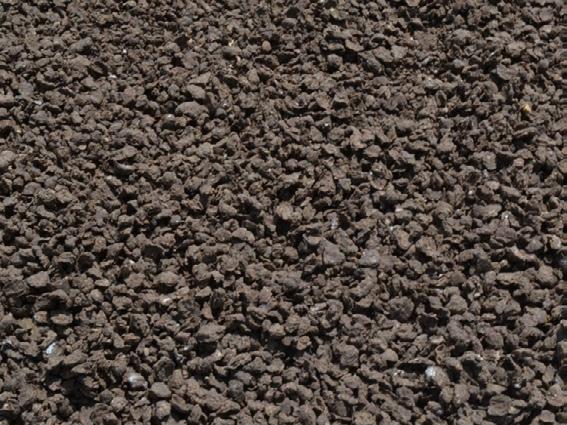
Rich with high levels of macronutrients, nutrients (NP-K) and crucial micronutrients, chicken manure-based fertilizers are a great comprehensive alternative to chemical fertilizers that safely improve the health of your lawn and garden soil.
By helping to improve overall soil structure, moisture retention and air circulation; it can be viewed not only as a highly effective fertilizer and plant food, but also as a very beneficial soil amendment
in
Kreher Enterprises, LLC Clarence, New York
• 5-4-3 OMRI Listed
• 4-3-10 Blend
• 8-2-2 Blend
• 7-2-6 Blend
* Custom blends available
Bison in the upper midwest:
By Sara Mooney
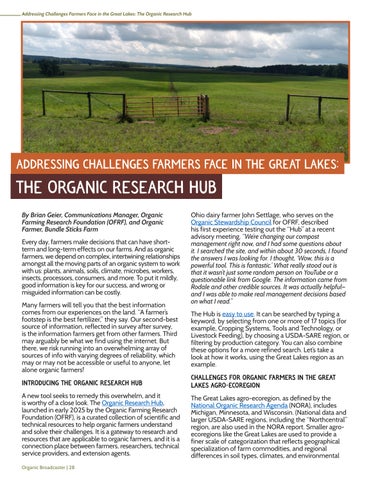
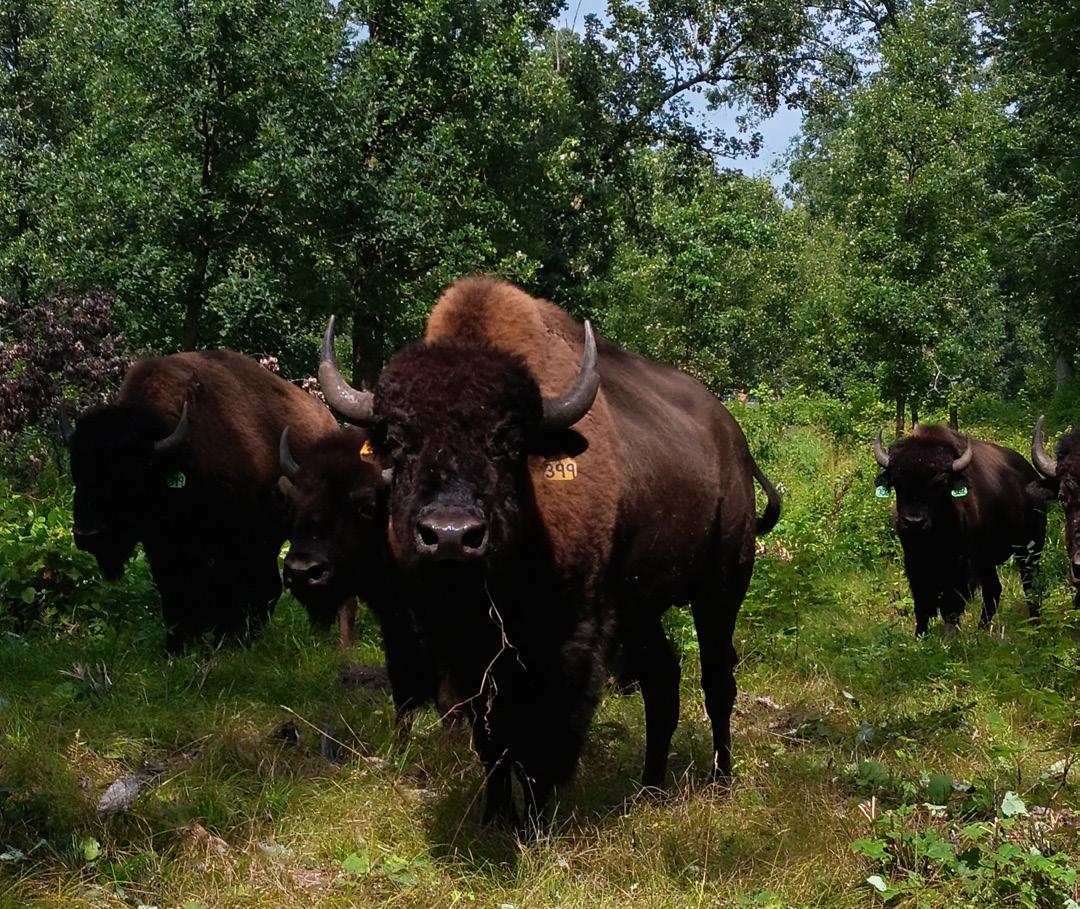
Arriving at Black Creek Bison, the first sign that something was different from most grazing operations was the abundance and variety of wildlife. Directly across the road, a conventional soybean field grew uniform and undisturbed by weeds, birds or insect life. Pulling into the farm, I spotted five different bird species and more monarch butterflies than I’d seen all week before the GPS announced that I’d reached my destination. As owner/operator Dave Fogerty walked from the barn to greet me, he pointed out a broad winged hawk perching on the frame of a windmill. The hawk had been spending time around the farmyard recently, gradually becoming more comfortable with Fogerty while enjoying the benefits of the abundance of small prey in the area. Since removing aspen, red oak and maple in order to rehabilitate a large oak savannah, bobolinks, eastern meadowlarks and savanna red-headed woodpeckers are regularly sighted. After removing aspen, red oak and maple in order to
rehabilitate a large oak savannah, bobolinks, eastern meadowlarks and savanna red-headed woodpeckers had become common here. The savanna red headed woodpeckers have suffered a 95% population decline due to loss of habitat and their return signals the positive environmental impact of employing a native ecosystem for agricultural use. Restoring savannas provides significant ecological benefits by increasing native plant and animal biodiversity, storing more carbon in soil and vegetation, improving soil health by reducing erosion and pathogens, enhancing water quality and boosting ecosystem resilience to climate change. Increased perennial grass cover, and the use of mechanical and fire management to control woody growth supports a diverse array of species that depend on a complex web of interdependence to thrive.
Pointing out some thick canopy of a neighboring woodlot where restoration work has not been performed, Fogerty notes that twenty-five years ago, all of the woodlands on the 200-acre property were
similarly crowded. With restoration, wildlife has returned and coexists with his bison herd. At Black Creek Bison today, large open paddocks planted to a variety of cover crops mixed with grasses, brassicas, and multiple other forage options surround a large, restored savannah habitat. A bison herd moves peaceably through all of it.
Fogerty originally purchased this land in Spooner, Wisconsin for hunting. Motivated by the threat of housing development in his town and subsequent tax increases, he decided to find an agricultural use for the land. The tillable acreage was sandy and almost completely lacking in organic matter. The ground wasn’t attractive to row croppers so leasing it wasn’t an option. On a whim, Fogerty introduced bison in 2000, despite knowing little about them. Smily wryly, he says he “wouldn’t recommend that kind of spontaneity.”
Fogerty built a high tensile electric fence that he keeps charged with two 9000-volt fencers that the bison respect. He learned quickly and gained respect for his herd’s sensibilities. Easily excited and volatile, the herd responded to predictable, repetitive management. Fogerty notes that “you can’t hurry bison; the only good idea is theirs.” As we watched from a distance, a lead bull moved the herd across the savanna to a sandy area where, one at a time, and starting with the lead bull, they took a leisurely rolls. Fogerty explained the importance of patience when moving the herd to new paddocks. He opens gates to a fresh paddock while the herd isn’t nearby and closes them once the herd has chosen to move and is well settled into the fresh forage. The paddocks are large (6 to 11 acres) and managed to allow the bison choices in which forage they eat.
Bison were native to most of Wisconsin until overhunting and habitat loss caused by European settlement caused the population to dwindle. The last two wild bison in Wisconsin were shot in 1832. Fogerty pointed out a towering white oak that a University of Wisconsin dendrologist had estimated to be over 400 years old. At this age this tree would have been established on this land while wild herds of native bison were still roaming the native prairies and savannas of the upper Midwest. I found myself imagining 18th century native bison herds moving peacefully past this very tree –a relative youngster of 100 or 150 years back then.
The land here is sandy and hosted thick stands of aspen, red oak and maple outcompeting the white and burr oaks when Fogerty purchased it. The savanna at Black Creek has been logged to remove much of the aspen and red oaks. Logging not only thinned the densely crowded canopy and made a more hospitable environment for the white and burr oaks but helped finance some of the initial infrastructure. The current plan for Black Creek Bison is to manage the savanna white and burr oak trees to maintain roughly 30% cover over a mix of native and introduced grasses. Although bison require little in the way of shelter from sun or the weather, this ratio provides grazing animals with adequate shade and shelter while allowing enough
Bison were natiVe to most oF wisConsin until oVerhunting and haBitat loss Caused By european settlement Caused the population to dwindle. the last two wild Bison in wisConsin were shot in 1832.
sunlight to maintain healthy understory growth. The relatively poor soil commonly found in oak savannas supports deep rooted grasses and fire-resistant oaks. Fire caused by lightning encouraged the formation of the complex, symbiosis of prehistoric savannas. Native people, moving into the Midwest around 12,000 years ago (at the end of the last ice age) began burning prairies and savannas – maintaining the systems their communities relied on. Oak savannas were a common and dominant plant community in the pre-settlement Midwest, covering millions of acres. These days, because skilled fire crews are hard to find and the threat of fire spread on dry soil, Fogerty relies on an impressively beefy brush hog to clear non-native brush and aggressive, fast-growing maples. Maples do not occur in naturally occurring savannas and threaten the health of the savanna by quickly invading the open understory displacing prairie grasses and native plants. The canopy that young maples quickly establish creates deep shade. This sort of understory favors invasive species like honeysuckle and buckthorn which further degrade the native plant habitat. Removing maples allowed the oaks to thrive, particularly the savanna white and burr oaks. Later that afternoon, we spotted the bison herd trampling and stripping the leaves off of a patch of maple seedlings that had cropped up in a sunny savanna clearing as if on a mission. Fogerty seemed pleased.
Yoana Newman is a professor in the agriculture department at University of Wisconsin - River Falls who specializes in forages. She has been working with Dave Fogerty for the last ten years to balance and fine- tune an approach to grazing that works best for a grass-fed bison herd at Black Creek Bison. One approach Newman and Fogerty are working on involves summer annuals such as crab grass, sorghum/sudangrass hybrids, oats and teff. Fogerty manages these forage crops closely. Since he is marketing grass-fed bison, he is careful to clip
seed heads while in the boot stage. (Boot stage refers to the growth stage when the seed head is still enclosed within the upper leaves of the plant and the grain is not fully formed.) The crab grasses grazed at Black Creek are not the weedy varieties we fight in midwestern corn fields and gardens, but varieties developed to feed ruminants in warmer climates. They offer very palatable, nutrient rich and high tonnage forage that does well in less fertile, sandy soils and short growing seasons. Fast growing crabgrass has proven to be better suited to outlast drought and shine during a summer growth slump when cool season grasses slow down or die back. Although annual grasses, some years have seen some successful overwintering, but Fogerty appreciates the opportunity to replant and remix the options available to his herd.
Fogerty worked with Newman to trial and experiment forage options and, over the past ten years, years he has created a system where the bison can access savannah grazing or choose from a well curated seasonal menu of sorghum/sudan grass hybrids, peas, native grasses and forbs, brassicas as well as crabgrass and legumes. Along with a dramatic increase in soil organic matter (from 0 to around 2%) the variety of species, alone and in combinations, allow the bison to pick and choose according to their needs. We looked at a hoary alyssum that had been nibbled on recently. The plant is a nonnative invasive and toxic to horses, but Fogerty figures the bison know what they are making the best choices for how they feel on a particular day.
Dave worked with Ron Spiering, NRCS District Conservationist for Washburn County to develop a grazing plan. This plan included fencing a wet area that the herd was using as a wallow to protect water quality as well as herd health. Also included in the plan was managing some paddocks for dual hay/grazing use. Here, a series of three roughly 10-acre fields are utilized early in the season then the herd is kept off the areas from early August until after a killing frost. The bison are then allowed back to graze off the dormant forage. Spiering is pleased with the outcome of adding annual forage to this grazing system, certainly not a common practice in the area. “Things are definitely moving in the right direction.”
Fogerty, ready to step back from full time management at age 79, quit breeding last year. Tyler Bergmann of Sky High Bison will carry on grazing his feeding stock here. Fogerty seems confident that his experiments mixing savanna with annual forages will allow a bison herd to continue to thrive here. “We can let nature sort it out.”
Sara Mooney is Marbleseed’s Conservation Outreach Specialist working on behalf of the Midwest Agriculture network in Wisconsin in partnership with the NRCS.
This work is supported by a Cooperative Agreement with USDA Natural Resource Conservation Service. USDA is an equal opportunity provider, employer, and lender.
fROm THE ExECUTIVE DIRECTOR
Continued from page 3
known as “Obamacare.” The OBBB authorizes shorter and fewer enrollment periods, reduced subsidies that will lead to higher premiums, and ineligibility for recent low-income LEGAL immigrants. The importance of access to health care for farmers could bring us into coalition with so many others already active in the fight for health care as a universal right.
With harvests and a busy season behind us, maybe we have time to reflect on how we will show up for ourselves and our communities? Where are there opportunities to raise our voices and/or uplift and join those of others harmed by current policies? Can we at least share our own story with our friends, family, and neighbors?
As I write this column, there is less likelihood of a comprehensive Farm Bill this year. Whether folks know it or not, the Farm Bill impacts everyone who eats. And beyond our calls for fairness in how our tax dollars are allocated by congress, what will we do instead? Can we work together to create resilient, regenerative, healthy local economies and farms? This seems to be a moment of “both-and.” We need to hold those with power accountable to us ALL while creating the world we want to see that will ensure the health of the planet, animals and future generations.
Lori Stern, M.A. Ed
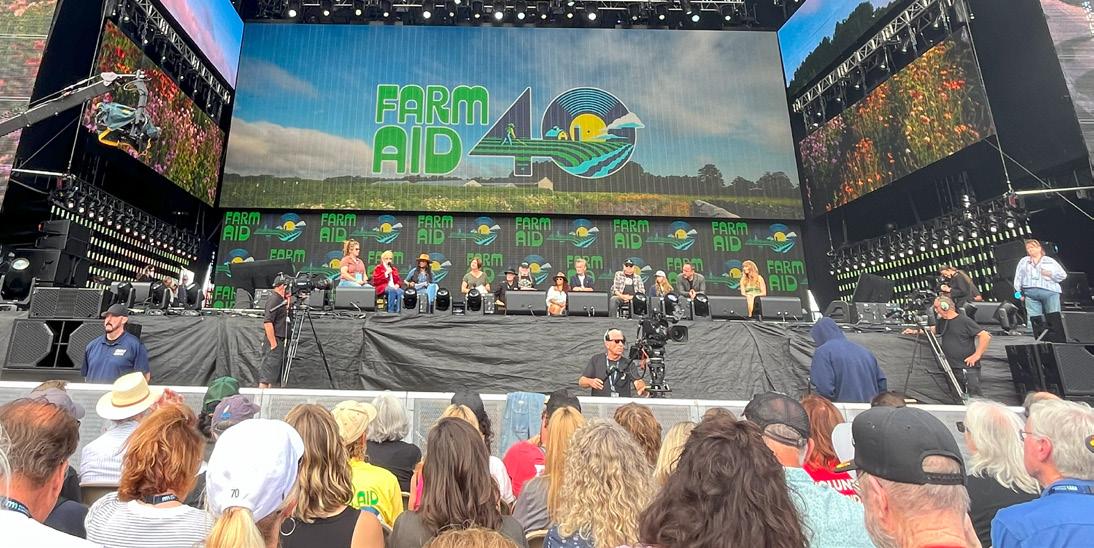
marBleseed at Farm aid 40!
By Emily Beaton and Alpa Goswami
We are still feeling the afterglow of Farm Aid events, from farm tours to music!
Marbleseed’s own Communications Specialist Emily Beaton got started on day one with farm tours. First stop: University of Minnesota’s research farm to hear from Forever Green, whose “roots run deep.” The University’s Forever Green Initiative is developing deep-rooted perennial and winter-hardy annual crops that protect soil, water, and boost farm sustainability year-round.
Second Stop: Kimber Contours Farm where Kurt Kimber “farms with the land—not against it” by following natural limitations and contours of his farmland. Through the practices of cover-cropping with clover and legumes, incorporating contoured prairie strips, and planting perennial grain like Kernza, he aims to reduce erosion and take care of the topsoil for today and tomorrow.
Final stop: The HAFA Farm (Hmong American Farmers Association’s farm), gave us a tour of their 155-acre research and incubator farm that leases space to Hmong American farmers, creating long-term land access, and cooperative resilience, and advocacy for its tenants.
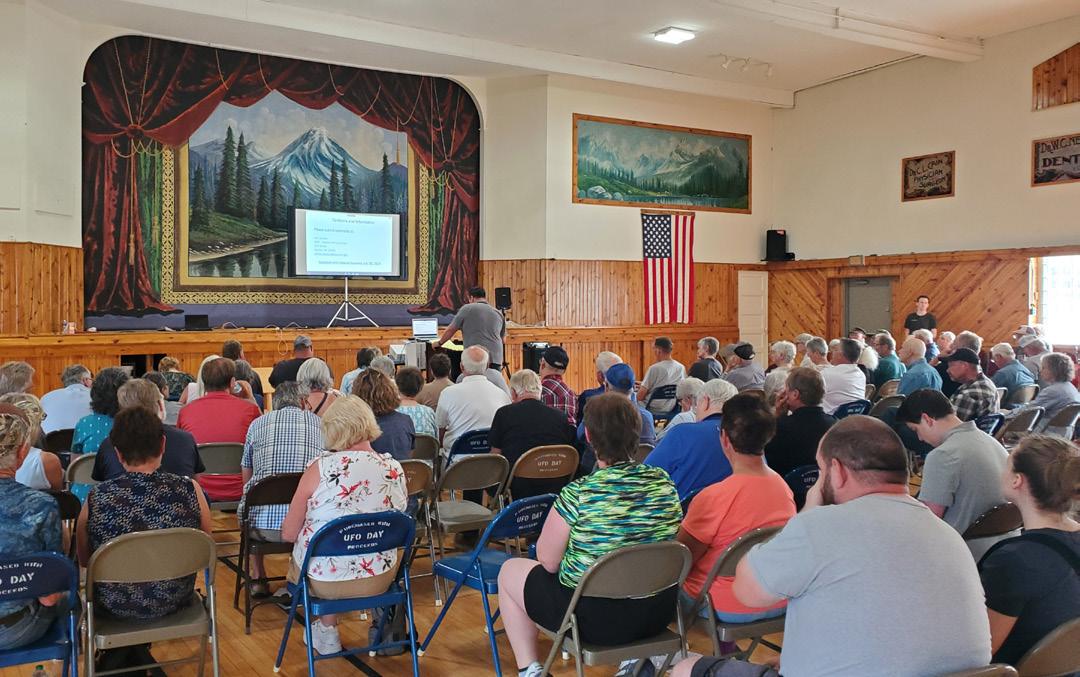
Our team had an inspiring day at the Farm Aid Farmer Forum at the University of Minnesota. The room was packed with farmers and farm advocates “seeding democracy, from our fields to our future.” We started the day by hearing from Indigenous leaders from the region who shared their wisdom and perspectives, then heard from prominent community figures who are at the heart of the farmer-led movement. We also heard from several Midwest state representatives and
their counterpart constituents who shared stories of how working in solidarity led to systematic change. The forum also featured a passionate keynote from Minnesota Attorney General Keith Ellison. The best part of the day was connecting with people, sharing stories, and learning from each other how we can move forward in solidarity.
Local farmers shared their stories at the Farm Aid 40 press conference with the festival’s leaders, Willie Nelson, Neil Young, John Mellencamp, Margo Price, and Dave Matthews. The lovely Margo Price emphasized the sentiment, “shared struggle builds solidarity, and hope is an act of resistance.” While the rebellious Neil Young advocated for a “Conscience Tax” to be paid by billionaires like, “what his name, the Microsoft guy.”
Festival goers experienced Marbleseed’s interactive soil health exhibit in the Homegrown Village, featuring a hands-on cover crop demo, rain simulator video, and powerful visuals that show how farming practices impact on our food system, water, and environment. This booth sparked curiosity, conversation, and inspiration for DIY environmental care and community-driven food systems.
We could not be prouder to be part of this amazing community of farmers, farm advocates, consumers, and musicians standing in solidarity with family farms!
Emily Beaton is Marbleseed’s Communications Specialist. She and her husband John also own and operate Fairhaven Farm near Duluth, Minn. where they grow vegetables and flowers and raise Icelandic sheep.
Alpa Goswami is Marbleseed’s Program Director.
ode to an heirloom:
what’s the Value oF an old apple?
By John Ela, Modern Farmer
This story was originally published by Modern
Farmer
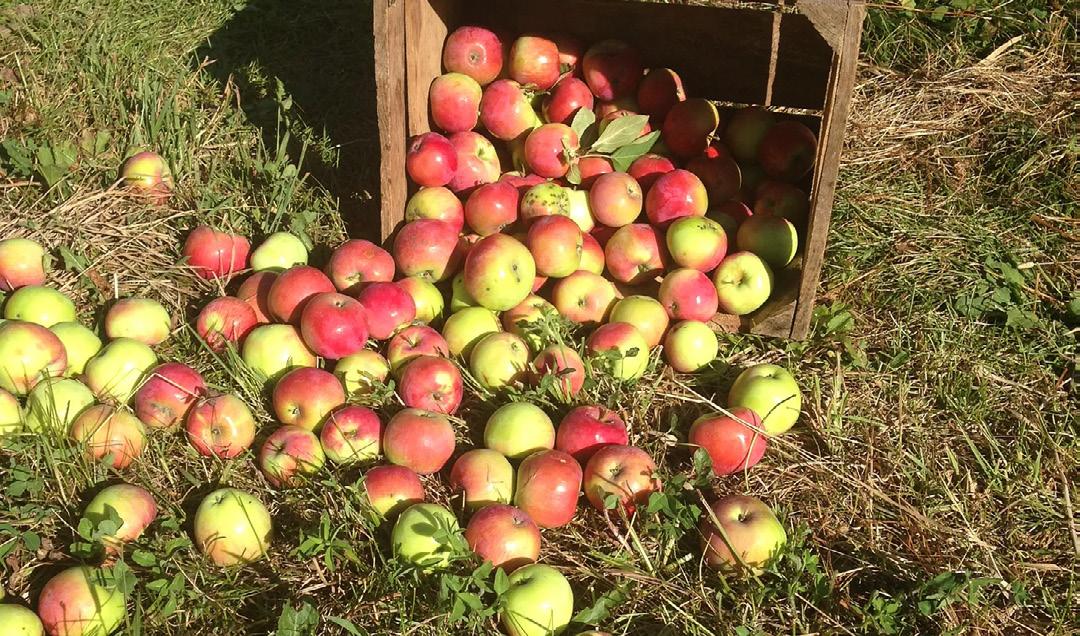
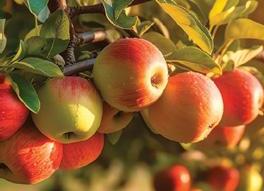
At Ela Orchard where I used to work, autumn’s encroaching frenzy had the most unassuming harbinger. One day in early August, a ladder would appear in a solitary old tree by the driveway, followed in the apple barn by some crates of pale green apples striped with cotton candy pink. I never quite knew who put the ladder there and picked those apples, but it was the starting gun for a helter-skelter season of picking, sorting, juicing, and selling apples. We’d catch our breath around Christmas.
That lonely tree stood apart from the rest of the orchard—its companions had long since died—as a sentinel from a bygone era. It was the orchard’s only remaining Liveland Raspberry, which is not in fact a berry, but a variety of apple—named after its country of origin, a former Soviet province. If you’ve never heard of it, that’s because the Liveland Raspberry is one of more than 10,000 varieties of heirloom apple grown in the United States.
A mystique surrounds heirloom apples. Some people drive across state lines to seek out rare varieties; others dedicate their lives to preserving them. Their price reflects the mystique: At my local food co-op, the heirlooms are twice as expensive as the other apples. The word “heirloom” basically means “old,” but it’s taken on some broader, ethereal meaning to many
people: novelty, obscurity, nostalgia, and maybe even superiority. For some people, heirlooms can ascend to become the object of a grail quest: the dream that we can bring the past back to life.
The irony in all this is that many heirloom apples aren’t actually that good. Take that lonely Liveland Raspberry: There was a reason the orchard was down to a single tree and more hadn’t been planted. Eaten out of hand, the Liveland’s texture is tough and its flavor is uninspiring. It’s better for cooking, but it’s still not as good as other apples in our August lineup. So, the Livelands generally withered in the cooler until some day in October, when we’d find them buried under a pile of crates and dump them all into the cider press. This was an annual tradition as consistent as the appearance of the phantom ladder. In this case, “heirloom” served as code for “relegated to history’s compost bin.”
Is there a way to peer through the ephemeral mist, to understand not only whether heirlooms are worth the hype, but what heirloom diehards are truly searching for?
I spoke with some growers who have devoted their lives to heirlooms to see if they could break the spell and help me understand the true value of an heirloom.
“I think an heirloom has to have a little bit more going for it” than just its age, says Dan Bussey, author of The Illustrated History of Apples in the United States and Canada, which catalogs and describes 16,350 varieties in seven volumes. “It needs to be something that had a
life someplace—that was popular, people liked it. It has to have some value other than just being old.”
Interestingly, the value of an old apple can actually be its newness. I once sold apples to a couple who were looking for heirlooms. I offered them samples of such ancient varieties as Golden Russet, Wealthy, and Tolman Sweet, before they tried a Melba and fell in love. I tried to explain that Melbas, the product of a Canadian breeding program, were not technically heirlooms, but they had none of it. They had tasted mana and wanted five pounds, thank you very much.
That couple was using “heirloom” in a way that many people do, which is to mean “obscure.” So, there’s no small irony that one of the world’s most well-known apples, the McIntosh, easily meets any definition of an heirloom, having been discovered as a seedling by John McIntosh on his Ontario farm in 1811.
Many people know the McIntosh as a soft, mealy apple, and they despise it. Yet, there’s a small club of us for whom the Mac represents the archetypal apple. Imagine scouring a tree for an apple that’s hung on long enough to turn bright crimson, so ripe that it falls off right into your hand; biting into its crisp, snappy flesh, the juice’s tartness cutting through the last heat of summer, its incomparably rich flavor transporting you, if only for a moment, into reverie.
But blink, and you could miss that moment. The problem with the McIntosh, like many heirlooms, is that it doesn’t store particularly well. Within as little as a week or two after picking, a Mac may begin to lose its perfect crunch. And considering that the average apple on a supermarket shelf has been in storage for eight months, by the time your average apple-eater encounters a McIntosh, September’s sweet-sour snap has given way to the mealy mush of May. Today’s apples need to function in a system of international commerce, and they need to look presentable 12 months and 12,000 miles from their time and place of origin.
The McIntosh has other traits that bedevil its growers— Macs bruise easily, are especially susceptible to the fungal disease Apple Scab, and tend to fall off the tree before they’re fully ripe. Modern apple breeding programs have worked to eliminate these nuisances.
When the needs of the grower and grocer eclipse those of the eater, then your supermarket apple boasts a bright, shiny skin that cloaks blandness and fatigue, and sends apple enthusiasts looking elsewhere.
However, if this sentiment becomes overblown, then heirlooms can become code for “snobbishly superior.” In this case, the apple’s worth is predicated on its rarity, which makes ubiquitous apples, like the McIntosh, inherently worthless.
I asked the orchardists I interviewed whether there were apple varieties that weren’t good enough to deserve
preservation. C.J. Walke, who manages the Maine Heritage Orchard, believes that’s the wrong question to ask. Instead, it’s important to look at the function of heirlooms in a robust local food system and regional economy. “If we go back 100-plus years, a lot of these varieties were grown on the farm or on the homestead, and they served a purpose for that family’s needs,” says Walke. Some were sold, but many were consumed right there by the family, eaten fresh or preserved as applesauce, cider, or vinegar. Heirloom varieties are so numerous because each fits a niche for every particular farm family, in terms of flavor, function, seasonality, and cold tolerance.
When I asked the orchardists why customers come to them looking for heirlooms, the reason that came up again and again was nostalgia.
“Their grandma had this tree, or their parents had this tree, and they haven’t seen it in 40 years,” says Jamie Hanson, the orchard manager at Seed Savers Exchange “And so, for them, it’s a very personal experience.”
The richness of those memories drives the orchardists’ passion for their work. What moves me is how many generations of people loved these varieties,” says Erin Robinson, Orchardist at Scott Farm, in Dummerston, Vermont. “I am a link in that chain. I feel like it’s my duty to preserve them.”
Indeed, there’s something about apples that makes us look towards the past. Heirlooms hold the promise that there was once a richness that has been lost in the glossy monotones of the supermarket, and a diversity that met each individual’s particular need.
What excites Dan Bussey about heirlooms is their specificity, that a person can find something that fits their exact tastes. “I like everything to be a democratic process, where we all get a chance to try something, and if we love it, we should share it,” he says. “We should make it available to anybody. And if we like growing old varieties, great. If we love growing new varieties, wonderful. It’s what you like. That’s the important thing.”
Author’s note: After this piece was originally published, I heard from Ela Orchard that customers were greatly enjoying the Livelands that season. My apologies to Liveland Raspberries everywhere for belittling you for the sake of making a point.
John Ela is Communications Specialist at Advancing Eco Agriculture, and author of the blog “Johnny’s Garden” on Substack. He lives in Vermont with his wife and two sons. His favorite apple is the Macoun (not an heirloom).
Modern Farmer is a nonprofit initiative dedicated to raising awareness and catalyzing action at the intersection of food, agriculture, and society. Sign up for their weekly newsletter here.
Link to original article: Ode to an Heirloom - Modern Farmer
joy and CollaBoration
at the Farmer-distiller grain ConneCtions Field day
By Kelly Debbink
In August, OGRAIN (Organic Grain Resource and Information Network) had the pleasure of working with talented, young fifth generation farmers and entrepreneurs as well as several great organizations to host a Farmer-Distiller Grain Connections Field Day in east-central Illinois. While we are fortunate to host many field days, few are this collaborative. With the help of The Land Connection, IDEA Farm Network, Rodale Institute, Artisan Grain Collaborative, and the Glaziks, people from across the organic grain chain were invited to come learn together and celebrate local, organic grains. The event was made possible through funding from the Transition to Organic Partnership Program (TOPP), another very collaborative and multi-pronged effort aimed at building a stronger, better connected support structure for transitioning and existing organic producers. TOPP is a program of the USDA Organic Transition Initiative and is administered by the USDA Agricultural Marketing Service (AMS) National Organic Program (NOP).
Most OGRAIN field days are aimed at helping farmers and researchers share agronomic information to help improve organic field
management practices. Farming organically requires extensive knowledge, an observant eye, and a willingness to adapt. Each farm is different and general field practices must often be adapted to fit each farm’s needs.
Keeping this in mind, it should be no surprise that organic marketing has no one-size-fits all approach and also requires many of the same skills. OGRAIN’s research and area of expertise does not include marketing, but we were excited to collaborate in this space to bring buyer insight and farmer marketing perspectives to field day attendees by engaging a panel involving a farmer, a grain buyer, and a distiller as well as inviting several buyers to introduce themselves and share their grain needs.
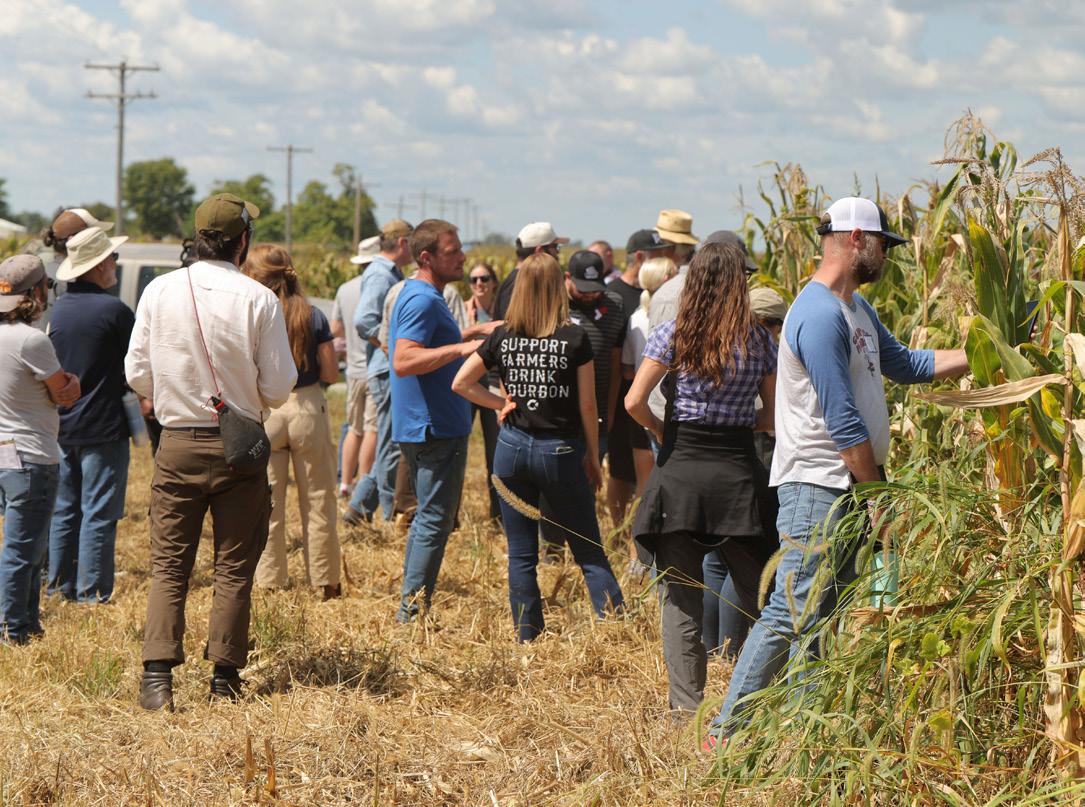
The field day featured a morning farm tour, lots of local food, a lunchtime grain chain panel, and afternoon distillery tour with grain quality discussion. The morning farm stops at Cow Creek Organic Farm showcased unique corn varieties, such as bloody butcher and a nitrogen efficient corn, polycultures of corn with beans and corn with squash, and grain handling and storage equipment. They also touched on the benefits of partnering with a livestock farmer to pair rotational grazing with
Photo Credit: Kory Henke
grain rotations, from controlling problematic weeds to minimizing volunteer corn and increasing fertility.
During the grain chain panel, we heard about the learning curve farmers face when starting to direct market specialty products, including stricter quality parameters as well as storage, packaging and distribution logistics. We also heard the perspective of a corn processor focusing on quality, consistency, and good customer service while connecting the supply chain between farmers and the food and beverage market. Finally, the distiller explained how high-quality, specialty grains from passionate producers shine through in the flavor and quality of the end product. We heard across the board the dedication to working with small and midsize farms, and the interest in sharing these farms’ stories with consumers.
The afternoon involved distillery tours of Silver Tree Spirits featuring the story behind the beautiful tasting room they’ve built, an explanation of their distilling process and equipment, and a view of their rickhouse and barrels made using Illinois oak by the only cooperage in Illinois, Crozehead Cooperage. The Glaziks utilize organic wheat, rye, and corn grown on their farm to create local, grainto-glass spirits. With 1,000 lbs of grain they’re able to fill one barrel. After aging losses, this barrel is enough to fill 200 bottles, equating each bottle’s contents to approximately 5 lbs of grain. The tour also included a discussion of common grain quality issues and an off flavor tasting of distillates created to zero in on each issue. This highlighted concerns such as high moisture content, old grains under improper storage conditions, and pre-milled and oxidized grains while producing a rare chance to sample the negative aromas and flavors these quality issues can impart. Increased awareness around these concerns is valuable in helping farmers and distillers alike to deliver a higher quality product by ensuring proper grain handling from field to glass.
When thinking back on this jam-packed day of field and distillery tours, and grain handling and marketing discussions, I see joy and collaboration take center stage. Joy was evident when Will and Dallas Glazik were explaining the diversity of corn they grow, the polycultures they’ve been experimenting with, how they’ve built their distillery, the delicious spirits they’ve created, and how they store and process grains to ensure quality ingredients. Community collaboration took many forms, involving landowners, grain farmers, livestock producers, local distilleries and restaurants,
and other local business owners and community members. What a community they have formed! We still live in a global economy, but I can’t help but latch onto this wonderful example of community connection as how we keep small and mid-size organic farms thriving. Does it take work? You bet! But is it filled with joy and a sense of purpose? Absolutely!
It’s no secret that organic grain farming and marketing can be challenging, but maybe getting bigger isn’t the only way to achieve a financially sustainable farm. Maybe another secret lies in finding what brings you joy. Find your joy and start telling that story until you discover your community. As your passion resonates with others, you’ll uncover your connections and your markets.
Of course, it’s rarely that simple. What else might it take to support more collaborations like this beyond a source of joy and passion? To start, it takes more guidance and assistance for out-of-thebox financial situations and evaluating potential business models. It also requires local food chain processing and storage networks, which may or may not exist in certain areas. At the most basic level, it requires demand and understanding from buyers. I believe that stems from a shared enthusiasm for these stories. Of course, that all starts with telling your story. Fortunately, the internet helps make that easier.
I’m inspired by the joy and collaboration I saw during this field day, and I hope others are too. These collaborations can and should take many forms, from connecting with livestock producers to restaurants, manufacturers and entrepreneurs, family members, neighbors and fellow growers. It’s hard work, and it absolutely deserves support, but I hope it’s the type of purpose-driven, joy-filled hard work that will keep attracting passionate young people to farming and food business ownership.
Kelly grew up climbing on hay bales and spent years as a wildlife biologist before returning to school to study plant pathology and transition to work in sustainable agriculture five years ago. Kelly is an outreach specialist for OGRAIN, the Organic Grain Resource and Information Network. OGRAIN provides resources, research, events, and a community network for organic grain production in the Upper Midwest. It is led by Dr. Erin Silva, Professor and Extension Specialist in Organic and Sustainable Cropping Systems at UW–Madison. You can learn more about OGRAIN by visiting https://ograin.cals.wisc.edu/, connect to the community through our listserv, and join us for a field day or our winter conference.
leVeling the playing Field:
how strong enVironmental proteCtions BeneFit rural Communities and Family Farms
By Peg Sheaffer
In recent years, powerful lobbying groups representing Wisconsin’s largest farms have launched coordinated legal attacks aimed at rolling back environmental oversight in our state. Their goal is to weaken the regulations that protect rural communities and help level the playing field for sustainable family farms. But thanks to the combined efforts of family farmers, environmental advocates, and legal experts, one such effort was recently defeated—not just once, but twice. These victories demonstrate that by working together— and using the power of the law—everyday people can preserve the strong environmental protections they depend on and hold even the most powerful interests accountable.
TWO BIG WINS fOR CLEAN WATER AND RURAL COmmUNITIES
In August of this year, the Wisconsin Court of Appeals upheld a lower court ruling in a case called Wisconsin Dairy Alliance v. Wisconsin Department of Natural Resources. The decision affirmed the authority of the Wisconsin Department of Natural Resources (DNR) to regulate the state’s largest livestock operations.
The case began in 2023, when Wisconsin Manufacturers & Commerce (WMC) sued the DNR on behalf of
Wisconsin Dairy Alliance and Venture Dairy Cooperative. The powerful lobbying groups alleged that the DNR had no legal authority to regulate concentrated animal feeding operations (commonly known as CAFOs), and that requiring CAFOs to apply for water pollution permits was unlawful.
Nonprofit law firm Midwest Environmental Advocates (MEA) quickly intervened in the lawsuit on behalf of Wisconsin Farmers Union (WFU), a grassroots organization that advocates for the interests of sustainable family farmers and rural communities. WFU and MEA got involved in the case to ensure that CAFOs are held accountable to our state’s environmental laws.
In January of 2024, the circuit court judge who heard the case sided with MEA and WFU. After the lobbying groups appealed the ruling, the case was sent to the Wisconsin Court of Appeals.
MEA and WFU filed legal briefs defending the DNR’s authority. They argued that state agencies must have the power to protect the public and the environment from pollution. Without that power, Wisconsin would lose one of its most important tools for safeguarding clean water.
In August 2025, the Court of Appeals ruled in favor of MEA and WFU, affirming the DNR’s right to require
CAFOs to obtain permits. This was a major victory for Wisconsinites who believe that responsible agricultural practices are the foundation of a clean environment.
“Family farmers understand that stewardship of the land and water is key to long-term success,” said Wisconsin Farmers Union President Darin Von Ruden in response to the decision. “Ensuring that large livestock operations follow commonsense permitting rules protects our shared resources and the future of farming in Wisconsin.”
WHAT WAS AT STAkE
A win for Wisconsin Manufacturers & Commerce and its allies would have dismantled the main system Wisconsin has developed to monitor and manage the massive amount of waste produced by the state’s largest farms.
Under the Wisconsin Pollution Discharge Elimination System (WPDES) program, all CAFOs must apply for and receive a WPDES permit before they can legally operate. In Wisconsin, CAFOs are defined as livestock or poultry operations housing more than 1,000 animal units. That’s the equivalent of approximately 700 dairy cows, 1000 beef cattle or 2,500 hogs.
WPDES permits are essential for effective environmental oversight. Without them, CAFOs could operate without accountability for the manure and wastewater they generate—posing serious risks to Wisconsin’s lakes, rivers, and groundwater.
“Wisconsin’s CAFO permit program creates transparency,” says Von Ruden. “It helps ensure that large livestock operations are accountable—not only to regulators, but also to their neighbors, who have a right to know what’s happening in their communities.”
As farms have become bigger and fewer in the past two decades, CAFOs have come to represent an increasing percentage of Wisconsin’s livestock industry. With over 330 permitted CAFOs in the state today— up from just 135 in 2005—the stakes have never been higher.
When industrial-scale farms operate without environmental accountability, they gain an unfair advantage over the thousands of small and midsized farms that follow best practices, invest in environmental stewardship, and bear the costs of doing things the right way. These farmers may spend thousands annually to maintain buffers, control erosion, plant cover crops and carefully manage nutrient applications to prevent runoff.
By contrast, operations that ignore or sidestep environmental safeguards can cut costs—but those savings come at a high price for surrounding communities: polluted wells, lower property values, and contaminated rivers and lakes.
mitigating the impaCts oF CaFo expansions at the loCal leVel
By Thomas Manley
The recent win in the Wisconsin Court of Appeals should be celebrated and does establish one more obstacle in the path of industry groups seeking to remove all oversite. However, there is more work to do, and we all need to get involved close to home.
I have witnessed firsthand the tactics the industry is using to influence and intimidate, and I have also witnessed the committed action and advocacy of farmers and residents in Wisconsin to maintain local control and protect our water and communities from the kinds of destructive impacts we have seen in some neighboring states.
My wife and I both serve in local government in our little township in Western Wisconsin, a township that is considering adoption of ordinances to regulate CAFO operations and road use. Several nearby towns have passed or are considering similar ordinances due to the massive expansion of an existing CAFO dairy operation in our county. Prior to the DNR permit request to expand from roughly 2,000 animal units to nearly 10,000, our township was already dealing with the costs these types of industrial scale operations socialize while privatizing all of their profits. Everyone who lives here has experienced the long trains of tanker trucks hauling liquid manure down township and county roads, often exceeding posted weight restrictions, and rolling out miles of tubing to pump and deliver that manure to fields far and wide. The damage to our roads is easy to see and document and has very real costs to every resident of the township and county. The environmental costs are often harder to quantify, but the experiences of folks in Iowa and other states have shown they are also very real and even more impactful to quality of life.
Recently, our town board was directly confronted by a lawyer representing the very industry groups that failed in their effort to circumvent all regulation in Wisconsin. Rather than engage in a conversation about how we can work together to ensure the rights and resources of township residents are protected, they chose instead to resort to threats and intimidation. This seems to be their preferred and frequently demonstrated approach. I have attended many meetings and public hearings during the DNR permitting process for this facility, and at no point have owners or their representatives felt compelled to attend and explain their commitment to good stewardship, rather they send lawyers with threats resembling those of mob bosses. They accuse all those who question or resist their efforts of being uninformed “city slicker vegans” who hate animal
Continued on next page
Continued from previous page
agriculture. This portrayal could not be further from the truth. Our town plan commission that is currently drafting potential ordinances is made up of five residents, four of whom actively farm and three of whom raise livestock as a primary component of their operations. I personally could not imagine my farm without cattle and am deeply committed to using ruminants to improve ecological outcomes. None of us are against animal agriculture, even on a large scale. A large-scale operation with a demonstrated history of good stewardship, nutrient management and protection of resources can do a lot of good across a lot of acres. Big is not inherently bad. What we are against is an unregulated factory disguised as a farm. For context, this expanding CAFO is currently building a single barn that will cover 11 acres. That is a Walmart distribution center, not a farm. A facility of this scale with little oversite is a potential, and based on real world evidence, a likely danger to those living anywhere near their operations. The industry reps have made it clear how they intend to deal with local efforts to mitigate these risks. Their plan: threaten, intimidate, and lobby state lawmakers to remove any and all regulations. They do not feel compelled to talk with their neighbors when they can just call in favors from friends in high places.
So, what can we do as farmers and residents who care? For starters, get up to speed on the issue. If you live in Wisconsin, GrassRoots Organizing Western Wisconsin has done a good deal of work on this issue and is a great resource for understanding how we can work collectively and effectively. Wisconsin Farmers Union is also a leader in working to protect local governance and the continued regulation of these operations, and the efforts of Midwest Environmental Advocates were instrumental in the recent court victory. Becoming a member and supporting one or all of these organizations is a great way to help build collective power and offset concentrated industry influence. And lastly, attend local town and county board meetings. Ask questions, share resources and start a conversation.
Those of you in neighboring states, get loud. Let your friends, neighbors and representatives at every level of government know that rural communities do not have to become the victims of unregulated industry like many urban communities have. Anyone interested in learning more about our experiences and successes in Western Wisconsin can feel free to reach out to me and I can connect you with people and resources to help. Never forget, as our friends at Farmers Union say, we are Stronger Together.
Tom Manley is the Climate and Conservation Director at Marbleseed and a farmer committed to continual improvement of natural resources. Feel free to reach him at Thomas.Manley@marbleseed.org
“Holding the largest, most powerful actors accountable levels the playing field,” said Adam Voskuil, an attorney at Midwest Environmental Advocates. “It ensures that the cost of pollution isn’t passed along to rural residents and that farmers who are doing the right thing aren’t put at an even greater competitive disadvantage.”
A DANGEROUS TREND IN OTHER STATES
What Wisconsin Manufacturers & Commerce attempted here in Wisconsin is not new. Similar efforts have succeeded in other states—and the results have been devastating for rural communities, family farmers, and the environment.
In Indiana, more than 800 CAFOs currently operate without pollution discharge permits. These facilities generate millions of gallons of untreated manure each year, much of it stored in open lagoons or spread on fields with little or no oversight. This lack of regulation has led to elevated nitrate levels in drinking water, fish kills in rivers and streams, and a public backlash from rural homeowners forced to install costly filtration systems—or abandon contaminated wells entirely.
The situation is even more extreme in Iowa, where over 95% of the state’s 4,200 CAFOs operate without permits. Iowa’s unregulated CAFO boom has contributed to some of the most polluted rivers in the country. The Des Moines Water Works, one of the state’s largest drinking water utilities, has spent millions on nitrate removal to make river water safe to drink—costs ultimately passed on to ratepayers. Rural counties across Iowa have documented widespread private well contamination and sharp increases in nitrate-linked health risks, including cancer and birth defects.
In both states, attempts to challenge the lack of regulation have been met with resistance from powerful agricultural lobbies and anti-regulatory lawmakers. Communities have been largely stripped of their ability to push back, while state agencies—under political pressure—have scaled back enforcement and public transparency.
This is the outcome WMC sought to bring to Wisconsin: a system where the biggest polluters are exempt from oversight, and ordinary people have little recourse when their water is contaminated, or their air becomes unbreathable.
COmmUNITy-LED LEGAL ACTION IS PAyING Off
The appellate court victory in Wisconsin Dairy Alliance v.Wisconsin Department of Natural Resources is just the latest milestone in a long-running grassroots effort to hold Wisconsin’s largest agricultural operators accountable to our environmental laws. For over two decades, Midwest Environmental Advocates has worked with rural communities around the state
to ensure that CAFOs follow the law, protect water resources, and operate transparently.
One of the most significant victories came in 2021, after a ten-year legal battle that went all the way to the Wisconsin Supreme Court. In that case, MEA represented neighbors of Kinnard Farms, a massive dairy CAFO in Kewaunee County. The neighbors, many of whom could not safely drink their water, took legal action after the Department of Natural Resources repeatedly failed to require Kinnard Farms to do more to prevent manure from contaminating drinking water.
In 2014, an administrative law judge agreed with them, finding that Kewaunee County’s drinking water crisis had been caused by “massive regulatory failure.”
Despite years of appeals and procedural delays, Kinnard’s neighbors refused to give up, and eventually their case reached Wisconsin’s highest court. Finally, in 2021, the Wisconsin Supreme Court issued a landmark ruling in the case, affirming that the Department of Natural Resources has both the authority and the obligation to require CAFOs to comply with permit terms and conditions meant to protect water resources. The Supreme Court’s decision laid the foundation for subsequent legal wins, including the successful outcome in Wisconsin Dairy Alliance v. Wisconsin Department of Natural Resources.
These hard-fought legal victories are part of a larger strategy to give rural communities back the power they’ve lost to well-funded industry groups.
“Too often, legislators have picked their voters, rather than voters picking their legislators,” says Voskuil, referring to the gerrymandering and political dysfunction that has weakened environmental oversight and accountability in Wisconsin. “In that vacuum, industry groups have stepped in to rewrite the rules.”
But legal action—guided by public interest law firms like MEA—is proving to be an effective way to restore balance and protect the public good. These recent court victories show that legal action can not only protect our environment—it can help create a system where doing the right thing doesn’t put family farms at a disadvantage.
Peg Sheaffer is Director of Communications at Midwest Environmental Advocates and is a proud resident of rural Green County. She has over twenty years of communications experience in the fields of sustainable agriculture, natural resources and conservation.
Cut and Carry mulCh
By Steffen Mirsky and Paulina Jenney
Mulching is one of the simplest ways to increase soil organic matter, retain moisture, and suppress weeds in an agricultural system. Many materials can be used for mulch, including both organic matter and synthetic materials such as plastic or landscape fabric. While plastic mulch is easy to apply, it creates waste and requires extra labor for removal. Organic mulches offer a more sustainable alternative, but sourcing enough plant material, chopped to a workable size, can be a challenge. Some farmers solve this by growing their own mulch crops, harvesting them, and then transporting the material to where it’s needed—a method known as cutand-carry mulching. Scaling up this process, however, often requires the right tools and techniques.
A recent SARE grant helped to establish a community of practice of organic vegetable farmers focused on reduced tillage methods. A topic of interest among the group was the need for more information about effective mechanization strategies for cut-and-carry mulching. Here, we share a few stories from participating farmers.
CASE STUDy #1: fOOD fARm, WRENSHALL, mN (JANAkI fISHER-mERRITT)
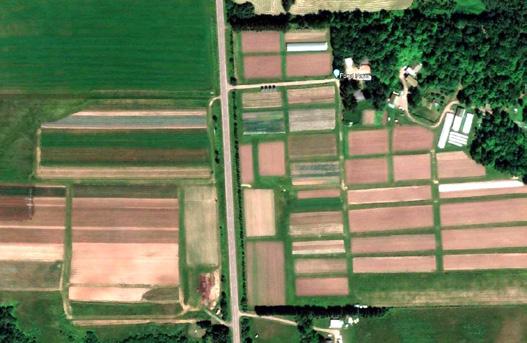
Janaki and his wife Annie Dugan operate The Food Farm in Wrenshall, MN, about 30 minutes south of Duluth. The Food Farm produces certified organic fruits and vegetables on 18 acres with another 20 acres in the rotation that is cover cropped (Figure 1). The Food Farm also raises laying hens.
Janaki and Annie’s passion is growing high quality food for their CSA members, providing a sustainable livelihood for their employees, and improving the productive capacity of their land. Their soil is not very well drained, so increasing soil organic matter is a priority—one they address in part by reducing the amount of tillage on their farm as much as possible.
“The better we can treat the soil, the healthier it is, the better crops do, the more resilient they are. Whatever I can do to reduce tillage operations—especially when it’s too wet or too cold here, that’s a good thing. It makes our lives easier,” Janaki said.
mANAGING A WINTER RyE CUT-AND-CARRy mULCH SySTEm
Janaki is working to optimize a winter rye cut-and-carry mulch system for some crops, such as tomatoes, which
Figure 1. An aerial view of Food Farm showing the 40 acre farmstead on the right side of the road containing most of the cropland. To the left of the road is newer land that Janaki and his family purchased in 2014.
has the added benefit of reducing the amount of labor needed for weeding.
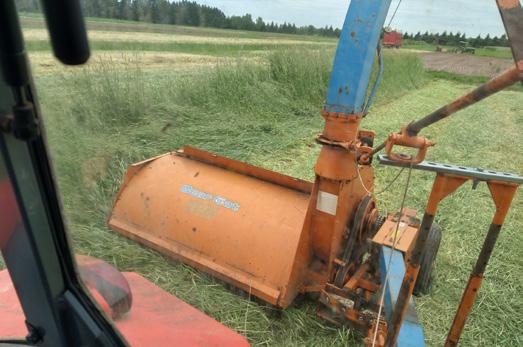
About three weeks after transplanting the tomatoes— usually around the end of June, when the winter rye is flowering and well before seeds begin to mature—Janaki mows the rye with a flail mower (Figure 2). Unless the rye is only 3-4 feet tall, he mows the rye twice to chop the stalks into shorter pieces, which are easier to spread and less likely to get tangled around the equipment during deployment.
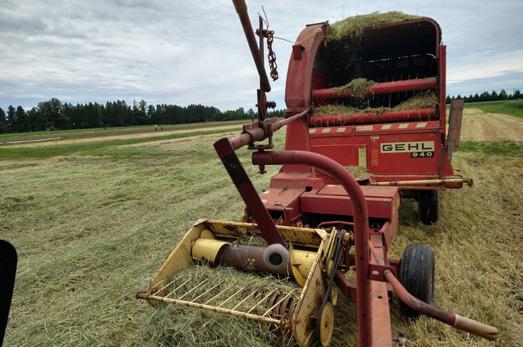
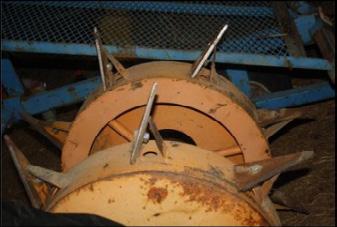
In the first pass, he opens the back of the flail mower and drops the rye onto the ground (video). In the second pass, he closes the back of the flail mower and uses a pickup head that lifts the rye—also called greenchop—into a chopper box, which is a wagon fitted with rotating beaters used to haul and unload silage or haylage (Figure 3).
WATCH THE RyE mOWING PROCESS
Typically, he chops the rye the first day, then comes back the next day to pick up and spread the mulch; leaving the rye to dry for a day helps to prevent the pile in the
chopper box from heating up. He also lets some of the greenchop dry fully in the field, then rakes and bales it to use on other crops, such as fall-planted garlic, and in the greenhouse where using a tractor isn’t feasible.
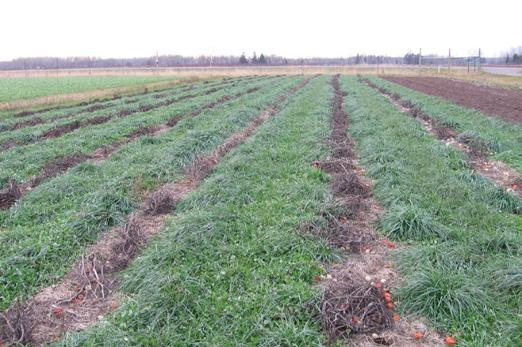
Before mulching, he cultivates the tomato beds once or twice at a shallow depth and hand hoes between the plants. Using a hand crank broadcast spreader, he seeds Dutch white clover at about 20 lbs per acre in the pathways to serve as a living aisle. Depending on his rotation the following year, he sometimes includes Italian ryegrass in the mix (Figure 4). Walking in the aisles during the mulching process helps to establish good seed-soil contact, and overhead irrigation ensures the clover and ryegrass establish well.
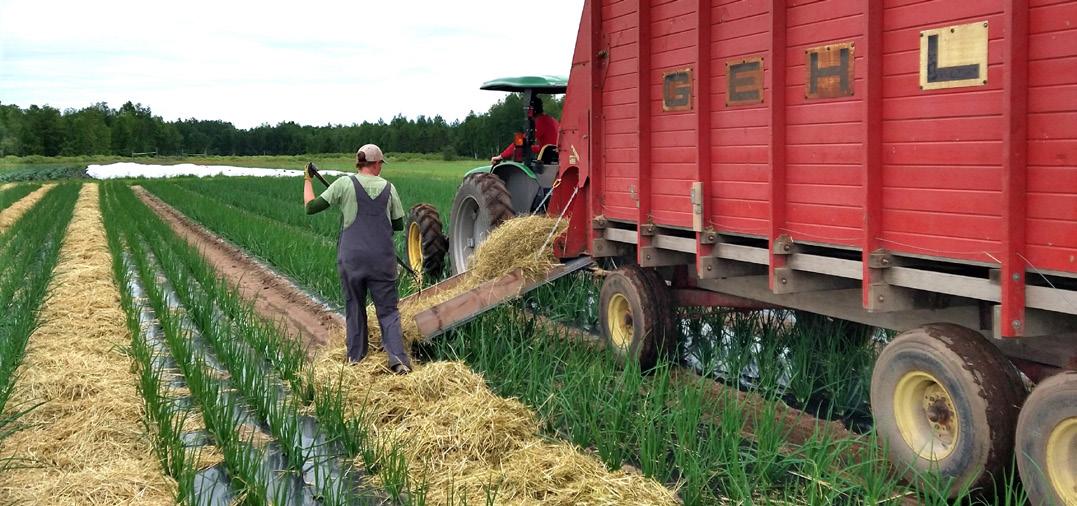
To spread the mulch, Janaki drives the tractor over the top of the tomato beds with the chopper box in tow. Two people follow behind. One person shields the transplants from the greenchop with a snow shovel while the second person spreads the mulch evenly around the plants by hand, aiming for a layer about 6” thick (Figure 5, video).
According to Janaki, it is important to ensure that the soil has warmed up sufficiently before adding the mulch. “If you mulch the tomatoes right after you plant them, it just insulates that 55-degree soil, and the tomatoes really don’t like it,” he explained.
WATCH THE mULCH SPREADING PROCESS
Because mulch generates heat as it decomposes, some farmers may worry about burning transplants by using greenchop for mulch. Fortunately, Janaki hasn’t had issues with the greenchop “going hot.” He attributes this to the high carbon content of the rye at the time of harvest—when it’s fully headed out—and how quickly the layer of mulch at 6-8” thick dries out once it’s on the beds. Even material that has been chopped directly and not left to dry in the field doesn’t hurt the transplants.
Figure 2. Chopping lodged rye with a flail mower. The back of the mower (out of view) is removed so that the rye drops on the ground rather than being blown up the chute.
Figure 3. The second pass: picking up the greenchop with a pick‑up header and mowing it a second time with the flail mower before it’s blown into the chopper box.
Figure 4. The tomato field about one month after mulching, with clover and Italian ryegrass coming up nicely in the pathways.
5. Delivering mulch to tomato transplants using the conveyor on the chopper box. One person protects the plants using a snow shovel while another person follows behind and spreads the mulch with a rake (background). The wheel and foot traffic helps the clover and ryegrass seed make good contact with the soil.
At the end of the season, Janaki leaves the rye mulch on the tomato beds. The Dutch white clover and ryegrass are left to overwinter and grow into the tomato beds the following year through the mulch residue, creating a uniform cover crop.
In addition to using mulch in beds, Janaki also uses the greenchop in the pathways between rows of onions and melons grown in black plastic (Figure 6). The chopper box is modified with a chute that delivers the greenchop to the pathways. The chute, made of scrap sheet metal, is attached to the chopper box with carabiners for easy removal. If he can time the beaters to unload the greenchop without piling up at the bottom of the chute, he can do the job alone. Otherwise, he says, someone follows along and spreads the mulch with a hay rake.
“I hate dealing with the pathways,” he said. “They always get weedy. You cultivate them half a dozen times. The
water runs off the plastic, and it can’t soak in very well because you’ve been running over it. But when you put rye mulch on there, the field is really, really nice.”
After the plastic is removed, he disks and harrows the field to redistribute the mulch, speed the decomposition process, and incorporate the rye into the soil, which helps create a beautiful tilth (Figure 7).
PRODUCTION AND APPLICATION RATES fOR WINTER RyE mULCH
Mulch production varies a great deal based on how tall and thick the rye is. Janaki generally gets anywhere from 5-10 wagon loads per acre from a good stand that is 5 to 7’ tall. In 2024, he used about one forage wagon load per 380 feet of pathway between onions or melons. The tomatoes don’t require as much mulch, so he covered about 450 bed feet per load. The garlic took one small square bale per 20 bed feet.
According to Janaki, the biggest challenges of cut-andcarry mulching—perhaps unsurprisingly—come with the
7. The tomato field in the fall, after plants have been removed. The clover and Italian ryegrass in the pathways overwinter and fill in the mulched beds the following year.
equipment. “If the rye is too tough or too long, it gets wrapped around the front beaters. It doesn’t load very well or it wears out the bearings. That’s a real hassle. And, you know, [chopping the rye] just takes a bunch of time.”
But, he said, “I love the way the soil feels the following year. It’s worth it, even though it’s a lot of work all at once.”
CASE STUDy #2: SCOTCH HILL fARm, BRODHEAD, WI (TONy ENDS)
Tony and Dela Ends ran Scotch Hill Farm, a certified organic farm in Brodhead, WI from 1994 until 2017. On their 5-acre farmstead and 41 acres of rented land, they produced organic vegetable crops, small grains, hay, straw, and pasture. They also had two high tunnel greenhouses, two cold frame greenhouses, and two
Figure
Figure 6. A beautifully mulched field of onions.
Figure
late-winter greenhouses for starting transplants.
For over 20 years, they provided fresh vegetables to central Wisconsin through their CSA. Tony reluctantly left farming in 2017 to pursue an off-farm job that paid a higher salary and offered a pension so that he could comfortably retire later in life.
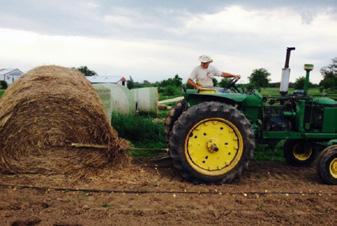
During his farming career, Tony worked to optimize a cut-and-carry mulch system using large round bales of switchgrass (Figure 9). His system involved unraveling the layers of the round bales onto vegetable beds and planting into the mulch layer.
This work was the basis of a SARE grant project (FNC12-857) from 2011 to 2012, which he recounted at a recent meeting of our community of vegetable growers interested in practices to reduce tillage.
CHOOSING A SWITCHGRASS CUT-AND-CARRy mULCH SySTEm
Tony’s experiments with mulching started about five years into farming with straw he baled from their own small grains. He later became familiar with switchgrass when his neighbor asked him to cut and bale a 20-acre field he planned to use as mulch for his asparagus, strawberry, and raspberry crops. In exchange for cutting and baling, Tony kept half of the bales, which provided him enough to mulch his crops for two years.
Persuaded to give it a try, Tony started growing about 3 acres of
switchgrass on a rented field and selling small bales of the surplus straw to community, school, and backyard gardens in Madison.
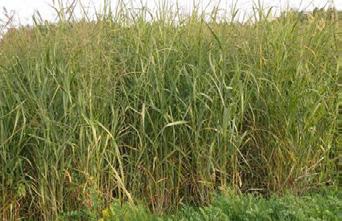
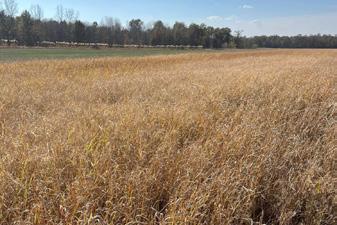
Switchgrass, a native perennial prairie grass that produces deep roots and a lot of above-ground biomass, has several advantages over wheat and oat straw as a mulch, as Tony found in a previous study funded by SARE (FNC08-742): it’s weed free; it harbors very little to no plant disease such as mold or rust; its low carbon-to-nitrogen ratio means it breaks down more quickly over the winter and doesn’t tie up nitrogen; and, as a perennial, it can be harvested for 10 or more years without replanting.
The ability to reduce off-farm inputs, while also improving soil organic matter and tilth was a major draw for Tony to incorporate switchgrass into their system, he said.
“With a yield of 120 bales per acre and a sales return higher than people were paying for small bales of hay, and with very little equipment needed after the first 2 years of establishment (just mowing and baling once a year), it was well worth my effort and production expense.”
He also liked switchgrass as an alternative to black plastic mulch. He had concerns about the ecological effects of using plastic and wanted to avoid having to pull up the plastic at the end of the season, as required by the National Organic Program.
“Straw mulch helped us avoid many back-breaking hours of black plastic
mulch removal by hand each cold fall—when we were so tired and ready for the season’s end.”
mANAGING A SWITCHGRASS CUTAND-CARRy mULCH SySTEm
Switchgrass takes 2-3 years to establish. For the first two years, Tony mowed the field twice each season with a rotary mower to prevent weeds from going to seed. Beginning in the third year, he harvested and baled the switchgrass each November, around Thanksgiving, after successive frosts had caused the grass to die back and drop its seed, ensuring that the stalks were dry and any seeds from the switchgrass or weeds had been shed so they didn’t volunteer in the vegetable beds.
“Every year the switchgrass came back denser and better established. In the 5th year at harvest, the grasses were chest high and golden. There were no weeds anywhere in the field.”
He cut the switchgrass with an All Crop Harvester that threw the straw into windrows. He kept the stalks long so that the plant material would roll out as an intact layer. The
Figure 8. Tony showing brassicas mulched with switchgrass during a tour of Scotch Hill Farm.
Figure 9. A round bale of switchgrass used to mulch vegetable beds.
Figure 11. A field of switchgrass in November, around the time Tony harvested for mulch.
Figure 10. Switchgrass in summer.
same day or the next day, he would bale the switchgrass using a Hesston 550 round baler (Figure 12). The bales were loaded onto a flatbed wagon with a bale spear attached to a bucket tractor and stored in his barn over the winter. He found that fall harvested switchgrass rolled out better than switchgrass harvested in the spring, which tended to be more fragile and prone to falling apart as the bales unraveled.
12. The Hesston 550 round baler Tony used to bale his switchgrass.
Prior to laying the mulch and about 6-8 weeks before transplanting, he spread goat and sheep bedding over the beds, which he incorporated into the soil by tilling with a 50” rotavator set to a depth of 2-4”. Drip tape laid over the bed served as a centering guide when rolling out the round bales of switchgrass mulch.
To roll out a large round bale, he drove a large metal rod through the center of the bale with a sledgehammer. He then attached ratchet straps to each end of the rod and ran them through the three-point hitch/arms of his JD 3020 tractor. Then, he lowered the 3-point hitch to the desired height and slowly drove the tractor over the beds while layers of switchgrass peeled off the bottom of the round bale like a roll of toilet paper (Figure 13).
13. Tony rolling out a bale of switchgrass on a vegetable bed using ratchet straps attached to each end of a large metal rod driven through the center of the bale and run to the three point hitch on his tractor.
The result was a mulch layer about 2 to 3 inches thick, sufficient enough to conceal the soil but not enough to provide thick cover for chipmunks and ground squirrels that rob certain vegetables. For the rodents that did find cover, his Jack Russell Terrier had no problem routing them out.
“I highly recommend a good Jack Russell Terrier in tandem with prairie grass mulch. They patrol with a vengeance,” he said.
APPLICATION RATES fOR AND TRANSPLANTING INTO SWITCHGRASS mULCH
A single 1,000 lb. round bale covered about two 100-foot double rows, plus the walking path in between. Because the thickness of the layers would vary as they came off the bale, someone would follow behind the tractor and even out the mulch layer by hand or with a rake.
Tony transplanted many different crops into the mulch, including tomato, cabbage, Brussels sprouts, and peppers. To penetrate the dense blanket of switchgrass straw, he used a waterwheel transplanter modified with fully removable extension spades (welded by his son) bolted onto existing points on the wheels (Figure 14).
He ran into some issues with the bottoms of the seats on the transplanter catching and dragging the mulch, leaving gaps. To remedy this, he cut out large pieces of cardboard that were fit around the metal rungs of the seat post
14. The modified wheels of the waterwheel transplanter showing the extension spades bolted onto existing points on the wheels.
and held in place by the riders’ feet. These “sleds” helped the transplanters glide over the dense mulch without disturbing, catching, or dragging apart the mulch (Figure 15).
Tony also successfully grew potatoes in the mulch. He simply planted the seed potatoes into the beds and then rolled out the mulch on top.
He noted that some weed varieties, especially thistles, were eventually able to penetrate the mulch as well but, by the time they emerged, the transplanted vegetables were usually thriving.
When asked to reflect on his system of cut-and-carry mulch, Tony offered: “This question should be asked of any practice in whatever system of agriculture. Does the practice increase dependency on a non-renewable resource? Does it cut costs or only increase other costs? Does it require cleanup of ground and surface water? Does it build resistance of weeds? Pests?
Figure
Figure
Figure
Figure 15. Transplanting into switchgrass mulch, with large pieces of cardboard fit around each seat post to keep them from catching and dragging apart the mulch.
Does it accumulate in the soil, in my body or the bodies of neighbors and loved-ones? Does it drift onto neighboring land? Does it acidify and compact soil? Is its efficiency truly for me, or for someone else? Working prairie grass mulch solutions into an organic vegetable crop system created benefit after benefit—reduced weeding costs, plastic mulch removal costs, soil fertility costs, rotational requirements—that all tended toward a healthier and healthier whole farm system.”
CONCLUSION
While mechanizing cut-and-carry mulch has worked well to suppress weeds and improve soil organic matter for some, there are still plenty of challenges when fine tuning the process to the challenges of a specific environment.
For example, one farmer who experimented with cutand-carry mulch found himself unexpectedly mowing his alfalfa/ grass mixture with a sickle bar mower when the flail mower he had planned to use was broken. While the sickle bar mower laid the residue down flat really well, the grass was too long to be useful as mulch and frequently got bound by the finger weeder he used to cultivate the beds.
Finding sufficient space can also be a challenge. While Tony managed his switchgrass on rented land, he noted that the long-term commitment of establishing and maintaining a perennial crop—coupled with proper vegetable rotation—could be done more successfully if one owned the land.
For those with the space and energy to experiment, mechanizing a cut-and-carry mulch system is an excellent way to reduce labor while increasing the resiliency of soil on a farm. Inventive tools—like Tony’s waterwheel points—make use of equipment on hand, while surely there are plenty of tools yet to be developed. Our community of practice convenes monthly to share insights on what’s working (and what isn’t) for farmers in the Upper Midwest. For more information, or to join the conversation, visit Climate Resilience for Organic Vegetable Production
Steffen Mirsky is the Emerging Crops Program Outreach Coordinator with UW-Madison Extension where he supports the development of emerging crops throughout Wisconsin by providing educational programming and support for growers and other stakeholders.
STRONG SEED FOR STRONGER FARMS.
We’re committed to providing strong solutions to make it a little easier to reach your goals. Blue River provides organic corn, soybean, and alfalfa seed. Albert Lea Seed also offers a quality lineup of forages, cover crops, and small grains. For more information or to find a dealer near you, visit alseed.com or call 800.352.5247.
growing Fruit
with the saVanna institute’s wisConsin agroForestry demonstration Farm network
By Eleanor Johnson
“Somebody once said that ‘the best compost for a tree is its owner’s shadow,’ which is very true. I try to visit every tree on our farm at least twice a year, checking on its health, pulling weeds, and doing some pruning if necessary.” Jorg, farmer at Good Trouble Grove Farm and recent event host with Wisconsin Agroforestry Demonstration Farm Network.
The Wisconsin Agroforestry Demonstration Farm Network is a new project from the Savanna Institute, made possible by a partnership with the Wisconsin Natural Resources Conservation Service (NRCS).
The Demo Farm Network, as it is familiarly called, is composed of farmers who practice agroforestry (farming with trees) in Wisconsin and provides a space to connect and learn from each other through in-person and virtual events. This network also invites the general public to see agroforestry in action.
Agroforestry is different from annual farming in many ways. “A good starting point for agroforestry is to step into the zone of being in multiple timelines, sequencing and scaling,” said Erin Schneider of Hilltop Community Farm in LaValle, WI. Trees and shrubs grow on longerscale timelines than annual veggies, and it’s necessary to put thought into the design process when planning your tree and shrub plantings, considering things like mature tree canopy width when deciding on spacing requirements. Many farmers in the Demo Farm Network have worked with the Savanna Institute’s Technical Assistance Program to get support in their agroforestry design phase.
The Savanna Institute supports agroforestry in many ways: by allowing the public to see agroforestry in action through projects like the Demo Farm Network, the Demonstration Farms the Savanna Institute runs in Spring Green, WI and central Illinois, through direct Technical Assistance, through research and plant breeding work in agroforestry crop varieties well suited to the Upper Midwest climate, and through free publications available on the Savanna Institute website, such as the handbook, Planting Tree Crops (https:// www.savannainstitute.org/planting-tree-crops/).
When asked about growing fruit in their agroforestry operations, several members of the WI Demo Farm Network were happy to offer their expertise and insights. Technical growing information is taken from this chart written by the Savanna Institute’s Matt Wilson for the NRCS: https://efotg.sc.egov.usda.gov/references/ public/WI/WI_Agroforestry_Crop_Trees_Chart_ March2025.pdf Below are some of the fruit crops that grow well in agroforestry systems with advice from Network members.
American Plum (Prunus americana) is native to Wisconsin and grows in a variety of sun and soil conditions (full sun to partial shade, adaptable pH, well-drained to somewhat poorly drained soils). Prairie Sundance of Fruit Circus near Lone Rock, WI, offers some advice on pollination and varieties: “For plums, pollination can be a challenge, so we’ve been growing them a little closer together with a wider range of varieties than we would other fruits. Our biggest challenges are late frosts, so selecting late-blooming varieties in our region is good, and brown rot, which can be a real problem in a wet year like this one. Removing
Elderberry
infected fruit and planting them in a location with good air flow can help some.”
Pawpaw (Asimina triloba) is native to North America and does well in zones 5-8. It prefers moderate to well-drained soil with a pH of 5.5-7. Pawpaw fruits must be used within a few days of picking or be pulped and frozen. Lauren Mortensen of Heartwood Farm in Platteville, WI, shared what she has found to work for germinating pawpaw seeds (this advice was given to her by Tom Wahl and Kathy Dice of Red Fern Farm in Wapello, IA): Remove the seeds from the fruit promptly and wash them thoroughly to remove the pulp. Keep the seeds moist but not wet and store them in the refrigerator in an airtight bag with some growing medium like peat or sawdust. In the spring, place the seeds in pots with a light, porous medium (not potting soil) and add compost. Importantly, keep the seeds moist at all times and in a very warm location, at least 75-85 degrees, but up to 95 degrees to speed up the process. Once the seedlings emerge, make sure to keep them in a shady location (direct sun could kill young seedlings), then set them out in their final location in late summer or early fall.
European Pear (Pyrus communis) is an introduced species that prefers full sun and moderate to well-drained soils with a pH range of 6-7.5. “I’m always surprised that more people don’t grow pears because they have so many fewer pests than apples,” said Rob McClure of Hilltop Community Farm. “It’s something really well adapted to this particular area.” Rob and Erin also shared a tip for harvesting pears: some varieties can be picked a few weeks before they’re ripe, which is helpful because they are less delicate to harvest, and then you have more time before the pears need to get to market.
American Persimmon (Diospyros virginiana) is native to North America and adapted to zones 5b-9, with a wide range for pH, drainage, and sun requirements. A 5:1 ratio of female to male trees is recommended for good fruit set. Jorg from Good Trouble Grove offered this advice, comparing starting persimmons from seeds to chestnuts, another commonly planted agroforestry species: “Chestnut is very easy to grow from seed, but is the most sensitive to transplanting, while Persimmon, on the other side, needs more patience to seed but is very forgiving during transplants and grows like a weed afterwards.”
Quince (Cydonia oblonga) is an introduced species, adapted to zones 5-8, soil pH 5-6.5, and moderate to well-drained soils. It is self-pollinating but is better when cross-pollinated. Fire blight can be a major disease issue. Erin from Hillop Community Farm researched quince when planting it several years ago and learned that quince used to be a common household fruit tree in the beginning of the 20th century due to its high pectin content–it was a useful ingredient for making jams and jellies–but when manufactured pectin became common, the trees were abandoned. She likes the niche that quince trees fill in the orchard, blossoming later in
the spring than other fruit trees and giving a harvest in October when other fruits have finished.
Black currant (Ribes nigrum) is introduced, though there are also ten native Ribes species in Wisconsin. It does well in hardiness zones as low as 2 and is adaptable to numerous soil types and shades conditions. Most newer varieties are resistant to White Pine Blister Rust. Andrew Adamski of Full Circle Community Farm in Seymour, WI has found black currants to be very forgiving. “We have never pruned them as recommended, and yet they produce an abundant flush of fruits every year. We planted the first 50 bushes straight into pasture, and they did well enough as long as the grass was mowed once or twice a year around them at the beginning.” Though black currants can be a good candidate for machine harvest, at Full Circle, they are happy to harvest by hand. “It works for our small scale and niche market in the CSA with about 50 pints a week starting the last week of July and ending likely the second week of August. If we scale up at all, it will have to be with a clear business plan model for utilization of much larger quantities via value-added production and a mechanical harvester that could also be used for other berries and/or nuts.”
American Elderberry (Sambucus canadensis) is native to Wisconsin and works well in zones 3-9 with moderate to well-drained soils and pH 5.5-6.5. Erin and Rob of Hilltop Community Farm take a minimalist approach to their elderberries and joked that they let the birds plant them (they also mentioned that they ordered bulk seedlings through the Wisconsin DNR). “We’re challenged most by the post-harvest for elderberries. We could certainly use a de-stemming machine.” They explained that leaving any stems in with your berries when processing will lead to “green goo” in your processing equipment. It’s also very helpful to network with other growers. Erin and Rob appreciated working with the Driftless Berry Grower Network to share processing equipment like destemmers, freeze driers and juicers.
Certain principles are good to keep in mind across the board. Jorg of Good Trouble Grove offered this advice for getting trees started: “Weed control and soil health are most important to the tree, while occasional watering during dry spells is essential. Also, from experience that I gathered during my time working for an arborist, is that pruning on an early stage and regular basis is important to lead the tree into the right growth pattern and to avoid any problems for the future.” And finally, Erin of Hilltop Community Farm had words of wisdom to offer about species selection: “Start by growing things that you like to eat and let that be part of your plant selection. You should be able to eat the fruits of your labor.”
Eleanor Johnson is the Wisconsin Demonstration and Partner Farm Coordinator at the Savanna Institute. She lives in Baraboo, Wisconsin, where she and her partner run a small CSA farm and are always trying to incorporate more trees and shrubs into their agriculture systems.
addressing Challenges Farmers FaCe in the great lakes:
the organiC researCh huB
By Brian Geier, Communications Manager, Organic Farming Research Foundation (OFRF), and Organic Farmer, Bundle Sticks Farm
Every day, farmers make decisions that can have shortterm and long-term effects on our farms. And as organic farmers, we depend on complex, intertwining relationships amongst all the moving parts of an organic system to work with us: plants, animals, soils, climate, microbes, workers, insects, processors, consumers, and more. To put it mildly, good information is key for our success, and wrong or misguided information can be costly.
Many farmers will tell you that the best information comes from our experiences on the land. “A farmer’s footstep is the best fertilizer,” they say. Our second-best source of information, reflected in survey after survey, is the information farmers get from other farmers. Third may arguably be what we find using the internet. But there, we risk running into an overwhelming array of sources of info with varying degrees of reliability, which may or may not be accessible or useful to anyone, let alone organic farmers!
INTRODUCING THE ORGANIC RESEARCH HUB
A new tool seeks to remedy this overwhelm, and it is worthy of a close look. The Organic Research Hub, launched in early 2025 by the Organic Farming Research Foundation (OFRF), is a curated collection of scientific and technical resources to help organic farmers understand and solve their challenges. It is a gateway to research and resources that are applicable to organic farmers, and it is a connection place between farmers, researchers, technical service providers, and extension agents.
Ohio dairy farmer John Settlage, who serves on the Organic Stewardship Council for OFRF, described his first experience testing out the “Hub” at a recent advisory meeting. “We’re changing our compost management right now, and I had some questions about it. I searched the site, and within about 30 seconds, I found the answers I was looking for. I thought, ‘Wow, this is a powerful tool. This is fantastic.’ What really stood out is that it wasn’t just some random person on YouTube or a questionable link from Google. The information came from Rodale and other credible sources. It was actually helpful— and I was able to make real management decisions based on what I read.”
The Hub is easy to use. It can be searched by typing a keyword, by selecting from one or more of 17 topics (for example, Cropping Systems, Tools and Technology, or Livestock Feeding), by choosing a USDA-SARE region, or filtering by production category. You can also combine these options for a more refined search. Let’s take a look at how it works, using the Great Lakes region as an example.
CHALLENGES fOR ORGANIC fARmERS IN THE GREAT LAkES AGRO-ECOREGION
The Great Lakes agro-ecoregion, as defined by the National Organic Research Agenda (NORA), includes Michigan, Minnesota, and Wisconsin. (National data and larger USDA-SARE regions, including the “Northcentral” region, are also used in the NORA report. Smaller agroecoregions like the Great Lakes are used to provide a finer scale of categorization that reflects geographical specialization of farm commodities, and regional differences in soil types, climates, and environmental
The new Organic Research Hub developed by the Organic Farming Research Foundation (OFRF) includes searchable databases of organic farming resources and specialists.
stressors.) In the NORA report, Great Lakes organic farmers identified the following challenges:
• The top production challenges are: controlling weeds (66% of respondents struggle with this), maintaining adequate yields (50%), and managing production costs (45%).
• The non-production challenges are: finding and developing markets for organic products (56%) and accessing labor (52%).
• The preferred source of information is other organic farmers (91% of respondents say so, a preference observed in all regions but strongest in the Great Lakes).
• The most influential methods for learning are field days, followed by printed materials, then online resources, then conferences.
• The top concerns are organic fraud and integrity, industrial organic, crop contamination, imbalance of domestic certified organic supply and demand, and funds for organic research.
ADDRESSING THE TOP ORGANIC PRODUCTION CHALLENGE Of THE GREAT LAkES: WEED mANAGEmENT
What would an organic farmer find on the Hub if they chose the Weed Management topic and the North Central region? At the time of this writing, this search generates 19 resources that farmers in the Great Lakes may find helpful when addressing their #1 production issue.
For example, farmers using plastic mulches might be interested in a study at Michigan State University that looked at the effects of several weed prevention strategies (cultivation, dead mulch, living mulch cover
Mike Lucas, of Farmacea in Munith, Michigan, like most organic farmers in the Great Lakes, is looking for ways to successfully address weed management. An on farm research trial led by Farmacea is looking at comparing synthetic and living mulches. Results are forthcoming and will be available on the Hub.
crops, and mowing) between plastic mulch rows on weed control, soil health, and cash crop quality/yield.
Producers interested in using reusable black tarps to smother weeds might note that in a recent study at Cornell, it only took 3 weeks to kill weeds with tarps, and results suggest that following tarping, mechanical cultivation, or field prep can be accomplished with less depth (and fuel).
And, with other results from this search, any farmer could:
• Sharpen knowledge of major weed families using this eOrganic virtual tour
• Integrate new strategies like flame weeding or increased field sanitation as laid out by Dr. Alan Leslie in this article on integrated weed management
• Take the “many little hammers” approach to weed management discussed by organic weed specialist Dr. Eric Gallandt in this guide to ecological strategies for weed control from SARE
RESOURCES fOR THE TOP NON-PRODUCTION CHALLENGE: fINDING AND NAVIGATING mARkETS
Over half of the organic farmers in the Great Lakes say that finding and navigating organic markets is a significant challenge. Looking at Hub results for the “Managing Production Costs: Business and Marketing” topic and the Northcentral region reveals an array of resources that provide valuable insights.
There are podcasts like Field, Lab, Earth Podcast, where filmmaker Anders Gurda and agricultural professional Paul Dietmann discuss finding markets for organic grains and the business side of transitioning to organic. A video from the Organic Agronomy Training Service explains the opportunities with locking in prices for future sales using ‘forward contracts’. Another publication
could help producers price organic products where organic markets may not already be established. And although not directly market related, another search result is a podcast with farmer Tom Frantzen exploring the importance of long-term planning and thinking for organic farmers
ORGANIC fARmING ExTENSION DIRECTORy AND OTHER RESOURCES fROm OfRf
In addition to digital resources like factsheets, videos and podcasts, farmers can now find a list of Extension agents and Technical Service Providers with organic expertise on the Hub. At the time of this writing, the Hub’s “Organic Farming Extension Directory” lists 15 organic farming experts in Wisconsin, two in Michigan, and nine in Minnesota. More specialists are expected to be added, and nominations are welcome (see below).
In addition to the Hub and Directory, this Resource page is the go-to spot for OFRF factsheets, webinars, networking sessions, and farmer-led resources like this suite on Crop-Livestock Integration. The Advocacy page also hosts our Organic Research State-by-State factsheets, which detail the size of the organic market, the importance of organic research investments, local organic research projects, and regional research priorities in each state, including Michigan, Minnesota, and Wisconsin
BUILDING AND fARmING INTO THE fUTURE
The Hub and the Directory are living resources open to additions. Feedback or suggestions for additions can be submitted via this form or by contacting OFRF staff at the email on the form. If farmers, ranchers, researchers, extension agents, or anyone has suggestions for additions to these resources, OFRF welcomes your input!
Results from on-farm trials being conducted by organic farmers in the Great Lakes are among the latest additions to the Hub. OFRF’s Farmer-Led Trials (FLT) program provides financial and technical support
to organic farmers to investigate and learn about solutions to their most pressing production challenges. Applications for the next round of FLT projects will be open this fall. Recent and forthcoming additions to the Hub from Great Lakes farmers in the FLT program include:
• Results of in-row seed spacing & root crop yield from the Green Things Farm Collective, Ann Arbor, Michigan.
• Effects of living clover mulches from farmers Mike Lucas and Rollin Baker of Farmacea, in Munith, Michigan.
• Results on anaerobic fermentation as a closed-loop farm-made fertilizer from Samantha Otto of The Woven Trifecta, in Whitehall, Michigan.
Otto, at The
western
leads an on farm trial looking at incorporating waste from her livestock and compost into anaerobic ferments to improve soil fertility and plant health. Results are forthcoming and will be posted on the Hub.
Addressing the myriad of challenges organic farmers face is not easy or formulaic. We need relevant, updated information from a wide swath of science areas. We want to see real results on working farms. Our information needs to be specific to production systems and regional factors. The Hub is a powerful step in this direction, and I hope readers will join me in using it and sharing it.
Brian Geier is a Communications Manager at the Organic Farming Research Foundation, where he helps write, design, and disseminate resources for the organic growers, researchers, advocates, and technical service providers. He lives and farms at Bundle Sticks Farm in Lanesville, Indiana.
Want to stay up-to-date with OFRF? The best way is to join our monthly newsletter, where you’ll receive alerts about new resources, upcoming events and webinars, paid internships with the organization, federal programs and funding for organic farmers and research, and policy updates relevant to the organic community.
Samantha
Woven Trifecta in
Michigan,
organiC grain mythBusters series
By Katie Bishop, The Land Connection, Organic Grain Mentorship Coordinator
Curious about organic certification but not sure where to start? You are not alone. Many farmers have questions, concerns, or misconceptions that hold them back from exploring the organic path. That is why we are breaking down some of the most common myths we hear and offering real, grounded truths from farmers who have been through it.
If you are thinking about transitioning to organic grain or want to support others through the process, check out the Organic Grain Mentorship Program from The Land Connection. This year-long program begins in late 2025 and matches new or transitioning farmers with experienced, vetted organic grain mentors. Mentee participation is free, and mentors are paid for their time. The program includes farm visits, goal-setting, independent learning, and one-on-one support.
Learn more at: https://www.thelandconnection.org/ assistance/organic-grain-mentorship/
myTH #1: “ORGANIC CERTIfICATION IS JUST TOO mUCH PAPERWORk.”
TRUTH: Yes, it involves documentation, but it’s manageable with good systems in place and actually helps you understand and improve your farm. Many certifiers accept simple handwritten notes, calendars with planting dates, or journals. You don’t need fancy software or a specific record-keeping system. Plus, lots of certifiers and organic organizations offer templates,
tech tools, and support to make it easier. Think of it as a record of your care and commitment.
Keeping records is just good business all around and will help you be a successful farmer and business owner regardless of whether you’re organic or not.
myTH #2: “IT’S TOO ExPENSIVE TO BECOmE CERTIfIED.”
TRUTH: At this time, the federal cost-share program for organic certification has been canceled, but some states still offer financial assistance. There are also conservation programs, grants, and cost-share opportunities that support organic practices like cover cropping, pollinator habitat, and buffer zones.
Financially, organic certification can absolutely pay off. There’s strong market incentive for organic grain and commodity crops, but also for specialty crops and livestock.Certified organic products often earn higher retail and wholesale prices, and in many cases, face less market competition.
Plus, organic farming reduces input costs by avoiding expensive synthetic pesticides, herbicides, and fertilizers. Certification is an investment, but one with meaningful returns.
myTH #3: “I ALREADy GROW USING ORGANIC OR REGENERATIVE PRACTICES SO WHAT’S THE POINT Of CERTIfICATION?”
TRUTH: If you’re already farming in a way that avoids synthetic chemicals, that’s something to be proud of.
But without USDA organic certification, you can’t legally market your products as “organic.” That certification isn’t just a technicality, it’s a trusted, recognizable symbol that gives your customers confidence that your practices are verified.
Many farmers are surprised to learn that organic isn’t just about being “chemical-free.” It’s a comprehensive system that also includes soil health, conservation, food safety practices, and humane animal handling and processing. Without formal training and standards, it’s easy to miss pieces that are required for certification, even when your intentions are solid.
Certification also opens the door to price incentives and access to premium grain, wholesale, and livestock markets where proof of organic status is essential. It’s about transparency, trust, and protecting the integrity of the good work you’re already doing.
myTH #4: “I DON’T WANT THE GOVERNmENT IN my BUSINESS.”
TRUTH: Organic certification does require transparency, but it doesn’t mean giving up control of your farm. Your annual inspection is done by a third-party, independent auditor, not a government official. The USDA authorizes private or nonprofit certifiers to carry out the process, and many of them are farmer-focused and want to see you succeed.
Your records are shared with your certifier, not the federal government, and unless there’s fraud or a major issue, the USDA isn’t directly involved.
And keep in mind, if you’re selling fruits, vegetables, eggs, meat, or dairy at any scale, you’re probably already subject to state or federal food safety inspections. Organic certification doesn’t increase that, it just gives you the tools and credentials to access premium markets, with confidence and integrity.
myTH #5: “my CUSTOmERS DON’T CARE If IT’S CERTIfIED ORGANIC.”
TRUTH: Many do care, and those who don’t yet might if you share your story well. The USDA organic seal sets you apart in a crowded market and provides assurance that your practices are verified, not just claimed. For many buyers, that credibility matters, and they’re often willing to pay more when they understand the value behind it.
If you’re not certified, you legally can’t market your products as organic, even if your practices align. That can lead to missed opportunities, especially when it comes to selling grain, livestock, dairy, or other commodities to a third party. Without certification, you can’t access the organic price premiums or wholesale buyers who require proof.
Certification isn’t just a label. It’s a tool for trust, transparency, and tapping into stronger markets.
myTH #6: “ORGANIC fARmING DOESN’T yIELD ENOUGH TO BE WORTH IT.”
TRUTH: While organic yields are sometimes lower, especially during the transition period, profitability isn’t just about bushels per acre. What really matters is how much you earn per acre, and organic prices are consistently higher across grain, livestock, and specialty crops.
With lower input costs and higher premiums, many organic farmers find that they come out ahead, even with a smaller yield. Plus, organic practices improve long-term soil health, making your land more resilient and productive over time.
So yes, yield matters… but profit matters more.
myTH #7: “ORGANIC fARmING mEANS yOU’LL BE OVERRUN WITH WEEDS.”
TRUTH: Weed management in organic systems is different, not worse. It takes planning, timing, and a systems-based approach, but many successful organic farmers keep weed pressure under control with tools like crop rotation, cover crops, cultivation, flame weeding, and well-timed planting.
Yes, you may see a few more weeds than in conventional fields, but a clean field doesn’t always mean a healthy one. Organic farming builds soil health and resilience, and over time, that balance actually helps suppress weeds naturally.
With the right tools and support, organic farmers can manage weeds effectively without relying on synthetic herbicides.
myTH #8: “I’LL BE AN OUTCAST. ORGANIC fARmERS DON’T fIT IN AROUND HERE.”
TRUTH: Choosing a different path can feel lonely at first, especially if your neighbors raise an eyebrow or crack a joke. But you’re not on your own. There’s a large, experienced, and generous community of organic farmers who are willing to share what works, answer questions, and help you succeed.
You may be surprised how many landowners, neighbors, and even conventional farmers are curious, supportive, or quietly rooting for you. Plus, there are mentorship programs, field days, conferences, and online networks that connect organic farmers across the country.
Being organic doesn’t mean going it alone, It means joining a growing movement of people who care deeply about the land and the future of farming.
myTH #9: “IT’S TOO LATE fOR mE TO SWITCH, I’VE BEEN fARmING THIS WAy TOO LONG.”
TRUTH: It’s never too late to make a change, and your experience is actually one of your greatest strengths. Long-time farmers often have a deep understanding of their soil, crops, and land, which gives them an edge when transitioning to organic.
Your ability to observe patterns, manage systems, and troubleshoot challenges is invaluable in organic farming. We’ve seen experienced farmers successfully transition after 20, 30, even 40 years, and many say it brought new meaning and energy to their work.
Plus, you don’t have to go it alone. There’s a strong, growing community of support from mentors and transition programs to technical advisors, certifiers, and fellow farmers. Whether you’re brand new to organic or just curious, you’re not starting from scratch, you’re building on a solid foundation.
myTH #10: “ORGANIC fARmING IS ANTI-TECHNOLOGy AND NOT mODERN.”
TRUTH: Organic doesn’t mean anti-science or antiprogress. In fact, organic farming often requires more creativity, innovation, and problem-solving. Many organic farmers use advanced technologies like GPSguided cultivation tools, drone imagery, soil health data
tracking, and modern equipment adapted for reduced tillage and precise planting.
Organic farmers also rely on the latest soil science, pest forecasting models, and research-backed conservation practices. It’s not about going backwards, it’s about moving forward in a different way, with long-term sustainability and resilience in mind.
Organic farming blends tradition and innovation, and the best systems often pull from both.
fINAL THOUGHTS
Organic farming can feel intimidating from the outside, especially with so many myths floating around about certification, yields, cost, and community. But when you look more closely, many of those fears are either outdated or simply untrue. With the right support, tools, and mindset, organic farming is not only possible — it can be profitable, practical, and deeply rewarding. Whether you are just exploring the idea or already farming in an organic way, there is a strong and growing network of farmers, mentors, and resources available to walk the path with you.
Katie Bishop is the Organic Grain Mentorship Coordinator at the Land Connection. Along with her family, Katie owns and operates PrairiErth Farm, a 400+ acre organic vegetable and grain farm in Central Ill.
CERTIFIED ORGANIC SEED YOU CAN DEPEND ON.
SECURE YOUR FAVORITE OR NEW PRODUCT BEFORE IT SELLS OUT. SCAN THE QR CODE TO LEARN MORE.
With a facility solely dedicated for processing organic and non-GMO seed, Beck’s Great Harvest Organics meets every organic standard. Plant confidently with Great Harvest Organics.
ConserVation planning For organiC transition: how Cpa 138 and dia 140 help Farmers suCCeed
By Mercedes Talvitie
Transitioning to organic production can feel like stepping into uncharted territory. The three-year organic transition period requires careful management of soil health, pest control, and nutrient cycles. The USDA’s Natural Resources Conservation Service (NRCS) offers two powerful tools to guide this journey: Conservation Planning Activity (CPA) 138: Conservation Plan Supporting Organic Transition and Design and Implementation Activity (DIA) 140. Together, these activities create a roadmap and provide technical assistance to help farmers transition successfully while improving the long-term health of their land.
CPA 138: BUILDING THE ROADmAP TO ORGANIC SUCCESS
CPA 138 is all about planning for success. This NRCS support activity helps producers design conservation strategies to address resource concerns and common challenges during the organic transition. It can also help align with or support the development of the Organic System Plan (OSP) required for certification.
Working with a Technical Service Provider (TSP) or an NRCS conservation planner , farmers evaluate their land through a new lens to look beyond what is growing now to what the soil, water, and ecosystem need to thrive in the future under an organic system. TSPs produce conservation plans that document farmer objectives, existing resource concerns, and farmer decisions regarding conservation practices that will be used to address identified resource concerns
Certified TSPs and NRCS planners help farmers:
• Assess resources: Evaluate soil health, erosion risks, water quality, pest pressures, and nutrient management needs.
• Identify conservation practices: Select strategies such as cover crops, crop rotations, riparian buffers, pollinator habitats, or improved grazing systems.
• Provide roadmap for organic transition: Develop maps, field inventories, and management schedules that can also support organic certification paperwork.
A STRUCTURED PATH TO ORGANIC
CPA 138 follows the NRCS’s conservation planning process but specifically works only with the first two phases, the Collection and Analysis Phase and the Decision Support Phase. These two phases include seven steps, which will be outlined lightly in this article,
but we encourage you to view the entire robust process at https://www.nrcs.usda.gov/getting-assistance/ conservation-technical-assistance/conservationplanning
IN PHASE ONE THERE ARE fOUR STEPS:
1. Identify Problems and Opportunities: Identify potential resource concerns , risks, and opportunities for improvement based on landowner knowledge and local conservation data.
2. Determine Objectives: Define clear, practical goals that balance production needs and environmental stewardship.
3. Inventory Resources: Document current conditions, including soils, slopes, vegetation, and water flow, often using maps and field photos.
4. Analyze Resource Data: Use NRCS-approved assessment tools (e.g., RUSLE2, WEPS, Nitrogen/ Phosphorus risk assessments) to compare current and desired conditions.
IN PHASE TWO THERE ARE THREE STEPS:
5. Formulate Alternatives: Develop different conservation strategies to address resource concerns.
6. Evaluate Alternatives: Compare each option for effectiveness, cost, and regulatory compliance.
7. Make Decisions: The producer selects practices based on their goals and objectives and their design and ability to implement ; the planner prepares documentation.
WHAT THE PLAN INCLUDES
A completed CPA 138 plan provides the producer with robust documentation that is needed to complete the Phase Three of Conservation Planning or can be a standalone document the producer refers to if they do not proceed with NRCS cost share or practice implementation:
• Cover Page: includes pre-work meeting information
• Maps: geographic maps lining out where the practice will take place and soil map/ descriptions.
• Resource Inventory and Assessment Documentation: Key findings, including assessment tool results from Step Four.
• Notes and Correspondence: Documentation of interactions, correspondences, and prepared material that support the understanding of the CPA.
• Practice Schedule: NRCS practice codes with timelines and locations for implementation.
OSP documentation is listed under CPA 138’s Resource Inventory and Assessment Documentation and is included as applicable, and the CPA 138 can be shown in OSP documentation to demonstrate compliance with relevant sections in an OSP. However, TSP’s are not responsible for developing the OSP.
After completing a CPA 138 conservation plan, the next challenge is turning that roadmap into reality. While CPA 138 focuses on assessment and planning, DIA 140 provides the technical expertise and design support needed to install conservation practices correctly.
DIA 140: TURNING THE PLAN INTO ACTION
Where CPA 138 provides the roadmap, DIA 140 ensures the plan is implemented correctly. This activity combines design, technical specifications, and installation support to ensure practices meet NRCS standards, maximize conservation benefits, and improve a producer’s chances of a successful organic transition.
It is important to note that TSP’s can only design or implement those practices for which they are certified. Depending on the Practice Schedule that results from the first seven steps, this may require involving NRCS staff or additional TSP’s. DIA 140 is intended to assist with:
• Design conservation practices: Site-specific conservation designs such as layouts for buffer strips, windbreaks, water systems, or fencing for grazing.
• Write technical specifications: Technical support to implement practices, such as seeding rates for cover crops, tree spacing for windbreaks, or compost application methods.
• Schedule installation: Timelines that fit the organic crop rotation and reduce disruption to farm operations.
• Verify compliance: Ensures installed practices meet NRCS standards, qualify for EQIP cost-share, and meet USDA Organic Regulations.
DIA 140 continues from the phases completed in the CPA 138. DIA 140 takes farmers through Phase Three of the NRCS conservation planning process. Phase Three has two steps but only Step 8 is done under DIA 140:
8. Implement the Plan: TSPs produce DIAs which include designs, prescriptions, or other instructions for implementing a single conservation practice, or a system of conservation practices derived from the participant’s conservation plan.
9. Evaluate the Plan: usually includes a Conservation Evaluation Monitoring Activity (CEMA) that produce results of an evaluation, monitoring, test, or assessment. There is not a CEMA for DIA 140.
DIA 140 ensures that the practice(s) chosen by the producer in Step Seven are implemented using proper design. Without this step practices may underperform or fail. However, the planning process can and should be iterative; producers can retrace steps and go back to other CPA Phases or Steps if the plan is no longer feasible or does not perform.
WHAT THE DIA INCLUDES
Many of these items are already done from CPA 138 but slightly altered:
• Cover Page: includes pre-work meeting information.
• Notes and Correspondence: Documentation of interactions, correspondences, and prepared material that support the understanding of DIA.
• Implementation Maps: geographic maps lining out where the practice will take place and soil map/ descriptions.
• Design and Implementation details: Site specific details (Statement of Work and Implementation Requirements) required for NRCS practice standards all can be found in the Field Office Technical Guide (FOTG).
• Supporting Documentation: Results from design tools and resource assessment to meet requirements.
STEPS TO EQIP OR ADDITIONAL mARBLESEED SUPPORT
Both activities discussed in this article are eligible for EQIP financial assistance, making the transition to organic both environmentally and economically beneficial. Together, CPA 138 and DIA 140 do more than check boxes for organic certification. They create
3 Phase, 9 Step Process Frame
working conservation systems that protect soil, water, and wildlife while supporting profitable organic production.
Marbleseed is lucky to have two joint agreements with the NRCS to help increase conservation planning and NRCS practice implementation on organic and transitioning-to-organic farms. If you are a farmer and interested in learning more about how to utilize NRCS programs for organic and transition-to-organic you can contact mercedes.talvitie@marbleseed.org or thomas.manley@marbleseed.org.
Mercedes Talvitie is Marbleseed’s Climate and Conservation Program Manager.
“This material is based upon work supported by the U.S. Department of Agriculture, under agreement number FBC24CPT0013866.
Any opinions, findings, conclusions, or recommendations expressed in this publication are those of the author(s) and do not necessarily reflect the views of the U.S. Department of Agriculture. In addition, any reference to specific brands or types of products or services does not constitute or imply an endorsement by the U.S. Department of Agriculture for those products or services.
USDA is an equal opportunity provider, employer, and lender.”
aBundanCe
By Rachel Wood
Let’s be honest — farming is hard. Nonprofit work is hard. Conference planning? Oof‑dah. And building a resilient organic movement on top of it all can feel even harder when the headwinds keep coming. At Marbleseed, that looks like shrinking grant funding, rising costs for everything from venues to food, and the never-ending challenge of keeping the conference accessible while still paying farmers and staff fairly. For farmers, it’s no small thing to step away and travel, even in the so-called “off season” (though, is there really such a thing?). Some days it feels like there’s never enough time, money, or resources to balance it all.
And yet… we still gather. We still show up for each other. We keep choosing to do the things that, though hard, are worthwhile for the organic farming community. I’m lucky to see this every day in my work at Marbleseed. Personally, I choose to show up because ever since I first attended the conference 10 years ago, I’ve believed this gathering is one of the most welcoming and impactful events for farmers and ag professionals. In the face of headwinds, Marbleseed will keep showing up however we can — and we know our community is doing the same.
That choice — that solidarity — is where abundance grows. Our theme this year, Abundance Grows in
Solidarity, reminds us of the power of bringing a diverse community together under one roof and cherishing the wealth of connection, knowledge, and resilience that flourishes when we do.
WHAT’S NEW THIS yEAR
With that in mind, we’re making some changes in 2026. We’re condensing the conference into one wing of the La Crosse Center, getting smart with our layout, and still making space for 1,000+ attendees, 100+ exhibitors, dozens of workshops, and plenty of opportunities to connect. Our organizational partners are preparing in-depth sessions on Thursday, affinity group spaces on Friday, and special events woven throughout the weekend.
This year, each 75-minute session will offer three new ways to engage:
1. Panel discussions featuring experts and farmers in the field.
2. Hands-on workshops to build skills you can take straight back to the farm.
3. Keynote speakers to connect the dots and keep the bigger picture in focus.
We know the value of practical tools, honest conversations, and moments that make us feel less alone in the grind — so that’s what we’re leaning into. Something for everyone, with everyone a part of something bigger.
WHy THIS CONfERENCE mATTERS
As the conference manager, I wish I could say this gathering will fix everything. It won’t erase the realities of trying to farm in a system that too often undervalues farmers and the networks built to support them. But it does create a space where we can name those struggles — and then look around and realize we’re not facing them alone.
That’s the abundance I believe in: ideas shared freely, networks built over coffee, solidarity between farmers, nonprofits, sponsors, and exhibitors who all know that if we want a different future, we have to build it together.
SAVE THE DATE
So, let’s keep showing up. February 26–28, 2026 at the La Crosse Center in La Crosse, Wisconsin. Come tired, come hopeful, come as you are — and leave knowing you’re part of something bigger.
Because abundance doesn’t mean we don’t struggle. It means that even in the struggle, we accomplish more when we face it together. I’ll see you there!
Rachel Wood is Marbleseed’s Conference and Partnerships Manager.
Learn more at conference.marbleseed.org
Abundance Grows in Solidarity: Notes
grows in solidarity: notes From the ConFerenCe manager
Photo Credit: Ben Morrison
From Flowers to Farrow-to-Finish hogs:
the moon uses FinanCial tools to make tough deCisions
Over the Moon decided to fully move from flowers to meat not only because of the potential scalability, but because they were getting burnt out. The amount of labor they would need to expand that enterprise was oVer
By Anna Thomas Bates
Anna and Shae Pesek launched Over the Moon Farm as a cut flower CSA on 10 acres of Shae’s Iowa family farm in 2019. While the dream to start a farm was rooted in a strong connection to agriculture and a dream to nourish their community, the decision to begin with flowers was a business strategy.
The Peseks grew flowers because the initial financial inputs were low, but with a considerable amount of their own labor they could yield a high-return crop. After six years of running a flower CSA, making bouquets, and lots of deliveries, this summer they officially phased out flowers and are exclusively selling livestock direct-toconsumer using their web site. They raise poultry and farrow-to-finish Berkshire hogs, and market beef for a nearby farm.
While spreadsheets and gross profit margins aren’t the most romantic aspects of farming, understanding the financial viability of farming enterprises is an essential tool to ensure a farm’s sustainability and prevent farmer exhaustion and burn-out.
They built their brand with a 150-member flower CSA. In addition to cultivating flowers, they spent time creating arrangements, handling customer service inquiries, and managing logistics. As they began incorporating livestock into the farm, they realized it was
much easier to scale poultry and hogs without hiring a significant number of employees. That wasn’t the case with flowers—to grow the flower side of the business meant a lot more employees. Over the past six years, they managed a slow transition of scaling down flowers while adding animals.
fINANCIAL TRAINING AS CATALyST fOR GROWTH
Over the Moon used that time to secure capital for adding more animals, grow their customer base, and participate in agricultural business training opportunities through Food Animal Concerns Trust (FACT) and Practical Farmers of Iowa (PFI).
The Universities of Wisconsin’s Food Finance Institute (FFI) played a role in each of these learning opportunities, supplying a financial foundations knowledge base filtered through an agricultural lens.
“FFI was so helpful with lots of things, from figuring out the best way to access an operating line of credit with our bank, organizing our financial documents, to looking at risk and working out how much money we needed to make,” said Anna.
overwhelming. This nudge led them to examine their finances closely and devise a plan to scale down the flower enterprise while growing the livestock side of their business and maintain both profitability and their well-being.
CONfIDENCE THROUGH fINANCIAL CLARITy
Anna expanded on their growing confidence as they understood their business financials better: “Our numbers aren’t perfect, but we’ve learned a lot and feel more empowered. It can be hard to sit down and look at your books, but ultimately, we were able to make better decisions.”
After Over the Moon’s training opportunities, they applied for a line of credit from their bank. “It’s overwhelming to even know what to ask the bank and what our options were for collateral, but we found resources to help us figure it out.” Having a line of credit allowed them to have the capital to purchase supplies when they needed them, not just when they had cash. Without optimizing and fully understanding their own profit and loss statement and balance sheet, they would not have been able to approach the bank for credit.
Anna says that learning the ins and outs of these financial statements was critical to their financial journey. “Before my training I was overwhelmed by our balance sheet and profit and loss statements, now I understand them as an important snapshot of our business and understand why they tell a fuller picture than just a bank account balance.”
COLLABORATION AND RESILIENCE IN A CHANGING LANDSCAPE
Over the Moon was recently awarded an $80K Value Added Producer Grant from the USDA to support their production costs, expand their subscription program, and increase their customer base and marketing efforts for their multi-species meat CSA. Anna says they wouldn’t have had the confidence to pursue such an intensive grant without the strong financial foundation they had developed.
Another benefit of knowing their numbers and cost of production was the decision to seek out products from other farms. Through looking at their own cost of production and the cost of purchasing animals from neighboring farms with similar farming ethos and practices, they were able to build relationships with those farms and use them to expand their own offerings. They market beef from a family member’s farm and buy extra chickens to fill their own orders. Anna says this was possible “because we understood our numbers and knew partnering with other people would help us build a more resilient business.”
Taking the time to understand the numbers behind their business allowed Anna and Shae to transform their farm, expand their business, and ensure sustainability.
Anna says, “We went from being very busy, very tired farmers doing 110 things to paring down our business and doing something we really like.”
FFI has received a USDA Beginning Farmer and Rancher Development Program grant to help farmers who have been in business for 10 years or less to gain the financial knowledge they need to increase their financial acumen and seek capital for growth. Program offerings include one-on-one coaching, cohort training on financial foundations, raising equity, or unlocking capital, and a team that can help develop a business proforma. (A proforma is a forward-looking collection of financial documents that illustrates the future business potential, used by lenders or investors.)
With the changing federal grant landscape, it is critical that farms are empowered to tell their own financial story and illustrate their future potential to lenders and investors to continue to grow and thrive.
Anna encourages farmers to utilize resources that can help improve financial literacy and build the confidence needed to make a viable agricultural business. “It can be hard to sit down and look at your books but ultimately, farming is running a business, so you need to know your numbers if your goal is to make money.”
Learn more about the Beginning Farmer and Rancher Development Program here: https://foodfinanceinstitute.org/unlocking-capital-forbeginning-farmers/
Anna Thomas Bates is the Farm Finance Specialist at the Food Finance Institute. She operated her own artisan cheese company Landmark Creamery, for 11 years. Anna has professionally written about food and agriculture for many years, including a decade at the Milwaukee Journal Sentinel writing a weekly cooking column and features on food businesses and farmers. An ardent supporter of local food systems and farming, she seeks to create meaningful relationships and connections that allow new and unique businesses to thrive and to help entrepreneurs create the tools and systems they need to help manage their businesses. She is based in Verona, Wisconsin.
COWSMO COMPOS T
Book reView
The WisDom oF The hive:
WhaT
honeybees can Teach us abouT collecTive Wellbeing
By miChelle Cassandra johnson & amy Burtaine
Written by Lori Stern
What if the bees are here to save us rather than the other way around?? This question forms the premise of The Wisdom of the Hive: What Honeybees Can Teach Us About Collective Wellbeing. In eighteen short chapters, along with an introduction and an epilogue, Michelle and Amy use their unique voices to take the reader through the answer.
The book lays out deep observations of honeybee behaviors, biology, and hive infrastructure coupled with meditations, poetry, and mindfulness exercises to connect the reader to ways in which the super organism of the hive is metaphor for our own human collective.
As someone who has always been curious about keeping bees, I loved the observations and facts that these two author-bee keepers provided. Woven through the chapters are facts about the life cycle of hives and the roles that all members of the bee community fulfill. Alongside these facts and experiences in bee tending are connections to the human experience.
In the chapter titled “The Darkness”, Amy observes:
In the midst of this Long Dark, a term referenced from Francis Weller) we must find new ways of being in the dark together. Weller tells us that in times of initiation, the focus migrates from the self to the commons. In winter, bees cluster close together in the heart of the hive to protect the queen and keep the hive at a comfortable, life-sustaining temperature. It is essential that we do the same. We can mirror the bees in times of darkness by huddling together as a hive, relearning and remembering to protect, look out for, and keep one another warm…As my friend Maanav Thakore says, ‘There is no problem for which community is not the answer.’
This is not a book about how to keep bees or harvest honey. However, the descriptions of some of these tasks, very much linked to the spiritual experience and connection to them made it even more enticing. And ultimately, this deeper connection to the honeybee superorganism was the point. No doubt for organic farmers, much of what this book offers is already in our own daily interactions with our complex farm ecosystems will be less revelation. The book is filled with practices and meditations that can slow us down and remind us of the more sacred aspects of our land stewardship.
In the chapter titled “Sweetness” the authors raise the fact that;
Some scientists posit that honey was essential to human evolution and brain development in that it supplied early humans with an energetically dense, sweet, glucose-high food that is also peppered with fat and protein. Even beyond honey, we eat—period— because of the bees. Every third bite of food we partake of is dependent on worker bee pollination to bring it to the table.
As farmers we are extremely aware of the role of pollinators in our ability to feed people.
Yet in this chapter on sweetness, the authors also offer themes of abundance and how we are often called upon to experience loss or death alongside sweetness. In our current culture of polarity, we are pulled to the ‘either-or’ and less so cultivating the capacity for both. Farming keeps us connected to these dualities. And this book is a great reminder to slow down and attend to this ability. This chapter instructs us to allow ourselves to fully appreciate and have gratitude for all that is sweet, remembering to share it with others. Within our current environment, that seems to promote scarcity
Photo Credit: Hannah Alden, Moody Root Farm LLC, Dorchester WI
and violence to move us collectively to fear and selfprotection, it may seem like connection and generosity are acts of resistance.
I include myself in the compulsion to live in a rural place and farm coming from a tendency toward introversion and stubborn independence. A book about the importance of human community is in itself a personal challenge. Even so, I loved the chapter on “Attunement.” It provided me with a handhold or access point to many of the lessons of the book. I also know that I am very much air-element, spending probably too much time in my head. Grounding for me has always had to be intentional practice.
This chapter gives other examples from the natural world of attunement or coming into a “sympathetic relationship with others.” The authors offer that we as humans also know how to attune but that our fight or flight brain does not serve our collective thinking as modern humans. They observe, “Historically people have had to attune to one another and work in collaboration, not only to survive episodes of stress and trauma, but also to thrive. It is our natural way of being but so much has gotten in the way of us attuning to one another and the ecosystem of which we are a part.”
Throughout the book I continued to be curious about this framing of humans as a collective or superorganism. Also, part of our history is tribalism and often framed as a survival skill, the ability to ascertain who is “us” and who is “them.” Although the authors offer that this view of other living beings, human or otherwise, is not serving us, my mind kept trying to imagine the ‘global hive’. This piece of the hive lesson felt more daunting. Most of the news from around the world, and even here in the United States, is not good. The authors take the time to point out that in response, we tend to use unhealthy coping strategies. And potentially, our own personal challenges of financial stressors, family and work commitments, and the distractions of modern life keep us from truly paying attention to the bigger picture. They reference a New York Times article titled “Why People Fail to Notice Horrors Around Them.” The article comes to the conclusion that extreme political movements and climate crises often escalate slowly which leads to less emotional reaction and resistance. And that we then habituate to these circumstances and accept them as the new normal.
The hope in this chapter that resonated with me was this attunement on three levels; self, others, and in a group. The authors note that, “The loss of cultural values of stillness, quiet communication, and communal care have weekend our ability to regulate our nervous system and, by default, model and teach healthy behaviors to our children and one another.” The chapter, like others, offers practices from breathing, humming, movement, and mindful nature walks, to doing some of these practices in groups.
Another critical theme throughout the book was the role that colonization and white supremacy has played in the loss of communal care and honeybee wisdom. Both of the authors are experienced racial equity facilitators. Our comfort with hierarchies, extraction of resources, wealth and labor without regard for mutual benefit has no doubt led us to acceptance of so much suffering. Despite so many cultures and religions that teach care of the collective, the authors point out that colonization has disconnected many of us from these spiritual and values-based teachings.
They observe that “Systems of oppression often rob us of our ability to use our voices. They are built to divide and conquer, to obfuscate and pull apart. Those in power (at the top of any hierarchy or ‘ism’) know that an organized collective of people is a threat to the system, so they intentionally cut off our communication, both with one another and with our own inner knowing. What they fear most is that we will band together and move as one, sing as one, speak as one.”
In the chapter on “Patterns of Communication” the authors talk about communicating ‘hidden in plain sight.’ The chapter ends with group sound-based practices as a way toward connection. It reminded me of one weekend where I both attended a kirtan of group chanting associated with a yoga teacher training and then was invited to a sweat lodge and shared communal meal the next evening at a tribal leader’s home. I was struck at the time by both the differences, but also deep similarities of coming together for a deeply meaningful shared experience.
The Wisdom of the Hive challenges our current systems and ways of viewing the world, while providing opportunities for practices that can shift and re-shape our perspective. There are questions for reflection and poems in each chapter. With each lesson from the honeybees, is an accessible meditative or mindfulness practice.
As we move into fall and our own season of rest and planning, this book could be a welcome addition to more focused reflection, just when we have some time. The last chapter is titled “Milk and Honey.” The authors spend time laying out the lessons learned throughout The Wisdom of the Hive. Before they ask us to engage in these lessons, they offer this; “The honeybees want us to be in right relationship with them and new and old ecologies. They want us to be in right relationship with the natural world and order of things. We should want this too. We should desire to be in right relationship with all that is flowing around us and within the ecosphere.”
I think this book is a great practice manual and opportunity to move more deeply toward the collective that is so needed.
Lori Stern is Marbleseed’s Executive Director
“just a Farmer?”
By Leanne and Jeff Hatfield
An article with this title has been brewing on the back burner for a long time. Years ago, we were asked by a member of our college’s alumni committee about listing a profession and simply replied, “Farmer.” Her response, after a few moments of silence, was “Just a Farmer?” This made us laugh. It obviously was not what she expected to hear. Yet, she eats food daily. Had she not ever wondered about or given a nod of respect to the farmers who toiled to grow her food?
We own Seeds and Spores Family Farm near Marquette, Michigan. This is our 28th year farming in the Upper Peninsula, and it continues to be an adventure. We are first generation farmers. Our education was in Business Management (Jeff) and Family Practice Medicine (Leanne), and everything else has been self-taught and trial by error. Of course, when we shared our vision about farming, everyone thought we were crazy to try to grow food in such a northern climate. Especially since we had no experience. It was a slow and steady progression introducing the idea of organic agriculture, increasing production, and creating local markets in this rural location. Decades later, there are now many small farms in the area, but we still need more. Our Farmers
Market and Food Co-Operative are bustling, and there are many farms with CSAs. It would be easy to think that there is plenty of food being produced locally, however, it is still minimal compared to what is being shipped into our community from long distances away.
Everyone passionate about small scale agriculture knows that we need more farmers. To attract more folks into farming, we need to spread the message that farming is exciting. It isn’t easy, but it certainly isn’t boring. After all, it is great to work outdoors and engage with nature. Every day is different, and there might not be another profession requiring such a diverse skill set. Let us change the notion of “Just a Farmer?” to “Wow, you’re a Farmer?”
The cornerstone of our farm is growing mixed produce organically on 5 acres and in twelve hoop houses. As you can imagine, there are endless steps between purchasing seeds and supplies to when the food is in the customers’ hands. Some of the time, the focus is on being an agronomist, and others a horticulturalist, a botanist, a plant pathologist, a soil chemist, a mycologist, an entomologist, or a biologist. Many hours are spent as a manual laborer seeding, prepping beds, transplanting, building or dismantling trellises,
Leanne Hatfield in herb garden
hand weeding, cultivating, hoeing, spaying foliar feeds, spreading compost, mulching, watering, etcetera. Then, the knowledge required to harvest, wash, pack, and distribute the produce at its peak vitality comes into play.
We obviously cannot attend to this all ourselves, so we hire a crew of 6-8 folks each season. Some are experienced farmers, and others are university students working on a farm for the first time. This makes us employers and human resource managers. We are also educators and mentors, and sometimes counselors and parental figures. We can hire folks to help because there is a place for humans on our farm. This is a design speaking to a proper scale not dominated by machinery, even though we love old tractors.
The practice of mechanical arts is a constant in farming. Between our fleet of tractors, implements, harvest van, chore truck, delivery vehicles, backhoe, bikes, trailers, wagons, backpack sprayers, and …, there is always something that needs to be fixed. Being able to trouble shoot and repair everything on site is the most efficient and affordable way to keep all the farm projects moving forward. Some days, you might need to be a welder and others an inventor and/or fabricator. The knowledge and ability to maintain equipment to prevent issues is essential. Sometimes, you get to incorporate physics into a project or activity. We have two long-standing mantras. The first is “it all comes back to physics.” The other is “it’s not broken, you just have to do it like this.”
With small scale farming, there is a grand opportunity to try different ventures and find out what you enjoy and what makes sense. Even though growing produce represents our primary focus and income, raising animals is integral to our operation and provides our source of high-quality local protein and fat. Over the years, we’ve tried including just about everything in our menagerie. Dairy goats, guinea hens, meat sheep, wool sheep, turkeys, ducks, broiler chickens, hundreds of laying hens, and dairy cows have all had a home on our farm in the past. To keep in balance with our land’s resources and our time, we’ve narrowed the list down and now tend a herd of rotationally grazed grass fed beef, raise farrow to finish pastured pork, and have a small flock of laying hens in a mobile coop. Depending on the day, we might be a veterinarian, grazier, cowboy, midwife (fondly called “pigwife” on the farm), cow/pig/ chicken whisperer, poop scooper, egg washer, and/or fence builder. To feed the hogs and hens, we purchase bulk organic grains and then get to be a miller grinding and mixing it in small batches. Most importantly, we are “decomposition specialists.” Starting in late fall, the cattle munch on hay until the pastures are lush again in the spring. Their manure, which is layered with spent hay, provides the base of our huge compost piles. After a couple years of turning, the compost is rich, full of worms, and biologically active. This amazing “closed loop” fertility feeds the soil in our produce fields and hoop houses.
We passionately believe that quality food is foundational for optimal health. A beautiful extension of “food as medicine” incorporates culinary and medicinal herbs. We currently work with at least seventy different herbs. Some are intentionally planted in an herb garden or hoop house, but many are wild harvested from the land. Some are vital to other parts of our operation, such as milky oats as a cover crop in the produce fields or red clover in the pastures. Others are simply abundant “weeds.” Crafting herbal products from these amazing plants is a great opportunity to engage senses and embrace many skills ranging from visual art to chemistry and math. Knowledge of botany and human physiology are essential as well.
The diversity of our farm requires a lot of infrastructure, so the disciplines of architecture and construction have been crucial. Other than an abandoned and gutted old farmhouse that was on the property, all the buildings were designed and built by our family. A wind and solar powered timber frame straw bale house was erected, followed by the first of many hoop houses, a barn, workshop, granary, and a small barn that the hogs can access. Of course, we build the hard way. Lumberjack and sawyer skills have been needed to fell trees, cut timbers and boards on the portable sawmill, and to keep the sheds of firewood full. Field stone masonry was learned and can be seen in our home and the wood fired pizza oven. The buildings are functional unique works of art. Evolving plumbing and electrical knowledge continue to be needed in various situations around the farm. When it became time to fix up the old farmhouse, we started by attaching a timber frame pack shed with a walk-in cooler and freezer. The project continued indoors to make space for a farm office, certified agricultural processing kitchen, consultation room, apothecary, and store. You can imagine the list of skills needed to complete that project. We are conscious of energy usage, so we installed an array of solar panels to power the farm and a wood boiler gasification system to heat the buildings. The ability to complete projects yourself, especially while repurposing, reusing, and upcycling materials, is fulfilling and invaluably cost saving.
We do not need to go to the gym or restaurants. Farming has allowed us to develop our skills as chefs, nutritionists, fermenters, and food preservation specialists. We have endless opportunities to practice “eating the rainbow” and “eating with the seasons.” It is necessary for us to have access to the clean and nutrient dense food that we grow to fuel our bodies, minds, and spirits. On the farm, you never know when your athletic prowess will need to shine. We walk, bike, and occasionally run (or sprint chasing loose animals) miles each day. Some activities on the farm frequently provide us the opportunity to be weightlifters and yogis.
We care deeply for our land and are ecologists, environmentalists, and natural resource conservationists.
Over the years, the biodiversity and habitats on our land have increased dramatically. The pollinators and other beneficial insects are plentiful, and bird songs fill the air. We are experimenting with permaculture and interact with hydrology by influencing the flow of water to retain nutrients and prevent erosion. Through systems engineering, we feed both macrocosms and microcosms.
We have developed a relationship with this dynamic living system and are part of it, not just observers. Our energy and attitudes influence it all. We embrace science and “woo” and have been called alchemists, magicians, and witches. The exploration of biodynamics, electroculture, pattern broadcasters, paramagnetism, moon cycles, and potions keeps everything interesting. The ability to harvest sunlight and transform it into colorful produce, quality animal products, and electricity is simply an act of wizardry.
Farming is also a business and the ultimate entrepreneurial endeavor. Small business ownership necessitates the practice of a completely different group of skillsets. Sometimes, it simply means you are the head janitor. Amidst everything else that needs to be accomplished on the farm, we need to find the time to be bookkeepers, accountants, and payroll managers. Over the years, we have created several outlets for our products, including a CSA, online store, farmers market stand, and sales to the food co-op and other locally owned stores and restaurants. We’ve dabbled with having a store on the farm. Customer relations is a constant focus in which we try to excel. Since we are mostly selling out of what we produce, we must be successful as salespeople. We are journalists of weekly newsletters but could be better on other marketing platforms. Inviting folks out to the farm always proves to be rewarding, so we try to be event planners and tour guides. We accept opportunities to be educators about our integrated farm organism, various health related topics, and the connection between local organic agriculture and the health of individuals, families, communities, and Mother Earth.
On a diverse farm, every day is a different adventure. We are researchers always trying to learn more and do things better. Each hour can require rotating skills, problem solving, creativity, ingenuity, and tenacity. Some of the work is less than glamorous and the conditions less than hospitable, ranging from hoop house harvests on hot humid days to working outdoors on cold, wet, windy days. We experience pests, relentless weed pressure, uncooperative weather, crop failure and death. Nonetheless, the overall picture is beautiful. We are working in harmony with nature. Small scale farming offers the opportunity for deep connection to and engagement with the community. The gratitude that we receive when folks eat our fresh, delicious, nutritious food is heartwarming and makes all the hard work and difficulties worth it.
Our farm, which was “born” the year before our oldest child, is not just a job or a career. It is a way of life, and it has been congruous with homesteading, homebirthing, homeschooling, and raising our three children on the best food that we could provide. The “kids” grew up as an integral part of the farm. It was a non-traditional upbringing, but they learned the value of hard work. They are now in their twenties, and each shine with resiliency, creativity, and unique skills. We are grateful that our family farm provided us with the ability to spend so much time together.
Farming requires a lot of hard work and ingenuity but is dynamic and fun. It offers an endless palette of opportunities and the chance to improve numerous skills. “Just a Farmer?” Ha!
Leanne and Jeff Hatfield own and operate Seeds and Spores Family Farm in the Upper Peninsula of Michigan. The diverse farm is a United Plant Savers Botanical Sanctuary. They incorporate “beyond organic,” regenerative, and authentic farming techniques to offer nutrient dense foods and quality herbal medicines to their community.
cultivate goodness, together. Call 844-275-3443 or visit HFIfamily.com
Join our family of growers who share our passion for cultivating goodness. We’d like you to grow with us.
Beans | Pulses | Grains | Flax
All life begins in the soil!
Naturally restore soil health and fertility with Sea-90’s complete spectrum of minerals and trace elements. Feed soil microbiology, enzymes, and fungi to naturally unlock plant-available nutrition for pastures, row crops, produce, and more.
Broadcast Sea-90 before winter freeze, or make a plan to include Sea-90 in your spring program. Plus ask about our brand new, spore-based biological to further amplify soil biologynaturally. Learn more on Sea-90.com, and give our team a call to build a custom program today.
PO Box 339
Spring Valley, WI 54767
ORGANIC fARmING CONfERENCE
Theme: Abundance Grows in Solidarity
February 26-28, 2026
La Crosse Center, La Crosse, Wisconsin
The Marbleseed Organic Farming Conference is one of the largest organic farming conferences in the United States. Every year regenerative and organic farmers from a wide range of farm sizes, experiences, and backgrounds gather to learn the latest in organic farming methods, build community, and shape the future of the organic farming movement.