makingit_18_pp6-13_globalforum_print 11/05/2015 12:38 Page 6
GLOBAL FORUM The Global Forum section of Making It is a space for interaction and discussion, and we welcome reactions and responses from readers about any of the issues raised in the magazine. Letters for publication in Making It should be marked ‘For publication’, and sent either by email to: editor@makingitmagazine.net or by post to: The Editor, Making It, Room D2142, UNIDO, PO Box 300, 1400 Vienna, Austria. (Letters/emails may be edited for reasons of space).
LETTERS Banking on growth In “BRICS bank – new bottle. How’s the wine?” (Making lt, number 16), Sameer Dossani admitted, “Even in a best-case scenario, initiatives like the [new BRICS development bank) are likely to take a GDPcentred, Northern development-model approach” but added “despite its many potential flaws, the proposal to establish the bank should be viewed with cautious optimism.” Well, we certainly need some new initiative for industrial development. Global growth is slowing and well below the rate before the recession of 2008-09. Clearly, the US economy will be stuck in its current low growth trajectory, at best, unless businesses start to invest in new equipment, plant and technology. As Dossani points out, “The period from 1980-2010 was in part defined by extremely slow growth globally. Where growth did occur in the North, it often turned out to be the result of speculative bubbles. This was because of what companies argued were relatively low rates of profitability on new productive investment, especially compared to returns on financial speculation. This coupled with low rates of interest allows companies to
6
MakingIt
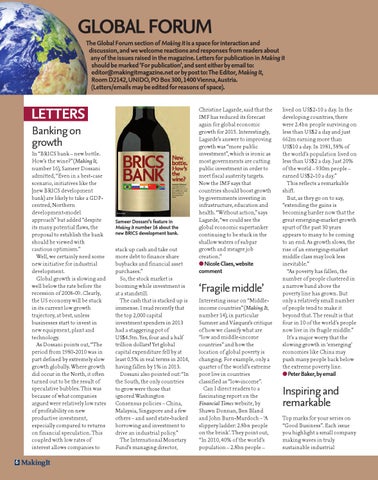
Sameer Dossani’s feature in Making lt number 16 about the new BRICS development bank.
stack up cash and take out more debt to finance share buybacks and financial asset purchases.” So, the stock market is booming while investment is at a standstill. The cash that is stacked up is immense. I read recently that the top 2,000 capital investment spenders in 2013 had a staggering pot of US$4.5tn. Yes, four and a half trillion dollars! Yet global capital expenditure fell by at least 0.5% in real terms in 2014, having fallen by 1% in 2013. Dossani also pointed out: “In the South, the only countries to grow were those that ignored Washington Consensus policies – China, Malaysia, Singapore and a few others – and used state-backed borrowing and investment to drive an industrial policy.” The International Monetary Fund’s managing director,
Christine Lagarde, said that the IMF has reduced its forecast again for global economic growth for 2015. Interestingly, Lagarde’s answer to improving growth was “more public investment”, which is ironic as most governments are cutting public investment in order to meet fiscal austerity targets. Now the IMF says that countries should boost growth by governments investing in infrastructure, education and health. “Without action,” says Lagarde, “we could see the global economic supertanker continuing to be stuck in the shallow waters of subpar growth and meagre job creation.”
● Nicole Claes, website comment
‘Fragile middle’ Interesting issue on “Middleincome countries” (Making It, number 14), in particular Sumner and Vázquez’s critique of how we classify what are “low and middle-income countries” and how the location of global poverty is changing. For example, only a quarter of the world’s extreme poor live in countries classified as “low-income”. Can I direct readers to a fascinating report on the Financial Times website, by Shawn Donnan, Ben Bland and John Burn-Murdoch – ‘A slippery ladder: 2.8bn people on the brink’. They point out, “In 2010, 40% of the world’s population – 2.8bn people –
lived on US$2-10 a day. In the developing countries, there were 2.4bn people surviving on less than US$2 a day and just 662m earning more than US$10 a day. In 1981, 58% of the world’s population lived on less than US$2 a day. Just 20% of the world – 930m people – earned US$2-10 a day.” This reflects a remarkable shift. But, as they go on to say, “extending the gains is becoming harder now that the great emerging-market growth spurt of the past 30 years appears to many to be coming to an end. As growth slows, the rise of an emerging-market middle class may look less inevitable.” “As poverty has fallen, the number of people clustered in a narrow band above the poverty line has grown. But only a relatively small number of people tend to make it beyond that. The result is that four in 10 of the world’s people now live in its fragile middle.” It’s a major worry that the slowing growth in ‘emerging’ economies like China may push many people back below the extreme poverty line.
● Peter Baker, by email
Inspiring and remarkable Top marks for your series on “Good Business”. Each issue you highlight a small company making waves in truly sustainable industrial