Photos: Oribags Innovations
makingit_18_pp40-41_good-business_print 06/05/2015 10:54 Page 41
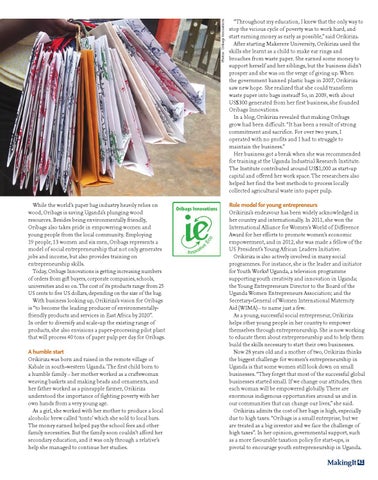
While the world’s paper bag industry heavily relies on wood, Oribags is saving Uganda’s plunging wood resources. Besides being environmentally friendly, Oribags also takes pride in empowering women and young people from the local community. Employing 19 people, 13 women and six men, Oribags represents a model of social entrepreneurship that not only generates jobs and income, but also provides training on entrepreneurship skills. Today, Oribags Innovations is getting increasing numbers of orders from gift buyers, corporate companies, schools, universities and so on. The cost of its products range from 25 US cents to five US dollars, depending on the size of the bag. With business looking up, Orikiriza’s vision for Oribags is “to become the leading producer of environmentallyfriendly products and services in East Africa by 2020”. In order to diversify and scale-up the existing range of products, she also envisions a paper-processing pilot plant that will process 40 tons of paper pulp per day for Oribags.
A humble start Orikiriza was born and raised in the remote village of Kabale in south-western Uganda. The first child born to a humble family – her mother worked as a craftswoman weaving baskets and making beads and ornaments, and her father worked as a pineapple farmer, Orikiriza understood the importance of fighting poverty with her own hands from a very young age. As a girl, she worked with her mother to produce a local alcoholic brew called ‘tonto’ which she sold to local bars. The money earned helped pay the school fees and other family necessities. But the family soon couldn’t afford her secondary education, and it was only through a relative’s help she managed to continue her studies.
“Throughout my education, I knew that the only way to stop the vicious cycle of poverty was to work hard, and start earning money as early as possible,” said Orikiriza. After starting Makerere University, Orikiriza used the skills she learnt as a child to make ear rings and broaches from waste paper. She earned some money to support herself and her siblings, but the business didn’t prosper and she was on the verge of giving up. When the government banned plastic bags in 2007, Orikiriza saw new hope. She realized that she could transform waste paper into bags instead! So, in 2009, with about US$300 generated from her first business, she founded Oribags Innovations. In a blog, Orikiriza revealed that making Oribags grow had been difficult. “It has been a result of strong commitment and sacrifice. For over two years, I operated with no profits and I had to struggle to maintain the business.” Her business got a break when she was recommended for training at the Uganda Industrial Research Institute. The Institute contributed around US$1,000 as start-up capital and offered her work space. The researchers also helped her find the best methods to process locally collected agricultural waste into paper pulp.
Role model for young entrepreneurs Orikiriza’s endeavour has been widely acknowledged in her country and internationally. In 2011, she won the International Alliance for Women’s World of Difference Award for her efforts to promote women’s economic empowerment, and in 2012, she was made a fellow of the US President’s Young African Leaders Initiative. Orikiriza is also actively involved in many social programmes. For instance, she is the leader and initiator for Youth Works! Uganda, a television programme supporting youth creativity and innovation in Uganda; the Young Entrepreneurs Director to the Board of the Uganda Women Entrepreneurs Association; and the Secretary-General of Women International Maternity Aid (WIMA) – to name just a few. As a young, successful social entrepreneur, Orikiriza helps other young people in her country to empower themselves through entrepreneurship. She is now working to educate them about entrepreneurship and to help them build the skills necessary to start their own businesses. Now 28 years old and a mother of two, Orikiriza thinks the biggest challenge for women’s entrepreneurship in Uganda is that some women still look down on small businesses. “They forget that most of the successful global businesses started small. If we change our attitudes, then each woman will be empowered globally. There are enormous indigenous opportunities around us and in our communities that can change our lives,” she said. Orikiriza admits the cost of her bags is high, especially due to high taxes. “Oribags is a small enterprise, but we are treated as a big investor and we face the challenge of high taxes”. In her opinion, governmental support, such as a more favourable taxation policy for start-ups, is pivotal to encourage youth entrepreneurship in Uganda.
MakingIt 41