makingit_18_pp36-39_CF_chile_print 06/05/2015 10:56 Page 39
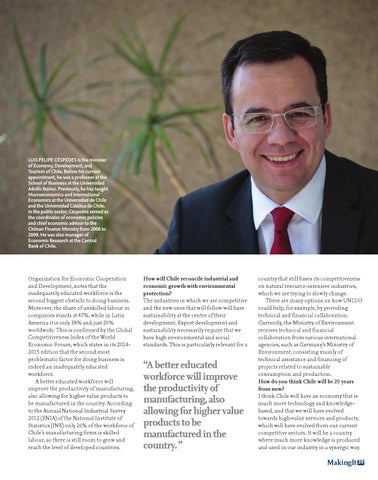
LUIS FELIPE CÉSPEDES is the minister of Economy, Development, and Tourism of Chile. Before his current appointment, he was a professor at the School of Business at the Universidad Adolfo Ibáñez. Previously, he has taught Macroeconomics and International Economics at the Universidad de Chile and the Universidad Católica de Chile. In the public sector, Céspedes served as the coordinator of economic policies and chief economic advisor to the Chilean Finance Ministry from 2006 to 2009. He was also manager of Economic Research at the Central Bank of Chile.
Organization for Economic Cooperation and Development, notes that the inadequately educated workforce is the second biggest obstacle to doing business. Moreover, the share of unskilled labour in companies stands at 47%, while in Latin America it is only 38% and just 29% worldwide. This is confirmed by the Global Competitiveness Index of the World Economic Forum, which states in its 20142015 edition that the second most problematic factor for doing business is indeed an inadequately educated workforce. A better educated workforce will improve the productivity of manufacturing, also allowing for higher value products to be manufactured in the country. According to the Annual National Industrial Survey 2012 (ENIA) of the National Institute of Statistics (INE) only 26% of the workforce of Chile’s manufacturing firms is skilled labour, so there is still room to grow and reach the level of developed countries.
How will Chile reconcile industrial and economic growth with environmental protection? The industries in which we are competitive and the new ones that will follow will have sustainability at the centre of their development. Export development and sustainability necessarily require that we have high environmental and social standards. This is particularly relevant for a
“A better educated workforce will improve the productivity of manufacturing, also allowing for higher value products to be manufactured in the country. ”
country that still bases its competitiveness on natural resource-intensive industries, which we are trying to slowly change. There are many options on how UNIDO could help, for example, by providing technical and financial collaboration. Currently, the Ministry of Environment receives technical and financial collaboration from various international agencies, such as Germany’s Ministry of Environment, consisting mainly of technical assistance and financing of projects related to sustainable consumption and production. How do you think Chile will be 20 years from now? I think Chile will have an economy that is much more technology and knowledgebased, and that we will have evolved towards high-value services and products, which will have evolved from our current competitive sectors. It will be a country where much more knowledge is produced and used in our industry in a synergic way.
MakingIt 39