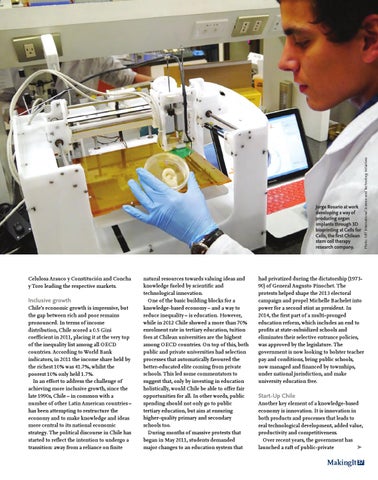
Jorge Rosario at work developing a way of producing organ implants through 3D bioprinting at Cells for Cells, the first Chilean stem cell therapy research company.
Celulosa Arauco y Constitución and Concha y Toro leading the respective markets.
Inclusive growth Chile’s economic growth is impressive, but the gap between rich and poor remains pronounced. In terms of income distribution, Chile scored a 0.5 Gini coefficient in 2011, placing it at the very top of the inequality list among all OECD countries. According to World Bank indicators, in 2011 the income share held by the richest 10% was 41.7%, whilst the poorest 10% only held 1.7%. In an effort to address the challenge of achieving more inclusive growth, since the late 1990s, Chile – in common with a number of other Latin American countries – has been attempting to restructure the economy and to make knowledge and ideas more central to its national economic strategy. The political discourse in Chile has started to reflect the intention to undergo a transition: away from a reliance on finite
natural resources towards valuing ideas and knowledge fueled by scientific and technological innovation. One of the basic building blocks for a knowledge-based economy – and a way to reduce inequality – is education. However, while in 2012 Chile showed a more than 70% enrolment rate in tertiary education, tuition fees at Chilean universities are the highest among OECD countries. On top of this, both public and private universities had selection processes that automatically favoured the better-educated elite coming from private schools. This led some commentators to suggest that, only by investing in education holistically, would Chile be able to offer fair opportunities for all. In other words, public spending should not only go to public tertiary education, but aim at ensuring higher-quality primary and secondary schools too. During months of massive protests that began in May 2011, students demanded major changes to an education system that
Photo: MIT International Science and Technology Initiatives
makingit_18_pp36-39_CF_chile_print 06/05/2015 10:56 Page 37
had privatized during the dictatorship (197390) of General Augusto Pinochet. The protests helped shape the 2013 electoral campaign and propel Michelle Bachelet into power for a second stint as president. In 2014, the first part of a multi-pronged education reform, which includes an end to profits at state-subsidized schools and eliminates their selective entrance policies, was approved by the legislature. The government is now looking to bolster teacher pay and conditions, bring public schools, now managed and financed by townships, under national jurisdiction, and make university education free.
Start-Up Chile Another key element of a knowledge-based economy is innovation. It is innovation in both products and processes that leads to real technological development, added value, productivity and competitiveness. Over recent years, the government has launched a raft of public-private ➤
MakingIt 37