makingit_18_pp36-39_CF_chile_print 06/05/2015 10:56 Page 36
COUNTRY FEATURE
Chile
Towards a knowledge-based economy
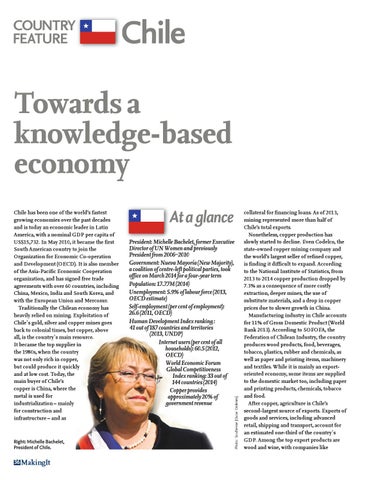
Right: Michelle Bachelet, President of Chile.
36 MakingIt
At a glance President: Michelle Bachelet, former Executive Director of UN Women and previously President from 2006–2010 Government: Nueva Mayoría (New Majority), a coalition of centre-left political parties, took office on March 2014 for a four-year term Population: 17.77M (2014) Unemployment: 5.9% of labour force (2013, OECD estimate) Self-employment (per cent of employment): 26.6 (2011, OECD) Human Development Index ranking : 41 out of 187 countries and territories (2013, UNDP) Internet users (per cent of all households): 60.5 (2012, OECD) World Economic Forum Global Competitiveness Index ranking: 33 out of 144 countries (2014) Copper provides approximately 20% of government revenue
Photo: SoulSense [Oscar Ordenes]
Chile has been one of the world’s fastest growing economies over the past decades and is today an economic leader in Latin America, with a nominal GDP per capita of US$15,732. In May 2010, it became the first South American country to join the Organization for Economic Co-operation and Development (OECD). It is also member of the Asia-Pacific Economic Cooperation organization, and has signed free trade agreements with over 60 countries, including China, Mexico, India and South Korea, and with the European Union and Mercosur. Traditionally the Chilean economy has heavily relied on mining. Exploitation of Chile’s gold, silver and copper mines goes back to colonial times, but copper, above all, is the country’s main resource. It became the top supplier in the 1980s, when the country was not only rich in copper, but could produce it quickly and at low cost. Today, the main buyer of Chile’s copper is China, where the metal is used for industrialization – mainly for construction and infrastructure – and as
collateral for financing loans. As of 2013, mining represented more than half of Chile’s total exports. Nonetheless, copper production has slowly started to decline. Even Codelco, the state-owned copper mining company and the world’s largest seller of refined copper, is finding it difficult to expand. According to the National Institute of Statistics, from 2013 to 2014 copper production dropped by 7.3% as a consequence of more costly extraction, deeper mines, the use of substitute materials, and a drop in copper prices due to slower growth in China. Manufacturing industry in Chile accounts for 11% of Gross Domestic Product (World Bank 2013). According to SOFOFA, the Federation of Chilean Industry, the country produces wood products, food, beverages, tobacco, plastics, rubber and chemicals, as well as paper and printing items, machinery and textiles. While it is mainly an exportoriented economy, some items are supplied to the domestic market too, including paper and printing products, chemicals, tobacco and food. After copper, agriculture is Chile’s second-largest source of exports. Exports of goods and services, including advanced retail, shipping and transport, account for an estimated one-third of the country’s GDP. Among the top export products are wood and wine, with companies like