makingit_18_pp34-35_casado_3-column 06/05/2015 10:41 Page 35
FERNANDO CASADO CAÑEQUE is the director and founder of GlobalCAD – www.globalcad.org – a strategic development consulting firm that focuses on promoting cross-sector partnerships to achieve the SDGs. Currently, he also co-directs the Towards the Human City Project, for which he is travelling around the world to document the 101 most innovative initiatives promoting a transition towards the concept of ‘Human Cities’.
The coming two years will be crucial to answer these questions and address the major challenges that urbanization will generate. On the one hand, the transition from the Millennium Development Goals (MDGs) to the Sustainable Development Goals (SDGs) provides a unique opportunity to place cities explicitly in the conceptual framework of development plans for the first time. The possibility of having SDG Goal 11 – ‘Make cities and human settlements inclusive, safe, resilient and sustainable’ – is the first attempt to build a framework of targets and indicators for sustainable cities and human settlements. These bring the possibility of enhanced and effective local, national and regional implementation from a quantitative perspective. On the other hand, we have Habitat III, the United Nations Conference on Housing and Sustainable Urban Development, taking place in Quito, Ecuador, in October 2016. Its purpose is to reinvigorate the global commitment to sustainable urbanization, focusing on the implementation of a “New Urban Agenda” that will renovate the Habitat Agenda designed in Istanbul in 1996. This will be the first United Nations global summit held after the adoption of the Post-2015 Sustainable Development Agenda and,
hopefully, a new climate change agreement. Such an event offers another unique opportunity to discuss the challenges of planning and managing cities, towns and villages. Getting the new urban agenda right and ensuring there is an SDG 11 on urban and human settlements can provide the incentives needed to encourage the role of cities as drivers of inclusive economic growth and sustainable development. However, we must ensure there are good governance systems in place, as well as robust public finance systems and effective institutions at the local level to make this happen.
Innovation as a driver of local productive capacities Cities, located on the frontline of the battle for sustainable development, are not only the first entities facing direct challenges, but are also the best-placed to identify opportunities and deliver solutions. One of the issues most cities will have to address is how to become competitive and ensure employment for young people so they won’t have to migrate to other cities to find opportunities. Given population trends, we could say that cities that are able to attract young people and offer them the possibility to develop have a brighter future.
Large corporations seem, to a large extent, to have lost their ability to innovate. Most of them are framing their strategies by buying start-ups for new technology and products. As a result, ensuring bottom-up innovation and decentralized local productive capacity is more relevant than ever. Cities have also become innovation hubs for public policy, becoming responsible for providing enabling environments for innovation and entrepreneurship. Attracting innovative industries, especially small industries and start-ups, requires supportive infrastructure, which the market does not necessarily always offer. An important challenge, therefore, is to combine creative policy design with urban planning, in order to attract companies that generate new businesses for youth. Incentives should focus on getting the private sector to hire youth, on engaging with civil society organizations on strategies that address urban youth unemployment, and on enabling linkages between civil society and the private sector in commercial ventures. Most importantly, cities will need to encourage youth entrepreneurship, and this implies building marketable skills derived from the natural creativity and innovation of young people.
Photo: Wee Sen Goh - http://creativecommons.org/licenses/by-nc/4.0/
A new agenda in the making
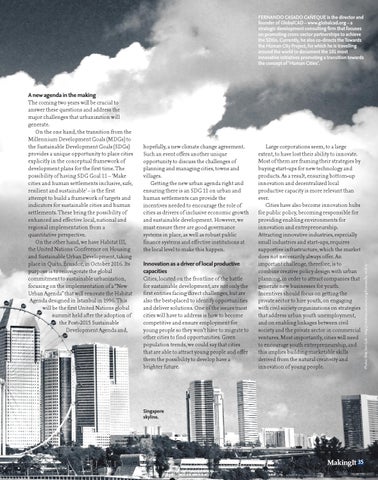
Singapore skyline.
➤ ➤
MakingIt 35