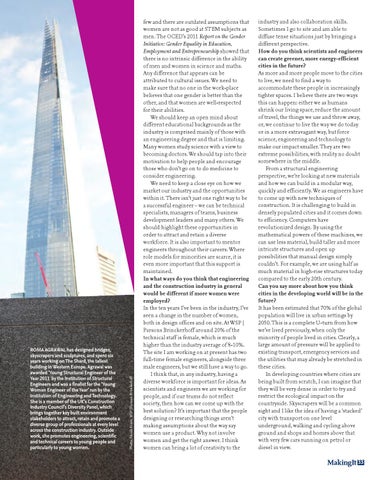
ROMA AGRAWAL has designed bridges, skyscrapers and sculptures, and spent six years working on The Shard, the tallest building in Western Europe. Agrawal was awarded ‘Young Structural Engineer of the Year 2011′ by the Institution of Structural Engineers and was a finalist for the ‘Young Woman Engineer of the Year’ run by the Institution of Engineering and Technology. She is a member of the UK’s Construction Industry Council’s Diversity Panel, which brings together key built environment stakeholders to attract, retain and promote a diverse group of professionals at every level across the construction industry. Outside work, she promotes engineering, scientific and technical careers to young people and particularly to young women.
Photo: Nicola Evans, WSP | Parsons Brinckerhoff
makingit_18_pp32-33_agrawal_version2 06/05/2015 10:28 Page 33
few and there are outdated assumptions that women are not as good at STEM subjects as men. The OCED’s 2011 Report on the Gender Initiative: Gender Equality in Education, Employment and Entrepreneurship showed that there is no intrinsic difference in the ability of men and women in science and maths. Any difference that appears can be attributed to cultural issues. We need to make sure that no one in the work-place believes that one gender is better than the other, and that women are well-respected for their abilities. We should keep an open mind about different educational backgrounds as the industry is comprised mainly of those with an engineering degree and that is limiting. Many women study science with a view to becoming doctors. We should tap into their motivation to help people and encourage those who don’t go on to do medicine to consider engineering. We need to keep a close eye on how we market our industry and the opportunities within it. There isn’t just one right way to be a successful engineer – we can be technical specialists, managers of teams, business development leaders and many others. We should highlight these opportunities in order to attract and retain a diverse workforce. It is also important to mentor engineers throughout their careers. Where role models for minorities are scarce, it is even more important that this support is maintained. In what ways do you think that engineering and the construction industry in general would be different if more women were employed? In the ten years I’ve been in the industry, I’ve seen a change in the number of women, both in design offices and on site. At WSP | Parsons Brinckerhoff around 20% of the technical staff is female, which is much higher than the industry average of 8-10%. The site I am working on at present has two full-time female engineers, alongside three male engineers, but we still have a way to go. I think that, in any industry, having a diverse workforce is important for ideas. As scientists and engineers we are working for people, and if our teams do not reflect society, then how can we come up with the best solution? It’s important that the people designing or researching things aren’t making assumptions about the way say women use a product. Why not involve women and get the right answer. I think women can bring a lot of creativity to the
industry and also collaboration skills. Sometimes I go to site and am able to diffuse tense situations just by bringing a different perspective. How do you think scientists and engineers can create greener, more energy-efficient cities in the future? As more and more people move to the cities to live, we need to find a way to accommodate these people in increasingly tighter spaces. I believe there are two ways this can happen: either we as humans shrink our living space, reduce the amount of travel, the things we use and throw away, or, we continue to live the way we do today or in a more extravagant way, but force science, engineering and technology to make our impact smaller. They are two extreme possibilities, with reality no doubt somewhere in the middle. From a structural engineering perspective, we’re looking at new materials and how we can build in a modular way, quickly and efficiently. We as engineers have to come up with new techniques of construction. It is challenging to build in densely populated cities and it comes down to efficiency. Computers have revolutionized design. By using the mathematical powers of these machines, we can use less material, build taller and more intricate structures and open up possibilities that manual design simply couldn’t. For example, we are using half as much material in high-rise structures today compared to the early 20th century. Can you say more about how you think cities in the developing world will be in the future? It has been estimated that 70% of the global population will live in urban settings by 2050. This is a complete U-turn from how we’ve lived previously, when only the minority of people lived in cities. Clearly, a large amount of pressure will be applied to existing transport, emergency services and the utilities that may already be stretched in these cities. In developing countries where cities are being built from scratch, I can imagine that they will be very dense in order to try and restrict the ecological impact on the countryside. Skyscrapers will be a common sight and I like the idea of having a ‘stacked’ city with transport on one level underground, walking and cycling above ground and shops and homes above that with very few cars running on petrol or diesel in view.
MakingIt 33