makingit_18_pp32-33_agrawal_version2 06/05/2015 10:28 Page 32
Why we need more women engineers Why do you think that it is important that more girls have the option to follow careers in science and engineering? I studied physics at university, went on to become a structural engineer and worked on the design of The Shard in London. Being a scientist or an engineer means that you are working on real-life problems and helping people and, besides, you can have any career with a science degree. As the world becomes more technologically driven, science qualifications will become more and more essential to our way of life. We have to show young people, especially girls, that far from closing down options, studying maths and science actually expands them. Apart from having a very rewarding career, you will be rewarded financially. Maths students can earn high salaries and in the UK, for example, careers in science and technology pay up to 20% more than average. We talk about the gender pay gap and are very aware that women earn less than men in full-time employment. One way we can try and improve this is by making sure girls aren’t ruling themselves out of wellpaid careers in science and engineering. Then there’s the skills shortage. In the West, we simply don’t have enough engineers to meet the demands of employers. Careers in science, technology, engineering and mathematics (STEM) allow you to travel, to live in different countries and hopefully keep you employed for life, and we don’t want girls to miss out on all this. What can be done to encourage and support women in male-dominated industries such as science and engineering? I believe there are a number of obstacles which people – especially women – face when it comes to careers in engineering. There are perception issues – science and maths are seen as being only for a ‘brainy’
32 MakingIt
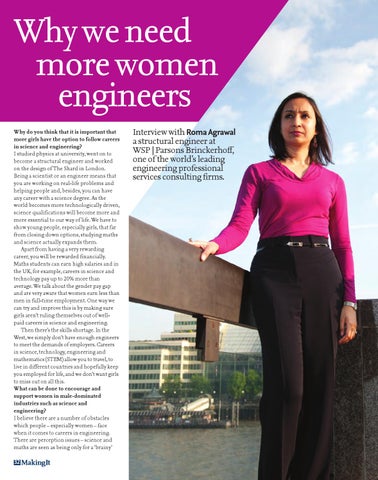
Interview with Roma Agrawal a structural engineer at WSP | Parsons Brinckerhoff, one of the world’s leading engineering professional services consulting firms.