makingit_18_pp30-31_asia_3-column 11/05/2015 12:39 Page 30
Already in 2010, the Asia-Pacific region’s urban inhabitants amounted to more than 750 million people, about 40% of the region’s population. Today, seven of the world’s ten most populous cities are located in the Asia-Pacific region: Beijing, Delhi, Dhaka, Kolkata, Mumbai, Shanghai and Tokyo. These mega-cities are generators of wealth and hubs for innovation and cultural activities. On the downside, these cities continue to harbour poverty and environmental disasters. Nevertheless, urbanization enhances productivity, increases gross domestic product per head and has turned into a major source of economic strength, illustrated by the fact that Asian cities contribute about 80% of the region’s gross domestic product. Small and medium-sized enterprises (SMEs) account for about 99% of all businesses in Asia and these companies are often concentrated in and around cities.
Lacking awareness, finance and often operating with out-dated equipment, they are responsible for a significant share of urban pollution, which poses hazards to the health of citizens. This current concentration of economic activities in Asian cities can only be sustained if industry stakeholders implement essential cleaner production principles. The SWITCH-Asia programme, the European Union’s largest cooperation programme with Asia promoting sustainable consumption and production, supports more than 80 projects to develop innovations that help SMEs reduce their waste, improve their energy intensity or become more resource efficient. One example is the circular economy approach developed by an industrial symbiosis project implemented in the industrial development zone of Binhai New Area in Tianjin, China.
Sustainable consumption and lifestyle initiatives in Asian cities
Patrick Schroeder and Uwe Weber share some experiences from the European Commission’sSWITCHAsia programme. 30 MakingIt
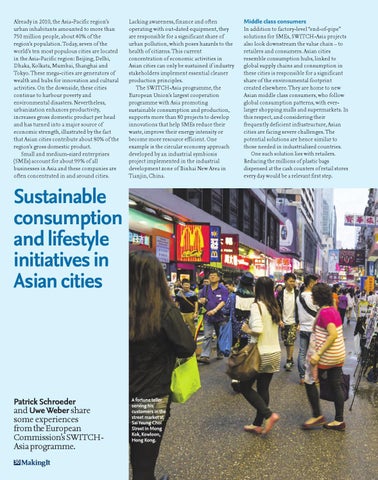
A fortune teller serving his customers in the street market at Sai Yeung Choi Street in Mong Kok, Kowloon, Hong Kong.
Middle class consumers In addition to factory-level “end-of-pipe” solutions for SMEs, SWITCH-Asia projects also look downstream the value chain – to retailers and consumers. Asian cities resemble consumption hubs, linked to global supply chains and consumption in these cities is responsible for a significant share of the environmental footprint created elsewhere. They are home to new Asian middle class consumers, who follow global consumption patterns, with everlarger shopping malls and supermarkets. In this respect, and considering their frequently deficient infrastructure, Asian cities are facing severe challenges. The potential solutions are hence similar to those needed in industrialized countries. One such solution lies with retailers. Reducing the millions of plastic bags dispensed at the cash counters of retail stores every day would be a relevant first step.