Illustration: Chappatte
makingit_18_pp22-29_keynote_version2 11/05/2015 16:25 Page 26
➤
➤ to be prepared for, and one of them is the ability to manage diverse and multi-ethnic societies. Today, cities like Dubai, Singapore and Toronto are really as much foreign as they are national. They are melting pots because they give new meaning to the term “cultural capital”. Their leaders don’t have the luxury of treating immigration as a temporary condition. It’s a permanent reality. Their mayors cannot offer citizenship to foreigners but they have to find a way to make everyone feel like a stakeholder and be a stakeholder in that society. Around the world, we see some countries are
26 MakingIt
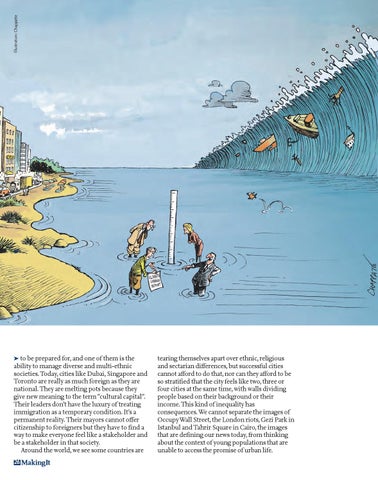
tearing themselves apart over ethnic, religious and sectarian differences, but successful cities cannot afford to do that, nor can they afford to be so stratified that the city feels like two, three or four cities at the same time, with walls dividing people based on their background or their income. This kind of inequality has consequences. We cannot separate the images of Occupy Wall Street, the London riots, Gezi Park in Istanbul and Tahrir Square in Cairo, the images that are defining our news today, from thinking about the context of young populations that are unable to access the promise of urban life.