makingit_18_pp20-21_ecocities_3-column 06/05/2015 10:27 Page 21
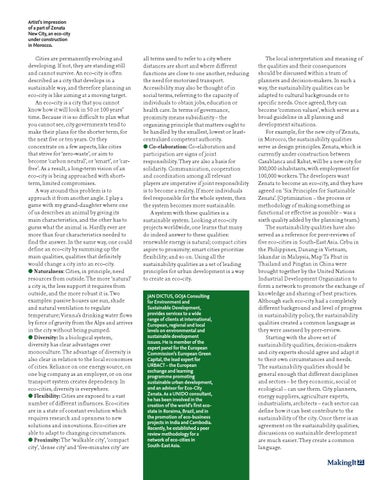
Artist’s impression of a part of Zenata New City, an eco-city under construction in Morocco.
Cities are permanently evolving and developing. If not, they are standing still and cannot survive. An eco-city is often described as a city that develops in a sustainable way, and therefore planning an eco-city is like aiming at a moving target. An eco-city is a city that you cannot know how it will look in 50 or 100 years’ time. Because it is so difficult to plan what you cannot see, city governments tend to make their plans for the shorter term, for the next five or ten years. Or they concentrate on a few aspects, like cities that strive for ‘zero-waste’, or aim to become ‘carbon neutral’, or ‘smart’, or ‘carfree’. As a result, a long-term vision of an eco-city is being approached with shortterm, limited compromises. A way around this problem is to approach it from another angle. I play a game with my grand-daughter where one of us describes an animal by giving its main characteristics, and the other has to guess what the animal is. Hardly ever are more than four characteristics needed to find the answer. In the same way, one could define an eco-city by summing up the main qualities, qualities that definitely would change a city into an eco-city. ● Naturalness: Cities, in principle, need resources from outside. The more ‘natural’ a city is, the less support it requires from outside, and the more robust it is. Two examples: passive houses use sun, shade and natural ventilation to regulate temperature; Vienna’s drinking water flows by force of gravity from the Alps and arrives in the city without being pumped. ● Diversity: In a biological system, diversity has clear advantages over monoculture. The advantage of diversity is also clear in relation to the local economies of cities. Reliance on one energy source, on one big company as an employer, or on one transport system creates dependency. In eco-cities, diversity is everywhere. ● Flexibility: Cities are exposed to a vast number of different influences. Eco-cities are in a state of constant evolution which requires research and openness to new solutions and innovations. Eco-cities are able to adapt to changing circumstances. ● Proximity: The ‘walkable city’, ‘compact city’, ‘dense city’ and ‘five-minutes city’ are
all terms used to refer to a city where distances are short and where different functions are close to one another, reducing the need for motorized transport. Accessibility may also be thought of in social terms, referring to the capacity of individuals to obtain jobs, education or health care. In terms of governance, proximity means subsidiarity – the organizing principle that matters ought to be handled by the smallest, lowest or leastcentralized competent authority. ● Co-elaboration: Co-elaboration and participation are signs of joint responsibility. They are also a basis for solidarity. Communication, cooperation and coordination among all relevant players are imperative if joint responsibility is to become a reality. If more individuals feel responsible for the whole system, then the system becomes more sustainable. A system with these qualities is a sustainable system. Looking at eco-city projects worldwide, one learns that many do indeed answer to these qualities: renewable energy is natural; compact cities aspire to proximity; smart cities prioritize flexibility; and so on. Using all the sustainability qualities as a set of leading principles for urban development is a way to create an eco-city. JAN DICTUS, GOJA Consulting for Environment and Sustainable Development, provides services to a wide range of clients at international, European, regional and local levels on environmental and sustainable development issues. He is member of the expert panel for the European Commission’s European Green Capital, the lead expert for URBACT – the European exchange and learning programme promoting sustainable urban development, and an advisor for Eco-City Zenata. As a UNIDO consultant, he has been involved in the creation of the world’s first ecostate in Roraima, Brazil, and in the promotion of eco-business projects in India and Cambodia. Recently, he established a peer review methodology for a network of eco-cities in South-East Asia.
The local interpretation and meaning of the qualities and their consequences should be discussed within a team of planners and decision-makers. In such a way, the sustainability qualities can be adapted to cultural backgrounds or to specific needs. Once agreed, they can become ‘common values’, which serve as a broad guideline in all planning and development situations. For example, for the new city of Zenata, in Morocco, the sustainability qualities serve as design principles. Zenata, which is currently under construction between Casablanca and Rabat, will be a new city for 300,000 inhabitants, with employment for 100,000 workers. The developers want Zenata to become an eco-city, and they have agreed on ‘Six Principles for Sustainable Zenata’. (Optimization – the process or methodology of making something as functional or effective as possible – was a sixth quality added by the planning team.) The sustainability qualities have also served as a reference for peer-reviews of five eco-cities in South-East Asia. Cebu in the Philippines, Danang in Vietnam, Iskandar in Malaysia, Map Ta Phut in Thailand and Pingtan in China were brought together by the United Nations Industrial Development Organization to form a network to promote the exchange of knowledge and sharing of best practices. Although each eco-city had a completely different background and level of progress in sustainability policy, the sustainability qualities created a common language as they were assessed by peer-review. Starting with the above set of sustainability qualities, decision-makers and city experts should agree and adapt it to their own circumstances and needs. The sustainability qualities should be general enough that different disciplines and sectors – be they economic, social or ecological – can use them. City planners, energy suppliers, agriculture experts, industrialists, architects – each sector can define how it can best contribute to the sustainability of the city. Once there is an agreement on the sustainability qualities, discussions on sustainable development are much easier. They create a common language.
MakingIt 21
➤ ➤