makingit_18_pp16-19_can-cities-feed_version2 06/05/2015 10:26 Page 19
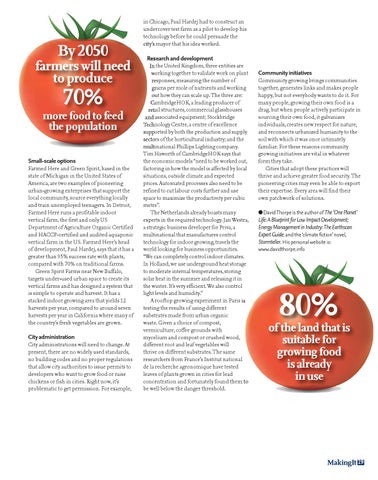
By 2050
farmers will need to produce
70%
more food to feed the population Small-scale options Farmed Here and Green Spirit, based in the state of Michigan in the United States of America, are two examples of pioneering urban-growing enterprises that support the local community, source everything locally and train unemployed teenagers. In Detroit, Farmed Here runs a profitable indoor vertical farm, the first and only US Department of Agriculture Organic Certified and HACCP-certified and audited aquaponic vertical farm in the US. Farmed Here’s head of development, Paul Hardej, says that it has a greater than 95% success rate with plants, compared with 70% on traditional farms. Green Spirit Farms near New Buffalo, targets under-used urban space to create its vertical farms and has designed a system that is simple to operate and harvest. It has a stacked indoor growing area that yields 12 harvests per year, compared to around seven harvests per year in California where many of the country’s fresh vegetables are grown.
City administration City administrations will need to change. At present, there are no widely used standards, no building codes and no proper regulations that allow city authorities to issue permits to developers who want to grow food or raise chickens or fish in cities. Right now, it’s problematic to get permission. For example,
in Chicago, Paul Hardej had to construct an undercover test farm as a pilot to develop his technology before he could persuade the city’s mayor that his idea worked.
Research and development In the United Kingdom, three entities are working together to validate work on plant responses, measuring the number of grams per mole of nutrients and working out how they can scale up. The three are: CambridgeHOK, a leading producer of retail structures, commercial glasshouses and associated equipment; Stockbridge Technology Centre, a centre of excellence supported by both the production and supply sectors of the horticultural industry; and the multinational Phillips Lighting company. Tim Haworth of CambridgeHOK says that the economic models “need to be worked out, factoring in how the model is affected by local situations, outside climate and expected prices. Automated processes also need to be refined to cut labour costs further and use space to maximize the productivity per cubic metre”. The Netherlands already boasts many experts in the required technology. Jan Westra, a strategic business developer for Priva, a multinational that manufactures control technology for indoor growing, travels the world looking for business opportunities. “We can completely control indoor climates. In Holland, we use underground heat storage to moderate internal temperatures, storing solar heat in the summer and releasing it in the winter. It’s very efficient. We also control light levels and humidity.” A rooftop growing experiment in Paris is testing the results of using different substrates made from urban organic waste. Given a choice of compost, vermiculture, coffee grounds with mycelium and compost or crushed wood, different root and leaf vegetables will thrive on different substrates. The same researchers from France’s Institut national de la recherche agronomique have tested leaves of plants grown in cities for lead concentration and fortunately found them to be well below the danger threshold.
Community initiatives Community growing brings communities together, generates links and makes people happy, but not everybody wants to do it. For many people, growing their own food is a drag, but when people actively participate in sourcing their own food, it galvanizes individuals, creates new respect for nature, and reconnects urbanized humanity to the soil with which it was once intimately familiar. For these reasons community growing initiatives are vital in whatever form they take. Cities that adopt these practices will thrive and achieve greater food security. The pioneering cities may even be able to export their expertise. Every area will find their own patchwork of solutions. ●David Thorpe is the author of The ‘One Planet’ Life: A Blueprint for Low Impact Development; Energy Management in Industry: The Earthscan Expert Guide; and the ‘climate fiction’ novel, Stormteller. His personal website is: www.davidthorpe.info
80%
of the land that is suitable for growing food is already in use
MakingIt 19