makingit_18_pp16-19_can-cities-feed_version2 06/05/2015 10:26 Page 18
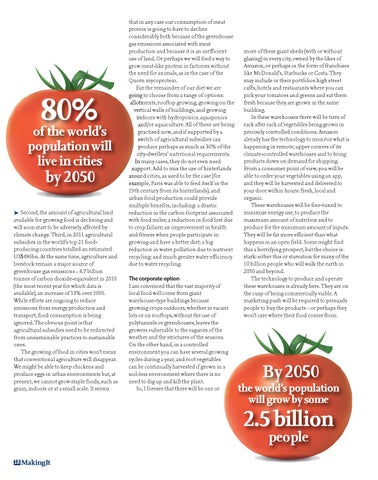
80% of the world’s
population will live in cities
by 2050
➤ Second, the amount of agricultural land available for growing food is declining and will soon start to be adversely affected by climate change. Third, in 2011 agricultural subsidies in the world’s top 21 foodproducing countries totalled an estimated US$486bn. At the same time, agriculture and livestock remain a major source of greenhouse gas emissions – 4.7 billion tonnes of carbon dioxide-equivalent in 2010 (the most recent year for which data is available), an increase of 13% over 1990. While efforts are ongoing to reduce emissions from energy production and transport, food consumption is being ignored. The obvious point is that agricultural subsidies need to be redirected from unsustainable practices to sustainable ones. The growing of food in cities won’t mean that conventional agriculture will disappear. We might be able to keep chickens and produce eggs in urban environments but, at present, we cannot grow staple foods, such as grain, indoors or at a small scale. It seems
that in any case our consumption of meat protein is going to have to decline considerably both because of the greenhouse gas emissions associated with meat production and because it is an inefficient use of land. Or perhaps we will find a way to grow meat-like protein in factories without the need for animals, as in the case of the Quorn mycoprotein. For the remainder of our diet we are going to choose from a range of options: allotments, rooftop growing, growing on the vertical walls of buildings, and growing indoors with hydroponics, aquaponics and/or aquaculture. All of these are being practised now, and if supported by a switch of agricultural subsidies can produce perhaps as much as 30% of the city-dwellers’ nutritional requirements. In many cases, they do not even need support. Add to mix the use of hinterlands around cities, as used to be the case (for example, Paris was able to feed itself in the 19th century from its hinterlands), and urban food production could provide multiple benefits, including: a drastic reduction in the carbon footprint associated with food miles; a reduction in food lost due to crop failure; an improvement in health and fitness when people participate in growing and have a better diet; a big reduction in water pollution due to nutrient recycling; and much greater water efficiency due to water recycling.
The corporate option I am convinced that the vast majority of local food will come from giant warehouse-type buildings because growing crops outdoors, whether in vacant lots or on rooftops, without the use of polytunnels or greenhouses, leaves the growers vulnerable to the vagaries of the weather and the strictures of the seasons. On the other hand, in a controlled environment you can have several growing cycles during a year, and root vegetables can be continually harvested if grown in a soil-less environment where there is no need to dig up and kill the plant. So, I foresee that there will be one or
more of these giant sheds (with or without glazing) in every city, owned by the likes of Amazon, or perhaps in the form of franchises like McDonald’s, Starbucks or Costa. They may include in their portfolios high street cafés, hotels and restaurants where you can pick your tomatoes and greens and eat them fresh because they are grown in the same building. In these warehouses there will be tiers of rack after rack of vegetables being grown in precisely controlled conditions. Amazon already has the technology to monitor what is happening in remote, upper corners of its climate-controlled warehouses and to bring products down on demand for shipping. From a consumer point of view, you will be able to order your vegetables using an app, and they will be harvested and delivered to your door within hours: fresh, local and organic. These warehouses will be fine-tuned to minimize energy use, to produce the maximum amount of nutrition and to produce for the minimum amount of inputs. They will be far more efficient than what happens in an open field. Some might find this a horrifying prospect, but the choice is stark: either this or starvation for many of the 10 billion people who will walk the earth in 2050 and beyond. The technology to produce and operate these warehouses is already here. They are on the cusp of being commercially viable. A marketing push will be required to persuade people to buy the products – or perhaps they won’t care where their food comes from.
By 2050
the world’s population will grow by some
2.5 billion people
18 MakingIt