makingit_18_pp14-15_business-matters_print 06/05/2015 10:18 Page 15
decide who is succeeding based on nothing but GDP figures.” The government started researching the feasibility of implementing ‘green GDP’ measures 11 years ago. But the idea withered on the vine as the central government devolved more decisions on environmental planning to the provinces, which, in a rush to meet ambitious targets, gave to the nod to hugely-polluting projects. Now, heavilyindustrialized provinces are coming under increasing pressure to shutter power plants, cement factories and steel works, particularly if these are inefficient
or generate surplus capacity. The closure of highly energyintensive installations could mean big job losses and slash economic growth in many provinces – at least in the short term – which partly explains why the government has been reluctant to implement ‘green GDP’ so far. However, some studies make the case that the shutdown of polluting, wasteful industries will give greater encouragement to low carbon and green technologies, which in time would create many more jobs than those lost in mines, power plants and steel works. (ChinaDialogue)
■ There is a widespread, contagious conversation taking place today about Additive Manufacturing (AM), also known as industrial 3D printing. For a manufacturing process to generate this much excitement is pretty rare in contemporary times. The enthusiasm is spreading so broadly because “additive” technologies that “grow” parts and products, rather than “subtract” material (via machining), are being embraced by young entrepreneurs and industry giants alike. From the wings of a Victoria’s Secret Angel to patient-specific
cranial-plate implants for skull injuries to high-tech nozzles for aircraft jet turbines, the reach and attraction of AM is indisputable. Those who apply themselves can learn to make something unique, be they engineers or artists. And they can do it very quickly and relatively inexpensively at a local service bureau – if not from their home, lab or office. This is why additive manufacturing, industrial 3D printing and all the variations of growing parts by laser, electronic beam and other means, will dramatically change business! (Forbes)
Industry’s role in forging green cities
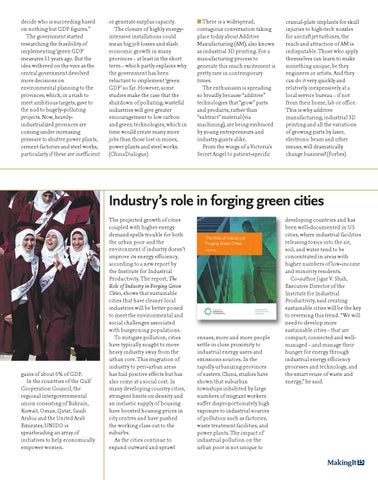
gains of about 6% of GDP. In the countries of the Gulf Cooperation Council, the regional intergovernmental union consisting of Bahrain, Kuwait, Oman, Qatar, Saudi Arabia and the United Arab Emirates, UNIDO is spearheading an array of initiatives to help economically empower women.
The projected growth of cities coupled with higher energy demand spells trouble for both the urban poor and the environment if industry doesn’t improve its energy efficiency, according to a new report by the Institute for Industrial Productivity. The report, The Role of Industry in Forging Green Cities, shows that sustainable cities that have cleaner local industries will be better poised to meet the environmental and social challenges associated with burgeoning populations. To mitigate pollution, cities have typically sought to move heavy industry away from the urban core. This migration of industry to peri-urban areas has had positive effects but has also come at a social cost. In many developing country cities, stringent limits on density and an inelastic supply of housing have boosted housing prices in city centres and have pushed the working class out to the suburbs. As the cities continue to expand outward and sprawl
ensues, more and more people settle in close proximity to industrial energy users and emissions sources. In the rapidly urbanizing provinces of eastern China, studies have shown that suburban townships inhabited by large numbers of migrant workers suffer disproportionately high exposure to industrial sources of pollution such as factories, waste treatment facilities, and power plants. The impact of industrial pollution on the urban poor is not unique to
developing countries and has been well-documented in US cities, where industrial facilities releasing toxics into the air, soil, and water tend to be concentrated in areas with higher numbers of low-income and minority residents. Co-author Jigar V. Shah, Executive Director of the Institute for Industrial Productivity, said creating sustainable cities will be the key to reversing this trend. “We will need to develop more sustainable cities – that are compact, connected and wellmanaged – and manage their hunger for energy through industrial energy efficiency processes and technology, and the smart reuse of waste and energy,” he said.
MakingIt 15