makingit_18_pp14-15_business-matters_print 06/05/2015 10:18 Page 14
■ China’s environment ministry is to consider whether the performance of provincial officials should take account of ‘green GDP’ – which measures the environmental damage caused by economic growth. The country’s environmental crisis has been blamed in part on performance targets that have measured success in terms of the pace of economic growth, meaning that officials have raced to build new roads, factories, power plants and housing, without considering the environmental consequences. President Xi Jinping has told officials: “We can no longer
trends primarily in emerging markets – are increasing the demand for finished goods. These trends have been building over the past several years, and they will continue to gain momentum. As a result, industrial manufacturers will need to do more with less. Compounding this problem is the fact that the easy gains have already been captured. Most organizations have already taken
the obvious steps – for example, upgrading their lighting and automating their heating, ventilation, and air-conditioning controls. Yet they are now bumping up against the limits of what they can accomplish using a traditional approach. Why? The fundamental premise of that approach – in which resource productivity is subordinate to other operational priorities – is no longer valid. (McKinsey)
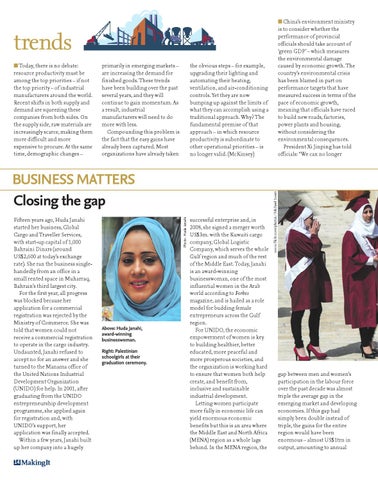
Fifteen years ago, Huda Janahi started her business, Global Cargo and Traveller Services, with start-up capital of 1,000 Bahraini Dinars (around US$2,600 at today’s exchange rate). She ran the business singlehandedly from an office in a small rented space in Muharraq, Bahrain’s third largest city. For the first year, all progress was blocked because her application for a commercial registration was rejected by the Ministry of Commerce. She was told that women could not receive a commercial registration to operate in the cargo industry. Undaunted, Janahi refused to accept no for an answer and she turned to the Manama office of the United Nations Industrial Development Organization (UNIDO) for help. In 2001, after graduating from the UNIDO entrepreneurship development programme, she applied again for registration and, with UNIDO’s support, her application was finally accepted. Within a few years, Janahi built up her company into a hugely
14 MakingIt
Photo: Huda Janahi
BUSINESS MATTERS Closing the gap
Above: Huda Janahi, award-winning businesswoman. Right: Palestinian schoolgirls at their graduation ceremony.
successful enterprise and, in 2008, she signed a merger worth US$3m. with the Kuwaiti cargo company, Global Logistic Company, which serves the whole Gulf region and much of the rest of the Middle East. Today, Janahi is an award-winning businesswoman, one of the most influential women in the Arab world according to Forbes magazine, and is hailed as a role model for budding female entrepreneurs across the Gulf region. For UNIDO, the economic empowerment of women is key to building healthier, better educated, more peaceful and more prosperous societies, and the organization is working hard to ensure that women both help create, and benefit from, inclusive and sustainable industrial development. Letting women participate more fully in economic life can yield enormous economic benefits but this is an area where the Middle East and North Africa (MENA) region as a whole lags behind. In the MENA region, the
www.flickr.com/photos / Michael Swan
■ Today, there is no debate: resource productivity must be among the top priorities – if not the top priority – of industrial manufacturers around the world. Recent shifts in both supply and demand are squeezing these companies from both sides. On the supply side, raw materials are increasingly scarce, making them more difficult and more expensive to procure. At the same time, demographic changes –
gap between men and women’s participation in the labour force over the past decade was almost triple the average gap in the emerging market and developing economies. If this gap had simply been double instead of triple, the gains for the entire region would have been enormous – almost US$1trn in output, amounting to annual