makingit_16_pp6-13_globalforum_print 22/07/2014 10:58 Page 6
GLOBAL FORUM
The Global Forum section of Making It is a space for interaction and discussion, and we welcome reactions and responses from readers about any of the issues raised in the magazine. Letters for publication in Making It should be marked ‘For publication’, and sent either by email to: editor@makingitmagazine.net or by post to: The Editor, Making It, Room D2142, UNIDO, PO Box 300, 1400 Wien, Austria. (Letters/emails may be edited for reasons of space).
LETTERS First, protect the environment In general, what I appreciate most about Making It is the diversity of extraordinary international stories on industry and economy. My favourite is the story about water-efficient toilets in issue #15, I suppose because I can’t find an analysis like this anywhere else. For Europeans, most surprising seems company managing director Chen Chunhong's attitude towards patent protection. She says “…if more companies would employ this water-saving technology, it would actually bring more benefits to the global environment as a whole. In this sense, copying our idea is a good thing.” Forget patent protection in favour of environmental protection! Marvellous! This is how we could make the world a better place. If only the rest of the world could share this attitude despite losing an enormous amount of money.
I
● Susanne Berger-Achatz, News Editor, Hitradio Ö3, Vienna, Austria
Technology and industrial development The interview with LI Yong in issue #15 introduces an excellent mission which is well
6
MakingIt
outlined by the UNIDO Director General. Technologies with technical experts can jumpstart the industrialization of underdeveloped and developing countries, with consequential benefits of economic growth, which helps to reduce poverty (a crucial mission of UNIDO) through job creation. And social uplift can be a by-product thereof. Technology can be a critical tool to sustain industrialization without adversely impacting the environment. For example, energy is a key input to industrialization, and various environmentally friendly alternative fuels to coal are progressively embraced, or at least being tested, across the globe. Alignment and willingness to share knowledge with less progressive societies can help us evolve to a better global society across cultures and political boundaries. While not wanting to minimize the segmented challenges, setting strategic development goals and developing tactical
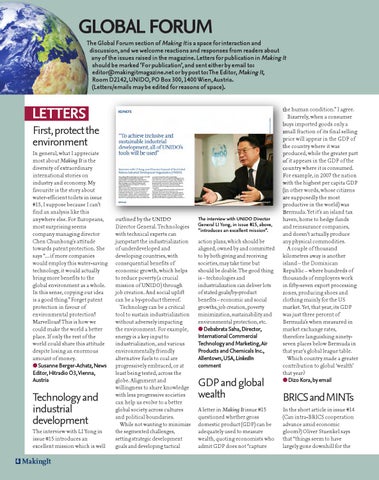
The interview with UNIDO Director General LI Yong, in issue #15, above, “introduces an excellent mission”.
action plans, which should be aligned, owned by and committed to by both giving and receiving societies, may take time but should be doable. The good thing is – technologies and industrialization can deliver lots of stated goals/by-product benefits – economic and social growths, job creation, poverty minimization, sustainability and environmental protection, etc.
● Debabrata Saha, Director, International Commercial Technology and Marketing, Air Products and Chemicals Inc., Allentown, USA, LinkedIn comment
GDP and global wealth A letter in Making It issue #15 questioned whether gross domestic product (GDP) can be adequately used to measure wealth, quoting economists who admit GDP does not “capture
the human condition.” I agree. Bizarrely, when a consumer buys imported goods only a small fraction of its final selling price will appear in the GDP of the country where it was produced, while the greater part of it appears in the GDP of the country where it is consumed. For example, in 2007 the nation with the highest per capita GDP (in other words, whose citizens are supposedly the most productive in the world) was Bermuda. Yet it’s an island tax haven, home to hedge funds and reinsurance companies, and doesn’t actually produce any physical commodities. A couple of thousand kilometres away is another island – the Dominican Republic – where hundreds of thousands of employees work in fifty-seven export processing zones, producing shoes and clothing mainly for the US market. Yet, that year, its GDP was just three percent of Bermuda’s when measured in market exchange rates, therefore languishing ninetyseven places below Bermuda in that year’s global league table. Which country made a greater contribution to global ‘wealth’ that year?
● Dizo Kora, by email
BRICS and MINTs In the short article in issue #14 (Can intra-BRICS cooperation advance amid economic gloom?) Oliver Stuenkel says that “things seem to have largely gone downhill for the