makingit_16_pp38-41_mongolia_print 22/07/2014 11:12 Page 38
COUNTRY FEATURE
Mongolia
Looking to diversify Mongolia has vast natural resources of copper, gold, uranium and coal. In a recent article in The Atlantic, Max Fisher wrote, “With China’s increasingly insatiable appetite for exactly the minerals that its northern neighbour boasts in abundance, Mongolia is joining a small class of onceimpoverished Asian nations that are getting rich by selling to Beijing. The problem is that Mongolia’s wealth is not sustainable. If the Chinese economy takes a sudden downturn, as it might, the Mongolian economy could shut down almost overnight. Even if that
At a glance Head of state: Tsakhiagiin Elbegdorj has been President of Mongolia since 2009 Government: The Democratic Party won the largest number of parliamentary seats in the June 2012 general election but fell short of a majority and formed a new ruling coalition with a number of smaller parties Population: 2.84m (2012, Asian Development Bank estimate) Percentage of the total population living in urban areas: 63 Percentage of rural population with access to an improved water source in 2012: 61 (46% in 2004) Percentage of the total population using the Internet: 18 Main exports: mineral products, textiles and textile articles, natural or coloured stones, precious metals and jewellery 38 MakingIt
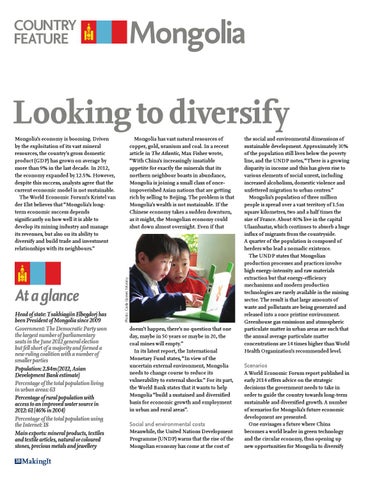
Photo: Carla Gomez Monroy
Mongolia’s economy is booming. Driven by the exploitation of its vast mineral resources, the country’s gross domestic product (GDP) has grown on average by more than 9% in the last decade. In 2012, the economy expanded by 12.5%. However, despite this success, analysts agree that the current economic model is not sustainable. The World Economic Forum’s Kristel van der Elst believes that “Mongolia’s longterm economic success depends significantly on how well it is able to develop its mining industry and manage its revenues, but also on its ability to diversify and build trade and investment relationships with its neighbours.”
doesn’t happen, there’s no question that one day, maybe in 50 years or maybe in 20, the coal mines will empty.” In its latest report, the International Monetary Fund states, “In view of the uncertain external environment, Mongolia needs to change course to reduce its vulnerability to external shocks.” For its part, the World Bank states that it wants to help Mongolia “build a sustained and diversified basis for economic growth and employment in urban and rural areas”.
Social and environmental costs Meanwhile, the United Nations Development Programme (UNDP) warns that the rise of the Mongolian economy has come at the cost of
the social and environmental dimensions of sustainable development. Approximately 30% of the population still lives below the poverty line, and the UNDP notes, “There is a growing disparity in income and this has given rise to various elements of social unrest, including increased alcoholism, domestic violence and unfettered migration to urban centres.” Mongolia’s population of three million people is spread over a vast territory of 1.5m square kilometres, two and a half times the size of France. About 40% live in the capital Ulaanbaatar, which continues to absorb a huge influx of migrants from the countryside. A quarter of the population is composed of herders who lead a nomadic existence. The UNDP states that Mongolian production processes and practices involve high energy-intensity and raw materials extraction but that energy-efficiency mechanisms and modern production technologies are rarely available in the mining sector. The result is that large amounts of waste and pollutants are being generated and released into a once pristine environment. Greenhouse gas emissions and atmospheric particulate matter in urban areas are such that the annual average particulate matter concentrations are 14 times higher than World Health Organization’s recommended level.
Scenarios A World Economic Forum report published in early 2014 offers advice on the strategic decisions the government needs to take in order to guide the country towards long-term sustainable and diversified growth. A number of scenarios for Mongolia’s future economic development are presented. One envisages a future where China becomes a world leader in green technology and the circular economy, thus opening up new opportunities for Mongolia to diversify