Photo: Reuters
makingit_16_pp28-31_ishii_version 2 22/07/2014 11:04 Page 31
Turkey. The uniqueness of the programme lies in its competition-based approach to identifying the most promising entrepreneurs across a country, serving as a driving force to inspire the instincts of entrepreneurs and resulting in the efficient use of limited financial resources. Entrepreneurs participating in the competition are eligible to receive support, including extensive training and mentoring on business plan development, product development, and funding strategies. Targeting industrial parks and economic development zones enables GEF to support the optimal combination of industrial activities to achieve greater impact in a more integrated manner. An eco industrial parks/ zone programme in Viet Nam has improved the environmental performance of targeted zones by reducing emissions of harmful chemicals, improving energy efficiency, and reducing greenhouse gas emissions through investments in clean, low-carbon technology in the parks, and improving water usage and reducing pollutants into surrounding water bodies. Private companies in the zones will be mobilized to actively participate in the project activities. GEF plans to replicate a successful project that addressed conflicting demands for fresh water in the Hai River Basin of China, which includes the capital, Beijing, and the country’s fastest-growing city, Tianjin. The GEF and World Bank have supported key investments in satellite technologies to reduce the use of water for irrigation and in practical sewage treatment options for smaller cities. The result has been sharply reduced nitrogen pollution and sharply
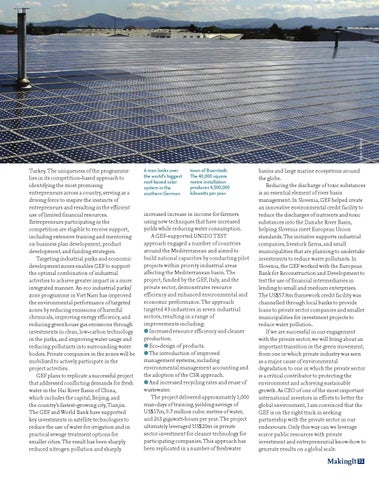
A man looks over the world’s biggest roof-based solar system in the southern German
town of Buerstadt. The 40,000 square metre installation produces 4,500,000 kilowatts per year.
increased increase in income for farmers using new techniques that have increased yields while reducing water consumption. A GEF-supported UNIDO TEST approach engaged a number of countries around the Mediterranean and aimed to build national capacities by conducting pilot projects within priority industrial areas affecting the Mediterranean basin. The project, funded by the GEF, Italy, and the private sector, demonstrates resource efficiency and enhanced environmental and economic performance. The approach targeted 43 industries in seven industrial sectors, resulting in a range of improvements including: ● Increased resource efficiency and cleaner production. ● Eco-design of products. ● The introduction of improved management systems, including environmental management accounting and the adoption of the CSR approach. ● And increased recycling rates and reuse of wastewater. The project delivered approximately 1,000 man-days of training, yielding savings of US$17m, 9.7 million cubic metres of water, and 263 gigawatt-hours per year. The project ultimately leveraged US$20m in private sector investment for cleaner technology for participating companies. This approach has been replicated in a number of freshwater
basins and large marine ecosystems around the globe. Reducing the discharge of toxic substances is an essential element of river basin management. In Slovenia, GEF helped create an innovative environmental credit facility to reduce the discharges of nutrients and toxic substances into the Danube River Basin, helping Slovenia meet European Union standards. The initiative supports industrial companies, livestock farms, and small municipalities that are planning to undertake investments to reduce water pollutants. In Slovenia, the GEF worked with the European Bank for Reconstruction and Development to test the use of financial intermediaries in lending to small and medium enterprises. The US$57.8m framework credit facility was channelled through local banks to provide loans to private sector companies and smaller municipalities for investment projects to reduce water pollution. If we are successful in our engagement with the private sector, we will bring about an important transition in the green movement, from one in which private industry was seen as a major cause of environmental degradation to one in which the private sector is a critical contributor to protecting the environment and achieving sustainable growth. As CEO of one of the most important international investors in efforts to better the global environment, I am convinced that the GEF is on the right track in seeking partnership with the private sector in our endeavours. Only this way can we leverage scarce public resources with private investment and entrepreneurial know-how to generate results on a global scale.
MakingIt 31