makingit_16_pp28-31_ishii_version 2 22/07/2014 11:04 Page 29
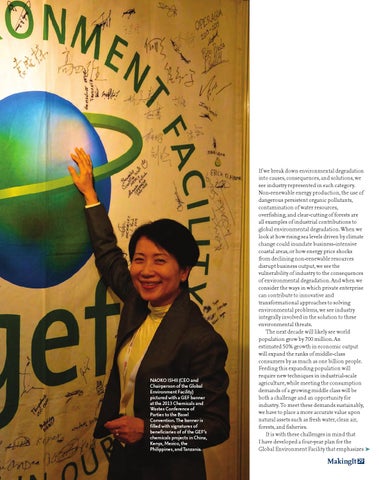
NAOKO ISHII (CEO and Chairperson of the Global Environment Facility) pictured with a GEF banner at the 2013 Chemicals and Wastes Conference of Parties to the Basel Convention. The banner is filled with signatures of beneficiaries of of the GEF’s chemicals projects in China, Kenya, Mexico, the Philippines, and Tanzania.
If we break down environmental degradation into causes, consequences, and solutions, we see industry represented in each category. Non-renewable energy production, the use of dangerous persistent organic pollutants, contamination of water resources, overfishing, and clear-cutting of forests are all examples of industrial contributions to global environmental degradation. When we look at how rising sea levels driven by climate change could inundate business-intensive coastal areas, or how energy price shocks from declining non-renewable resources disrupt business output, we see the vulnerability of industry to the consequences of environmental degradation. And when we consider the ways in which private enterprise can contribute to innovative and transformational approaches to solving environmental problems, we see industry integrally involved in the solution to these environmental threats. The next decade will likely see world population grow by 700 million. An estimated 50% growth in economic output will expand the ranks of middle-class consumers by as much as one billion people. Feeding this expanding population will require new techniques in industrial-scale agriculture, while meeting the consumption demands of a growing middle class will be both a challenge and an opportunity for industry. To meet these demands sustainably, we have to place a more accurate value upon natural assets such as fresh water, clean air, forests, and fisheries. It is with these challenges in mind that I have developed a four-year plan for the Global Environment Facility that emphasizes ➤
MakingIt 29