makingit_16_pp14-15_business-matters_print 17/07/2014 19:41 Page 15
■ In a forthcoming report, the Inter-American Development Bank (IADB) is calling for industrial policies in Latin America. This is a welcome development, writes Andrés Velasco, a former presidential candidate and finance minister of Chile, in an article for Project Syndicate. Velasco’s preview of Rethinking Productive Development: Sound Policies and Institutions for Economic Transformation points out that the IADB does not speak of industrial policies, and instead uses the politically correct phrase
“productive development policies”. But, he writes, “the message is clear: in Latin America, the state and public policy should have a role in deciding what gets produced. A generation ago, this message would have been heretical. Today, it is a matter of common sense.” The IADB report states, “There is now a growing consensus among policymakers and analysts alike that by putting all industrial policy out of bounds, the region may have thrown out the baby with the bathwater. More and more, the question is not put in terms of whether to do active productive development policies but rather how to do them.” ■ Migrant entrepreneurs have created one in every seven British
Photo: UN Photo/Eskinder Debebe
2013, largely concentrated in China, the report said. The biofuel industry, with 1.45 million employees, and wind energy, with 830,000, were the second and third largest employers.
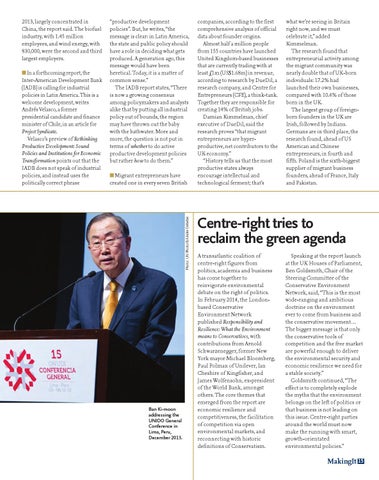
Ban Ki-moon addressing the UNIDO General Conference in Lima, Peru, December 2013.
companies, according to the first comprehensive analysis of official data about founder origins. Almost half a million people from 155 countries have launched United Kingdom-based businesses that are currently trading with at least £1m (US$1.68m) in revenue, according to research by DueDil, a research company, and Centre for Entrepreneurs (CFE), a think-tank. Together they are responsible for creating 14% of British jobs. Damian Kimmelman, chief executive of DueDil, said the research proves “that migrant entrepreneurs are hyperproductive, net contributors to the UK economy.” “History tells us that the most productive states always encourage intellectual and technological ferment; that’s
what we’re seeing in Britain right now, and we must celebrate it,” added Kimmelman. The research found that entrepreneurial activity among the migrant community was nearly double that of UK-born individuals: 17.2% had launched their own businesses, compared with 10.4% of those born in the UK. The largest group of foreignborn founders in the UK are Irish, followed by Indians. Germans are in third place, the research found, ahead of US American and Chinese entrepreneurs, in fourth and fifth. Poland is the sixth-biggest supplier of migrant business founders, ahead of France, Italy and Pakistan.
Centre-right tries to reclaim the green agenda A transatlantic coalition of centre-right figures from politics, academia and business has come together to reinvigorate environmental debate on the right of politics. In February 2014, the Londonbased Conservative Environment Network published Responsibility and Resilience: What the Environment means to Conservatives, with contributions from Arnold Schwarzenegger, former New York mayor Michael Bloomberg, Paul Polman of Unilever, Ian Cheshire of Kingfisher, and James Wolfensohn, ex-president of the World Bank, amongst others. The core themes that emerged from the report are economic resilience and competitiveness, the facilitation of competition via open environmental markets, and reconnecting with historic definitions of Conservatism.
Speaking at the report launch at the UK Houses of Parliament, Ben Goldsmith, Chair of the Steering Committee of the Conservative Environment Network, said, “This is the most wide-ranging and ambitious doctrine on the environment ever to come from business and the conservative movement… The bigger message is that only the conservative tools of competition and the free market are powerful enough to deliver the environmental security and economic resilience we need for a stable society.” Goldsmith continued, “The effect is to completely explode the myths that the environment belongs on the left of politics or that business is not leading on this issue. Centre-right parties around the world must now make the running with smart, growth-orientated environmental policies.”
MakingIt 15