makingit_16_pp14-15_business-matters_print 17/07/2014 19:41 Page 14
trends ■ The State of Green Business 2014, an annual assessment of corporate sustainability trends and metrics, paints a mixed picture. The good news is that the art of corporate sustainability continues to evolve. What’s business as usual today was, not that long ago, innovative, even breakthrough: bio-based products, accounting systems that place a realistic value on water and carbon, smart supply chains that optimize transportation, and renewable energy that isn’t just for show. The bad news is that for all of the advancements and achievements,
when you actually measure yearon-year progress companies are making, it’s a disappointing state of affairs. The report, produced by GreenBiz.com and Trucost, looked at the 500 US companies that make up Standard & Poor’s Index, and the MSCI World Index, covering more than 1,600 companies in 24 developed markets. In most cases, progress over the last five years is incremental. In some cases, it’s flat, or even declining. For example, total greenhouse gas emissions among both US and
the public that “sustainability” isn’t just about preserving icebergs, rainforests and charismatic fauna – it’s also about public health, community wellbeing, food security, affordable housing and alleviating poverty.
global market indices remain flat. Intensity, which are emissions normalized to economic activity, is also largely unchanged. For all the efforts companies are making, it’s not leading to progress. It’s not just carbon. The progress on water use, air emissions and solid waste is minimal, or worse. But there remain reasons for optimism, powered by significant shifts in attitudes among companies and their investors and customers; the growth of technology poised to leapfrog progress and accelerate change; and a growing recognition among
■ Renewable energy jobs grew by 14% to 6.5 million employees worldwide last year, led by the solar panel industry, according to a new report from the International Renewable Energy Agency. Employing a total of 2.6 million workers in renewable energy jobs, China led in hiring in 2013, followed by Brazil and the United States. The solar industry – spurred by increasing photovoltaic panel installations in Asia and falling prices – employed 2.27 million workers at the end of
consumption and production.” The third area where UNIDO can contribute, Ban said, is in helping to meet the challenge of climate change. “Climate change is a serious
threat to the development and prosperity of all the nations…. Greenhouse gas emissions continue to rise. We need to progress further and safer and faster.”
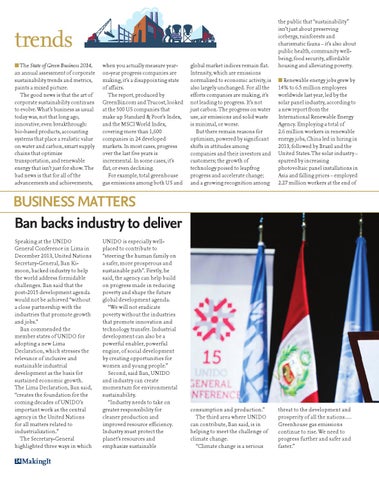
BUSINESS MATTERS Ban backs industry to deliver Speaking at the UNIDO General Conference in Lima in December 2013, United Nations Secretary-General, Ban Kimoon, backed industry to help the world address formidable challenges. Ban said that the post-2015 development agenda would not be achieved “without a close partnership with the industries that promote growth and jobs.” Ban commended the member states of UNIDO for adopting a new Lima Declaration, which stresses the relevance of inclusive and sustainable industrial development as the basis for sustained economic growth. The Lima Declaration, Ban said, “creates the foundation for the coming decades of UNIDO’s important work as the central agency in the United Nations for all matters related to industrialization.” The Secretary-General highlighted three ways in which
14 MakingIt
UNIDO is especially wellplaced to contribute to “steering the human family on a safer, more prosperous and sustainable path”. Firstly, he said, the agency can help build on progress made in reducing poverty and shape the future global development agenda. “We will not eradicate poverty without the industries that promote innovation and technology transfer. Industrial development can also be a powerful enabler, powerful engine, of social development by creating opportunities for women and young people.” Second, said Ban, UNIDO and industry can create momentum for environmental sustainability. “Industry needs to take on greater responsibility for cleaner production and improved resource efficiency. Industry must protect the planet’s resources and emphasize sustainable