makingit_15_pp6-15_globalforum_print 21/11/2013 13:59 Page 11
GLOBAL FORUM
Photo: Edgard Garrido/Reuters
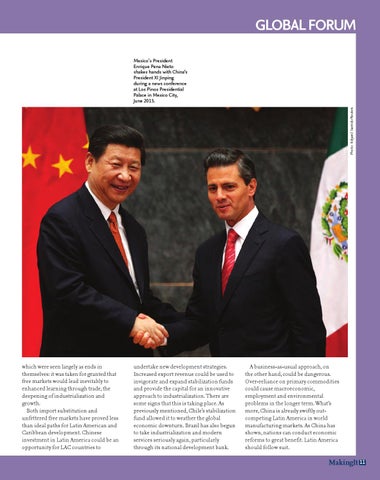
Mexico's President Enrique Pena Nieto shakes hands with China’s President XI Jinping during a news conference at Los Pinos Presidential Palace in Mexico City, June 2013.
which were seen largely as ends in themselves: it was taken for granted that free markets would lead inevitably to enhanced learning through trade, the deepening of industrialization and growth. Both import substitution and unfettered free markets have proved less than ideal paths for Latin American and Caribbean development. Chinese investment in Latin America could be an opportunity for LAC countries to
undertake new development strategies. Increased export revenue could be used to invigorate and expand stabilization funds and provide the capital for an innovative approach to industrialization. There are some signs that this is taking place. As previously mentioned, Chile’s stabilization fund allowed it to weather the global economic downturn. Brazil has also begun to take industrialization and modern services seriously again, particularly through its national development bank.
A business-as-usual approach, on the other hand, could be dangerous. Over-reliance on primary commodities could cause macroeconomic, employment and environmental problems in the longer term. What’s more, China is already swiftly outcompeting Latin America in world manufacturing markets. As China has shown, nations can conduct economic reforms to great benefit. Latin America should follow suit.
MakingIt 11