AUGUST 4, 2017
The Jewish Voice
HEALTH
PAGE 43
Addiction & Jews – An Overview By Rabbi Dr. David Nesenoff
T
he catastrophic numbers of drug users, deaths and overdoses only pale to the nightmare of a 90% relapse rate. This plague has not passed over the Jewish people. Does Judaism have anything to offer in the recovery of those battling addictions? Can poring over the weekly portion, mumbling through mincha prayers, tying tefillin, kindling candles and sitting in a Sukkah really be the magic pills to eradicating the epidemic of alcohol, drug, sex, food and gambling addictions? That sounds foolish. But don’t be so foolish to not
The addict is all about selfishness. It is a nasty dangerous business of self indulgent, hoggish, egocentric narcissism. understand that Yiddishkeit is indeed the exact shining key to unlocking the elusive chamber that contains the treasure to finally healing the addict forever. In reality, Judaism is the gateway solution; it helps to transform one’s life by discovering the actual purpose of why we are here. The addict is all about selfishness. It is a nasty dangerous busi-
ness of self indulgent, hoggish, egocentric narcissism. The user is devout and devoted; it is his religion. And it’s not a two-day-ayear religion for him. He is orthodox about it. Every minute of the day he is either using or praying to be using. And he will sacrifice his own family, even his only son Isaac. He wants to be high and then get even higher; he wants to be the highest. Which essentially means no one and no thing can be higher. That is his goal and the purpose of his life. Enter Judaism. The practices, Torah, texts, stories, deeds and mystical teachings are all about negating one’s self centered, ungenerous, greedy plots and plans. The negation occurs by serving others; and by serving the highest entity Who is higher than the mortal seeking to get high. A complete transformative focus must be the new goal. How can I connect with the Creator who awoke me from my slumber this morning? And how can I selflessly connect to His creations living in my community and world? The spark of connection is initiated via the mitzvah and the ongoing contact is protracted and propagated through continued acts and teachings that define one’s very purpose in life. Was the whole world created, and survived over the centuries, for me to be born and wake up this morning in order to get wasted?
Does Judaism have anything to offer in the recovery of those battling addictions? Can poring over the weekly portion, mumbling through mincha prayers, tying tefillin, kindling candles and sitting in a Sukkah really be the magic pills to eradicating the epidemic of alcohol, drug, sex, food and gambling addictions?
Or is there a deeper meaning as to the very purpose of my life; so I shouldn’t waste it. “Judaism may work or help in other aspects of life, but addiction is different!” So goes the mantra of some in the recovery world. But we are reminded this very month of the commemoration
of the prison release of the blessed soul of Rabbi Yosef Yitzchak Schneersohn, the sixth Chabad Lubavitch Rebbe, also known as the the Friediker Rebbe, the Previous Rebbe. After being rescued from Nazi-occupied Warsaw in 1940, the Friediker Rebbe arrived on the shores of New York. Upon
Maimonides Leads in Healthcare Information Technology as “Most Wired” Hospital Edited by: JV Staff
F
or the 17th time, Maimonides is recognized as one of the nation’s “Most Wired” hospitals, and has been commended for using advanced technologies to enhance care delivery. Maimonides has been placed on the 2017 “Most Wired” list by Hospitals & Health Networks, a journal of the American Hospital Association. “Investment in information technology has benefitted
“Investment in information technology has benefitted our patients and physicians in so many ways,” said Kenneth D. Gibbs, President & CEO. “Our commitment to utilizing the most advanced technologies has strengthened communication, improved patient safety and enhanced the quality of care we provide at Maimonides.”
our patients and physicians in so many ways,” said Kenneth D. Gibbs, President & CEO. “Our commitment to utilizing the most advanced technologies has strengthened communication, improved patient safety and enhanced the quality of care we provide at Maimonides.” “Our clinical specialists are part of the team that designs our systems,” explained Walter Fahey, Chief Information Officer. “This allows us to transform care delivery, while customizing the experience to meet the needs of our patients.” The “Most Wired” designation is given to hospitals and health systems across the country for effectively using innovative information technologies in critical areas of care, including: clinical quality and safety, administrative management, infrastructure, and clinical integration across all services. “Most Wired” hospitals like Maimonides use mobile devices, telehealth and remote monitoring systems to create more ways to reach patients and provide services. The “Most Wired” recognition reflects the commitment at Maimonides to use emerging technologies as a tool for accessing health services, capturing health information and reducing medical errors. Maimonides continues to be an industry leader in utilizing computerized technologies and expanding the capabilities of
reaching dry ground, he was told that the western world has dissimilar and divergent goals and purposes than his sacred old world books. Rabbi Yosef Yitzchak firmly straightened up from his wheelchair and said, “America is nisht anderisht!” American is not different. From a righteous man, who understood what it took to be freed from a Soviet prison cell who went on to lay the foundation for the global renaissance of Torah - we can learn that recovery “is nisht anderisht!” Recovery is also not different. We need Judaism. As Jews, we indeed do have tools that assist us from escaping from our imprisonment. We can rebuild our personal growth, the kind of unselfish growth that leads to discovering our very purpose in this world. Stopping addictive behavior is not about the end of a specific action; it is the complete love, loyalty
As Jews, we indeed do have tools that assist us from escaping from our imprisonment. We can rebuild our personal growth, the kind of unselfish growth that leads to discovering our very purpose in this world.
Rabbi Dr. David Nesenoff writes, “Stopping addictive behavior is not about the end of a specific action; it is the complete love, loyalty and purposeful enthusiasm for a new all-consuming positive stimulant”
and purposeful enthusiasm for a new all-consuming positive stimulant. (Rabbi Dr. David Nesenoff has lectured in over 600 cities throughout the world to communities, campuses and corporations. He is the founder of the Center for Jewish Addiction Rehabilitation and the director of the Florida licensed, kosher, Tikvah Lake Recovery & Spa. 24/7 phone: 954.644.5040 website: TikvahLake.com)
Mutation Explains Why Some Men Live to 100 Israeli study suggests that making a slight change in the specific piece of DNA could possibly make people live longer By: Abigail Klein Leichman
For the 17th time, Maimonides is recognized as one of the nation’s “Most Wired” hospitals, and has been commended for using advanced technologies to enhance care delivery. Maimonides has been placed on the 2017 “Most Wired” list by Hospitals & Health Networks, a journal of the American Hospital Association.
electronic medical records. Maimonides Medical Center is Brooklyn’s pre-eminent healthcare provider, nationally recognized for clinical excellence across all major specialties. Our physicians are known for innovation, major achievements in advancing medical science, and strengthening our teaching and research programs. With 711 beds, the Medical Center is dedicated to bringing patients the most advanced care available—anywhere. Maimonides continues to grow in response to evolving models of care that better serve patients and families, and is an affiliate of Northwell Health. To learn more, please visit www. maimonidesmed.org.
J
ust as smaller animals of a given species generally live longer than their larger cousins, one might expect that taller humans are genetically programmed to sacrifice longevity for height. But it’s not that simple. A major multinational study of 841 men and women from across four populations found lower levels of insulin-like growth factor 1 (IGF-1) in men living to age 100 and yet most of them were taller than men in the younger control group. The apparent explanation for this head-scratcher is that some long-lived men – and only men — have a genetic mutation that makes their growth hormone receptors more sensitive to the effects of the hormone. The cells absorb less growth hormone, yet protein expression is increased by several times. This mutation seems to be responsible for their ability to live about 10 years longer than the control group of 70-yearold men without the mutation, even though they have a lower amount of growth hormone and are about 3 centimeters (1.18 inches) taller. The lead author of the study is Prof. Gil Atzmon of Albert Einstein College of Medicine in New York and head of the Laboratory of Genetics and Epi-
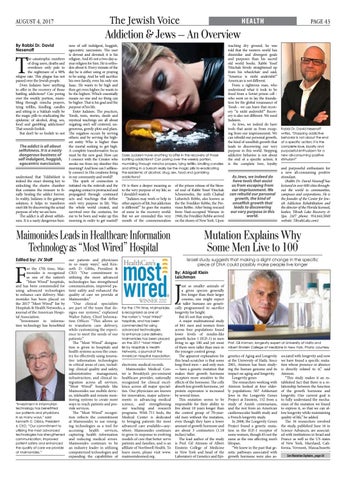
Prof. Gil Atzmon, longevity expert at University of Haifa and Albert Einstein College of Medicine in New York. Photo: courtesy
genetics of Aging and Longevity at the University of Haifa. Since 2001, Atzmon has been studying the human genome and its impact on aging and longevity. Longevity genes The researchers working with Atzmon looked at four elderly populations: 567 Ashkenazi Jews in the Longevity Genes Project at Einstein, 152 from a study of Amish centenarians, and the rest from an American cardiovascular health study and a French longevity study. In 2008, the Longevity Genes Project found a genetic mutation in the IGF-1 receptor of some women, though it’s not the same as the one affecting men’s lifespan. “We knew in the past that genetic pathways associated with growth hormone were also as-
sociated with longevity and now we have found a specific mutation whose presence or absence is directly related to it,” said Atzmon. “This study makes it an established fact that there is a relationship between the function of the growth hormone and longevity. Our current goal is to fully understand the mechanism of the mutation we found to express it, so that we can allow longevity while maintaining quality of life,” he added. The 16 researchers involved the study, published June 16 in Science Advances, are associated with institutions in Israel and France as well as the US states of New York, Maryland, California, Vermont, Massachusetts See Mutation Explains , page 36