THE BIG picture Asia Australia Europe NORTH AMERICA STUDIo 2
24
42
62
138
144
Full contents overleaf
Welcome
What a year 2016 was. A lacklustre global economy, Brexit, a new British prime minister and a controversial US president-elect. Despite the instability in the markets this caused, we had a very productive 2016 and are determined to keep making the best of an uncertain situation this year. As an international practice with studios in London, Hong Kong and Sydney, Make will continue to work on cutting-edge projects here in the UK while strengthening our local presence everywhere we work around the world, and seeking out high-profile projects in new markets. This year’s Annual is a celebration of our reach and ambition, with features on global ‘big picture’ topics as well as more regional ones. These include biophilic design, co-living, the Danube Valley tech industry and the ambitious development of China’s Hengqin Island, among many others. You’ll also find a selection of our projects, such as the revitalisation of St James’s Market for The Crown Estate in London, the international competition-winning redevelopment of Wynyard Place in Sydney and our 300m twin residential towers in Mumbai. Lastly, this Annual is a tribute to the importance of collaboration at Make, with nearly 20 external contributors helping it take shape, from journalists to industry experts to everyday users of our buildings. A warm thank you to everyone. I hope you enjoy reading.
Ken Shuttleworth 1
2
3
The call of the wild
Biophilic design expert Bill Browning explains how humans’ innate connection to nature can be translated into design and why we should all be doing more of this.
Bill Browning is a founding partner of US-based biophilic design consultancy Terrapin Bright Green. He has advised Fortune 500 companies, universities, non-profit organisations, the US military and foreign governments.
What is biophilia? Humans have evolved in the natural environment, and therefore we respond to the experiences of a place based on that connection with nature. As a result, we innately favour specific sensory interactions with nature and the spatial properties of certain natural landscapes. This is the concept behind biophilia – that humans have an innate attraction to nature. Whether one is engaging with nature by walking through a park, interacting with animals or having a view of greenery, biophilic design (the concepts of biophilia in practice) has many applications that help transform mundane settings into stimulating environments. Now that more than half of the world’s population lives in cities, this has become an imperative design consideration. Biophilia is a concept that has been recognised for several decades by the scientific and design communities, and intuitively for hundreds of years by the population at large. Biophilic design incorporates nature into the 4
The big picture
built environment. Green building traditionally focuses on costs of energy, water and materials – all important topics. Yet human costs are 112 times greater than energy costs in the workplace. Incorporating nature into the built environment is a sound economic investment that supports occupant wellbeing, improves productivity and boosts the bottom line. The growing evidence Studies conducted by neuroscientists, psychologists and endocrinologists have indicated that positive experiences of nature elicit beneficial psychological and physiological responses, such as lowered blood pressure and heart rate, reduced muscular tension, better mental focus, lowered levels of stress hormones, and enhanced creative problem-solving abilities. For instance, neuroscientists have found that viewing complex, dynamic natural scenes is a pleasurable experience, whereas scenes with less visual richness, such as a blank
wall or a treeless street, trigger less pleasurable mental reactions. A team at Melbourne University had participants complete a stressinducing task, take a break and then complete a recovery task. During the 40-second break, they viewed one of two scenes: an urban rooftop consisting of concrete or the same rooftop rendered as a green roof with extensive plantings. The participants who viewed the concrete roof did not exhibit a shift in brain processing mode, while those who viewed the green roof shifted brain mode and performed better on the recovery task. These studies support Attention Restoration Theory (ART), which asserts that nature serves as a positive restorative environment for humans and is an effective platform for stress management, health promotion, psychotherapy and disease deterrence. Working with biophilic design Certain biophilic strategies have specific cognitive or physiological outcomes, so a designer must select
interventions that will have the desired effects. Terrapin Bright Green’s report 14 Patterns of Biophilic Design identifies patterns with proven health benefits to help guide designers in creating effective biophilic spaces. The patterns fall under three general categories: –– Nature in the Space –– Natural Analogues –– Nature of the Space Nature in the Space addresses the direct physical and ephemeral presence of nature in a space or place. This can include plant life, water and animals, as well as breezes, sounds, scents and other natural elements. Common examples include potted plants, flowerbeds, bird feeders, butterfly gardens, water features, fountains, aquariums, courtyard gardens, green walls and vegetated roofs. Natural Analogues address organic, non-living and indirect evocations of nature. Such interventions can include
The call of the wild
5
“Biophilic office environments can deeply affect our cognition and health. Research at the University of Oregon found that 10% of employee absences could be attributed to architectural elements that did not connect with nature.”
objects, materials, colours, shapes, sequences and patterns found in nature, and manifest as artwork, ornamentation, furniture, décor and textiles in the built environment. Examples include mimicry of shells and leaves, furniture with organic shapes, and natural materials like wood planks or granite tabletops. Nature of the Space addresses spatial configurations in nature. This includes our innate and learned desire to be able to see beyond our immediate surroundings, our fascination with the slightly dangerous or unknown, obscured views and revelatory moments, and sometimes even phobia-inducing properties when they include a trusted element of safety. Biophilic design for the workplace Biophilic design has often been regarded as a luxury for property owners who want the best-possible workplace for their employees or who want to showcase their efforts to be more environmentally responsible. Yet biophilic design has been proven to improve employee wellbeing, consequently impacting productivity costs and the bottom line.
2
Biophilic office environments can deeply affect our cognition and health. Research at the University of Oregon found that 10% of employee absences could be attributed to architectural elements that did not connect with nature, and that the quality of a person’s view was the primary predictor of absenteeism. These studies, among many others, demonstrate how biophilic environments can decrease illness and absenteeism, increase staff retention, and improve job performance through the reduction and prevention of mental stress and fatigue. In other words, biophilia can be directly linked to thousands of dollars saved in productivity costs per employee. Biophilic design in urban environments One of the realities of the 21st century is that a much larger proportion of our population is now living in cities 6
The big picture
than ever before, making design and planning decisions ever more important. Most urban environments can increase mental fatigue and stress, whereas natural environments and features can maintain our mental and physiological health. Studies in Japan have found that walking through forest atmospheres decreases stress hormone levels, blood pressure and heart rate in comparison to walking through urban areas. With the loss of natural green space due to continued urbanisation, we must consider how urban environments will have a detrimental effect on public health now and in the decades to come. Strategic biophilic interventions in urban spaces can mitigate the impact of urbanisation on our mental health. Pocket parks (small parks inserted into highly dense urban areas), art installations that evoke natural patterns and forms, publicly accessible waterfronts and the like all create opportunities for people to interact with nature within the urban environment. We term the collective effect of these interventions ‘biophilic urban acupuncture’. Essentially, threads and nodes of biophilic interventions in specific urban places can help improve people’s moods, connect people to place and improve mental health. Whether it’s interior workplaces or outdoor public spaces, biophilic design is increasingly recognised as an important element in the built environment. It reminds us that occupant comfort, health and happiness are crucial to creating engaging spaces that people love. Implementing low-cost measures like ensuring that interior spaces provide views to the outside and receive good daylighting, or that outdoor spaces create areas of refuge and have greenery, helps create a more inviting, healthy environment. For more information please visit www.terrapinbrightgreen.com
3
1 (Previous spread) The atrium of the HSBC Private Bank headquarters in Geneva, designed by Make, has biophilic design elements such as natural lighting, exposed wood, expansive views and a green wall. 2 Artist Michael Heizer’s sculpture Levitated Mass, located at the Los Angeles County Museum of Art, is a good example of humans’ fascination with the slightly dangerous. 3 The PARKROYAL on Pickering hotel in Singapore has abundant greenery, water features, organic architectural forms, and a diverse array of spaces and views. 4 Paley Park is a pocket park in the heart of Midtown Manhattan with extensive plantings and a waterfall feature, offering a calming urban respite.
4
The call of the wild
7
Mary, queen of hotels
“Culturally curious and happy on the move,” Mary Lussiana writes for a number of titles, including Condé Nast Traveller, House & Garden, the FT’s ‘How to Spend It’, and The Daily Telegraph.
Mary Lussiana, travel writer and hotel connoisseur par excellence, talks to Make about what makes a good hotel and why she doesn’t use TripAdvisor.
What are the up-and-coming hotel brands, the ones to watch? What are they getting right? The House Collective by Swire and Cheval Blanc are the two I watch most closely. Both have three properties at the moment, with more in the pipeline, and both have an innate understanding of elegant luxury and real hospitality, fulfilling that old cliché of being a home from home. Another excellent small collection is La Réserve (Geneva, Ramatuelle, Paris), which successfully combines wellness with a wealth of delicious food and flawless service. For slightly bigger groups, I am impressed by Six Senses and by Rosewood, whose new openings deliver a keen sense of place and, particularly in the new Six Senses Zil Pasyon, an ability to step back and create a hotel that pays tribute to its surroundings rather than trying to dominate them. What do you look for in a hotel? Do you have any boxes that always need ticking? It might seem obvious, but true hospitality. For me that means being shown to my room and not handed a key card at reception; treating me as an individual, not a number. I hate a turndown service that puts a weather card on my pillow with a chocolate and ignores the glasses that need to be cleared away or the wet towels that need to be changed. Hotels are a people’s business, and that is where the smaller hotels get it right by looking not at a rule book but at the person standing in front
8
The big picture
of them. Having said that, the giant Four Seasons chain still has the best service out there. What have been some of your most memorable stays recently? People make your stay memorable. I arrived at the Goring Hotel in London not long ago, exhausted after a trip, and one of the managers took one look at me and said, “I am sending up a glass of wine” – a small gesture, but it makes you feel looked after. The new Amanemu in rural Japan stands out for its utter tranquillity. Sitting in a hot onsen outside their beautiful spa, under a night sky lit by a full moon and a multitude of stars, in complete silence, was unforgettable. And Amansara in Siam Reap has something special about it – it’s hard to pinpoint, but if I close my eyes, it’s my go-to comfort place. Are there any experiences that still make you cringe or laugh out loud at how bad they were? A long time ago, I was staying with my family at the Çırağan Palace in Istanbul, on holiday. When we returned from dinner, the reception couldn’t find our key, so they let us in with the master key and said they would look again in the morning. At some early hour of the morning, a rather passionate couple opened our door and fell in giggling. My husband and small son slept on while I challenged the invaders, who said they had been given their key and told this was their room. Luckily, they left without a fight, but I had just got back to sleep when reception rang to apologise. I felt it could have waited.
1 The Upper House in Hong Kong, part of The House Collective by Swire.
1
2 Cheval Blanc Courchevel in Courchevel, France.
2
Mary, queen of hotels
9
Hotels by Make
In a world where people are travelling more and more for both business and leisure, global travellers are looking for comfortable and authentic hotel experiences. At Make we have a deep understanding of what it takes to create them. The hotelier’s vision The best hotels have a strong, visionary hotelier behind them. We believe in listening to and understanding that vision so we can create buildings and spaces that deliver a holistic guest experience. We work with hoteliers to deliver a seamless concept that incorporates everything from a guest’s initial digital interaction on the hotel’s website through to their physical arrival, stay and, finally, to check-out. The future is about service design, which buildings are only a part of. As lead designer, we like to be ‘conductors’ of an ‘orchestra’ that includes lighting and landscape designers as well as library and music providers. In each of our hotel projects, we strive to provide an overarching concept for guests to enjoy, one that considers all possible ways to improve people’s stay. Delivering authenticity Guests want to stay in hotels that reflect a sense of place and are integrated into their local community. Our hotel designs are mindful of their location and 10
The big picture
Make’s Katy Ghahremani, who led the design of the award-winning Temple House in Chengdu for Swire’s House Collective, explains our approach to hotel design.
take inspiration from their context – be it country, city, neighbourhood or the building itself. The best hotels have public areas used by locals as well as guests, as this offers a glimpse of local life and sense of community. Hotel guests don’t want to stay on ‘cruise liners’ anymore, isolated from the area where their hotel is located. With the rise of Airbnb and its hospitality focus, hotels must work harder than ever to deliver a personal, friendly and authentic experience. Embedding guest service Designing back-of-house areas that allow hotel staff to deliver the best service is imperative. The easy flow of goods in and waste out is just as important as how guests themselves move through the building. The same goes for the journey of hot food – how it travels from the kitchens to the restaurant tables and hotel rooms – and the staff areas, as a happy staff leads to a better level of service, which in turn produces a better guest experience. Thankfully, being thoughtful about this kind of design doesn’t necessarily mean being more costly, just more creative. Prioritising wellbeing At a basic level, the most important function of
a hotel is to provide a safe and comfortable place for people to sleep. And yet so often rooms are not designed with sleep in mind. Whether it’s due to confusing light switches or noise coming from the corridors, sleep deprivation is all too common. Our ambition is to design great rooms that encourage peace and calm, and allow guests to sleep, relax and work in comfort. This means thinking about the smallest details, such as allowing for privacy in the sleeping area when the hotel room’s door is opened and locating light switches and charging sockets by the bed. It’s these details, whether seen or unseen, that result in a memorable stay.
“People make your stay memorable. I arrived at the Goring Hotel in London not long ago, exhausted after a trip, and one of the managers took one look at me and said, ‘I am sending up a glass of wine.’”
3 The Temple House in Chengdu, designed by Make, opened in 2015 and is the third hotel in Swire’s House Collective. 4, 5 The spa at the Mandarin Oriental in Taipei was crowned the world’s best luxury hotel spa at the World Luxury Spa Awards in 2015.
3
4
5
How are the best hotels approaching food these days? I don’t think there is one particular hard-and-fast rule, as the location of a hotel often dictates its approach to food. But hotels are definitely divided between a local approach and a celebrity one. The Mandarin Oriental chain delivers a culinary quality that is unique in the hotel industry, with often two or three fine dining, Michelin-starred experiences under one roof. Its Tokyo location, for example, is astonishing in its range of gastronomic experiences and as such is very in tune with the city. For Cheval Blanc too, food is paramount, and even in the far-flung Maldives they seamlessly deliver an authentic, gastronomic taste of Italy or France or Japan. Other hotels opt for a local, understated menu – grownup comfort food – or decide, like The Temple House in Chengdu, to create the best Italian in the city rather than compete with the many excellent Sichuan restaurants. If a hotel has a spa, what makes it stand out to you? Most important are the therapists, and one has to trust the quality of the hotel to invest in excellent staff. So, from that point of view, it is important to know if the spa is outsourced or owned by the hotel. Secondly, the products – there should be more than one brand, ideally an organic line and a result-driven, more scientific one. I also love to experience whatever is local. The Mandarin Oriental in Taipei has a treatment at their spa called Formosa (after the original name of Taiwan) in which they draw on all the
island’s ingredients, polishing your skin with sea pearls blended with salt, rehydrating it with white mud, using a butterfly (they are famous for their butterflies) massage technique and scraping, a Taiwanese facial therapy, before offering you a cup of their oolong tea. I love that total immersion. What are your top What Not to Dos for hotels? I know it’s a sad necessity, but I hate when the first words I’m greeted with are, “Can I have your credit card please?” I find it an affront to assume I will drain the minibar dry and leave in the dead of night. And I think there can never be too much emphasis placed on having the right friendly porter on the door. When I’m greeted by an efficient, smiling presence who removes all my luggage before I’ve taken two steps out of the taxi, my heart soars. What’s the fate of the star system, now that some hotels are eschewing it entirely? I think it has become irrelevant. Brand image is much more powerful than how many stars a place might have, and true hospitality has nothing to do with having that fifth star because you have a lift, swimming pool et cetera. What role do you think social media plays in how hotels operate? I don’t think it changes how hotels operate on a daily basis, but obviously it is a vital marketing tool that every hotel is chasing. The visually led Instagram puts hotels in front of people and reaches a far wider Mary, queen of hotels
11
“Most important for hotel spas are the therapists, and one has to trust the quality of the hotel to invest in excellent staff. Secondly, the products – there should be more than one brand, ideally an organic line and a result-driven, more scientific one.”
6 Six Senses Bhutan, slated to open in the second half of 2017. 7 Barnsley House in the UK’s Cotswolds. 8 Hotel Cipriani in Venice.
audience than many an editorial can do. And whereas a website informs, Instagram tempts. How do you feel about TripAdvisor? I hate it, and I never look at it. I simply cannot understand why someone would take on trust a review by someone they don’t know. How can they know whether or not they are like-minded people? The only positive is that it’s definitely made hotels much more careful about how they treat their guests, but a good hotel doesn’t need the threat of TripAdvisor to know how to look after its guests.
of being there with my parents as a child and more recently of taking my own children there, so I have an enormous emotional attachment to it. And the icing on the cake is the wondrous city of Venice glinting across the water for you to feast your eyes on. Impossible to get bored.
6
7
What hotels are you dying to visit in 2017? Six Senses in Bhutan and Six Senses in Fiji, the new Swire House in Shanghai, The Silo in Cape Town, on a continent I don’t know at all, and Alila in Cambodia, a chain that seems to be doing all the right things but which I’ve never stayed in. If you could stay in only one hotel for the rest of your life, what would it be and why? (Possibly an impossible question!) Yes, impossible! I think it would depend on the seasons as much as anything, and my need to constantly keep up with evolving styles, but if time froze right now, Barnsley House in the Cotswolds is up there in terms of home comforts. And for abroad, Amankila in Bali is a gem – over 20 years old and still up there with the good and great. But my absolute first love is the Cipriani in Venice. Spoiling in the extreme, it comes with memories 12
The big picture
8
The Hotel Manager
Kurt Macher is the general manager of The Temple House in Chengdu, designed by Make. He tells us about growing up in Austria and experiencing the tea culture in China.
How did you get into the hospitality sector? Growing up in rural Austria, my best friend lived next door, and her family ran a small restaurant and B&B. I remember spending my days after school at the restaurant and learning what good hospitality was about. I started out over 26 years ago as a trainee chef and have always been very driven. I have lived abroad most of my adult life and have been fortunate to work for top luxury hotel groups such as Four Seasons Hotels and The Peninsula Group.
Chengdu is known for its excellent Sichuan cuisine, from fiery hotpots to the wide range of snacks along Wide and Narrow Alley. Also, pandas are a large part of the Chengdu identity, and a visit to the Panda Research Base – where they have made major strides in preventing pandas from going extinct – is a must. We also have a very strong tea culture in Chengdu, and you can sample some of the region’s finest teas at our MI XUN Teahouse. Finally, those with a penchant for retail therapy have to visit the shopping haven that is Taikoo Li.
What do you enjoy most about your job? There is never a dull moment in a hotel, and I thrive in the fast pace and ever-changing environment. I enjoy motivating and inspiring my team so that they can perform at their best. I also enjoy being a mentor for the younger generation of staff and helping them in their personal journeys to becoming world-class hoteliers. Of course, one of the highlights remains meeting guests from all over the world, understanding their evolving needs and delivering the understated luxury service The House Collective is known for.
What are your own favourite things to do in Chengdu? To get away from the urban jungle of Chengdu, I do enjoy going to the many parks in the city. It’s always interesting to have tea in one of the teahouses at People’s Park, where the local masters carry on the age-old tradition of ear-cleaning. I also personally find Bamboo Park to be a wonderful place to unwind.
What do you hope to achieve at The Temple House? Our young House has not yet risen to its full potential, and exciting times lie ahead for us. I want to continue to enhance our wellness and gastronomy offerings, to establish our House as one of the best urban resorts in China. We will continue to partner with high-end luxury brands – most recently Cartier and Lanvin – and artists and influencers to create atelier experiences for our guests. We also want to rediscover forgotten Chinese traditions and art. Through our specially curated library of 1,000 Chinese and 1,000 English books, we also hope to connect with people via engaging literary content. What are your top recommendations for first-time visitors to Chengdu? I highly recommend a visit to the Daci Temple, a beautiful historic temple that The Temple House gets its name from. Mary, queen of hotels
13
14
The big picture
Under the same roof
Property journalist Graham Norwood tells us all about co-living, the latest trend to hit the housing market, and why it’s taking off around the globe.
Graham Norwood contributes regularly to a range of national publications including The Daily Telegraph, The Sunday Telegraph, Daily Mail, Daily Express, Financial Times, The Independent and Estates Gazette.
The 21st century has already thrown up new lifestyle and business concepts, from the gig economy to the longevity dividend. Now there is another: it’s called co-living. As with many contemporary trends, coliving lacks exact definition. To most, however, it appears as a new form of housing where residents – drawn by a common interest, vision or simple financial necessity – share living space with tens or even hundreds of others. Co-living has come about from a mix of social forces. Traditional housing costs have boomed, in cities particularly, so more young people are willing or obliged to share; likewise, the experience of co-working has shown some young people the benefit of using limited space in a communal fashion – so why not translate that into ways of living, too? That’s precisely what a number of savvy developers around the world are doing. With co-living, some residents may own a share in the property, while others may rent. But a common thread
is that almost all co-livers are 20- or 30-somethings happy to find a home alongside their peers in an apartment or house customised for sharing. Unlike the communes and kibbutzes so popular in the 1960s and 1970s, what makes today’s co-living movement truly innovative is that it is embracing such a wide group of followers, from tech entrepreneurs committed to the sharing economy to millennials who can’t afford to buy and want more bang for their rental buck. That cost imperative should not be underestimated: according to Knight Frank Research, the median house price (at the end of Q3 in 2016) in London was £474,000, in New York City it topped £508,000, and in Melbourne it hit £368,000. Rents are no less forgiving and provide little guarantee over the quality of accommodation. Co-living costs are often lower, though not always. In London you can get a room starting at £220/week,
while in Brooklyn you might pay £400/week. The convenience, quality and community received in return, however, are indisputable. Rent covers everything from utilities and furniture to cleaners and linen changes – and sometimes more, depending on the development.
friendly encounters across the shared spaces.
Bedrooms are private, and often equipped with an en suite and sometimes a kitchen, while other spaces such as lounges and kitchens are shared. Depending on the development, residents may also enjoy shared libraries, workspace, games rooms, media rooms, gyms, laundry rooms, cafés, gardens and roof terraces.
Each co-living scheme is different in style, specification and appearance, though. As an updated version of the old saying goes, variety is the spice of co-living. So on the one hand you have a scheme like The Collective Old Oak, an 11-storey co-living scheme in London with just shy of 550 bedrooms. Rents start at £220 per week and include utilities, council tax, wi-fi, concierge services, 24/7 security, room-cleans, community events and classes. There’s also commercial workspace within the same complex, as well as an on-site restaurant and café.
Design is key to the appeal of coliving, with spaces designed to a high standard meant to attract urban millennials with well-honed taste. Spaces look immaculate and, above all, just plain cool. Residents enjoy regularly scheduled community events like book clubs, networking or film nights, not to mention informal
Elsewhere in London you can have a very different co-living experience by renting a room in number of repurposed, existing properties – from ex-council flats to Georgian townhouses – via Spaces Property Group. By removing old-style lounges and installing communal eating and relaxation areas, more residents can Under the same roof
15
2
1 (Previous spread) The communal ground floor of R50 in Berlin. 2 The library at The Collective Old Oak in London. 3 A WeLive apartment in New York City. 4 Roam in Bali. 5 Roam in Miami.
3
16
The big picture
be accommodated, meaning prices fall and the co-living experience is consolidated. The group is now looking to develop purpose-built coliving buildings from the ground up. With many other cities around the world experiencing similar sets of social and economic circumstances, co-living – or at least the idea of it – is starting to take root all over the globe. In Australia a co-living company called Base intends to set up the country’s first co-living prototype by mid-2017 in Melbourne, where up to 16 specially selected residents from a diverse range of ages and backgrounds will live for 6 to 12 months. In Hong Kong, where co-working has taken hold with WeWork and other smaller companies, real estate services giant Savills sees plenty of opportunity for co-living in the London and New York model, but notes on its company blog that “investors and developers would have to be persuaded that building to own and manage offered better returns than developing apartments to sell.” The closest current example of co-living there is the recent boom in student hostels, like SynBOX Hostel and Campus Hong Kong. Meanwhile in Berlin – fast becoming Europe’s hub for experimental modes of living – there are literally hundreds of Baugruppen, or ‘building groups’. In this model, individuals collectively finance and plan (with the help of an architect) a block of homes in which they each have an apartment but also share common living spaces. One of the most successful is R50, a 6-storey block built in the hip Kreuzberg neighbourhood. Here 19 households share a roof terrace, a communal ground floor and outdoor space. The home of co-living, however, is the US, where scores of schemes offer the widest range of lifestyles. Krash, which has properties in Boston, Chicago, Los Angeles, New York and Washington, DC, caters to entrepreneurs and investors
“What makes today’s co-living movement truly innovative is that it is embracing such a wide group of followers, from tech entrepreneurs committed to the sharing economy to millennials who can’t afford to buy and want more bang for their rental buck.”
looking for mid-term accommodation and an innovative bootcamp-style experience. On its website, the company likens being a ‘Krasher’ to “getting a back-stage tour to the local start-up and innovation economies.” In California, OpenDoor has three properties in the Bay Area, each with a different organising principle. The Farmhouse comes complete with a vegetable garden, chickens and a backyard fire pit. Residents of The Canopy are “all about knowledge sharing and creative empowerment” and share a co-working space, while the theme at Euclid Manor is “metamorphosis and social impact.” The looseness of co-living, in the US and worldwide, means there is no record of exactly how many people live this way, but there are plenty of statistics to show this approach has already become a business model as well as a way of life.
4
The website coliving.com lists well over 100 spaces worldwide actively seeking members. WeWork, one of the world’s largest co-working companies, recently valued at $10 billion, has now branched into the game with co-living arm WeLive and properties in Washington, DC and on Wall Street in Manhattan. The company aims to have 34,000 WeLive members by 2018. Meanwhile in London, The Collective Old Oak, currently home to 533 residents, is the planet’s largest co-living community. Perhaps inevitably, co-living is already stretching beyond city and even national borders. A global startup called Roam has expanded its property portfolio from Bali to include Miami, Madrid and London, with Tokyo and San Francisco in the pipeline. For an $1,800 pay-as-you-go monthly fee (or $500 weekly), Roam ‘members’ can use any of these premises to live or work whenever they wish.
5
Are such Roam-ers homeless or home-rich? Either way, they are millennial nomads – and one day soon they may be co-living near you. Under the same roof
17
Full-court press
A new arena for Barcelona In 2016 Make came second in a global competition to design the Nou Palau Blaugrana, a new multi-purpose indoor arena for FC Barcelona, one of the world’s great sports clubs. Best known for its supreme footballing prowess, FCB also has European Championship-winning teams in basketball, handball and ice hockey, all of which currently play in the badly outdated Palau Blaugrana, the smaller sibling of the 100,000-plus-seat Camp Nou football stadium. Building upon our experience designing the Copper Box – the popular handball arena for the London 2012 Olympics – as well as our masterplan for the new Tottenham Hotspur FC stadium, Make led a team to produce a design that sets a new industry standard for multi-purpose venues around the world. The brief called for a 12,500-seat indoor sports and entertainment venue that could host a variety of sports and concerts year-round and provide additional training and performance facilities alongside the main arena. Working closely with MANICA Architecture from Kansas City and BCQ Arquitectura from Barcelona, we produced a bespoke solution that’s both stateof-the-art and cost-effective. The flexible design – a visually strong orthogonal form – balances the key drivers of functionality, value for money and placemaking, creating a robust standalone identity for the Palau. 18
The big picture
The all-important bowl The seating bowl is key to the success of a venue like this. It needs to offer spectators maximum comfort and provide an immersive, exhilarating visual and auditory experience. Since the atmosphere of a Barcelona basketball game can easily be as intense as that of the football matches next door, intimacy and flexibility were vital considerations in our design. Together with David Manica and his team – brought on as technical designers for the bowl and its functional layout – we created a unique 270-degree configuration that meets the strictest federation requirements for basketball, handball, futsal and ice hockey. The horseshoe arrangement of suites and upper-deck seating ensures maximum seating and revenue generation for end-stage concerts, and creates a spectacular viewing experience from every seat in the house. All sightlines meet the minimum requirements of C=90mm throughout, though the compactness and intimacy of the design means many viewing angles actually exceed these requirements. The orthogonal form offers excellent acoustics and state-of-the-art sound control for all modes of entertainment, from European Cup basketball games to classical concerts. We pushed the efficiency of the volume, using a flat-trussed roof structure to provide maximum acoustic quality and flexibility in lighting control. We also produced an upper and lower tier design, separated by a VIP level,
Maker Stuart Blower describes the experience of designing a second-place competition entry for FC Barcelona’s Nou Palau Blaugrana and how we can apply it to world-class stadia everywhere.
which allows the upper tier to be easily curtained off. This enables the bowl to work for full and partially full events alike without losing that all-important atmosphere. A major benefit of our orthogonal design is the reduced construction costs and programme, compared to more complex forms. It minimises wasted internal space, holds the facade as close to the bowl as possible and features four carefully tuned elevations as a result. A focus on people and placemaking The venue is designed as a good neighbour and has quality placemaking at its heart. The principal elevation responds directly to Espai Barça (the forthcoming remodelled Barça campus), marking the main entrance to the Palau and extending the public realm right up to the front door. Visitors are greeted by an animated facade that reflects activity inside and out, adding to the great sense of arrival. Concourses blur the boundary between internal and external, with some concessions pulled outwards to get the bowl as tight as possible to the field of play, animating the exterior and providing additional revenue streams all year round. Our design welcomes, energises, feeds and entertains spectators and players alike. It offers the bestpossible environment for fans to support their team and display their allegiance, ensuring they’ll return time and again to this wholly
community-owned club. A full venue is a successful venue and, therefore, a sustainable one. Creating a successful sports arena To be successful, venues like this need their own character – a unique feel, both internally and externally, that differentiates them from others and creates a sense of belonging among spectators. As designers, it’s up to us to study the habits and rituals fans engage in before, during and after a match. Where, when and how do they gather? What features can we provide to enable and enhance this? Paving the way for an unforgettable visitor experience was a key consideration for us. The Nou Palau needs to be its own building and brand, not simply a mini-Camp Nou. Today’s spectator experience is so much more than a hot dog and soda (though that’s still on offer); it’s approaching a VIP offering. Getting close to the action now extends beyond simple glimpses of the athletes to include exclusive views of and even interaction with teams as they arrive and leave the pitch. Our Palau design introduces a ‘dine-andview’ restaurant with table service, overlooking the field of play, as well as VIP suites with direct access to courtside seats. It’s all about providing a live experience that beats watching the match at home on TV. This is the future of sports matches and a crucial way to retain fans. We should also be aware of how new technologies are enhancing the spectator experience at multi-
1 Bird’s-eye view of the FC Barcelona campus with our proposed design. (Visualisation)
Key 1 Nou Palau Blaugrana 2 FCBEscola, ice rink, handball arena and training facilities 3 Proposed Espai Barça with new public realm, FCB offices and future development site 4 Camp Nou
1
2
1
3
4
Full-court press
19
2 Animated facade of the main entrance, with public realm on all four sides. (Visualisation)
2
3 Make’s Copper Box Arena, designed for the London 2012 Olympic Games. 4 Inside the Copper Box. 5 The Tottenham Hotspur FC stadium at the heart of Make’s masterplan for the club. (Visualisation)
entertainment venues. With smart devices, spectators can instantly upgrade their seats, change viewing angles, watch replays, order food and drink, and listen to referee commentary and TV analysis. These offerings will only continue to improve in the future. And then there’s the athletes’ experience, which is integral to a sports venue’s success. Players need state-of-the-art training and warm-up facilities and a secure, well-organised environment that supports pre-game preparation. The offer should be premium but relaxed. Ideally, venues should inspire the home team to win and intimidate the away team. A legacy that lives on Creating a legacy venue depends on a number of factors, the most important of which is financial sustainability. That means being open every day of the year, whether there’s an event or not, and offering more than just sports and concerts – essentially, being a leisure destination in its own right. Just look at The O2 in London, which alongside its sporting and music arena has a cinema, a bowling alley, clubs, restaurants and bars, and is busy year-round. Flexibility is a key part of being financially sustainable. Make’s design for the Copper Box, for instance, placed maximum emphasis on the post-Games legacy. The venue’s ability to host multiple events – from sports to concerts to conferences – enables the arena to maintain a profitable life years later. This layering of uses 20
The big picture
is inherent in our Nou Palau design, which includes outward-facing retail units with external access around the building that benefit from Barcelona’s Mediterranean climate, support the venue during events, animate the public realm at other times and provide those valuable additional revenue streams. The design also features a community football pitch on the flat roof that can accommodate major sponsorship opportunities. We’ve got our game face on While we didn’t win this high-profile competition, the experience has been unbeatable and stands us in great stead for our next sports venue design. We firmly believe our design is as good as any other around the globe recently built, offering a world-class entertainment experience, the very best in placemaking and a magnificent new home for FC Barcelona.
3
4
5
THE ATHLETE
Clare Cubberley is a member of Leyton Netball Club, whose home ground is the Copper Box, which Make designed for London 2012. She tells us what makes a good sporting arena and where to go for curry in Whitechapel.
How long have you been playing netball? I’ve been playing netball since I was about nine or ten. I played for Essex Open as a teenager, then on my university team, and subsequently joined Leyton for the 2012/2013 season and have been there ever since. I’d thought my netball days were over but became inspired to research local clubs in the summer of 2012 after being a spectator at the basketball and handball fixtures at the London Olympics. What do you enjoy most about being part of Leyton Netball Club? It’s great because it’s both a serious club with a team competing in a National Premier League as well as a local community club for players of all ages and abilities. I’ve also met a number of characters at Leyton who I socialise with outside of netball.
What do you like best about where you live? My favourite thing about living in Bow is the proximity to my favourite places: Victoria Park, Mile End, Wanstead and Hackney. Some parts of Bow have been gentrified, and some haven’t, so it’s the best of both worlds. My least favourite thing is that every month after I’ve paid my mortgage and bills, I have about £5 to my name. What do you like to do locally? My favourite things to do locally usually revolve around eating and drinking. I love Lahore One in Whitechapel for curry, Natura in Hackney Wick for Italian, and Ariana in Mile End for Persian and shisha. Local spots like Broadway Market, Columbia Road, Victoria Park and the Olympic Park are all great to visit at the weekends, especially in the summer.
Our move to the Copper Box is another of my favourite things about Leyton. The women in charge of the club had to pitch against bigger and more successful clubs in order to secure the venue as our home ground, which makes it even better to be able to train and play there. It’s great to watch teams like England, Australia and Jamaica compete against each other at our home ground on Sky Sports. What do you look for in a sporting arena? As a player, the most important things in a venue are space and the quality of the courts. Older courts often have uneven surfaces and faded boundary lines, but the staff at the Copper Box are great at managing the upkeep of the courts. As a player and a spectator, good transport links are key. The Copper Box is close to Stratford and Hackney Wick stations, which is great. It’s an added bonus that it’s a cool building. I like the small touches, which set it apart from other venues: the light pipes in the roof which fill the courts with natural light, the multi-coloured seating and the ‘RUN’ structure outside the building. Full-court press
21
The Human Office
The future office will be a human office, created with people at its heart. Designed for humans to flourish, it will respond to people’s diverse social, biological and intellectual needs. In the future, workplaces will provide a stimulating environment which encourages the innovation, wellbeing and productivity essential to sustainable, thriving businesses.
modes of working – such as quiet concentration in an isolated spot, collaborative working in an informal meeting space, admin work standing at a table with a device, or making phone calls from a booth – will be tailored for. Technology will play a fundamental and discreet part in enabling people to work as flexibly as they like.
Workspace will be designed holistically to allow people to interact in a more natural way than what’s allowed by the rigid, deskbound model prevalent today. By acknowledging the richness of human life and behaviour, we can replicate it to form an exciting ecosystem which recognises the countless physical and organic connections which form a vital environment.
It’s equally important to have spaces where people can relax, socialise, eat and play. Whether it’s yoga on a green roof, sleep pods in a designated ‘quiet corner’, or a canteen offering locally grown fruit and veg, these spaces are vital, as people are ever more focused on health and wellbeing. Providing spaces for these activities will look after people’s social and emotional needs, allow them to physically recharge, and provide rich territory for new ideas.
Central to this is designing space which provides flexibility for different types of businesses, whether financial services or tech, whose staff will use the space in different ways. Multiple 22
The big picture
Spontaneous, natural interactions which create community and inspiration will occur as people move between activities and spaces.
As wellness continues to move up the design agenda, Make considers the future of the office and the kind of workplace it could become.
Analysis of behavioural patterns and business structures will allow designers to evolve and adapt space and routes accordingly. This could result in more flexible lease arrangements, allowing tenants to shrink, grow and restructure more efficiently. In the future there will be less physical division between indoors and out, allowing the outdoors to come into the building, bringing people closer to nature. Based on humans’ innate attraction to nature, spaces will harness biophilic design creating extensive visual connections, greenery, natural materials, circadian lighting and pleasant acoustics. Building facades will clean and filter natural air while also enhancing and maximising natural light. Together, these elements will create a less stressful and therefore more productive environment. Workplaces will achieve zero-carbon wherever possible and start to learn how to generate positive energy
back to the environment. Reuse will be paramount, and developments will maximise the use of historic fabric. This will contribute to lowering carbon, as well as providing a unique sense of identity for the workplace and staff. Companies that express their brand values within their overall design will also benefit from greater staff engagement. At ground floor, offices will nurture connections to the public realm, with fully customisable space which invites people in, allowing businesses and users to fully engage with the wider community.
Opposite page Conceptual illustration of the human office.
The human office
23
24
25
Rising 285m in the sky along Mumbai’s fabled Marine Drive, our international competition entry India Tower was designed to be one of the world’s signature towers. Conceived as a sculptural object providing panoramic views for its residents, the tower’s design draws on native organic forms such as the lotus flower and seashells, as well as the district’s Art Deco heritage and numerous parks and gardens.
Location Mumbai, India
Project team Arup, Uniform
Status Concept
Make team Yuting Jiang, Paul Scott, Sanaa Shaikh, Ken Shuttleworth, Andrew Taylor, Greg Willis
Sector Residential, tall buildings Area Confidential Client Confidential
Flower of India 26
Asia: India
Project title
27
2
1 (Previous spread) Building’s crown, designed to resemble a lotus flower opening to the sun. Accommodation is arranged in the individual petals, with windows carefully angled to prevent overlooking while maximising panoramic vistas. (Visualisation) 2 Individual petals combine to provide a striking design on the famous promenade. (Visualisation) 3 Building entrance continues the sweeping curves of the tower through a welcoming Art Deco-inspired entrance lobby arranged around a secluded garden forecourt. (Visualisation) 4 Apartments are organised around a central reception space, with individual rooms spiralling off to provide different panoramas of the city. (Visualisation) 5 The circular motif continues throughout the building, signifying unity and beauty in this exclusive new community. (Visualisation)
28
Asia: India
3
4
5
India Tower
29
SEEKING BALANCE
“For effective architectural results, energies and their implications have to be understood.” So says Rasesh Shah, a professional consultant on Vaastu Shastra, the ancient Sanskrit guide to architecture. The philosophy, which is widely practised in India and translates to ‘the science of dwelling’, is rooted in the idea that balancing the Earth’s energies and elements during a building’s design and construction can ensure occupants’ health, prosperity and happiness. Much like feng shui, Vaastu endeavours to integrate architecture into nature in the hopes of achieving harmony. While Vaastu incorporates certain Hindu principles, like observing the wishes of Vaastu Purush, the god of structures, it isn’t explicitly religious. On the contrary, practitioners regard it as a secular and even scientific practice. As Shah notes, “Vaastu Purush is a part of mythology which falls under esoteric semiology.” As such, he is not so much a religious figure, Shah continues, as “a graphical representation of the inherent energy levels present in any plot or structure.” Vaastu followers tend to regard the practice as more of a set of guiding principles than a strict code. Guidelines can get quite specific, however, with detailed directives on everything from site selection and building orientation to room layouts and furniture arrangement. Direction is a core tenet: iconography typically depicts Vaastu Purush lying on his back, with his head pointing northeast and feet pointing south-west – a pose that influences all sorts of 30
Asia: India
Make’s Sara Veale explores Vaastu, the ancient Sanskrit guide to architecture practised widely across India, including in Make’s Aranya scheme in Mumbai.
architectural details, including which direction a building’s main entrance should face (east or north is ideal) and where toilets can be placed (anywhere but the north-east corner).
is working with the future occupants themselves, “so any issues or potential violations can be discussed directly with them, as they will be the end user,” Sanaa Shaikh, lead architect, notes.
As such, it’s important Western architects working in India respect the expertise of consultants like Shah and demonstrate cultural sensitivity in their client interactions and designs.
Make is currently overseeing two residential schemes in India that employ Vaastu in their design. Shah has been meeting periodically with both architectural teams to consult on their designs. The first scheme, Aranya, is a pair of towers together housing more than 800 apartments, overlooking the Victorian botanical gardens in South Mumbai. Piramal Realty, the developer, is targeting buyers known as ‘balance seekers’: middle-aged couples seeking stylish, sophisticated homes. Many of them would like their residence to comply with basic Vaastu principles.
In the instance that a Vaastu violation can’t be avoided – for example, an electrical fitting that can only function in an area where Vaastu advises against features associated with fire – “one should apply a Vaastu-approved remedy to nullify the negative impact of the violation in question,” Shah says.
“Understanding the culture of India, our way of daily life, and the diversity that exists among the various ethnicities and types of family here can be quite daunting,” Rakesh Sharma, president of Piramal Realty, notes. “Make has worked successfully to create a design that embodies our standards and values. This was possible because Make strives to be a listening practice, one always trying to learn, engage, improve and, above all, respond positively.”
“The adjustments we’ve had to make, while out of the ordinary, haven’t been too difficult to achieve,” says Aranya’s project architect, Greg Willis. “For example, you can’t have ceiling beams in bedrooms, because in Vaastu tradition these represent a psychological weight, so we’ve configured the beams to skirt the edges of the apartments. Vaastu also warns against sleeping with your feet pointing south or east, so we’ve designed floor plans in which each bedroom contains a bed-ready wall pointing in another direction.” The architects working on the second project, a private luxury house, have made similar adjustments to their designs to render them Vaastucompliant. This time around the team
These remedies often involve the strategic placement of metal to absorb or counteract the bad energies a violation emits – for instance, Shah advised the team designing the private house, who encountered the aforementioned electrical quandary during the installation of a car lift, to embed iron into the ground under the lift to reinstate the energy balance. “I keep specially designed marble cubes and copper and silver plates on hand for similar issues,” says Shah. The extent to which Vaastu dictates architectural designs in India varies greatly depending on both the region and the individual client. In any case, it’s a more complex practice than Westerners tend to appreciate. “A common misconception about Vaastu is that it’s only about directions,” says Shah. “In fact, it’s more multidimensional than that. It’s a holistic science involving a complex matrix of architecture, forms, shapes, building materials, earth energy, cosmic energy and astrology.”
“A common misconception about Vaastu is that it’s only about directions. In fact it’s more multidimensional than that, involving a complex matrix of architecture, forms, shapes, building materials, earth energy, cosmic energy and astrology.”
Right Traditional Vaastu icon depicting Vaastu Purush, the god of structures, lying on his back with his head pointing northeast. This orientation influences numerous architectural details but is not the only aspect of Vaastu.
N
NW
Air
W
Water
E
Space
Earth
SW
NE
Fire
S
SE Seeking balance
31
Aranya, a world-class residential development for Mumbai, and our first project in India, is now on site. The two slender 300m-high towers together contain upwards of 800 apartments with breathtaking views over the city’s Victorian botanical gardens and the Mumbai Harbour. The word ‘aranya’ means ‘forest’ in Sanskrit and has inspired everything from the building podiums, which act as a forest floor of sorts, to the tree-like canopy over the lobby.
SETTING THE SCENERY 32
Asia: India
Location Mumbai, India Status On site Sector Residential, tall buildings Area Confidential Client Piramal Realty
Project team BuroHappold, EDSA, HBA, Inhabit, SSA Make team Stuart Fraser, Yuting Jiang, Dragan Krstevski, Paul Scott, Sanaa Shaikh, Ken Shuttleworth, James Taylor, Greg Willis, Yiping Zhu
Project title
33
2
3
34
Asia: India
1 (Previous spread) A significant proportion of the towers offers true dual-aspect accommodation, with views over both the harbour and botanical gardens. (Visualisation)
4
2 The forest theme is continued to the very top of the buildings, each of which has a private residential terrace offering stunning views of the entire Mumbai peninsula. (Visualisation) 3 The 52-acre botanical garden provides a truly unique setting for the super-slim towers, with the harbour in the background. (Visualisation) 4 The buildings’ structure is kept away from the edge of the towers to allow glazed corner windows throughout the apartments. (Visualisation) 5 An 8-storey car parking podium allows a garden in the sky, with sport and recreational space for the exclusive use of the Aranya community and its guests. (Visualisation)
5
Aranya
35
36
Asia: Singapore
The green tiger
Environmental design consultant Henry Woon of Atelier Ten speaks to architecture writer Sylvia Chan about what makes Singapore one of the world’s most sustainable cities.
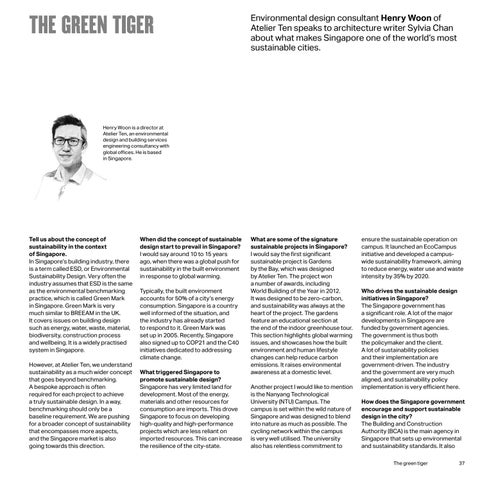
Henry Woon is a director at Atelier Ten, an environmental design and building services engineering consultancy with global offices. He is based in Singapore.
Tell us about the concept of sustainability in the context of Singapore. In Singapore’s building industry, there is a term called ESD, or Environmental Sustainability Design. Very often the industry assumes that ESD is the same as the environmental benchmarking practice, which is called Green Mark in Singapore. Green Mark is very much similar to BREEAM in the UK. It covers issues on building design such as energy, water, waste, material, biodiversity, construction process and wellbeing. It is a widely practised system in Singapore. However, at Atelier Ten, we understand sustainability as a much wider concept that goes beyond benchmarking. A bespoke approach is often required for each project to achieve a truly sustainable design. In a way, benchmarking should only be a baseline requirement. We are pushing for a broader concept of sustainability that encompasses more aspects, and the Singapore market is also going towards this direction.
When did the concept of sustainable design start to prevail in Singapore? I would say around 10 to 15 years ago, when there was a global push for sustainability in the built environment in response to global warming. Typically, the built environment accounts for 50% of a city’s energy consumption. Singapore is a country well informed of the situation, and the industry has already started to respond to it. Green Mark was set up in 2005. Recently, Singapore also signed up to COP21 and the C40 initiatives dedicated to addressing climate change. What triggered Singapore to promote sustainable design? Singapore has very limited land for development. Most of the energy, materials and other resources for consumption are imports. This drove Singapore to focus on developing high-quality and high-performance projects which are less reliant on imported resources. This can increase the resilience of the city-state.
What are some of the signature sustainable projects in Singapore? I would say the first significant sustainable project is Gardens by the Bay, which was designed by Atelier Ten. The project won a number of awards, including World Building of the Year in 2012. It was designed to be zero-carbon, and sustainability was always at the heart of the project. The gardens feature an educational section at the end of the indoor greenhouse tour. This section highlights global warming issues, and showcases how the built environment and human lifestyle changes can help reduce carbon emissions. It raises environmental awareness at a domestic level. Another project I would like to mention is the Nanyang Technological University (NTU) Campus. The campus is set within the wild nature of Singapore and was designed to blend into nature as much as possible. The cycling network within the campus is very well utilised. The university also has relentless commitment to
ensure the sustainable operation on campus. It launched an EcoCampus initiative and developed a campuswide sustainability framework, aiming to reduce energy, water use and waste intensity by 35% by 2020. Who drives the sustainable design initiatives in Singapore? The Singapore government has a significant role. A lot of the major developments in Singapore are funded by government agencies. The government is thus both the policymaker and the client. A lot of sustainability policies and their implementation are government-driven. The industry and the government are very much aligned, and sustainability policy implementation is very efficient here. How does the Singapore government encourage and support sustainable design in the city? The Building and Construction Authority (BCA) is the main agency in Singapore that sets up environmental and sustainability standards. It also The green tiger
37
drives their implementation. BCA’s strategies in promoting sustainability design are quite multifaceted. They include policy and regulationmaking, initiatives to improve baseline performances, publicity of the Green Mark best practices, and provision of incentives to encourage developers to embrace sustainability measures. One extremely effective measure in incentivising developers to design projects with high environmental performance is additional GFA allowances. Singapore has a very high population density. What are some of the unique aspects in sustainable design in the country? I think the density of the city gives designers and developers the opportunity to establish infrastructure and utilise resources in a more centralised way. An economy and lifestyle that emphasise sharing can facilitate Singapore’s sustainable development. The city-state is moving towards this direction by embracing a smart city economy. The Sustainable Singapore Blueprint 2015 outlines Singapore’s vision to become more sustainable. What new measures will the city take to achieve this goal? The blueprint covers a wide range of areas, including sustainable resources, environmental quality and community sustainability. The ‘car-lite’ campaign, transportation infrastructure upgrade, waste recycling (particularly food waste) and drainage treatment are some of the key new measures to enhance sustainability. What are the latest smart technologies used for sustainable design in Singapore? Singapore has the vision to become a Smart Nation and is believed to be in the midst of its fourth industrial revolution. The next phase of Singapore’s growth will be driven by IoT (Internet of Things, or the infrastructure of the information society), data and services, as well as sustainable design principles that will improve work efficiency and quality of life. 38
Asia: Singapore
2
I think the key contribution of smart technologies is allowing extensive data collection and monitoring at the right time and the right place. This makes timely action possible. Intelligent and interconnected systems also allow environmental design and operational objectives to be met. This is very powerful, and will change industries, businesses and people’s lives. What are Singapore’s latest goals in sustainable design? I think Singapore’s commitment to COP21 has a monumental effect on the nation’s sustainability development. The nation will need to reduce carbon emission intensity by 36% based on the 2005 benchmark, and this is a very ambitious target. The government has also set a goal to retrofit 80% of its buildings by 2030 and rolled out measures to encourage energy efficiency, which will reduce the citystate’s dependence on foreign energy import. All these will help Singapore to maintain its competitiveness in global business. What sorts of investments or resources are needed to meet these goals? Resources can go in the form of business initiatives, policies, or education and community projects. Investments in smart technologies and infrastructure are also important. As Singapore is very much a government-led society, policies are usually very well coordinated and can be implemented efficiently to promote sustainability design.
system eliminates conflicting and overlapping regulations that could lead to inefficiency or confusion in the industry. This is very important to a successful approach to sustainable development. If a city simplifies and strengthens its sustainability regulations and clarifies it goals, developers, architects and contractors will be able to understand and comply with them more easily. Singapore is a successful example that illustrates how effective this approach can be. Sylvia Chan specialises in research, writing and public relations in architecture. She is currently a PhD candidate at the University of Hong Kong, and her research interests include architectural representations, translations in architecture and the concept of Chineseness.
1 (Previous spread) Singapore’s Gardens by the Bay. 2 Inside the Learning Hub at Nanyang Technological University (NTU), designed by Heatherwick Studio. 3 The School of Art, Design and Media at NTU, designed by CPG Consultants. 4 The Henderson Waves bridge, designed by RSP, connects Mount Faber Park and Telok Blangah Hill Park, and is a prime example of Singapore’s green infrastructure.
3
4
Different cities face different challenges. How can other cities best learn from Singapore’s sustainable design initiatives? One thing that Singapore has successfully established is a simple, straightforward and standardised set of green building regulations. The Green Mark is a single document that covers all the principles of sustainable design, and it delineates regulations for both residential and commercial buildings. The simplicity of the benchmarking The green tiger
39
Pearl of the delta
Travel writer Amy Fabris-Shi tells the fascinating story of China’s Hengqin Island, and how this once-sleepy backwater in the Pearl River Delta is now flooded with billions of dollars in property investment.
Amy Fabris-Shi writes about China for titles like Elite Traveler, Travel + Leisure and Destination MO, and is the co-founder of the content consultancy Check-in Asia (www.check-in.asia). She is based in Shanghai.
Until recently, Hengqin Island was like that one jigsaw piece that got lost under the sofa, a vacant patch in an increasingly integrated picture of the Pearl River Delta in China’s southeastern Guangdong province. Now that missing piece is sliding neatly into the bigger framework. Due to its strategic location, it was only a matter of time before Hengqin became a key player in the region’s development. Residing at the southern mouth of the prosperous Pearl River Delta, south of the Mainland Chinese city of Zhuhai (which it is officially part of) and less than 200m west of Macau’s southern islands at its closest point, the 106.5km2 island is more than three times larger than Macau. Until earlier this decade, Hengqin was still a sleepy rural backwater with fewer than 7,000 inhabitants, mostly farmers and fishermen, and rudimentary transport and communication infrastructure between villages and stilted settlements. As the world’s most 40
Asia: China
lucrative casino destination shimmered just 187m across the water, Hengqin’s long, sandy beaches, oyster fields and mountainous forests lay empty. A dramatic transformation It was Macau’s stymied growth prospects and strained infrastructure that led planners and developers to look towards Hengqin, dubbing it the potential ‘Orlando of China’ to Macau’s ‘Las Vegas’. In August 2009, China’s State Council approved the commercial development of Hengqin. It was ratified as the third national-level Strategic New Area (after Shanghai and Binhai in Tianjin) and later as a Free Trade Experimental Zone. Investors were enticed by the region’s preferential tax, trade and investment policies. In December 2014, 24-hour customs clearance was opened at Lotus Bridge, which connects Hengqin with Macau. Hengqin’s prime location is a key part of the ‘One Country, Two Systems’ equation the government wishes to
use to unite China with Hong Kong and Macau, regions Beijing considers Special Administrative Regions (SARs). Hong Kong and Macau – respectively governed by Britain and Portugal until they returned to Chinese rule in 1997 and 1999 – enjoy greater freedoms than the mainland, including legalised gambling in Macau. Hengqin Island is now being used to test political and economic initiatives that explore new modes of cooperation between China and its two SARs to drive future growth in southern China. Since its establishment as a New Town in 2009, Hengqin’s metamorphosis has been dramatic, even by China’s high-octane standards. Some $12 billion in infrastructure funding has flooded in. The once sleepy isle has become a giant construction site, with mushrooming hotels, luxury condos, offices, R&D facilities, holiday resorts and amusement parks linked by six-lane highways fringed with palm trees and flowerbeds. Property prices have soared to double those of urban Zhuhai on the mainland, though they
are still less than half the average of those in Macau. In 21st-century China style, the entire island has been vigorously masterplanned. The southern portions are reserved for leisure resorts and theme parks. The middle zone will focus on culture, creativity, education and R&D, specifically in the fields of food security, internet creativity, and Traditional Chinese Medicine (TCM) science and technology. The north contains the Shizimen CBD, residential communities and a high-tech industrial zone. Here, glassy office blocks and sculptural civic landmarks are rising to dominate the waterfront skyline. Building big for the future Chimelong Ocean Kingdom was one of the first of Hengqin’s major projects to be unveiled, in March 2014. By 2015, it had become the 13th most-visited theme park in the world, with a reported 7.5 million visitors that year. The world’s largest water park, it includes one of the world’s
1
2
biggest aquariums, with rare whale sharks, belugas, polar bears and other exotic creatures. It is the first of nine attractions the Guangdong-based family entertainment developer has planned for the island, four of which are currently being constructed on an adjacent site at a 50 billion-yuan price tag.
in finding creative ways to facilitate two-way traffic of visitors between islands. Mainland China visitors still need a visa to enter Macau, and foreigners in Macau need a China visa to enter Hengqin. Plans to allow Macau vehicles to freely enter Hengqin, but not the rest of Zhuhai, are currently under discussion.
Meanwhile Hong Kong-based Lai Sun Group’s Creative Culture City will include a 22,000m2 Immersive Experience Centre operated by Australia’s Village Roadshow Theme Parks. The virtual reality park will be themed around Lionsgate film franchises, such as The Hunger Games, and is due for completion in 2018.
Overcoming issues of space Hengqin’s giant masterplan has barely begun, but the island is already concerned about space, with many large-scale developments opening in 2016 and 2017, and the continuing demand for more land outstripping the allotted supply. In December 2015, the State Council granted approval to reclaim up to 28km2 of land from the sea off the southern tip of the island. As most of Hengqin is hilly, this would effectively double its usable land for development – currently an area almost equivalent to the entire land area of Macau.
Italian luxury yacht maker Ferretti, now owned by Chinese machinery company Shandong Heavy Industry, is building its Asia-Pacific headquarters on Hengqin Island, plus a yacht club and a navigation school. Meanwhile Galaxy Entertainment, whose Galaxy Macau casino resort is just minutes across the bridge on Macau’s booming Cotai Strip, is investing 10 billion yuan in a luxury Maldives-style resort on the south-west shoreline. Make Architects is also making its stylish mark on Hengqin, with Serensia Woods, a high-tech health resort for spa relaxation and non-invasive surgery. It includes a 200-room hotel with leisure facilities, restaurants and retail boutiques, plus 400 residential apartments and luxury villas for sale. Landscaped tropical gardens complete the exotic wellness retreat. 1, 2 Make’s Serensia Woods scheme. (Visualisation)
Hengqin is currently connected to Macau via two underwater tunnels as well as the Lotus Bridge. Another major piece of the masterplan will take shape with the long-awaited completion of the Hong Kong-ZhuhaiMacau Bridge – the world’s longest over-sea bridge, currently proposed for late 2017. When it is opened, it will take just 5 minutes to drive from Hengqin to Macau, and from there, 40 minutes to Hong Kong. As Hengqin’s development continues apace, the pieces of the Pearl River Delta puzzle are becoming ever more interconnected.
Another development demonstrating the unprecedented cooperation between neighbours is the Hengqin campus of the University of Macau, where classes are already in session at ten residential colleges. Linked to the SAR by a 1.5km underwater tunnel, the new campus is the only part of Hengqin governed by Macau law. Although the campus has an open border with Macau, it is sealed off from the rest of Hengqin, highlighting some of the issues that authorities face Pearl of the delta
41
42
43
At the heart of Sydney’s central business district is Wynyard Place, Make’s first Australian project. Here, a grand new ‘urban room’ will host flagship retail and a world-class transit hall for Wynyard Station, the city’s busiest transport hub. Above that will be a new 27-storey office tower, which will house the new headquarters for National Australia Bank, reestablishing this location as Sydney’s commercial hub.
Location Sydney, Australia Status On site Sector Office, retail, transport Area 74,000m2/796,000ft2 Client Brookfield
New arrival 44
Australia
Project team Airsafe, Altitude, APP, Architectus, Arup, CPP, Douglas Partners, GML Heritage, Group DLA, GTA, JBA, Mack, MGAC, Multiplex, Oculus, Renzo Tonin & Associates, RLB, Robert Bird Group Make team Marios Chatzidoukakis, Adam Grice, Grigor Grigorov, Regine Kandan, Simon Lincoln, Ian Lomas, Wandrille Madelain, Mehrnoush Rad, James Redman, Jack Sargent, Paul Scott, Ken Shuttleworth
Project title
45
1 (Previous spread) The tower’s layered form of interlocking boxes can be read from many vantage points. The adjacent low-rise 285 George Street (foreground) and the listed Shell House (with the clock tower) will also be restored and converted, and given new roof terraces. (Visualisation)
4
2 The redevelopment will establish new connections between George Street and the adjacent Wynyard Park, further integrating the scheme into the area. 3 Built for Shell Oil in the 1930s, Shell House is a fine example of inter-war commercial palazzo architecture. The clock tower will have its original Gillett & Johnston mechanisms restored. 4 View looking west towards Wynyard Place, showing the relationship between the tower and 285 George Street. (Visualisation)
2
3
46
Australia
5
5 View of the multi-level ‘urban room’ and entrance to Wynyard Station from George Street at the base of the tower. The space will have pedestrian concourses and flagship retail stores, and a connection to Wynyard Lane, which runs through the site, and Wynyard Park on the other side. (Visualisation)
6
6 Complex section illustrating the multitude of physical and visual connections above, below and beyond the site. (Visualisation)
Wynyard Place
47
Future capital
Architecture and design writer Penelope Barker describes what the recently announced plans of the Greater Sydney Commission and the City of Sydney have in store for the development of the capital.
Penelope Barker is the founder of SoCo Communications, a boutique content agency specialising in architecture, design and real estate, and the former editor of several leading Australian print magazines. She is based in Australia.
In 1788, 11 small ships from Britain crammed with about 1,500 souls sailed into Port Jackson (now Sydney Harbour) and established a penal colony that barely survived its first few years of existence. A little over 200 years later, that tiny struggling penal colony is now the glittering global city of Sydney, with a population of 4.6 million. Once ranked among the top ten most liveable cities in the world, Sydney is undergoing notable growing pains, from a transport system that’s no longer adequate to a sustained property boom that has pushed housing prices skywards, plus a rapid population growth that’s expected to reach 6.2 million people by 2036 and 8 million by 2056. In response to these increasing pressures, in late 2015 the New South Wales government appointed the Greater Sydney Commission, an independent organisation established to take over planning decisions from Sydney’s 41 local 48
Australia
councils and coordinate and align the planning that will shape the future of greater Sydney. In November 2016, the commission released a draft amendment of its 40-year vision for Greater Sydney, titled Towards Our Greater Sydney 2056. The focus of the plan is the creation of a metropolis of three cities: the Eastern Harbour City, the Western City around Sydney’s planned second airport, and the Central Parramatta River City, each conceived as a ‘30-minute city’. Greater Sydney Commission chief Lucy Turnbull, a former Lord Mayor of Sydney, has said the city must be reimagined as three cities for its growth to be successful – “so that people get the housing and jobs and the infrastructure, hard and soft, the transport, as well as the schools and hospitals that a growing population needs […] So that people are 30 minutes from either work, school, university or whatever they like to get up to in their recreational
time, so that the 30-minute city is achievable across a much wider part of metropolitan Sydney. This makes our city more liveable, productive and sustainable for everyone.” Meanwhile, in July 2016, the City of Sydney, responsible for planning strategies in Sydney’s CBD and surrounds, unveiled its own 20year planning strategy identifying opportunities to unlock up to 2,900,000m2 of additional floor space for retail, hotel, cultural and office needs to meet long-term targets for the city centre’s growth. The strategy identifies ‘tower cluster’ areas where there is potential to build 310m-tall commercial buildings while retaining solar access planes in important public green spaces. Integral to the plan is the promotion of design excellence – all new towers and major developments are required to go through a design competition process. The strategy states that the encroachment of apartment towers on prime office
space in recent years poses “a direct risk to the Australian economy.” Central Sydney generates nearly 8% of the national economy, generating A$108 billion of economic activity annually, and is the location of the country’s highest concentration of top-500 companies and banking institutions as well as its largest retail centre. Launching the strategy, City of Sydney Lord Mayor Clover Moore said: “Past planning strategies have successfully increased the number of residential buildings in the city centre, but now we need to protect and increase the amount of productive floor space to maintain Sydney’s economic vitality and resilience.” The city is also planning to introduce a policy requiring developers in the CBD to make a financial contribution to the provision of affordable housing. The Greater Sydney Commission plan includes a target of 5% to 10% on rezoned land for affordable housing.
The 2056 vision: a Sydney of three cities
Key Sydney in 2016 Proposed 2056 borders
Norwest
Northern Beaches Hospital Precinct
Greater Penrith Blacktown
Central Parramatta River City Greater Parramatta
Western City
Macquarie Park Chatswood St Leonards
Rhodes
North Sydney
Sydney Olympic Park
Sydney City
Eastern Harbour City
Western Sydney Airport
Green Square – Mascot Randwick Health and Education
Liverpool
Sydney Airport Kogarah
Port Botany
Campbelltown – Macarthur
Future capital
49
In a city where affordable housing has reached crisis point, there have been numerous objections to both strategies on the basis that they simply do not go far enough to tackle the issue. In 1975, the median house price in Sydney was A$33,960, or four times the median household income. By 2015, the median house price had tipped over the A$1 million mark, or 12 times the median household income, and prices are still rising.
The 2036 vision for Central Sydney
Observatory Hill
The Rocks
A compounding problem is that while the housing supply has risen substantially over the past few years, many property investors have bought housing stock as an asset to hold rather than tenant. It’s estimated that some 80,000 residential properties around Sydney are currently vacant. “I’ve seen apartment buildings where only a handful are occupied,” says architect and urban designer Professor Helen Lochhead, Dean of the Faculty of Built Environment, University of New South Wales. “It’s a complex situation that needs to be addressed. In the CBD, an increasing number of apartments are investment properties, second homes or rented out as short-term accommodation so they are intermittently occupied.
Darling Harbour
Central Park
Key Current Central Sydney boundary Proposed expansion of Central Sydney boundary Identified tower clusters
1 (Previous spread) Map of Sydney’s proposed three ‘30-minute cities’. 2 The tower clusters could help unlock up to 2,900,000m2 of floor space for retail, hotel, cultural and office needs.
2
“Both strategies are a step in the right direction towards easing the housing pressure in Sydney. However, the allowances for affordable housing are still too low. Transport and affordable housing are the big issues in Sydney. We need to stop talking about density and start talking about urbanity. Which areas have the most amenities within a 5km radius that could support a denser population? Why should so many people have to commute four hours a day to work in Sydney from other cities such as Gosford, Newcastle and Wollongong, instead of building the economies of these smaller cities to support more employment? “Sydney has wonderful natural resources. In addition to the coast and harbour, the river estuaries could support greater population densities along their shores. We need to value
50
Australia
these natural features but keep people close to those places as well. We need to keep density to a level that is sustainable, to retain the natural attributes of the city while doing what’s required to ensure it stays liveable.” The scale of the city’s plans is rightly ambitious and presents a once-ina-lifetime opportunity, according to some. Providing Sydney with the world-class built environment it needs (and Sydneysiders deserve) will help make sure it remains that glittering global city on the sea.
Designing in Sydney
Make’s Ian Lomas, who recently relocated to Sydney to help grow our studio there, explains why designing in Sydney is so different from in London.
Light and shadow Any first-time visitor to or returning resident of Sydney is struck by the sharp precision of its light, which crisply incises shadows and details into the city’s walls, describing an architecture of light and shadow. A heady mixture of Mediterranean heat and Alpine clarity, Sydney’s high-definition light unrelentingly highlights each shift in texture and exposes every imperfection, with shade a place of retreat.
This material is now in short supply, and much of the stone quarried today looks drained by comparison. Wisely, our new extensions to these buildings don’t seek to mimic the originals but employ materials and forms that accentuate the grand sandstone base. A series of delicate diagrids appear to float in the sky above the Lands Building, while a rigorous rhythm of slumped glass bays, topped by a dramatic cornice of garden terraces, defines the reinstated shady garden court of the Education Building.
Arriving from London, characterised by its soft light and history of understatement, the Make team has had to question our established relationships with building materials. We relish this opportunity to explore the changed personalities of our long-time friends and collaborators – concrete, stone, brick, glass and metal – and choose materials that absorb and diffuse this light.
Topography and grid The internet encourages us to experience the world remotely, through satellite images that serve to trick with their easy overview and tell us nothing of what it means to walk streets and experience places. From above the shifting grid iron of central Sydney, contained within a narrow peninsular jutting out into the harbour, the city seems as straightforward and recognisable as Manhattan. However, the steep hills, landscape and history have other plans.
No material celebrates these characteristics more than the original sandstone quarried in the city. The stone seems to both drink the light and emanate it. The Lands and Education Buildings of our Sandstone Precinct project are hewn from the ground they sit above, with deeply recessed loggias, reveals and cornices richly brought to life by dark shadows and the fierce sun.
unexpected vistas, allowing seemingly diminutive buildings a dramatic presence, with grand set pieces often enjoyed through tightly focused slivers that tease the pedestrian. When we were invited to participate in the Wynyard Place competition, we had to throw away our first sketch designs, which had neatly rendered Sydney in a two-dimensional plan. Our final, winning design was driven by the context, which we came to understand only after we walked the streets at length and experienced how people move, views change and the city guides you – something architects must do in all cities they work in. We deliberately took the massing apart and reassembled it to alternately anchor views down Hunter Street, open up vistas to the Shell clock tower and act as a backdrop to Wynyard Park.
In New York the buildings conspire to provide drama, with street canyon vistas focusing on the void of water. In Sydney the experience is more spatially complex, with the rolling topography, grid alignments and buildings playing sometime harmonious, sometime discordant melodies. This dramatic urban setting conspires to frame Future capital
51
We’re honoured to be restoring and reimagining two historic buildings in Australia’s Sandstone Precinct to create one of the world’s finest grand hotels. Formerly government-occupied buildings, they will be opened up to allow the public to engage with their fabric for the first time. Externally, Farrer Place will be transformed and reinstated as a pivotal city square, linking harbour and city.
Location Sydney, Australia Status Planning submitted Sector Hotels and resorts Area 32,000m2/344,500ft2 Client Pontiac Land Group
La grande dame 52
Australia
Project team BAR Studio, Core, Curio, GBA Heritage, JBA, McKenzie, MGAC, Ridley, Sagent, Slattery TTW, Wood & Grieves Make team Tim Davies, Michelle Evans, Justin Lau, Ian Lomas, Sebastian Maher, Richard Meddings, Mehrnoush Rad, James Redman, Jack Sargent, Ken Shuttleworth
Project title
53
1 (Previous spread) Our design will retain internal and external heritage features of both the Education Building (foreground) and Lands Building (left). Farrer Place is directly in front of the Education Building. 2 The buildings are just minutes from Sydney Harbour, with views of the Harbour Bridge from the hotel’s upper levels.
3 The Education Building will have a 3-storey roof extension with curved glass bays, while the Lands Building will have a curved steel and glass diagrid roof. The clock tower will have a new lift and viewing platform. (Part visualisation) 4 Farrer Place will be landscaped with new paving, greenery, integrated seating and a water feature. (Part visualisation)
1
Key 1 The Education Building 2 The Lands Building
54
Australia
2
2
3
4
Sandstone Precinct
55
We’ve designed the interiors for 104 premium apartments, plus private amenities and a marketing suite, for Opera Residences, a prestigious new development overlooking the Sydney Harbour Bridge, Opera House and Royal Botanic Garden. We’ve channelled sightlines through to these stunning views at every opportunity, and chosen premium materials – including Calacatta marble, Italian travertine and inlaid Flemish copper – to create tactile layers of luxury and emphasise the grandeur of the architecture.
Location Sydney, Australia Status Complete Sector Interiors, residential Area 13,300m2/143,200ft2
Project team ADP Consulting, CBRE, Crone, FKD Studio, Point of View, The Property Agency, Tzannes, Urban, Visualisation One Make team Ian Lomas, Sanaa Shaikh, Ken Shuttleworth, Alice Simmons, Stefanie Taylor, Tracey Wiles, Charlotte Wilson
Client Macrolink and Landream
Sydney spectacular 56
Australia
Project title
57
Marketing suite
2
58
Australia
3
1 (Previous spread) Opera Residences is located on the last remaining piece of freehold land on Bennelong Point. Sales have broken records, with two penthouses selling for A$26 million and A$27 million.
4
2 Perimeter columns are clad in travertine with hints of brass detailing, while anthracite lacquer panels frame views throughout. 3 Reception with bespoke furniture that references the soft curves of the building facade and our interiors. 4 Kitchens can be selected from a premium materials palette, with island benches crafted out of Corian and marble, offset by bespoke Flemish copper inlays. 5 Long views past the curved feature bar are accentuated by the unique quality of Sydney’s light. 6 Every element of furniture and decorative detail in the suite is bespoke and designed with meticulous consideration. Soft furnishings are set against a fluid backdrop of chevron timber walls and flooring. 7 Generous bathroom with a curved Corian insertion surrounded by randomised stacked marble walls. Flemish copper is continued throughout the tapware and bespoke detailing.
5
6
7
Opera Residences
59
Main residences
8 Our design references the soft curves and bronze materiality of the external facade, by Australian architects Tzannes, as well as the forms of the Opera House. (Visualisation) 9 The curation of views and choreography of spaces create a sense of journey, which is key throughout all apartments. (Visualisation) 10 Typical marble kitchen island and recessed splashback. Bespoke Flemish copper detailing wraps around the unit, accentuating its curves. (Visualisation)
8
60
Australia
11 Typical Corian bathroom with marble vanity and generous curved mirror, with Flemish copper detailing continuing to form a towel rail. (Visualisation) 12 Penthouse with open-plan kitchen and living area. Exclusive penthouse features include marble feature walls, Versailles parquetry, juxtaposed Portoro and Calacatta marble in the kitchen, and fluted glass doors. (Visualisation)
9
10
11
12
Opera Residences
61
Put in content
62
63
St James’s Market, just south of Piccadilly Circus, is a new destination in the heart of the West End and part of a decade-long investment programme by The Crown Estate to revitalise this historic area. The development includes two buildings – one Grade II-listed, one contemporary – with 210,000ft2 of Grade A office accommodation, five flagship stores, seven new restaurants and 950m2 of new public realm, all designed to redefine this part of London.
Location London, UK Status Built Sector Office, retail, urban design Area 34,000m2/366,200ft2 Client The Crown Estate and Oxford Properties
Project team AECOM, Atkins, Balfour Beatty, CBRE, Clarke Saunders, David Thorpe, Edmonds, Gardiner & Theobald, GIG, Hanover Cube, NDM, Ramboll Fire, Techrete, Waterman Structures Make team Harry Godfrey, Jonathan Mitchell, Justin Nicholls, Vicky Patsalis, James Roberts, Ken Shuttleworth, Luke Smith, Rebecca Thomas
Reestablished in 2016 64
Europe: London
Project title
65
1 St James’s Market
3
2
66
Europe: London
4
3
6
5
7 1 (Previous spread) The scheme sets a new bar for placemaking, providing a new commercial, retail and public destination for Londoners and visitors alike. 2 With its retained classical Portland stone facade, 1 St James’s Market has an air of permanence and grandeur. The high-end retail space along the newly renamed Regent Street St James’s has 7.5m bronze shopfronts.
MF to remove bin and leg
3 The remodelling of the roof involved skilled work on elements including dormer leadwork, timber window mouldings and lead cartouches. 4 Detail of new facade on 1 St James’s Market showing back-lit bronze fretwork. 5 Double-height reception with a monolithic marble desk, ribbed limestone walls and ceiling, and a linear lighting feature. 6 Specially commissioned artwork by British artist David Thorpe, inspired by the historical trades of St James’s. 7 The atrium rises through all seven floors to the rooflight and features a suspended Corian staircase with bespoke lighting.
St James’s Market
67
2 St James’s Market
9
8 10
68
Europe: London
8 2 St James’s Market takes inspiration from the more eclectic architectural style of Haymarket and a number of Art Deco buildings nearby. It is clad in curving ribbons of Portland stone inlaid with metal bands.
12
9 The building’s upper levels benefit from roof terraces with uninterrupted views across the city. 10 The building’s more organic form acts as a strong contrast to the rectilinear expression of 1 St James’s Market, yet the facade materials and detailing clearly connect the two. 11 The building’s form swoops inwards at the main entrance to create a greater sense of space between the two buildings. 12 London Plane timber from the Crown-owned Windsor Forest forms the reception walls, desk and seating area. 13 The bespoke lifts open onto the reception and are integrated into the space.
11
13
St James’s Market
69
Public realm
14
70
Europe: London
15
14 Public art is key to the public realm strategy. Artworks include timber benches by SWINE, a ceramic ‘art wall’ by artist David Thorpe and an ‘art pavilion’ by Studio Weave.
17 New restaurants in the development include the acclaimed Aquavit in 1 St James’s Market, and Veneta, Anzu and Ole & Steen in 2 St James’s Market, along Norris Street.
15 The ‘fin’ on 1 St James’s Market, with glass-encapsulated bronze mesh, and fretwork inspired by ornate stonework on the original building, demarcates the main entrance and new-build portion.
18 The former St Alban’s Street and new central square have been repaved in Yorkstone, with granite ribbons and metal plaque inlays. The bronze plaque at the centre celebrates the re-establishment of St James’s Market.
16 View towards Haymarket along Norris Street, and of the art pavilion by Studio Weave, which features a voiceover by St James’s resident Stephen Fry.
18
16
17
St James’s Market
71
19 Site plan. St James’s Market and Norris Street have been pedestrianised, while pavements along Regent Street St James’s and Haymarket have been widened and resurfaced.
Haymarket
3
St James’s Market
3
3
Jermyn Street
3
Norris Street
19
3 1
St James’s Market 3 4
Carlton Street
1
3
2 2
2
2
2
Regent Street St James’s Key 1 Office entrance 2 Retail 3 Restaurant 4 Loading bay
72
Europe: London
10m 32ft
The Chef
Jamie Thickett is the head chef at Veneta, Salt Yard Group’s new restaurant in St James’s Market. He tells us about his signature dishes and where he likes to eat in London.
Was cooking something you always wanted to do? Not really – I guess I fell into it. I dropped out of college; it wasn’t really for me. I just started washing up basically and got a love for it through that. The work ethic, comradery and obviously the food – that was it. I was hooked from the age of 17. So I didn’t actually do any college training; I just learned on the job. I had a great mentor back in Yorkshire – he was a very passionate, very skilful guy. I did mostly modern British cuisine to start with, and then I moved down to London and got into the Spanish and Italian side of things as well.
People always love to know where chefs eat. Can you tell us some of your own favourites? There are so many to choose from, but for breakfast I really love Dishoom. I think they’ve got breakfast completely nailed – their bacon roll is just amazing. For lunch and dinner, there’s a place in Clapham called The Dairy which is fantastic. There’s a fairly newish place in Farringdon called Anglo that does a taster menu for like £40 that’s incredible. Then in Shoreditch there’s Oklava, a modern Turkish place which is great. I could go on for hours.
What do you enjoy most about being a chef? What do you find most challenging? I certainly enjoy the creative side – coming up with new dishes is great. I love managing a team. We’ve got 17 chefs here, and it’s very rewarding to nurture talent and watch the young guys progress through the ranks. I think as a head chef now there’s a lot of admin, so staying on top of all that is definitely a challenge. How would you describe the overall St James’s Market development? I think the whole development is fantastic. There’s a mix of old and new, a lot of heritage. I especially love this building we’re in. It’s beautiful, with the curves. When we first came down and saw it, it was very much ‘wow’, and we were very excited about the prospect of working here. Working here is a bit of a step up in terms of the style and feel of the place. The systems, the loading bay – everything is quite slick. It makes us immediately feel a bit more professional and sets the tone for the restaurant. Have any signature dishes emerged since your opening in October 2016? Yes, there are definitely a few that are really popular. There are a couple from the raw bar – the tuna and the mackerel – then the goat ragu with pappardelle, and a pork rib eye. Those are really popular. On the whole we’ve been very pleased with the feedback on the food. St James’s Market
73
Our redesign of the Harrods Menswear department is our fourth project for the premier London store. We’ve reconfigured the space to reflect its historic order and connect it with our newly renovated Hans Crescent entrance hall. Bespoke fixtures and heightened coffered ceilings transform this lower ground space into a generous hall, while glass vitrines and marble plinths play on the idea of a curated museum display.
Location London, UK Status Built Sector Interiors, retail Area 1,470m2/15,800ft2 Client Harrods
Elevating menswear 74
Europe: London
Project team  Affinity Fire Engineering, Dowling Blunt, Emmaus Consulting, Hilary Bell, Jaysam Contractors, Lighting Design International, WSP Make team Katy Ghahremani, Grigor Grigorov, Griffen Lim, Ian Lomas, Mehrnoush Rad, Ken Shuttleworth, Carla Sulaiman, Tracey Wiles
Project title
75
2
3 1 (Previous spread) Menswear is our fourth completed project for Harrods in the last three years, with a number of others underway. We undertook a complete retail fit-out, from the architectural space to the bespoke display vitrines designed with the presentation of merchandise in mind. 2 Glass vitrines with mannequins create a sense of arrival and curate views into the space. 3 The lower ground floor of the Hans Crescent Escalator Hall, also designed by Make, flows seamlessly into Menswear. A brand fit-out now occupies this space as part of the Menswear project.
76
Europe: London
4 The ceiling was raised and coffered details introduced to further enhance the sense of height, while feature lighting adds softness and perception of depth. The clear visual lines through the space provide greater legibility. 5 Feature halo lighting around the top of each column contributes to the sense of height. 6 Polished white marble shelving provides a luxurious display for garments.
5
6
4
Harrods Menswear
77
7
8 7 Marble plinths and dark bronze hanging rail fixtures are specifically designed to display merchandise. The location of each fixture in the hall is carefully considered to create a layout that is both varied and engaging. 8 Branding is integrated into the detailing of the architecture and fixtures. 9 Window vitrines integrated into Noir St Laurent marble walls act as a neutral backdrop and highlight individual products.
78
Europe: London
9
10 The accessories vitrines display a variety of merchandise, with every item presented in a creative manner. The dark bronze framing, integrated lighting and marble backing create a consistent backdrop for showcasing luxurious products. 11, 12 The vitrine detailing – such as the trays, nameplates and pegs – is purposely designed for the size and shape of the accessories.
11
12
10
Harrods Menswear
79
City-making and Sadiq
New London Architecture chairman Peter Murray gives us his view on how London’s mayor, Sadiq Khan, might deliver the “good growth” he has promised.
Peter Murray is the chairman of New London Architecture and The London Society, and president of the creative agency Wordsearch. A trained architect, he founded Blueprint Magazine and the London Festival of Architecture.
Make partner Jason Parker recently gave a talk in the City of London’s Guildhall about development in the Square Mile and why its cluster of tall buildings is the way it is. He talked about the protected view corridors of St Paul’s Cathedral, the restrictions on building heights, the conservation areas and the composition of the towers – the maximum height of which is defined by the requirements of the Civil Aviation Authority and flight paths rather than urban planners. The London Jason described is one shaped by pragmatism – a system of creating pieces of city that come about as a result of argument, enquiry, and a response to geographical, commercial and electoral pressures, rather than from a grand vision of a desirable city. In light of the growing debate about tall buildings and density in London, how will Sadiq Khan set about shaping the capital as he sits down to write new his plan? The mayor has said that he supports the idea of London accommodating 80
Europe: London
as much of its economic growth as possible, and at the same time he wants to do that without impinging on the Green Belt. Thus he will need to intensify development across the city, particularly in locations with good transport capacity. This means higherdensity development and, in some cases, additional taller buildings. In the current London Plan, largescale development is proposed to take place in Opportunity Areas. Some of these come under a single development entity, like King’s Cross and Earls Court. Others have multiple ownership, like Nine Elms and South Quay on the Isle of Dogs. The two mayoral development corporations, for the Olympic Legacy and Old Oak Common, create masterplans with developers delivering individual sites. King’s Cross is a good example of how masterplanning can work. The developers and their consultants produced a clear layout for the site, retaining areas of key heritage and providing locations and size of
buildings with a mix of uses around the site. The plan was flexible enough to change as the economic situation changed; based on a series of sound rules, it retained a level of coherence in scale and detail. The architects of individual buildings were given freedom in developing their own palette of materials in order to create variety and interest. By contrast, South Quay, not far from Canary Wharf on the DLR, is in multiple ownership. Each landowner jockeys for taller and taller buildings, with guidance arriving late in the day from the authorities when it seemed that the density of the area could exceed even that of Central Hong Kong. Although a masterplan has now been developed, it gives no hint as to the overall form, the townscape, of this key part of the capital. Next door at Canary Wharf, today’s development is still recognisable in drawings made as far back as 1984. The architecture has changed over time, but the shape of the
development is pretty much as planned. In addition to Opportunity Areas, the mayor will look to develop more public land, particularly some of the 5,700 acres owned by Transport for London. Since many of the sites will be around and above stations, one can expect to see denser developments taking place in town centres across the capital. One can expect plenty of debate about whether this means more clusters of towers or lower-rise but denser developments. How do other cities do it? Vancouver’s towers are more consistent in height and less clustered than London’s, although the location of tall buildings is similarly determined by views, in this instance of the natural landscape and geography that surround the coastal city. The strategy of creating “intense, dense neighbourhoods with short commutes” was developed by city planner Larry Beasley and dubbed Vancouverism – a key element of which is the podium block, providing
London’s Opportunity Areas
Percentage growth of London’s population, 2011-2036
Key Adopted Lower Lea Valley (adopted) Progress Not started
Key 30 to 41.5% 20 to 29% 1 to 19% 0.1 to 0.9%
1
2
an animated street scene with mixed use, green space and family homes at the base and smaller apartments in the towers. In 1977 Valéry Giscard d’Estaing, then president of France, upset by the impact of the 210m-high Montparnasse Tower, introduced a law that banned any buildings over 10 storeys high in the centre of Paris, which has over the years become increasingly museum-like, with low economic growth. In response, mayor of Paris Anne Hidalgo has adopted a policy of permitting taller buildings in select locations within the central area, the first being the 180m Tour Triangle by Herzog & de Meuron. The Central Sydney Planning Strategy, meanwhile, has come up with an envelope of maximum heights created to protect the views and light of parks and places. With the extreme pressures that London is facing to accommodate growth within a limited footprint, Khan needs to shift away from the current reactive and regulatory planning
system to one that is more proactive, positive and creative if he is to provide the “good growth” he is promising in his planning consultation document A City for All Londoners. A proactive plan will give a better idea of the 3D shape of the future city than the current 2D local plans, which leave it to developers to fill in the gaps. Providing a clearer idea of the shape of the future city will give greater certainty to developers and communities alike; it will reassure local people about what is going up in their backyard, reduce land speculation and make development less of a gamble. The London Plan sets out where development happens and what density it might be, but gives little thought to what it is going to look like or what form it might take.
but also give us an idea of what it is actually going to be like.
1 As of March 2015. Opportunity Areas are London’s major source of brownfield land with development potential (eg commercial or residential) and varying levels of public transport access. Typically they can accommodate at least 5,000 jobs and 2,500 new homes, along with other supporting facilities and infrastructure. 2 London’s population has grown every year since 1988, and in the last five years has grown much faster than anticipated in the 2011 London Plan. The population projections of the 2016 plan show London growing from 8.2 million in 2011 to 10.1 million in 2036.
As the mayor writes his own version of the London Plan, he has the opportunity to not just say what the London of the future will contain, how many people it can accommodate and what sort of jobs they will do, City-making and Sadiq
81
An island site along the entire western side of Leicester Square, LSQ London is key to this iconic square’s regeneration. The development houses a new retail and office complex, with four additional floors, behind the retained 1920s Portland stone facade. The result is a landmark building with four retail units – including the world’s largest Lego store – and nearly 100,000ft2 of Grade A office space, all under a curved mansard roof.
Location London, UK Status Built Sector Office, retail Area 17,500m2/188,400ft2 Client Linseed Assets
West end story 82
Europe: London
Project team Brookfield Multiplex, CORE, EQ2, Hilson Moran, JMP, Rolfe Judd, Tavernor Consultancy, Waterman Structures, WT Make team Stuart Blower, Frank Filskow, Stuart Fraser, Ines Fritz, George Guest, Robert Lunn, Daniel Murray, Chinmay Potbhare, Amanda Sexton, Ken Shuttleworth, Andrew Taylor
Project title
83
1 (Previous spread) The highquality materials in the reception – including Portuguese limestone and bronze anodised aluminium – reference the materials found in the original building. 2 View from Leicester Square of the retail frontage, which actively engages with the square. With 42 million pedestrians passing by every year, improving the quality of offering to catch their attention was key.
2
84
Europe: London
3
4
5
3 Detail of bronze anodised aluminium fins on mansard roof. The new Portland stone attic storey features four new clocks on each corner, whereas the original building had only three. 4, 5 Blackbird (the persistence of vision), by artist Kenny Hunter, is a frieze that wraps around the building above the ground floor. The artwork depicts a blackbird in flight, referencing early photographic studies of motion by Eadweard Muybridge.
LSQ London
85
6
7
6 Close-up of the chandelier, which comprises 1,820 bronze anodised aluminium rods. 7 Lift lobby with integrated LED strip lighting. 8 Double-height reception enjoys abundant daylight and sense of space. Quality materials create an elegant, inviting atmosphere. 9 Top floor view west with Leicester Square Odeon in the foreground. Grade A office space delivers a significant upgrade in the quality and value of office space normally found in the West End. 10 Stair detail. 11 Third floor lift lobby looking towards Leicester Square through the retained facade portion. 12 Lift door.
86
Europe: London
8
9
10
11
12
LSQ London
87
13 Cross-section from the south.
13
2 1
2 2 3 3 4
3
4
3
5
5
6
7
8
Key 1 Fins 2 Roof office space 3 Office space 4 Full-height windows 5 Retail 6 Reception 7 Leicester Square 8 Basement
88
Europe: London
10m 32ft
The receptionist
Julija Drachli-Paukste is the head receptionist at LSQ London. She tells us what she thinks of the building and what’s taking up all her spare time these days.
How did you get where you are today in your career? I actually studied law for a year but realised it’s too dry for me. I love travelling, though, so I studied that instead and worked in every possible field of hospitality, from tourism agency to hotel receptions. I also worked as an organiser of scientific conferences. Then my partner and I decided to try something different, so we moved here. I started as a waitress, then moved to reception, in quite a few high-end restaurants. It was fun but very hectic, so I decided to look into the corporate world. I got a job with JLL opening their King Street reception in Mayfair. I was there for two years, then this building came up in October, and I thought, “Oh my God, this is twice the size, but it’s so interesting, so new. And the location is amazing.” What do you like best about reception work? The best thing for me is my relationship with the people. All my tenants say “good morning,” and some stop by and chat about their weekend or if they had bad start to the day on the Tube. If someone smiles for me on the street or in a coffee shop, after a horrendous start to the day, I forget about everything. So why wouldn’t you do it for someone else?
“What am I going to get?” Honestly, it’s so gorgeous. The lighting features, the colours – it’s just perfect. I don’t like being cramped up in the corner, so it’s perfect here, with all the space and windows. The chandelier is really something. I can see the wave in it from where I sit, and in the evening its reflection in the windows. And on the eighth floor, you have the views. When I was first up there, I said to our security manager, “OK John, you can leave me here for a good five minutes.” What do you get up to outside of work? My partner and I love travelling, and are big foodies as well. But at the moment, I hardly have any time left because I started studying photography in September. But it’s helping me to look into spaces, into lighting, from different perspectives. So hopefully one day, ‘when I grow up’, I’ll be shooting buildings. That’s one of the interesting things to consider, interiors and architecture photography.
At my previous place we had 400 people (we’ll have maybe 1,200 here), but I knew them all by name, company or face. It’s fun, because even if you don’t work for them directly, you still feel like a part of the same team. It can be challenging when it’s very quiet, though that’s a perfect opportunity to catch up on admin! Or it could be very busy with the phone ringing, ASAP emails coming in, a group of ten people through the door, security ringing. How are you finding the new space so far? Quite often modern buildings are very cold, corporate, dry. That’s it. Even the service can be dry. So I was thinking, LSQ London
89
Make’s competition-winning 8 Artillery Row in Westminster reimagines an archetypal London housing model, the mansion block. The structure of the original 1980s office was retained and three levels added. Externally, we referenced local Victorian warehouses, with richly articulated brick reveals and cast metal balustrades, while our interior design is sumptuous but subtle. The building won Best London Home at the 2016 Evening Standard New Homes Awards.
Location London, UK Status Built Sector Interiors, residential, retail Area 3,000m2/32,300ft2
Project team 8Build, Access=Design, Edwin McGinn, NRP, Hoare Lea, Michelmersh, PIP, Turley Associates, URS (now AECOM), Make team Tim Davies, Adam Grice, Ian Lomas, Richard Meddings, Ken Shuttleworth, Tracey Wiles
Client Victoria Property Holdings and LBS Properties
AT HOME IN VICTORIA 90
Europe: London
Project title
91
1 (Previous spread) The scheme contributes to the revitalisation of the area and features a 2.2m clock as a civic gesture to the street. 2 Two-level belvedere with cast bronze screens housing penthouse dining space and master bathroom, with views over London. 3 View from apartment through clock onto Victoria Street. 4 The scheme won the prestigious BDA Chairman’s Award at the 2015 Brick Awards for the quality of its brickwork.
5 Cast and patinated bronze elements are used as balustrades, ventilation grilles and a decorative screen next to the residential entrance.
3
6, 7 The interiors are holistically designed, with a focus on quality materials and architecturally led spaces. 8 Outward view through a loggia. The brick soffits and reveals give the impression that the recesses are carved out of a solid stack of brickwork.
2 4
5
92
Europe: London
6
7
8
8 Artillery Row
93
The Harrods Hans Crescent Escalator Hall continues our collaboration with the world’s most iconic department store, creating the grand entrance hall it demands. We’ve installed 16 cascading nickelbronze escalators, plus hand-moulded plasterwork and sinuous stone arcades, and crowned the hall with a new glass dome. Our reconfiguration fuses innovation and artisan craft with the service and sense of wonder embedded in the store’s DNA.
Location London, UK Status Built Sector Interiors, retail Area 1,240m2/13,300ft2 Client Harrods
FUTURE HERITAGE 94
Europe: London
Project team Ainsleys & Partners, Crosstec, Domus, E&M Tecnica, Glass UK , Hilary Bell, Jaysam Contractors, Nulty Lighting, Rawfire, ThyssenKrupp, Turner & Townsend, WSP Make team Katy Ghahremani, Grigor Grigorov, Regine Kandan, Justin Lau, Ian Lomas, Mehrnoush Rad, Jack Sargent, Ken Shuttleworth, Tracey Wiles
Project title
95
1 (Previous spread) Lightwells in the reconfigured escalator hall allow views from ground floor all the way to the roof. Hans Crescent is the only escalator hall in Harrods with these views. 2 New escalators as sculptural insertions in the space. They complement the historic screening elements and are flipped to visually increase the width of the entrance. 3 Photograph of the hall in 1939, the year it was built.
2
96
Europe: London
4 Original 1939 window with restored metalwork and glasswork, and replica 1930s chandelier. 5 Detail of concierge podium joinery, carved from a solid piece of marble, with leather and brass inserts. 6 Transitional space between the entrance hall and Cosmetics Hall, with marble arches, uplit glassreinforced plaster domes and restored 1930s wall sconces.
3
6
4
5
Harrods Hans Crescent Escalator Hall
97
Key 1 Rooflight 2 Floor 5 3 Floor 4 4 Floor 3 5 Floor 2 6 Floor 1 7 Mezzanine 8 Hans Crescent Hall entrance 9 Ground floor 10 Lower ground floor 11 Transitional space to Cosmetics Hall
1
2
3
4
5
6
7
8
9
11
10
7
5m 16ft
98
Europe: London
7 Cross-section showing new entrance hall, escalators and roof dome. 8 View through lozenge-shaped lightwells, internally clad in mirrorpolished nickel bronze, to the ground floor, with polished brass Harrods insignia inlay.
8
Harrods Hans Crescent Escalator Hall
99
Key 1 Escalator 2 Soffit detail – pressed aluminium fluted cladding 3 Side detail – pressed aluminium cladding 4 Cantilevered mezzanine 5 Termination detail – cast aluminium fluted cladding with feathering fin details
9
3 1
5
3 3
1
5
4 2
3
5 2
10
100
11
Europe: London
12
13
14
9 3D illustration showing cladding components. 10 Cantilevered escalator mezzanine between the ground and first floor. 11 The fluting of the escalator cladding and metal inlays in the walls are designed to work together. 12 The nickel bronze cladding is pressed and cast aluminium with liquid metal finish. 13 Third floor view showing hallwithin-a-hall concept, restored 1930s chandelier and recreated decorative metalwork panelling in windows. 14 The roof dome is made of bespoke double-curved fritted glass, and features a polished stainless steel spirograph and a clear oculus at its pinnacle.
Harrods Hans Crescent Escalator Hall
101
2036: A FLOOR SPACE ODYSSEY
Property writer Peter Bill takes us through the key points of the City of London’s recently published City Plan 2036: Shaping the Future City.
Peter Bill is a former editor of Estates Gazette and the author of Planet Property.
“The best jobs in the future are going to Where to start? Begin with the dull but reassuring 187-page London Labour be what I call STEMpathy jobs,” wrote Market Projections 2016, published New York Times columnist Thomas by the Greater London Authority Friedman late last year. “Jobs that blend STEM skills (science, technology, last June. Key sentence: “Demand for professional occupations, and engineering, math) with human managers [will account for] three empathy. We don’t know what many quarters, or 979,000, of additional jobs of them will look like yet.” Indeed. between 2014 and 2041.” At 100ft2 per But we do know enough about human empathy to know that nothing of much worker, that works out at damn near value gets done in spare bedrooms 100,000,000ft2 of space – about 220 by pyjama-clad loners – something Gherkins, London-wide. How many the City of London holds to be true, the City will attract is, of course, the for the next 20 years at least. corporation’s only concern. Corporation planners are devoting much of 2017 to figuring out how the Square Mile might look and feel in 2036. Consultation closed last December on the 75-page City Plan 2036: Shaping the Future City, which provides plenty of clues for architects, planning consultants and developers. Clues are embedded in questions and maps showing what they might want and where. A draft local plan will be published this autumn, with adoption chalked in for summer 2019. But this year is for exploring opportunities. 102
Europe: London
The bad news is that half the space needed by 2036 has already been designed and granted permission, including 14 towers. “Schemes under construction and permitted but not commenced could accommodate the Local Plan’s projected increase in office jobs in the City up to 2026,” says Plan 36, without mentioning the diameter of the pipeline. But it’s not hard to root out City figures showing a 4,700,000ft2 pipeline. Say 10 Gherkins, which sounds about right, given 20 are needed by 2036.
Plan 2036 declines to enumerate how Do not despair. Work has begun many of those jobs will land in the City – on the biggest of the 14 towers, wisely perhaps, given its dull-dog the 1,400,000ft2 22 Bishopsgate image among the under-30s and EY’s scheme. This 67-floor skyscraper worries expressed late last year about will be towering over the City by 2020. 83,000 banking jobs on the line as we It just needs two or three other big Brexit. GLA economists predict 80,000 developments to begin and a few more more jobs in the Square Mile by 2041, to be abandoned and the pipeline up 20% from today’s figure of 400,000. will shrivel like a punctured inner tube. Nearly 20 Gherkins-full. The word Then what? Actually “then where?” ‘office’ has a quill-pen ring; ‘workspace’ is the better question. The Eastern has overtones of sweated labour. Cluster is where. Think of the gap So let’s first see where the City might between the Cheesegrater and the allow Friedman’s STEMpathy space. Walkie Talkie and east out to Aldgate.
Anyone with an interest in the next generation of towers will have been exploring this area since last summer, when the City released a plan delineating an Eastern Cluster. A 3D model of the area has since been produced and published. “This work is at an early stage but has already confirmed the limits of change in the Cluster that include impacts on the wider setting for the Tower of London,” says Plan 36. “The Local Plan review will consider whether any changes should be made to the area of the Cluster.” My italics. Read that quote carefully, and remember the answer lies in the question. Move on. “What should the City look and feel like in 2036?” is the key question. “The current Local Plan evolved from the 2011 City of London Core Strategy, which was based on evidence collected prior to 2011. The Local Plan now requires updating to address recent development trends and to reflect the City’s emerging priorities and aspirations.” To translate: “The old
2036: A floor space odyssey
103
1 (Previous spread) View over Liverpool Street Station of the City of London tower cluster, with Make’s 5 Broadgate in the right foreground. 2 City tower cluster including consented schemes, with Make’s 1 Leadenhall in the centre foreground. (Visualisation)
2
104
Europe: London
3 Make’s 40 Leadenhall Street scheme, which will house up to 10,000 people upon completion, is one of the biggest schemes to ever receive planning permission in the City. (Visualisation) 4 1 Leadenhall, by Make, along Leadenhall Street. The scheme received a resolution to grant planning consent in January 2017. (Visualisation)
plan is out of date. We need a new post-Brexit plan.” Here comes the key phrase: “One option would be to identify a ‘Commercial Core’ where only offices and complementary uses will be permitted, with a more flexible approach to other land uses including housing outside the Commercial Core, though this may impact on space suitable for SMEs.” Bets are hedged, so as not to annoy small businesses. But to baldly translate: “If things get bad, we may need to delineate a formal Central Business District – the sort of thing that most other cities on the planet operate.”
“‘The Local Plan needs updating to address recent development trends and to reflect the City’s emerging priorities and aspirations.’ To translate: The old plan is out of date. We need a new post-Brexit plan.”
be replaced by a Leadenhall-in-theWest gallery of shops and cafés? Maybe. But any proposal risks the porters’ terrible wrath. Don’t bank on it happening before 2036.
3
A CBD would include Broadgate, and maybe further north and east into areas where under-30s might feel comfortable. “There may be potential for further business intensification in this area, particularly linking with the Tech City area around Shoreditch and Old Street.” Groovy. Meaning more developments like the 320,000ft2 Fruit and Wool Exchange, now being rebuilt by Exemplar. But what might fill the areas between a new CBD and the 2,000-year-old Roman boundaries of the Square Mile? More homes? A few. “Should we indicate where further residential development would be permitted?” asks Plan 36. The GLA is pressing for the present 110-units-a-year ceiling to be raised to 141 a year. The City has 8,000 full-time residents and 1,400 second-home owners. There is no indication more would be welcome. Over 200 flats are being built near St Bartholomew’s Hospital, close to Smithfield Market, an ancient bloodsoaked spot which gets wary attention in Plan 36.
4
“Smithfield has been the home of a meat market for hundreds of years [...] we will need to reconcile the needs of the meat market with greater pedestrian pressure resulting from Crossrail and the emerging Cultural Hub.” For “emerging cultural hub,” read the by-no-means-certain relocation of the Museum of London to empty market buildings. Will meat-trading 2036: A floor space odyssey
105
Built directly opposite London’s iconic Monument, The Monument Building required a unique architectural response. Ours was to enlarge the public realm and provide a distinctive – and fitting – south facade to face the 62m column. This frontage comprises a full-height curtain of twisting aluminium ribbons referencing the gilded ‘flames’ of the Monument. The building has nine floors of Grade A office space, ground-floor retail and office provision, and a spectacular vista from the roof terrace.
Location London, UK
Project team Arup, GIA, Skanska, SRW
Status Built
Make team Ade Awoye, Cara Bamford, Peter Matcham, Gary Rawlings, Ken Shuttleworth, Rahul Vishwakarma, Suyang Xu, William Yam
Sector Office Area 13,600m2/146,400ft2 Client Skanska Project Development
Hot property 106
Europe: London
Project title
107
2
1 (Previous spread) Each of the 69 twisting fins is made up of 9 individual pieces, for improved buildability. Overall, there are four different types assembled in a pattern that creates a fluid but apparently randomised surface. 2 The east, west and north chequerboard facades are made of Jura stone and bronze anodised aluminium. Altogether, the building has only 45% glazing, contributing to its BREEAM ‘Excellent’ rating. 3 The limestone facade creates a clean contrast to the fins. 4 Reception desk made of the same black granite as the building’s plinth stone. The detailing incorporates the external fins. 5 The reflection of light off the fins into the building changes throughout the day. 6 Section from the west.
108
Europe: London
3
4
5
6 1
2
3
5
4 4 4 4 4 4 4 7
4
8
6 9
Key 1 Roof plant 2 Top floor office space 3 Roof terrace 4 Office space 5 The Monument 6 Reception 7 Servicing 8 Cycle storage 9 Basement plant room
10m 32ft
The Monument Building
109
Collaboration was key to 33 Cavendish Square, our interior refurbishment of Great Portland Estates’ headquarters. We worked closely with the London property developer to create a design that reflects its ongoing expansion and lets its collegiate ethos shine. One of the key architectural installations is a new cantilevered timber staircase, which unlocks cross views of the London skyline, showcasing GPE’s expansive portfolio across the capital.
Office with a vIEw 110
Europe: London
Location London, UK Status Built Sector Interiors, office Area 1,420m2/15,300ft2 Client Great Portland Estates
Project team Cannon Glass, Cordless Consultants, Exigere, Heyne Tillett Steel, Hilson Moran, Jackson Coles, James Johnson, KKS Strategy, Knoll, Mace, Merit Office Installations, MLM, MovePlan, Overbury, Redinet, Sandy Brown, Smartcomm, Spiral Make team Griffen Lim, Jason Parker, Ken Shuttleworth, Alice Simmons, Stefanie Taylor, Tracey Wiles
Project title
111
1 (Previous spread) Entry lobby featuring skylight and black lacquer architectural insertion, with visitors’ lounge (left) and staff social area (right). The insertion features a glass slot to visually connect the areas. 2 Open-riser timber stair connecting level 16 social areas to formal meeting suites on level 17. The double-height space allows for views to Cavendish Square below.
3
4
2
112
Europe: London
3 The reception desk is made of book-matched Sahara Noir marble, with a backdrop of walnut timber panelling. 4 Leather handrail and blackened steel stringer on staircase. 5 The visitors’ lounge doubles as breakout space, encouraging staff-client interaction. Bespoke shelving units allow cross views into staff social space while showcasing GPE’s range of projects.
5
33 Cavendish Square
113
6 The staff social area serves as a multifunctional space. Running the length of the room is a 9m refectory table that can be split into four individual tables. 7 Both the staff area and visitors’ space enjoy expansive views over London. 8 The layout of the staff work zone on level 17 has been designed for flexible use and to accommodate future growth. 9 State-of-the-art technology has been integrated into the design of the boardroom. The use of black lacquer and walnut creates visual continuity between levels 16 and 17. 10 Bespoke marble credenza detail.
6
114
Europe: London
7
8
9
10
33 Cavendish Square
115
Boomtown Birmingham
Birmingham journalist Stacey Barnfield explains why the city is currently undergoing vast amounts of development and takes us through some of the most significant schemes.
Stacey Barnfield is the former editor of the Birmingham Post. He is now director of publishing and PR agency Edwin Ellis Creative Media and chairman of connections and events group Downtown Birmingham in Business.
Birmingham is changing. Politically, economically, visually, this is a city region experiencing widespread upheaval in all areas of life. A new beginning After a devolution agreement reached with the government in November 2015, we’re finally learning to live, work and play with our neighbours to help shape a West Midlands Combined Authority. This new super-council will be made up of 19 local authorities and 3 Local Enterprise Partnerships working together to move powers from Whitehall to locally elected politicians in the West Midlands, who, one hopes, know this region best. At the top of the political tree is our directly elected mayor, a new role that will either utterly charm the West Midlands region’s 4 million-plus residents or struggle to win over voters sceptical about additional bureaucracy in a time of civic austerity. Revving up the economy It’s all part of the ‘Midlands Engine’, 116
Europe: UK
a government initiative launched in December 2015 by then-Secretary of State for Business, Innovation and Skills Sajid Javid MP to support jobs and growth in the area. It’s like the Northern Powerhouse but, dare I say it, a bit better. Overall it covers 86 local authorities and 11 Local Enterprise Partnerships and aims to, among other things, create 300,000 jobs by 2020, boost the UK economy by £34 billion by 2030 and create a regional strategic transport strategy to save local businesses in the region of £500 million. In the March 2016 budget, the chancellor followed this up with announcing a £250 million Midlands Engine investment fund. On top of that, as part of the devolution agreement, the Midlands will receive £40 million annually from the government for the next 30 years. Birmingham’s 2030 vision Back in Birmingham, you’ve also got the city’s Big City Plan, the 20-year
vision for regeneration and growth launched in 2010, with various Enterprise and Economic Zones created to support the masterplan in its delivery. Its stated aim is to “create a world-class city centre delivering sustainable growth, improved connectivity, authentic character, environmental quality, new residential communities and a diversified economic base.” As a result of all of this, Birmingham is experiencing vast regeneration, the likes of which we haven’t witnessed since the late 1980s, when the great Sir Richard ‘Dick’ Knowles – better known as ‘Mr Birmingham’ – almost single-handedly transformed the city and left Symphony Hall, the ICC, canalside regeneration and large swathes of the ‘concrete collar’ inner-ring road removal as his legacy. Considered to be the most important city centre development outside London, the £500 million Paradise project is possibly the biggest of them all. The complex scheme on the site
of the now-demolished and controversial Brutalist Central Library is an office-led development of commercial, civic, retail, leisure and hotel spaces, with new pedestrian access and public realm. Construction of the first two Paradise buildings – One and Two Chamberlain Square – will complete in 2018 and 2019 respectively, with PwC set to relocate its 1,400-strong Birmingham team to One Chamberlain Square in early 2019. And just yards away there’s the Make Architects-designed Arena Central masterplan on the site of the former ATV studios. The 9-hectare development will include Grade A offices, apartments, a hotel, and retail and leisure facilities. Alongside 2 Arena Central, £10 million is being spent on innovative public realm designed by acclaimed landscape architectural practice Gillespies that will create an urban meadow running from the north to the south of the site.
“The ‘Midlands Engine’ is a government initiative launched in December 2015 to support jobs and growth in the area. It’s like the Northern Powerhouse but, dare I say it, a bit better.”
Right Arena Central, where Make has designed three buildings – 1, 2 and 3 Arena Central – as well as the area’s masterplan. (Visualisation)
The development made local and national news when, in 2015, it was announced HSBC was buying 2 Arena Central to become the head office of its UK ring-fenced bank serving personal and business customers. That major announcement quickly, and quite rightly, became one of the most significant marketing and inward investment catchlines the city has used for some time. Meanwhile in Eastside that £50 billion political hot potato, HS2, is slowly taking shape. The rail scheme’s social and economic benefits in the West Midlands have been well documented: 50,000 additional jobs (26,000 of these in Birmingham/Solihull) and a £4 billion annual increase in economic output. This undeniable benefit to the Midlands Engine was lost in the early PR backlash to headlines that talked of little more than a sub-50-minute train journey to London. It’s so much more than that. What I find most appealing about HS2 is what it will do to the eastern fringes
of the city centre and our nationally important Curzon Street ticket office, which is the oldest railway terminus in the world and once connected the first railway line to link London to Birmingham. This is an incredible, imposing structure that deserves to be at the heart of any HS2 CGIs or blueprints. Get this project right and we will connect seamlessly Birmingham’s retail core to the new Conservatoire, City Park, Millennium Point and the blossoming Birmingham City University area, with its stunning Parkside and Curzon buildings and Eastside Locks scheme beyond. And sticking with the east side, plans are afoot to transform the wholesale markets area into Smithfield, a tenyear, £500 million scheme to create family housing, leisure facilities, new public squares and a museum. All this will emerge right next door to Bullring in what is considered the oldest part of the city. Here’s hoping the design and layout reflect the important heritage and history that lie beneath any foundations.
Finally, let me draw your attention to Icknield Port Loop, a disused stretch of canal on the outskirts of the city centre that will soon welcome 3,000 new houses, community facilities and a school. This is a project long in the making, with planning and financial setbacks that have now been overcome.
as part of the government’s new industrial strategy. All things considered, it would seem there’s no slowing down the mighty Midlands Engine.
This is only a selection of regeneration projects that present mind-boggling figures of floor space and budget. There’s so much more besides and – if the Brexit spanner doesn’t jam the works too much – future projects in the pipeline to look forward to. Indeed, the latest Autumn Statement laid out plans for further devolution, and earmarked £5 million for the Midlands Rail Hub – a programme of rail improvements in Birmingham – and £542 million to Local Enterprise Partnerships in the Midlands and East of England. And this all on the back of Theresa May’s statement of commitment, in the Birmingham Mail in August 2016, to the Midlands Boomtown Birmingham
117
The Hiscox Building is a new underwriting and customer experience centre for global insurer Hiscox. The building’s interior centrepiece – a ribbon-like concrete staircase – is inspired by the undulating city walls, as is the brick weave facade. Art is integrated throughout, including a 12m decommissioned Soviet rocket in the 3-storey glazed atrium. The open layout and plentiful breakout spaces create a strong sense of community and collaboration.
LIFT OFF 118
Europe: UK
Location York, UK Status Built Sector Office Area 4,700m2/50,600ft2 Client Hiscox
Project team Access=Design, Allen & Overy, Arup, Asset Building Consultancy, BAM Construction, CBRE, Chapman BDSP, Charles Funke Associates, FMDC, Gerald Eve, Gleeds, KKS Strategy, MLM Building Control, Schumann Consult, The Brand Experience Consultancy Make team Robin Gill, George Guest, Jason Parker, Ken Shuttleworth
Project title
119
1 (Previous spread) The building is made with 5,000m3 of concrete – enough to fill two Olympicsized pools – forming the piled foundations, superstructure, feature staircase, balustrades, escape stairs and brick-faced facade panels. 2 Main entrance viewed from the north. A new cycle and footpath runs along the east side of the building, creating a new connection to the River Foss. The half-timbered building on the left is the Grade II*listed Black Swan pub, which dates from the 15th century.
2
120
Europe: UK
3 View of the atrium from the main entrance, with reception to the right and sculptures from the Hiscox art collection to the left, along the glass wall. The light-filled triple-height atrium provides a warm welcome.
3
4 The staircase was constructed with ‘in situ’ concrete, with plywood formwork built on site. The result is a freestanding, flowing staircase that beckons both visitors and staff into the atrium. 5 Bespoke details include leather-wrapped handrails, benches and ledges. Material tactility was an important element of the overall design.
6 The open plan provides numerous breakout areas and strong visual connections from all vantage points, encouraging collaboration, communication and a sense of community – a key part of Hiscox’s brief.
5
6
4
The Hiscox Building
121
7 First floor workspace with an ‘art wall’ that conceals staff locker space. Noise-reducing baffles hang from the exposed concrete soffits.
7
8 Meeting room and artwork. Integrating works from the Hiscox art collection into the design was central to the brief. The pieces, which include the rocket, seek to provoke and inspire, increase productivity, and engender a sense of pride among employees. 9 Ground floor workspace with artwork by Yorkshire-born writer and artist Harland Miller.
8
9
122
Europe: UK
10 The third floor roof terrace provides access to green space, fresh air, sculpture and excellent views of the Minster to the north. The planting supports local biodiversity as well as the two beehives housed there (out of frame). 11 The building’s brick weave facade, which wraps around twothirds of the building along the west and south, draws on the former hay and wool market that existed on the site until the 1920s. It was constructed using precast, brick-faced concrete panels for a rapid installation.
10
11
The Hiscox Building
123
12 Third floor plan. 13 Ground floor plan.
12 3
4
10
10 11 10
10
12
10
Key 1 Reception 2 Staff room 3 Plant room 4 Kitchen 5 Loading bay 6 Cycle storage 7 Changing rooms 8 Café 9 Open-plan office space 10 Meeting rooms 11 Terrace 12 Rooflight
13
5
3
2
6
9
4 7
1
8
10m 32ft
124
Europe: UK
The Facilities Coordinator
Steph Bateman is the facilities coordinator at the Hiscox Building. She tells us what she thinks of the rocket and gives us her top recommendations for York.
What does your role entail? My day-to-day here involves looking after everyone in the office, from desk assessments, making sure they’re all comfortable in the workplace, to helping with anything they might need. I also look after our ‘Business Club’, where local businesses come in and use the space. I’ve also recently started looking after the security here, and I look after the regions and their day-to-day running and any refurbs they might have. What was it like moving from the old building to the new one? The old building is actually just across the road. There, we only had the third floor and part of the second floor, so it was a bit tight on space, but it was nice because everyone got to see each other in the kitchen. Also, the beauty of being over there was that we got to see this building getting built, which was quite exciting, and we’d bring people over for tours.
What are your top recommendations for someone visiting York? My recommendations would be the live music and the food. There are lots of great restaurants around here, the Thai ones especially. I also like the dog walks. I’ve got two dogs, and I can take them down by the river, where you’re close enough to be in York, near the nice shops and restaurants, but also far away enough to feel closer to the nice countryside. What’s your ideal holiday destination? My ideal holiday destination would be Thailand – I’ve wanted to go for ages. Or maybe Canada. One of my friends recently moved there, and the pictures were so nice. Or both – I can’t decide! Thailand for the food and Canada for the views.
Finally moving in has just been great, and we’ve all got plenty of space. There’s a lot more of a social element now that we’re in a bigger building, even though we’re more spread out. People are proud to be here. When people pass by, they want to come in and have a look at the rocket and the artwork. We’re very proud of this office. Do you have a personal favourite part of the building? I actually think the rocket. I didn’t think it would be, but I’m used to it now, and I can’t image the office not having it. It goes so well, and it’s a huge talking point. Every time people walk past the office, you always see them pinned up against the glass, looking in at the rocket. It’s quite a spectacle locally! One of the things that’s good as well is the cycle store, which has encouraged more people to cycle in, me especially. At the back of the building there’s an entire area for bicycles, with shower facilities, hairdryers and straighteners. So it’s working quite well.
The Hiscox Building
125
Make has been chosen to develop the design concept for the Swindon Museum and Art Gallery. Our design – still subject to public consultation and planning – is inspired by the concept of a cradle holding the town’s precious historical artefacts and remarkable collection of modern and contemporary British art. Ultimately, we hope to create a major new public destination that inspires civic pride and helps lead Swindon’s cultural and economic regeneration.
Past Present Future 126
Europe: UK
Location Swindon, UK
Project team Alinea, Arup, Steensen Varming
Status Concept
Make team Sam Barclay, Jason Chan, Yuting Jiang, Paul Miles, Jason Parker, John Prevc, Jonny Prevc, Matthew Seabrook, Roman Shumsky, Ken Shuttleworth, Alice Simmons, Sara Veale, Bill Webb
Sector Arts and culture Client Swindon Museum and Art Gallery Trust
Project title
127
2
1 (Previous spread) Night-time view of the museum cafĂŠ opening out onto the new civic plaza during an evening event. (Visualisation)
5 Close-up view of one of several rooftop terraces that provide views across the sculpture garden and Swindon as a whole.
2 Model showing the striking form of the building, which helps announce its presence in the city and attract visitors, and enables column-free space.
6 The transparent facade opens onto the civic square, giving passers-by a glimpse of the wide range of historical objects on display in the museum’s interactive entrance hall.
3 Building as it will be seen from the foyer of the adjacent Wyvern Theatre, raised above the site. 4 Aerial view of gallery spaces opening onto the sculpture garden. Education spaces above overlook this heavily planted landscape.
128
Europe: UK
3
4
5
6
Swindon Museum and Art Gallery
129
We’re immensely proud of our design for the Nou Palau Blaugrana stadium for FC Barcelona, which came second in a hotly contested international competition. Together with BCQ Arquitectura Barcelona and MANICA Architecture, we designed a world-class 12,500-seat sports and entertainment destination that’s rooted in the history of FCB and sets new industry standards for arenas across the world.
Location Barcelona, Spain Status Concept Sector Sports and leisure Area 45,000m2/484,400ft2 Client FC Barcelona
BARCA, BARCA, BAaaRCA! 130
Europe: Mainland Europe
Project team AiA Engineering, Arau Acustica, BAC Engineering Consultancy Group, BCQ Arquitectura Barcelona, FAHE, Lighting Design Collective, MANICA Architectur, Momentum Transport, WT Partnership Make team Stuart Blower, Keith Diplock, Kathryn Edwards, Frank Filskow, Stuart Fraser, Ken Shuttleworth
Project title
131
1 (Previous spread) The approach from Camp Nou and Espai Barça, showing the animated facade and main entrance. The arena is surrounded by high-quality public realm. (Visualisation) 2 Black ceramic fins wrap around the Palau. The building’s form allows for a variety of spaces within, such as breakout areas, retail, a ticket office and a viewing terrace on the upper level. (Visualisation)
3, 4, 5 The flexible arena layout allows for different internal configurations. Pictured here are a basketball game, concert and ice hockey game. (Visualisation) 6 Facade concept sketches.
2
132
Europe: Mainland Europe
3
4
5
6
Nou Palau Blaugrana
133
7
8
134
9
Europe: Mainland Europe
10
11 7 Aerial view of the new public realm serving the FCBEscola venue, which houses the FCB football school, ice hockey rink and handball arena. The area extends past the secondary entrance of the Palau all the way to Camp Nou, linking all three venues. (Visualisation) 8 Drawing illustrating connectivity within the public realm. 9 Sketch exploring possible use of colour to mark entrances of the Palau and FCBEscola building. 10 Sketch exploring the cladding. 11 Internal view of the cladding and concourse, with a view into the arena. (Visualisation)
Nou Palau Blaugrana
135
Digital Danube
Juraj Porubský, editor of Forbes Slovakia, banishes old stereotypes for good with his account of today’s dynamic world of tech in the Danube Valley.
Juraj Porubský is the editorin-chief of Forbes Slovakia and former editor-in-chief of Pravda, one of Slovakia’s major daily newspapers.
You pass the Vienna Opera House, go up the stairs to the Albertina gallery, then past the Imperial Butterfly House, and there it is. The Hofburg Palace, heart of the once-mighty Habsburg Monarchy. You enter the majestic building with thoughts of Empress Elisabeth but instead find a completely 21st-century spectacle. The great halls of the palace are lit up by young entrepreneurs, start-ups and chats about the next big business ideas. It is the Pioneers Festival, the biggest start-up summit in the region. You close your eyes and listen to the mixture of different languages: German, Czech, Slovak, Hungarian, but mostly English. If it weren’t for all the English, you could easily imagine going back in time, enjoying the Viennese Café Central, maybe meeting Sigmund Freud. You might take the Pressburger Train from Vienna and jump out in the heart of Pressburg, as Bratislava used to be called. You could stroll the boulevards of Budapest, the most dynamic city of the empire at the beginning of the 136
Europe: Mainland Europe
20th century, or admire the work of Ludwig Mies van der Rohe in the famous Villa Tugendhat from the 1930s, which sits nicely above Brno. But when you open your eyes again, you’re still at the Hofburg Palace and see that the present is much different from the traditional, romantic view of the Danube Valley. Today it is young, high-tech, open and full of energy. It has a vibrant start-up environment and attracts innovators such as Hyperloop, creators of a mode of transportation with the potential to move passengers faster than aeroplane speed, connecting Vienna and Bratislava with less than ten minutes of travel time. Tech change In a world where computers are more dangerous than arms, where major elections are won or lost on the battlefields of social media networks, it is the heart of Central Europe that holds the three major cybersecurity companies: Eset, Avast and AVG. Just recently Eset detected the source of the attack on Tesco
Bank that took away money from the accounts of 9,000 customers. These companies are global, but with owners and headquarters located in the region, they support the business environment and invest a lot in local real estate projects – like the famous Savoy-Carlton Hotel, in the heart of Bratislava, which was bought by the owners of Eset this year. If you want to understand the transition this region is going through, just think about other companies – for instance Prezi, a Hungarian software firm that offers a worldclass way of making presentations, or Pixel Federation, a Slovak gaming studio whose TrainStation game has over 20 million players worldwide. These businesses have grown from local backgrounds but enjoy the opportunities of the global digital market. They are part of the driving force behind the new development of the local environment. Starting out in the mid-90s, there was no state aid, no push from universities.
Just a bunch of local entrepreneurs with global know-how and some money they earned thanks to the business opportunities presented by the marvellous new world wide web. They understood the power of sharing knowledge, contacts and money, and supporting others to develop interesting new ideas. After a couple of years, supporting a start-up became a sexy hobby for local businessmen, big corporations and even governments. The EU’s Joint European Resources for Micro to Medium Enterprises (JEREMIE) programme supported the biggest venture fund in Slovakia, pledging €16 million, while Vienna and the Austrian government offer incentives to the Pioneers Festival, which also gets backing from Red Bull’s Austrian cofounder, billionaire Dietrich Mateschitz. South Moravia in the Czech Republic has a great municipality programme for start-ups called JIC. But the core of this movement is entrepreneurs. Nowadays, it’s not just about money but also the talent to execute an idea.
1
Business engine for development So how do the region’s cities cope with this fresh wave of economic activity? Of course Vienna regularly enjoys the top spots in many rankings of standard of living, but what about Budapest, Bratislava, Brno? They’ve been all going through massive development, and though the old hearts of these towns will keep their spirit, some of the newer parts will completely change. As towns attract more and more millennials, some of the old parts will get a much-needed revival. Just think about the famous ‘ruin pubs’ in Budapest’s District VII (the old Jewish Quarter), very close to Andrássy Avenue, a main high street of the Hungarian capital. These formerly empty buildings have been turned into bars (often doubling as cultural venues) that are now an important part of the city’s nightlife and have helped to revitalise the district. As businesses grow and towns need more offices, some of the brownfields in the region are being completely
2
redeveloped. The best example is the Mlynské Nivy quarter in Bratislava, which used to be occupied by old industrial halls but now will host major blue-chip brands, including Swiss Re, Microsoft, Accenture and PwC. Many of them are bringing their ‘shared services centres’ to Slovakia, employing tens of thousands of people in the country. Danube Valley vision In case you get lost in this fast-moving new world of Central Europe, you still have the leading navigation company Sygic, based in Bratislava, sitting in the new heart of the town. However, not even the best navigation can solve the problems of infrastructure and transportation. These will continue to be main issues for all the countries coming out of the old socialist era. It will take a lot of public investment and skills to find smart solutions. Bratislava’s EU funds are mostly limited to infrastructure projects outside of the most developed towns, and after 2020 they will shrink anyway.
Money will then have to come from public funds, or private developers will need to calculate extra costs into their projects, a trend you can already see in Bratislava. Of course you can still be a dreamer, because at the outskirts of Bratislava AeroMobil is building a plant for its flying car. Who knows, maybe we’ll have self-flying cars in the near future that will bring these four countries of the Danube Valley even closer. (A more likely scenario is that they might help people in places like China, Africa or Australia, where infrastructure is often lacking.)
1 The Pioneers Festival, now in its sixth year, hosts 2,500 tech innovators from over 100 countries at the Hofburg Imperial Palace in Vienna. This year the festival will take place on 1 and 2 June. 2 The mixed use Sky Park development in Bratislava, by Zaha Hadid Architects. The scheme will deliver three residential towers and two office buildings. (Visualisation)
Until then, with distances here easily accessible by car, a common history and a young generation with no borders in their minds, this place offers unique potential for the future. Some people say that the Habsburg Empire was the most prosperous period for this region. I say the coming one can offer much more.
Digital Danube
137
138
139
140
North America
A NEW YORK PLANNING STATE OF MIND
Make talks to New York’s chief urban designer, Jeffrey Shumaker, about a range of topics, including density, placemaking, public spaces and designing for wellbeing.
Jeffrey Shumaker is Chief Urban Designer and Director of Urban Design in New York’s Department of City Planning, and the founder of urban design practice Urbanscape.
Historically, New York’s density has resulted in tall buildings in Manhattan. Is height still the answer today? In areas with a lot of transit access, we think density makes a lot of sense, so areas like Midtown Manhattan, which don’t have height controls, have seen a number of very tall residential towers going up in recent years. Midtown has traditionally been our central business district, but, like Lower Manhattan, the financial district, it’s starting to see more residential development, which is making it a far more interesting neighbourhood, more 24-hour. New York is a growing city, so we’re constantly looking for places to add density, which usually translates into height, not just in Manhattan but across the city. Height is often a concern that the community has, though, and trying to figure out where height makes sense is a big role that I play. There are many parts of the city that we think can take additional density, which comes with all the great vibrancy we love about New York – the
restaurants, the cultural scene and the density of people. That’s something we want to continue to embrace. Tell us about the densification happening outside of Manhattan. Long Island City in Queens is another area with no height controls, and we rezoned it about ten years ago. There’s good transit access, it has some offices coming in, and it’s a place where a lot of people want to live. So there’s quite a density of residents, and we’re seeing additional towers coming online there. Downtown Brooklyn is another rezoned area where we’re seeing more towers. Even Staten Island, which is probably our lowest-density borough and more suburban in character, has parts near the ferry and transit hubs that are becoming denser. We obviously can’t support 30-storey towers in some of those areas, but potentially up to 10 or 12 storeys, which is taller than much of the current existing fabric. We’re also looking at the Bronx – so really every borough.
How has the idea of placemaking evolved in New York? We have zoning as a tool, but more recently we’ve been looking at neighbourhoods more holistically. It’s not just the built fabric but also pulling in the Department of Transportation (DOT), looking at our streets, sidewalks and public spaces, creating plazas, and carving out spaces for pedestrians in the public realm. We’re also working with our Parks Department, which has a number of relatively new initiatives, taking parks beyond their borders and thinking about how to better integrate them in communities. Placemaking is very important and has been for the ten years I’ve been here and will continue to be. We frame everything we do from the public realm. Even when we look at the architecture that supports it, we think about how the ground floor of buildings and the uses within them can really support a vibrant place. I’d say it’s essential to our work.
What can you tell us about New York’s POPS initiative? POPS are privately owned public spaces provided by developers in exchange for additional floor area. They come out of our 1961 zoning rewrite, but the problem was that there were virtually no design requirements, so many of the earlier POPS were just the space itself, with no thought about seating or planting or the relationship to the streets and sidewalks. So in 2007 and again in 2009, we rewrote the guidelines to require much more design as a minimum. The requirements are now quite specific, even looking at the amount of seating that needs a back and the angle the back has to have. These spaces are actually designed to be comfortable places where people want to visit and linger. For examples of recent POPS, you can visit the Municipal Arts Society of New York’s ‘APOPS’ website, which evaluates POPS across the city. One example is the base of the Frank Gehry A New York planning state of mind
141
residential tower on Beekman Street in Lower Manhattan. It meets all the current requirements for seating, planting and other things, and is far superior to some of the earlier ones. What did New York learn from its work in 2008 with Jan Gehl, whose pilot projects helped shape the city’s strategy for more people-friendly places? The work done under the previous transportation commissioner here, Janette Sadik-Khan, really forced New Yorkers to take a different look at their streets. Really until then – and this is just ten years ago – the streets were viewed primarily as places for cars. It was Gehl’s work that flipped that on its head – for example, looking at the entire length of Broadway and finding there were virtually no places for people to sit. It led to a temporary transformation with the Broadway Boulevard pilot scheme, where Broadway was closed to traffic between Times Square and Herald Square, and then in the case of Times Square, a more permanent transformation. It was finding the right balance for streets and carving out spaces for pedestrians that can make streets perform better, even for vehicular traffic. Today the DOT runs the Plaza Program across the city, not just Manhattan. One of the issues we continue to face is that we can create public space amenities, but they need to be maintained, and so we require a non-profit partner to be at the table, ready to take this on. More and more communities want to see these sorts of plazas created in their neighbourhood. Once the DOT does their initial analysis and shows that it’s not going to have a detrimental effect on traffic flows and other things, then we work with them to make it happen. What is the city’s public consultation process for public realm projects? In New York the public realm is generally controlled by the DOT. When you look at our streets and sidewalks, from property line to property line, all of that is in the purview of the DOT. 142
North America
Public parks are controlled by our Parks Department. As the planning agency, we’re often described as the overview agency, and we have a very specific public process which is required by law to include quite a lot of public consultation. Even before we get into what we call the ULURP process (Uniform Land Use Review Procedure), there’s a lot of consultation that happens with the local community board. Every neighbourhood in New York has a community board so they have local representation. We have a planner assigned to each community board so they’re on the ground and have a good sense of what communities want. We have regular consultation, but when we want to change or rezone or do a masterplan in a certain area, that has to go through this ULURP process. But there’s never enough consultation. Communities always want more, so we’re always trying to figure out ways we can connect more with people. We’re now starting to look into how we can use technology better, pulling in even more people who are looking for ways to contribute but can’t necessarily be there in person. Tell us about the city’s Active Design Guidelines. The Active Design Guidelines form a manual for architects and urban designers who want to design healthier buildings and public spaces. They were an inter-agency effort led by our Department of Health and Department of Design and Construction, drawing on City Planning and Transportation. This was about ten years ago. What it resulted in was the city’s first-ever active design guidelines, linking a lot of the stuff we already think about and do as urban designers and city planners – improving the built environment, making streets more walkable, and thinking about how buildings can contribute and make places feel safer. A lot of it isn’t necessarily new, but it’s linking that to public health and
“Placemaking is very important and has been for the ten years I’ve been here and will continue to be. We frame everything we do from the public realm.”
1 (Previous spread) New York’s Park Avenue during the city’s annual Summer Streets event, where 7 miles of streets are opened to the public. In 2015, nearly 300,000 people took part. 2 Viñoly Architects’ 432 Park Avenue in Midtown Manhattan, part of the recent wave of supertall residential towers in this part of the city and the tallest residential tower in the Western hemisphere.
2
3 New York’s High Line park, an exemplar of active design, runs for nearly 1.5 miles along a disused railway track on the west side of the city. 4, 5 Times Square, before and after its 2016 redesign. Broadway between 42nd and 47th Streets has been transformed into five new interlinking pedestrian plazas.
3
evaluating it more scientifically. I think this is a relatively new discovery in the public health world – rather than medicating the problem after the fact, let’s look proactively at our neighbourhoods and think about how we can make them places people will want to be physically active naturally. It’s about encouraging people to walk more, to take the stairs rather than elevators or escalators, and making access to fresh fruits and vegetables more prevalent. We looked at everything from urban design to the interior layout of buildings – for example, pulling the stairs closer to the front door, not tucking them away. In broad-stroke terms, what will New York look like in 2025? I think a lot of what we’re doing is going to continue. A big challenge for us is climate change, and given the results of the presidential election, it’s unfortunate that the national level is probably not going to take it seriously.
4
5
President Obama had a Congress that pretty much blocked any move he tried to make, which is what forced him into issuing an executive order to take on climate change. What that forces cities to do is to continue to make the city more resilient and think about ways we can cut our emissions. Mayor de Blasio is taking that on in a big way, and we’re looking at serious reductions of emissions. A lot of that is pretty technical, challenging work, looking at our existing built fabric, because that’s really where most of the emissions are coming from. Things like changing the boilers out – that can have a huge impact. Then of course there’s making the city more resilient to rising sea levels and more hurricanes and other things that, unfortunately, are probably inevitable. So that’s one way the city will be different by 2025. One thing about New York is that it’s always changing, so it’ll certainly look different from how it does today. A New York planning state of mind
143
144
145
BCO 2017: LONDON REFOCUSED
As BCO senior vice president this year, Ken Shuttleworth will be hosting BCO 2017 in London, for what we hope will be an unforgettable event. We are delighted to confirm that Lord Foster of Thames Bank OM, founder and chairman of Foster + Partners, will be giving the keynote address, and that we will be hosting over 40 building tours across the city. The theme of this year’s conference is ‘London Refocused’, which is about how London now has the opportunity 146
Studio
to shape its own destiny in the midst of political and economic uncertainty. Despite this recent turmoil at home and abroad, London is still the global financial capital and one of the most ethnically diverse cities in the world, home to more than 8 million people. An international centre for commerce and an unrivalled mixing pot of creativity, entrepreneurialism, culture, history, trade and finance, it’s consistently ranked as one of the best places to live and work in the world.
Everyone thinks they know it, but for BCO 2017 we’re giving you the chance to see it anew. Tours of some of London’s best new buildings will take you across the city – such as Battersea Power Station, 6 Pancras Square in King’s Cross, and Here East in Queen Elizabeth Olympic Park. At the plenary sessions, you’ll hear from the likes of Sir Stuart Lipton of Lipton Rogers and renowned international architect Ole Scheeren, as well as former US diplomat James
Rubin, workplace transformation expert Despina Katsikakis and director of IBM’s Watson Group Paul Chong, among many distinguished others. With over 60 sessions and building tours, BCO 2017 should help you gain a fresh perspective on the city we already know and love. We hope to see you there.
FUTURE SPACES FOUNDATION 2016
Right The Foundation’s 2016 Vital Cities: Transport Systems Scorecard ranks the transport systems of 12 global cities, awarding each an overall grade from A to F.
In May 2016, the Future Spaces Foundation – Make’s research and development arm – released its Vital Cities: Transport Systems Scorecard, the result of an in-depth international research project exploring urban transport and connectivity across the globe. The scorecard highlights the unique strengths and weaknesses of transport systems, policies and infrastructures in 12 major cities, from London to Hong Kong. It can be accessed through an interactive data hub on the FSF’s website.
Researchers looked at key factors that affect urban transport – including accessibility, affordability and network capacity – and ranked each city on its performance across more than 30 individual measures. While no city scored a perfect A+ overall, Copenhagen – with its first-class record for sustainability, safety and mobility – topped the scorecard with an impressive B+. Since its release, our research has received coverage across a number
of international news platforms. In the spring, we proposed reforms for London’s cycling infrastructure, citing data that shows the city trailing behind on this front, and used the findings on London’s innovative use of data and apps to call upon more cities to introduce open data policies. And in October, Maker and FSF vice-chair John Prevc travelled to Shenzhen to present a paper on the state of transport in megacities like Beijing at the 2016 Council on Tall Buildings and Urban Habitat Conference.
Our findings have been crucial in helping us understand the connectivity challenges facing cities around the world. By showcasing successfully implemented transport strategies and initiatives, and exploring areas where infrastructure falls short, our research paves the way for cities to enable residents to move around, exchange and innovate in more efficient, sustainable and stressfree ways.
News
147
AJ100 Employer of the Year 2016
We were thrilled to be named Employer of the Year 2016 in the Architects’ Journal annual AJ100 survey last June. It was Make’s friendly, collaborative culture that won judges over. “The innovative structure embeds everything Make does and offers a sense of empowerment,” said the judges. “The practice makes it possible to live and work in London from Part 1 level. There is a real investment in people – it’s not just gimmicks.” 148
Studio
They noted that our non-hierarchical structure encourages the free flow of ideas and opinions, while the Make Forum involves employees in fundamental business decisions. Other in-house initiatives include Friday presentations, monthly Make Social outings, the various teams of Make Sport and the office band, Make Noise. Judges singled out the array of benefits we provide that go above and beyond the norm – for example,
the annual profit share received by every Maker (with £3,600 tax-free), our generous non-contributory pension scheme of 8% (rising to 9% by 2019), enhanced maternity and paternity pay, and up to six months’ unpaid sabbaticals. Lastly, they highlighted our holistic, tailored approach to career development, which includes management skills workshops, monthly CPDs and regular appraisals in which we assess individual
development opportunities. For Makers completing Part 3, we pay their fees in full and award a £500 bonus upon qualification. All together, these elements create the thriving, happy workplace that Make is today, with employee satisfaction found to be “high across all key markers.” Maintaining it will always be a top priority.
planning received
1
2
3
4
A selection of Make projects that have recently received planning
1 The Wellesley Terraces at night. (Visualisation) 2 Aerial view of the redeveloped Botley Centre. (Visualisation) 3 1 Leadenhall. (Visualisation) 4 2 Ruskin Square. (Visualisation)
1 Leadenhall (London) 36-storey tower in the City of London with 28 floors of office space, 3 of retail, including a public terrace, and an enhanced pedestrian environment. The Wellesley Terraces (London) New terraces for The Wellesley Hotel to open up views to and from this historic building, constructed in 1906 as Hyde Park Corner tube station. Teaching & Learning Hub (Nottingham) Teaching facility for the University
of Nottingham with numerous social spaces arranged around offices, seminar and study rooms, and a lecture theatre. 2 Ruskin Square (London) 20,000m2 office building with ground floor restaurant and retail space, part of Schroders and Stanhope’s masterplan near East Croydon Station. 60 St John’s Wood Road (London) Premium new residential development overlooking Lord’s Cricket Ground,
expressing a modern take on the Victorian mansion block. Exeter Halls (Exeter) Student housing with generous-sized rooms, a gym, a private courtyard, retail and restaurant provision, and improved public space at street level. Buckingham Road (Brighton) New end-of-terrace residential building and conversion of four terraced houses back to residential use as townhouses.
Botley Centre (Oxfordshire) Redevelopment of a local centre with new homes, student accommodation, retail, a hotel, a church and community facilities. Gloucester Lodge (London) Alterations to preserve and enhance a Grade I-listed property in John Nash’s prestigious Regent’s Park development.
News
149
A year in pictures
2
1
5
4
6
150
3
7
Studio
1 Makers with student mentees from Open-City’s Accelerate into University! programme, founded in 2012 in partnership with Make and The Bartlett School of Architecture. 2 Maker Matthew Bugg (left, in black) en route to Cannes on the 6-day, 900-mile Cycle to MIPIM in March. 3 Ken Shuttleworth chaired the final plenary session as BCO junior vice president at BCO 2016 in
Amsterdam. World Architecture Festival director Paul Finch, British Land’s Roger Madelin and Delos’s Paul Scialla were also on the panel. 4 In May Make hosted a Brexit vs Bremain debate in our studio between Labour’s Gisela Stuart MP – a prominent face of the ‘Leave’ campaign – and Conservative politician Laura Sandys MP, former chair of the European Movement UK and ‘Bremain’ advocate.
5 Makers and clients at the Make Client Party 2016, held in our studio in May. 6 Make Noise, our office band, performing at Construction Rocks 2016, where they won Best Fundraiser. 7 One of the Make teams at the Crystal Maze experience in London, on an evening organised by Make Social.
8
10 We celebrated UK Employee Ownership Day on 1 July, hosting breakfasts for all Makers in our London, Hong Kong and Sydney studios.
9 At a RIBA event in March, Maker Dragan Krstevski gave a talk about Japanese architect Kenzo Tange’s plan for rebuilding Skopje following an earthquake in 1963 that almost completely destroyed the city.
11 Stuart Blower (left) sending off fellow Makers Sharon Nolan and Rob Lunn at King’s Cross, before the intrepid duo set off on the 4-day, 320-mile BCO Londonto-Amsterdam charity cycle.
12 Our new programme with the Stephen Lawrence Charitable Trust, called ‘Building Futures’, sees Makers work with third-year university students to help prepare them for their Part 1 placements. 13 For our 2016 summer party, we put on the first-ever Make Festival, in East Sussex. Makers and their loved ones enjoyed a swimming pond, BBQ, local beer and cider, and a barnstorming performance by Make Noise.
9
10
12
8 Liam Bonnar (left) competing in Dig Deep, an adventure race in the Lake District. His team was sponsored by our client Stanhope and raised money for charity 353.
11
13
A year in pictures
151
Drawing At Work
We set up our first freehand drawing classes with Make in 2004, when it was still a freshly founded studio. Ken had stressed early on how valuable sketching would be for quick dissemination of ideas in the office, and everybody was encouraged to attend the classes. But this was not to be ‘training’; it was to be a premium drawing experience for those who loved to draw. In those early days, Make was renting a big space from Arup with mobile 152
Studio
Trevor Flynn, director of Drawing at Work, recalls the early days of his ongoing collaboration with Make, which “generates and communicates complex visual ideas with the right mix of rigour, curiosity and chaos.”
walls on castors, so spaces could be changed around at will. We pushed the walls together to form a large square draped in paper dust sheets and, screened off like this, did life drawing with nude models. (This was unheard of at the time and quickly spread to other offices where I was running drawing programmes.) The group produced a huge range of fast and slow drawings, and we raised our game to find fresh challenges week after week.
This set the ball rolling for regular drawing and idea-generation programmes, and 12 years down the line our collaboration continues to grow richer. In 2016, for instance, ten Makers took part in a five-session course from April into May in which we covered speed sketching, townscape watercolour drawing (led by artist Brian Sayers), 3D geometric exercises, ‘exploded’ diagramming (led by architect Peter Ayres of Beep Studio) and a design charrette.
Every year it is a programme that generates and communicates complex visual ideas with the right mix of rigour, curiosity and chaos – a programme which, I would hope, proves enriching for all who attend.
Drawing at Work
153
REMEmBERING Paul Scott
Paul was an exceptionally gifted architect and left behind an incredible portfolio of projects that he delivered over his 30-year career. He worked on the Commerzbank in Frankfurt during his time at Foster + Partners, where he also played a key role on the ARAG Tower in Düsseldorf and the Scottish Exhibition and Conference Centre in Glasgow. It was while working together on The Gherkin for Swiss Re in London – for which Paul led the architectural team – that Paul and I became lifelong friends. 154
Studio
Ken Shuttleworth remembers Make partner Paul Scott, who tragically passed away in January 2016 after a short but courageous battle with cancer.
After relocating to Cheltenham to work for Glenn Howells Architects on another beautiful and iconic building – the Rotunda – Paul joined Make as a partner in 2005. He established Make’s Birmingham studio, and led the team for The Cube, the Thomas Clarkson Academy in Wisbech and the Montpellier Chapter hotel in his hometown of Cheltenham. He also helped deliver The Temple House hotel in Chengdu, China, and led the design development of some of our highest-profile projects, including
40 Leadenhall Street in London, Wynyard Place in Sydney, Aranya in Mumbai and Arena Central in Birmingham. Paul’s stream-of-consciousness style of creation and problem-solving was as legendary at Make as his passion for architecture’s potential – its ability to inspire, regenerate, communicate, the way it impacts people as much as place – was infectious. His technical expertise, love of design and professional influence reached
far and wide, touching clients, colleagues and collaborators alike. Many will remember him in the future by asking “What would Paul do?” when faced with a design challenge. What greater legacy can we leave than to inspire people that way?
Remembering Paul Scott
155
Credits
Annual team Sam Barclay, Tom Featherby, Martina Ferrera, Daire Hearne, Emily Lauffer, Ken Shuttleworth, Sara Veale Editorial assistance Liz Glassford, Sharon Nolan, Connie Suffren Proofreading Adèle Linderholm With special thanks to Penelope Barker, Stacey Barnfield, Steph Bateman, Peter Bill, Bill Browning, Sylvia Chan, Clare Cubberley, Julija Drachli-Paukste, Amy Fabris-Shi, Tim Laing, James Lewis, Mary Lussiana, Kurt Macher, Peter Murray, Graham Norwood, Juraj Porubský, Jeffrey Shumaker, Jamie Thickett, Henry Woon Printed by Pureprint Group, a Carbon Neutral Printing Company Make 32 Cleveland Street London W1T 4JY www.makearchitects.com info@makearchitects.com @makearchitects © 2016 Make Ltd All rights reserved. No part of this publication may be reproduced or transmitted in any form or by any means, electronic or mechanical, including by photocopy, recording or any other information storage or retrieval system, without prior permission in writing from Make Ltd. All illustrations of guest writers are by Tim Laing (www.timlaing.co.uk). All photography by Martina Ferrera, Zander Olsen and Make unless stated below. The big picture p. 6: 2 – Kate Dollarhyde, “Don’t call it ‘The Rock’”, Flickr, creativecommons.org/licenses/ by-nc/2.0/legalcode p. 7: 3, 4 – Bill Browning p. 9: 1 – Michael Weber p. 9: 2 – Cheval Blanc p. 11: 3 – John Madden p. 11: 4, 5 – Photo courtesy of Mandarin Oriental, Taipei p. 12: 6 – Six Senses Bhutan p. 12: 7 – Barnsley House p. 12: 8 – Belmond Management Limited p. 13: Noel Yeo of Nudge Photography p. 14: 1 – Noshe p. 16: 2 – Amandine Alexandra for The Collective Old Oak, London p. 16: 3 – Courtesy of WeLive/WeWork p. 17: 4 – Chris Wise p. 17: 5 – Andrew Litsch p. 20: 2 – Labtop
156
Credits
p. 23: James Weston Lewis www.jwestonlewis.co.uk Asia p. 27–29: 1–5 – Uniform p. 33–35: 1–5 – Uniform p. 36: 1 – Jonathan Reid – Arch.Photos p. 38: 2 – Hufton & Crow p. 39: 3 – NTU Singapore p. 39: 4 – Sustainable Singapore Blueprint, 2015, Henderson Waves p. 41: 1 – VISUALHOUSE Australia p. 45–46: 1, 2 – dBox p. 46–47: 4, 5 – Factory Fifteen p. 53: 1 – Tyrone Branigan p. 54: 2 – Mark Merton p. 55: 3, 4 – Doug & Wolf p. 57–59: 1–7 – John Madden p. 60–61: 8, 9, 12 – Fkd Studio p. 61: 10, 11 – Visualisation One Europe p. 66: 4 – © Rory Gardiner p. 68: 8 – Martina Ferrera p. 72: 19 – Advanced Animation (UK) Ltd p. 88: 13 – Advanced Animation (UK) Ltd p. 92: 5 – Edmund Sumner p. 97: 3 – Harrods Ltd p. 97: 4, 5 – Zander Olsen p. 98: 7 – Advanced Animation (UK) Ltd p. 100: 9 – Advanced Animation (UK) Ltd p. 100–101: 11, 13 – Zander Olsen p. 103: 1 – John Madden p. 104–105: 2, 4 – Millerhare for Brookfield p. 105: 3 – dBox p. 109: 6 – Advanced Animation (UK) Ltd p. 117: Uniform p. 123: 11 – Tom Bright p. 124: 12, 13 – Advanced Animation (UK) Ltd p. 131–132: 1–2 – Labtop p. 133: 3–5 – MANICA Architecture p. 134–135: 7, 11 – Labtop p. 136: 1 – Michael Holmes p. 136: 2 – Penta Investments North America p. 140: 1 – New York City Department of Transport p. 142: 2 – Aerial view of the New York City © iStock/mshch p. 143: 3 – The High Line Park New York © iStock/Alija p. 143: 4, 5 – New York City Department of Transport Studio p. 149: 1 – The Neighbourhood p. 149: 2 – REDVERTEX p. 149: 3 – Millerhare for Brookfield p. 149: 4 – Uniform p. 150: 1 – Lawrence Carlos p. 150: 2 – Matt Alexander for Club Peloton p. 150: 5 – Andy Paradise T/AS ‘Paradise Photo’ p. 150: 7 – Crystal Maze p. 151: 8 – Ben Roberts p. 155: Foster + Partners