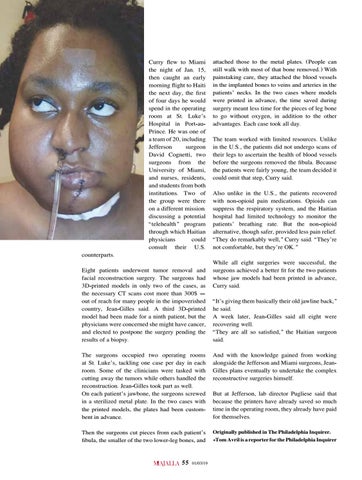
counterparts.
Curry flew to Miami the night of Jan. 15, then caught an early morning flight to Haiti the next day, the first of four days he would spend in the operating room at St. Luke’s Hospital in Port-auPrince. He was one of a team of 20, including Jefferson surgeon David Cognetti, two surgeons from the University of Miami, and nurses, residents, and students from both institutions. Two of the group were there on a different mission: discussing a potential “telehealth” program through which Haitian physicians could consult their U.S.
Eight patients underwent tumor removal and facial reconstruction surgery. The surgeons had 3D-printed models in only two of the cases, as the necessary CT scans cost more than 300$ — out of reach for many people in the impoverished country, Jean-Gilles said. A third 3D-printed model had been made for a ninth patient, but the physicians were concerned she might have cancer, and elected to postpone the surgery pending the results of a biopsy.
attached those to the metal plates. (People can still walk with most of that bone removed.) With painstaking care, they attached the blood vessels in the implanted bones to veins and arteries in the patients’ necks. In the two cases where models were printed in advance, the time saved during surgery meant less time for the pieces of leg bone to go without oxygen, in addition to the other advantages. Each case took all day. The team worked with limited resources. Unlike in the U.S., the patients did not undergo scans of their legs to ascertain the health of blood vessels before the surgeons removed the fibula. Because the patients were fairly young, the team decided it could omit that step, Curry said. Also unlike in the U.S., the patients recovered with non-opioid pain medications. Opioids can suppress the respiratory system, and the Haitian hospital had limited technology to monitor the patients’ breathing rate. But the non-opioid alternative, though safer, provided less pain relief. “They do remarkably well,” Curry said. “They’re not comfortable, but they’re OK.” While all eight surgeries were successful, the surgeons achieved a better fit for the two patients whose jaw models had been printed in advance, Curry said. “It’s giving them basically their old jawline back,” he said. A week later, Jean-Gilles said all eight were recovering well. “They are all so satisfied,” the Haitian surgeon said.
The surgeons occupied two operating rooms at St. Luke’s, tackling one case per day in each room. Some of the clinicians were tasked with cutting away the tumors while others handled the reconstruction. Jean-Gilles took part as well. On each patient’s jawbone, the surgeons screwed in a sterilized metal plate. In the two cases with the printed models, the plates had been custombent in advance.
And with the knowledge gained from working alongside the Jefferson and Miami surgeons, JeanGilles plans eventually to undertake the complex reconstructive surgeries himself.
Then the surgeons cut pieces from each patient’s fibula, the smaller of the two lower-leg bones, and
Originally published in The Philadelphia Inquirer. *Tom Avril is a reporter for the Philadelphia Inquirer
55
01/03/19
But at Jefferson, lab director Pugliese said that because the printers have already saved so much time in the operating room, they already have paid for themselves.