l u x e m b o u r g
sleep in the trains, but they were already part of the low-income group who had the right to free transport, so that shouldn’t change,” reassures François Bausch. Regarding station personnel: “ Ticket offices are being closed down in stations and teller machines set up on the platforms. The station personnel will have an advisory role for members of the public and they’ll increase quality and safety for travellers.” Obviously, railway legislation needs to be adapted.
A BENEFIT FOR FRONTIER WORKERS
34
This measure also benefits frontier workers (who make up almost half of the active population in the Grand Duchy) travelling by train from Germany, Belgium or France for the part of their journey taking place in the Luxembourg territory. Their transport passes will now be cheaper. People travelling from Athus (Belgium), Volmerange-les-Mines or Audun-le-Tiche (France) will no longer need a pass. As these three stations are CFL (Chemins de Fer Luxembourg – Luxembourg Railways) terminuses on foreign territory close to the border, and partly run by Luxembourg, they’re part of the free transport zone.
Luxembourg, a testing ground? More and more countries and cities are contemplating free transport. In France, around 30 municipalities have made this choice, among which is Dunkirk. Paris is seriously considering it. In Estonia, buses are free, but trains remain a paid service, except for residents of the capital, Tallinn.
A NEW PUBLIC SERVICE
At the moment, public transport revenue is approximately 41 million per year and ope-
rating costs are around 600 million. In 2017, a study carried out on the country’s road traffic costs – which included infrastructure maintenance and development, the effects of pollution on people’s health, accidents – estimated that taxes financed a third of every car journey. With this in mind, it makes perfect sense for public transport to be a public service, to reduce road traffic and improve congestion. On the government programme, this measure is an “element in the Modu 2.0, a global strategy whose main objective is to develop infrastructures,” explains François Bausch. In a short period, the Grand Duchy has made enormous investments to develop its transport infrastructure. “Luxembourg holds the world record in this field: we are investing 600 euros per year and per inhabitant in the expansion of the rail network alone, almost double that of Switzerland,” announced the minister, before reminding us that: “While the transport offer is higher in quality, circulation is increasing.” Four billion have already been invested in the railways over ten years with the purchase of rolling stock, the extension of Luxembourg’s station (two extra platforms), the creation of multimodal stations (Howald, Pfaffenthal and soon Ettelbruck), and the development of P+Rs.
MULTIMODALITY IS KEY
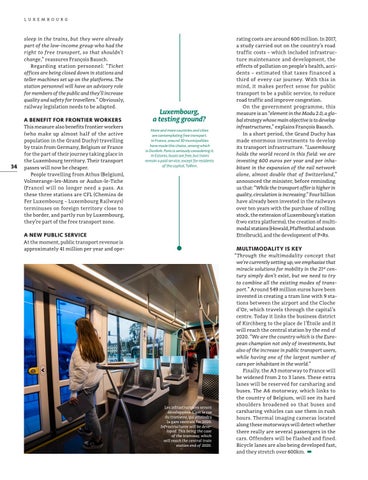
Les infrastructures seront développées. C’est le cas du tramway, qui atteindra la gare centrale fin 2020. Infrastructures will be developed. This being the case of the tramway, which will reach the central train station end of 2020.
“ Through the multimodality concept that we’re currently setting up, we emphasise that miracle solutions for mobility in the 21st century simply don’t exist, but we need to try to combine all the existing modes of transport.” Around 549 million euros have been invested in creating a tram line with 9 stations between the airport and the Cloche d’Or, which travels through the capital’s centre. Today it links the business district of Kirchberg to the place de l’Étoile and it will reach the central station by the end of 2020. “We are the country which is the European champion not only of investments, but also of the increase in public transport users, while having one of the largest number of cars per inhabitant in the world.” Finally, the A3 motorway to France will be widened from 2 to 3 lanes. These extra lanes will be reserved for carsharing and buses. The A6 motorway, which links to the country of Belgium, will see its hard shoulders broadened so that buses and carsharing vehicles can use them in rush hours. Thermal imaging cameras located along these motorways will detect whether there really are several passengers in the cars. Offenders will be flashed and fined. Bicycle lanes are also being developed fast, and they stretch over 600km.