luxembourg at a glance Financial centre
Economy
government
Tourism
Bourse de Luxembourg
Banque Européenne d’Investissement
Ministère d’État
Casino Luxembourg - Forum d’art contemporain
Banking hotspot and investment fund industry
A steel giant and satellite provider
In the heart of Europe
A hub of culture
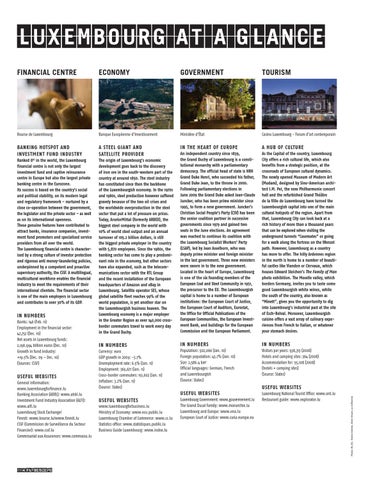
Ranked 8th in the world, the Luxembourg financial centre is not only the largest investment fund and captive reinsurance centre in Europe but also the largest private banking centre in the Eurozone. Its success is based on the country’s social and political stability, on its modern legal and regulatory framework – nurtured by a close co-operation between the government, the legislator and the private sector – as well as on its international openness. These genuine features have contributed to attract banks, insurance companies, investment fund promoters and specialised service providers from all over the world. The Luxembourg financial centre is characterised by a strong culture of investor protection and rigorous anti money-laundering policies, underpinned by a competent and proactive supervisory authority, the CSSF. A multilingual, multicultural workforce enables the financial industry to meet the requirements of their international clientele. The financial sector is one of the main employers in Luxembourg and contributes to over 30% of its GDP.
The origin of Luxembourg’s economic development goes back to the discovery of iron ore in the south-western part of the country at around 1850. The steel industry has constituted since then the backbone of the Luxembourgish economy. In the 1970s and 1980s, steel production however suffered gravely because of the two oil crises and the worldwide overproduction in the steel sector that put a lot of pressure on prices. Today, ArcelorMittal (formerly ARBED), the biggest steel company in the world with 10% of world steel output and an annual turnover of 105.2 billion dollars, is still the biggest private employer in the country with 5,870 employees. Since the 1980s, the banking sector has come to play a predominant role in the economy, but other sectors have also expanded, such as the telecommunications sector with the RTL Group and the recent installation of the European headquarters of Amazon and eBay in Luxembourg. Satellite operator SES, whose global satellite fleet reaches 99% of the world population, is yet another star on the Luxembourgish business heaven. The Luxembourg economy is a major employer in the Greater Region as over 140,000 crossborder commuters travel to work every day in the Grand Duchy.
An independent country since 1839, the Grand Duchy of Luxembourg is a constitutional monarchy with a parliamentary democracy. The official head of state is HRH Grand Duke Henri, who succeeded his father, Grand Duke Jean, to the throne in 2000. Following parliamentary elections in June 2009 the Grand Duke asked Jean-Claude Juncker, who has been prime minister since 1995, to form a new government. Juncker’s Christian Social People’s Party (CSV) has been the senior coalition partner in successive governments since 1979 and gained two seats in the June elections. An agreement was reached to continue its coalition with the Luxembourg Socialist Workers’ Party (LSAP), led by Jean Asselborn, who was deputy prime minister and foreign minister in the last government. Three new ministers were sworn in to the new government. Located in the heart of Europe, Luxembourg is one of the six founding members of the European Coal and Steel Community in 1951, the precursor to the EU. The Luxembourgish capital is home to a number of European institutions: the European Court of Justice, the European Court of Auditors, Eurostat, the Office for Official Publications of the European Communities, the European Investment Bank, and buildings for the European Commission and the European Parliament.
As the Capital of the country, Luxembourg City offers a rich cultural life, which also benefits from a strategic position, at the crossroads of European cultural dynamics. The newly opened Museum of Modern Art (Mudam), designed by Sino-American architect I.M. Pei, the new Philharmonie concert hall and the refurbished Grand Théâtre de la Ville de Luxembourg have turned the Luxembourgish capital into one of the main cultural hotspots of the region. Apart from that, Luxembourg City can look back at a rich history of more than a thousand years that can be explored when visiting the underground tunnels “Casemates” or going for a walk along the fortress on the Wenzel path. However, Luxembourg as a country has more to offer. The hilly Ardennes region in the north is home to a number of beautiful castles like Vianden or Clervaux, which houses Edward Steichen’s The Family of Man photo exhibition. The Moselle valley, which borders Germany, invites you to taste some good Luxembourgish white wines, while the south of the country, also known as “Minett”, gives you the opportunity to dig into Luxembourg’s industrial past at the site of Esch-Belval. Moreover, Luxembourgish cuisine offers a vast array of culinary experiences from French to Italian, or whatever your stomach desires.
In numbers
In numbers
In numbers
Population: 502,066 (Jan. 10) Foreign population: 43.7% (Jan. 10) Size: 2,586.4 km2 Official languages: German, French and Luxembourgish (Source: Statec)
Visitors per years: 938,313 (2008) Hotels and camping sites: 364 (2008) Accommodation for: 55,108 (2008) (hotels + camping sites) (Source: Statec)
Banks: 146 (Feb. 11) Employment in the financial sector: 42,752 (Dec. 10) Net assets in Luxembourg funds: 2,198.994 billion euros (Dec. 10) Growth in fund industry: +19.5% (Dec. 09 – Dec. 10) (Sources: CSSF)
Useful websites General information: www.luxembourgforfinance.lu Banking Association (ABBL): www.abbl.lu Investment Fund Industry Association (ALFI): www.alfi.lu Luxembourg Stock Exchange/ Finesti: www.bourse.lu/www.finesti.lu CSSF (Commission de Surveillance du Secteur Financier): www.cssf.lu Commissariat aux Assurances: www.commassu.lu
Currency: euro GDP growth in 2009: -3.7% Unemployment rate: 6.5% (Jan. 11) Employment: 365,671 (Jan. 11) Cross-border commuters: 151,602 (Jan. 11) Inflation: 3.2% (Jan. 11) (Source: Statec)
Useful websites Useful websites www.luxembourgforbusiness.lu Ministry of Economy: www.eco.public.lu Luxembourg Chamber of Commerce: www.cc.lu Statistics office: www.statistiques.public.lu Business Guide Luxembourg: www.index.lu
Luxembourg Government: www.gouvernement.lu The Grand Ducal Family: www.monarchie.lu Luxembourg and Europe: www.ena.lu European Court of Justice: www.curia.europa.eu
Useful websites Luxembourg National Tourist Office: www.ont.lu Restaurant guide: www.explorator.lu
Photos: DR, BEI, Etienne Delorme, Olivier Minaire, Luc Deflorenne
In numbers
114 flydoscope
15_114_lux_quick.indd 114
04.03.2011 17:30:21 Uhr