58
59
BUSINESS
BANKING
Text by STEPHEN EVANS
Photography by MIKE ZENARI
THE BATTLE FOR PRIVATE BANKING Financial institutions in the Grand Duchy that ser ve wealthy clients have made a momentous pivot over the past two years. But they are not finished evolving yet.
D
efying some predictions, Luxembourg’s wealth management sector has thrived in recent years. It’s not plain sailing, though, and worries about costs and competition are growing. What’s the outlook for the country’s private banks and family offices? There was a more than 10% increase in assets managed by Luxembourg private banks last year, following steady growth earlier in the decade. This appears to vindicate the decision to change strategy toward tax transparency. Since 2015 banks have been required to disclose information about clients’ savings to international tax offices. After the 2007/08 crisis, the country could no longer be seen as a hub for illegal tax evasion, so total secrecy had to go.
CHANGED STRATEGY “It was the big challenge we had to respond to in Luxembourg,” said Hubert Musseau, CEO of BGL BNP Paribas Wealth Management and vice-head of the Luxembourg Bankers Association’s (ABBL) Private Banking Group. “There was a willing strategic decision taken by government and industry players to proactively adapt to a new regulatory environment of tax transparency and compliance,” he explained. No longer would the country allow savers from abroad to hide savings in bank accounts and simple savings products. Details of these holdings were henceforth communicated to relevant tax offices abroad, thus making it impossible for savers to avoid paying their due. The aim was to shift from focusing on serving moderately affluent clients October 2016
living nearby towards wealthier global citizens. The latest figures from the ABBL and the financial regulator CSSF suggest this strategy is working. Clients with wealth of more than €20m account for 55% of the €351bn in assets held by Luxembourg’s private banks. This share is 14 percentage points higher than in 2011. Meanwhile, the relative holdings of the affluent (with wealth under €1m) halved to 12% of the total. Those in between still account for around a third of assets.
DOING MORE FOR THE SAME Other figures point to the efforts being made to achieve this adjustment. Private banks’ income has remained broadly consistent in recent years, at close to the 2015 figure of €1.66bn. Thus, while assets under management have risen, income is stable. In other words, the country’s private bankers are having to work harder just to stand still. This squeeze on profitability is partly the price of the country’s move to clean up its image and come off international financial sector blacklists. However, this is also a trend affecting the whole European industry. “Private banks in Europe now need to manage around 30 per cent more assets to deliver the same level of profits as before the crisis,” Sébastien Lacroix, leader of the McKinsey’s European private banking practice told the Financial Times in August. The consultant has calculated that European profit margins--earnings as a percentage of total assets--are down by a quarter since before the 2007/08 financial crisis. These figures were reported in McKinsey’s European Private Banking Survey 2016. Private banks will be cheered by the prediction that opportunities are increasing. The McKinsey survey suggested the pool of wealth
A
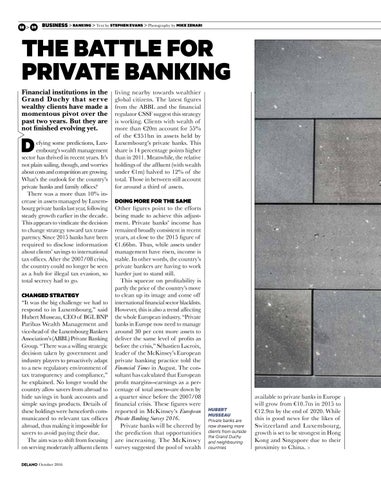
HUBERT MUSSEAU Private banks are now drawing more clients from outside the Grand Duchy and neighbouring countries
available to private banks in Europe will grow from €10.7tn in 2015 to €12.9tn by the end of 2020. While this is good news for the likes of Switzerland and Luxembourg, growth is set to be strongest in Hong Kong and Singapore due to their proximity to China.