6
7
UPFRONT
CURRENT AFFAIRS
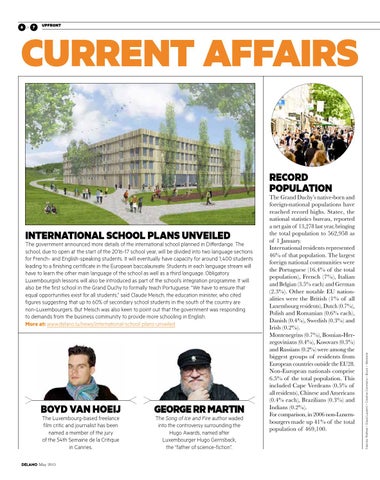
INTERNATIONAL SCHOOL PLANS UNVEILED
The government announced more details of the international school planned in Differdange. The school, due to open at the start of the 2016-17 school year, will be divided into two language sections for French- and English-speaking students. It will eventually have capacity for around 1,400 students leading to a finishing certificate in the European baccalaureate. Students in each language stream will have to learn the other main language of the school as well as a third language. Obligatory Luxembourgish lessons will also be introduced as part of the school’s integration programme. It will also be the first school in the Grand Duchy to formally teach Portuguese. “We have to ensure that equal opportunities exist for all students,” said Claude Meisch, the education minister, who cited figures suggesting that up to 60% of secondary school students in the south of the country are non-Luxembourgers. But Meisch was also keen to point out that the government was responding to demands from the business community to provide more schooling in English. More at: www.delano.lu/news/international-school-plans-unveiled
BOYD VAN HOEIJ The Luxembourg-based freelance film critic and journalist has been named a member of the jury of the 54th Semaine de la Critique in Cannes.
May 2015
GEORGE RR MARTIN The Song of Ice and Fire author waded into the controversy surrounding the Hugo Awards, named after Luxembourger Hugo Gernsback, the “father of science-fiction”.
The Grand Duchy’s native-born and foreign-national populations have reached record highs. Statec, the national statistics bureau, reported a net gain of 13,278 last year, bringing the total population to 562,958 as of 1 January. International residents represented 46% of that population. The largest foreign national communities were the Portuguese (16.4% of the total population), French (7%), Italian and Belgian (3.5% each) and German (2.3%). Other notable EU nationalities were the British (1% of all Luxembourg residents), Dutch (0.7%), Polish and Romanian (0.6% each), Danish (0.4%), Swedish (0.3%) and Irish (0.2%). Montenegrins (0.7%), Bosnian-Herzegovinians (0.4%), Kosovars (0.3%) and Russians (0.2%) were among the biggest groups of residents from European countries outside the EU28. Non-European nationals comprise 6.5% of the total population. This included Cape Verdeans (0.5% of all residents), Chinese and Americans (0.4% each), Brazilians (0.3%) and Indians (0.2%). For comparison, in 2006 non-Luxembourgers made up 41% of the total population of 469,100.
Fabrizio Maltese > David Laurent > Creative Commons > Bruck + Weckerle
RECORD POPULATION