No. 78
MAY 2021
Luxembourg in English
Nasir Zubairi: Driving digital demand The pandemic has prompted a fintech surge. The Lhoft director talks about the winners and the road ahead.
Competitive capital: private equity report €4
Experienced or beginner trader invest 100% online €0 custodian fees From only €14.95 per transaction Open a free account on keytradebank.lu
keytradebank.lu Contact us on +352 45 04 39 Monday to Friday from 9.00 am to 5.30 pm
One step forward, two steps back Cybersecurity made headlines in April with revelations that data from 188,200 Facebook accounts in the grand duchy, including from the Luxembourg prime minister, had been leaked online. The names, dates of birth and email addresses being out there, in the ether, increase the risk that those concerned will be targeted by a phishing attack. I don’t know about you, but after a year of the pandemic, I didn’t have the energy to summon up the anxiety this news merited. I knew I should have changed my passwords, but part of me thought, “it happened in 2019, I think you can sleep on it”. Except that, for the past six months, there’s not a lot of sleep getting done. At bedtime, my brain reverts to that of a petulant child-I’m exhausted but not ready to sleep. The result is that the days feel like a low-energy line dance up Everest, one step forward, two steps back. Your goals always seem just out of reach. Truly, it’s the hardest thing I have ever lived through. There isn’t enough space here to list all the “sleep solutions” I’ve tested. I knew I was getting desperate when I resorted to burning dried sage. At least, it left me calmer than when I read a book about the effects of sleep deprivation on the body. It’s somehow reassuring to know that I’m not alone. I was unable to obtain data on sleep complaints in Luxembourg over the past 12 months, but Google trends for Luxembourg show various peaks in the use of “insomnia” as a search term at the beginning of November, middle of December and end of February. Anecdotally, “how are you sleeping?” has replaced the weather in small talk. I’ve found
myself discussing sleep habits with strangers who, it turns out, are living the same torment. At times, they bring up other ailments: skin conditions, mood swings or memory blanks. We all know it’s the result of being in a sustained state of fight or flight, and that the main solution is better mental hygiene. Thought about that way, it means we’re having daily conversations with strangers about mental health in a country where showing any hint of mental weakness is taboo. According to the country’s free access mental health platform d’Ligue, one in every four people suffers ill mental health and one in five will suffer depression. Yet two-thirds of people experiencing ill mental health don’t seek the help they need. Could this change in future, particularly since employers are becoming increasingly bold about introducing and talking about mental health support and training? I’m hopeful that something positive will come out of it. It doesn’t make the endless treadmill of this pandemic any less hard to live, especially when you’re running on two or three hours of sleep. But at least we’re scaling Everest together. Two steps forward, one step back.
Journalist JESS BAULDRY
3
MAY 2021
Editorial #PandemicFatigue
EMBRACING THE FINEST WINES & SPIRITS DRINK RESPONSIBLY
Caves Wengler S.A. 2 Rue Neuve, L-6581 Rosport
Contents May 2021
Competitive capital: a look at Luxembourg’s private equity sector
06 #POLITICS - DAVID WAGNER
“You risk that these media will disappear” –
08 #BUSINESS - JOOST VAN OORSCHOT
–
38 Head to head THOMAS SEALE VS VIVIANE REDING
Boardroom balance
p. 16 Nicolas Schmit on the EU’s social rights action plan
40 Essay
10 #FINANCE - DIEGO MANZETTI
“Look at insurance law from a broader perspective” –
12 #CULTURE - KEVIN MUHLEN
“You need an open mind”
14 Dashboard
Demographic, financial sector and maritime fleet figures Conversations
16 POLITICS - NICOLAS SCHMIT
“Austerity would be the wrong answer to this crisis” –
22 BUSINESS - NASIR ZUBAIRI
How are parents coping with the increasingly blurry line between personal and professional life? 44 Gusto
Spring cocktails 46 Business Club 50 Pick’n’mix
Money matters
“Suddenly we saw a big spurt in digital demand”
p. 22
Photos
Mike Zenari
Nasir Zubairi on the shift in fintech since the pandemic started
p.40 Working parents in the ‘next normal’
MAY 2021
30 Business report
Ristretto
“It would be in line with landing a rover on Mars”
5
Ristretto #Politics
MAY 2021
6
“You risk that these media will disappear” David Wagner (déi Lénk) is calling on the government to create a legal framework for Luxembourg’s community media, one of his last fights in parliament before he is replaced in May by Nathalie Oberweis. You introduced a motion in parliament to create a legal framework for community media. Why do you think this is needed? It’s necessary because community media are in a precarious situation. You can take the old Luxembourg approach to give them an ad hoc subsidy from one ministry or another. The media ministry has now proposed a convention with Radio Ara for five years, but this isn’t serious. When it expires, it needs to be renegotiated, maybe with a new government. There’s no security. That’s why you need a law that provides a framework, like it exists in many other countries. It’s about the fact that these media exist, whether you want to protect them and allow them to flourish, setting clear rules instead of this piecemeal approach. What do you see as the possible next steps? I’ve considered proposing a draft law, but we’ve had bad experiences with law proposals. You can submit them and then they’re ignored. It’s the right moment for a motion, which would mean that the government has to submit a bill. How do you assess the support by the coalition parties, which you’ll need to get this passed? The DP manages the media ministry poorly. The problem in the coalition is that everyone has their department, and they don’t want to interfere with each other. But I think the LSAP and déi Gréng have understood that you cannot just let the DP carry on, because you risk that these media will disappear or will always be in an unstable situation. I really hope for better cooperation. As an opposition party, déi Lénk frequently submits draft laws or motions to kick off a debate. Are there other topics you want to tackle before leaving the chamber? Many. The digital classroom will stay after the crisis. But it uses tools that are controlled by Big Tech instead of more freeware. Children should learn coding early. But the government’s
logic is to train future Apple employees. My logic is to say that they should learn coding not to be conned by Apple and Big Tech. It’s diametrically opposed. This is a discussion I still want to have. What are some of the things you’re proud of having achieved? When it comes to housing, we’ve done a lot. Of course, the initiatives and draft laws haven’t been adopted so far, but they also haven’t been shot down. You can exert pressure, which I think has an effect. We managed that rents cannot be increased during the crisis. We demanded this until December this year, which was followed by the government saying it would be until mid-year. It’s a partial victory. Otherwise maybe nothing would have happened. What is it like leaving the chamber during the pandemic? It’s strange to leave right in the middle. But when you’ve been doing something for a long time and enjoy it, it’s always a strange feeling. It’s healthy to take a break though. It’s not a farewell. I will stay politically active and will have more time for the party itself. Do you have any advice for your successor? Not to let yourself be impressed by the jargon of politicians. It’s important to know your worth and not to be ashamed to ask questions that could appear naïve. If you’ve been in parliament for a long time, you start seeing things as normal that really aren’t normal. That’s why it’s good to leave from time to time. There’s cynicism to it. When you’re new, you question why things are being done the way they are. David Wagner became an MP in April 2015 and is leaving as part of a party rotation plan
Interview CORDULA SCHNUER Photo ROMAIN GAMBA
COLOURS are our thing Showroom: 7, rue de Godbrange L–6118 Junglinster
layout © marcwilmesdesign.lu | picture © eijffinger
T. 42 64 95 – 1 www.phillipps.lu
home specialist
Ristretto #Business
MAY 2021
8
“It would be in line with landing a rover on Mars” Solar panel technology firm Maana Electric is one of the recent joiners to Luxembourg’s space ecosystem. CEO and founder Joost van Oorschot explains why Earth is just a stepping-stone in its strategy. What’s your business premise? Maana Electric uses its proprietary in situ resource utilisation technologies to produce solar panels using locally available resources. It means that on Earth, we can deploy one of our small factory systems to a desert area, and we can use the local desert sand to produce fully functional solar panels. Our long-term goal is to do the same on the moon, where we would send one of our small factories to use the local moon dust, the regolith, to produce fully functional solar panels on the moon. And we sell solar panels, and build and operate these small factories. Luxembourg doesn’t have much sand or sun. Why settle here? What Luxembourg does have is a very great space community, and of course our technologies come from the space industry. Originally, that’s why me and the co-founders created [the company]. We have the experience from the space sector, and Luxembourg is one of the few places that have the legal framework which would allow us to use those space resources. The space portion will always be a critical part of our business. We see the terrestrial portion as a kind of stepping-stone to allow us to test our systems to improve on them before sending them to the moon. When is that likely to happen? That’s something that we hope we could achieve by the end of the decade, but it’s going to take some time. It’s very much dependent on all the other players in the market. In terms of a mission, it is not a small feat. It would be in line with landing a rover on Mars. It will take a lot of time, effort and people to make it happen, so we’ve a long journey ahead. Space aside, how has it been received here on Earth? The solar panels that we are intending to produce here on Earth are meant for the energy industry or solar project developers. In general, the
reception is good because they see it’s different to what they have seen in the past. Yes, you can buy solar panels in China, but here we are coming with a really different angle and we do have advantages over other processes. We are much cleaner in the production process. Standard solar panels have a lot of toxic chemicals that are used in them. Also, a lot of carbon emissions are used in the production process. We don’t have that issue. And then, we had the Suez dilemma recently, which makes everyone think, ‘Okay, how about local production?’ It can be useful to have local production. And that’s really what we focus on with our technology. You’re competing with big players in China, which manufactures the lion’s share of solar. How did that happen? The solar revolution really happened in Europe. Until 2008, Germany was the biggest manufacturer of solar panels in the world. But, following the financial crisis, the Chinese government dumped a lot of capital into this industry. China has basically taken over, not just in solar, but in many things, as the manufacturing state of the world. I understand you’re moving in June to a new site in Foetz. Are there other expansion plans? We needed more space, so we’re going to have close to 2,000 square metres. It will be both for R&D, manufacturing and assembly. For now, we see this as a place we can settle for a longer time and we also have the possibility to expand it. We’re always looking to grow, but first we have to get our full facility operational, which will be early next year. Once that’s done, we will look at the next step.
Serial entrepreneur Joost van Oorschot went to International Space University to develop the idea for Maana Electric
Interview JESS BAULDRY Photo ROMAIN GAMBA
Ristretto #Finance
MAY 2021
10
“Look at insurance law from a broader perspective” Diego Manzetti, a lawyer with a large American non-life insurer, talks about co-founding the Luxembourg chapter of the International Insurance Law Association (Aida) last year. What brought you to Luxembourg? I’m from Italy. I moved to Luxembourg in 2018, when my employer moved its European headquarters to Luxembourg as a consequence of Brexit.
developed, in terms of the attention that the regulators have on how companies deal with the pandemic, also in terms of coverage... Companies with their headquarters in Luxembourg, but with offices in other countries, have to make sure that they are keeping very good knowledge of the different requirements that have been introduced in all the different countries. Because if a company operates, let’s say, in 10 markets, but with a headquarters in Luxembourg, then, of course, you need to be aware [of 10 sets of local rules] and there’s a lot of coordination to be done in relation to what rules apply to your employees, what rules apply to the policies you sell in those countries.
Were you already active in Aida? Yes, I was involved in [the regional committee for] Aida Europe… and when I moved to Luxembourg, I thought it would be good to be involved in the Aida Luxembourg chapter, when I realised that actually, there wasn’t an Aida chapter in Luxembourg. Although it’s interesting to know that Aida was actually founded in Luxembourg originally... it was 1960 when Aida International was founded in Luxembourg, but then with the years, the organisation left the country. What does Aida try to accomplish? It’s a community that not only includes lawyers that work for [insurers], but it brings together different professionals that are interested in insurance law, coming from companies, but also law firms, the regulators, universities… so it is a place where we can look at insurance law from a broader perspective.
Are national rules sometimes contradictory? Most of the rules come from European legislation, so they remain in a way more or less aligned, outside of covid, of course. But when you need to coordinate with many different countries, with employees based in different jurisdictions, even a slight change in one rule from one country to another may have a real impact on you, because you cannot apply a consistent approach to solving a problem. We need to [create documentation] country by country, which requires increased cost. That may be seen as not material, but when you really have to deal with a large number of employees, a large number of countries, there’s an impact, and that’s where I think, as Aida, we can bring value. Because we can speak with the different players that have different experiences. We are connected with our colleagues at Aida around Europe, and so we can get their expertise.
How did you get things off the ground here? Aida Luxembourg was formally accepted within the Aida community at the end of 2020... we found the good partner in Luxembourg to start our activities in the ALJB. That is the association of banking lawyers. So Aida has been formed within ALJB, to start with. Membership of Aida Luxembourg comes together with membership of the ALJB. And we are working together because we believe that there are a lot of common interests between the banking and insurance sectors, and there are a lot of commonalities. And therefore, we created this, let’s say, a sort of joint venture and we started this adventure together. How has the pandemic changed the sector? [Covid] changed the way we work, in terms of the work from home environment that before was less
Diego Manzetti, president of Aida Luxembourg, previously lived in Italy and the US
AIDA Luxembourg
Interview AARON GRUNWALD Photo ROMAIN GAMBA
ACTIVELY Yes, you can imagine the future with serenity: innovative, bold even, or simply confident. Yes, you can dare to go further and further; at the end of your projects and your dreams because you are in good hands with our teams of experts. Dedicated teams who take actively care of your assets so that tomorrow belongs to you. Want to know more? www.degroofpetercam.lu Or make an appointment at +352 45 35 45 42 19
Imagine Tomorrow since 1871
Banque Degroof Petercam Luxembourg S.A., 12, rue Eugène Ruppert - L-2453 Luxembourg, R.C.S. B25459.
And you, how do you IMAGINE the future?
Ristretto #Culture
MAY 2021
12
“You need an open mind” This year marks the 25th anniversary of contemporary art venue Casino Luxembourg. Artistic director Kevin Muhlen discusses the venue’s missions and art in pandemic times. How has the Casino evolved over the last 25 years? It permanently evolves. When the Casino was founded, it was the first place [in Luxembourg] where you could see and experience international contemporary art. The environment has developed; new venues have joined. The Casino isn’t alone anymore with a monopoly on contemporary art. We must make sure to find our path in this evolution. We adapt; we evolve; we see what the cultural scene has to offer.
We have a small programme of events, a film screening. It’s not the same as in previous years but people adjust. What are the wider implications of the pandemic for the contemporary art world? The art world is organised around big events where people meet and exchange, around fairs, galleries. When all these things cease, what remains to keep the art world alive? The art itself. But the market needs places where collectors get together. A lot of artists are cooped up in their studios, which is great, because they can work. But it’s also isolating. They cannot travel to where they need to be. Preparing an exhibition is difficult. It’s challenging.
You’ve been artistic director since 2009. What have been some of your highlights? There are many highlights and many great memories. Next year, we are hosting an exhibition of a project we’ve been following for nearly ten years by French artists Fabien Giraud and Raphaël Siboni. In 2014 there was a first exhibition, the second in 2018, and the third and last one will be in 2022. To follow this has been very exciting. There are a lot of international collaborations. A real network has developed. We try to stay cuttingedge, experimental, to give artists a platform where they can blossom and try things that they can’t do in the art market or a museum institution.
Where do you see the Casino’s role in promoting Luxembourg artists? We work a lot with Luxembourg artists, not only locally but also internationally. We’re now also in a generation of artists for whom the Casino has always existed. In February, we opened a new space, the Casino Display. It shows very young artists. But it’s also a place where young people who are curious about studying art or who want to get an insight can go and receive advice, have discussions.
The pandemic has probably been more of a challenge than a highlight. How have you experienced this past year? It was strange, closing down in the spring not knowing when we’d reopen. We work according to a schedule, a programme. And when everything collapses from one day to the next, you must rethink. It was strange to see exhibitions that just sit there, works that aren’t alive in the interaction with the audience. Luckily, we weren’t closed that long, but it had an impact. The Museum Days are taking place this year on 15 and 16 May. What can visitors expect given the constraints? Everything is a bit more stretched across the two days, less compact than normally. But we’re adapting; we’re open. Every museum has its own concept. We’re well equipped to welcome people.
Does contemporary art still have to compete with more traditional art? There are always people who prefer more classical or traditional art. We facilitate access. But the ambition of an exhibition shouldn’t be determined by appealing to the public. When audiences become used to being confronted with contemporary art, they become more comfortable with it. You need an open mind.
Exhibitions should challenge audiences and not just appeal to them, says Kevin Muhlen
Interview CORDULA SCHNUER Photo ROMAIN GAMBA
You are the reason we made it to 40. Thank you!
It’s great to build, especially when we have the satisfaction of putting a smile on your face. Driven by passion and enthusiasm, #TeamCLK stays on top of the trends and innovates continuously for you to have the best construction experience possible. Over 2000 clients have already trusted us. Now it’s your turn!
Visit CLK.lu and follow us on social networks to discover the world of CLK Constructions.
Dashboard #DemographicsAndFinance
14
Source -2.5
-2.0
-1.5
Eurostat
-1.0
-0.5
0
0
0.5
Liechtenstein**
+14.5% Increase in Luxembourg home prices (on a national, unweighted basis) in 2020. Source
Statec
-1.1%
Spain Bulgaria Lithuania Poland Romania Belgium Italy Czech Rep
Profitability of Luxembourg’s banks in 2020, compared to 2019. The decline was partially driven by increased expenses and restructuring costs.
Slovenia Luxembourg
Source
Slovakia Croatia Hungary
Luxembourg Financial Sector Supervisory Commission (CSSF)
80%
Portugal Sweden Switzerland** Austria France Netherlands Greece Estonia
Proportion of people who teleworked last year that would like to continue working remotely to some extent.
Malta Germany Iceland**
Source
Cyprus
Chamber of Employees
Latvia Denmark Finland
“ The development of digital tools in health technologies is of crucial importance for the Luxembourg economy.”
Norway**
*Figures for Ireland & UK not available **Non-EU countries
POPULATION BY NATIONALITY, AS OF 1 JANUARY Luxembourg’s population grew by 1.3% last year. Foreigners make up 47% of the total. The number of British and Portuguese declined, but much of that was due to residents acquiring Luxembourg nationality. Migration from outside of the EU rose notably. Source
POPULATION 2020 626,108
94,335
22,996
48,502
Luxembourgers 335,304
23,532
19,823
19,613
12,849
12,785
4,168
4,127
39,863
41,271
5,317
France
55,261
Italy
Other EU †Britain was counted in EU figures until 2020
Belgium Britain†
Germany Other Non-EU
4,561
Netherlands
Matic Zorman (archives)
47,805
Luxembourgers 329,643
Portugal
The economy minister (LSAP), announcing a pilot healthtech R&D funding project, to be administered by the National Research Fund and Luxinnovation. Proposals can be submitted from 4 May to 30 June.
POPULATION 2021 634,730
95,057
48,587
Franz Fayot
Statec/CTIE
Photo
MAY 2021
CHANGE IN LIFE EXPECTANCY, 2020 Life expectancy declined across most of the EU* in 2020, compared to the previous year. A baby born in Spain last year was expected to live 1.6 fewer years than one born there in 2019. The projected lifespan of a baby born in Belgium was cut by 1.2 years. However, life expectancy increased in some Nordic countries.
LUXEMBOURG FUND ASSETS
LUXEMBOURG MERCHANT FLEET
Total net assets in Luxembourg-domiciled investment funds increased by 9.04% in the year to February 2021*.
The total number of barges, cargo carriers, cruise ships, tugboats and other maritime vessels registered in the grand duchy has remained relatively stable in recent years, but the fleet is roughly 10% smaller than a decade ago.
Source
Luxembourg Financial Sector Supervisory Commission (CSSF)
Source
MAY 2021
15
Luxembourg Maritime Administration
Nov 2019 Dec 2019
300
Jan 2020 Feb 2020
250 230
March 2020
243
260
247 225
220
2015
2016
April 2020
209
207
215
216
2017
2018
2019
2020
200
May 2020 June 2020 July 2020
150
Aug 2020 Sept 2020
100
Oct 2020 Nov 2020
50
Dec 2020 Jan 2021 Feb 2021
0 €1trn
€2trn
€3trn
€4trn
€5trn
€6trn
2011
2012
2013
2014
0
*Figures for the last day of each month.
CONSUMER CONFIDENCE INDICATOR While the central bank’s indicator* has recovered some ground since the height of the pandemic, Luxembourg households remain broadly pessimistic about the economy and their own financial outlook. Source
Central Bank of Luxembourg (BCL)
*The indicator represents “the difference between the percentages of respondents giving positive and negative replies” across four components. Seasonally adjusted.
5
0
-5
-10
-15
-20
-25 January
2018
February
2019
March
2020
April
2021
May
June
July
August
September
October
November
December
MARCH 2021 Nicolas Schmit, Luxembourg labour minister between 2009 and 2018, was a member of the European Parliament before his appointment as EU commissioner in 2019
Conversation Nicolas Schmit
“Austerity would be the wrong answer to this crisis” The European Commission launched, in March 2021, an action plan to strengthen social rights in the EU. Nicolas Schmit, commissioner for jobs and social rights, says it’s time to give the union a more social face and show it works for everyone. Interview CORDULA SCHNUER Photos MIKE ZENARI
The European Pillar of Social Rights the urgency of taking care of social issues, is a wide-ranging package of and also better integrating the social principles and ideas. You presented dimension in our policies, national and an action plan in March to turn it European, has been clearly underlined. into practice. Why is this project so important for Europe? The pillar doesn’t give the commission The pillar was an important project any more competences on social before the pandemic, and it has become rights. Do you wish the commission had greater powers in this domain? more important since the pandemic. We saw--and this was already the case We could have a bit more competence for the Juncker commission--that after in some areas, like health policy. This is the financial crisis the social gaps in a consequence of the pandemic. People Europe increased, that citizens didn’t really recognise themselves in this kind of Europe, where the social dimension wasn’t considered very important. BACKGROUND I think that was the reason why [JeanNovember 2017 Claude Juncker] came up with this The European Parliament, council and commission proclaim the proposal. The pillar is 20 principles. European Pillar of Social Rights at the And immediately afterwards came the Gothenburg Summit. It sets out 20 demand to have an action plan. And key principles on equal opportunities, labour market access, working that’s what this commission decided conditions, and social protection from the outset. We came up with a and inclusion. document where we outlined the difMarch 2021 ferent directions in which we would The European Commission under like to go, and then came the pandemic. Ursula von der Leyen presents an action plan to implement the pillar Social issues became very obvious: across member states by 2030, investment in health, investment in social turning principles into concrete actions. services; inequality is growing, poverty is growing, unemployment is also growMay 2021 The Porto Social Summit aims ing, youth unemployment is growing. to renew political commitment The action plan isn’t fundamentally difto implement the pillar, also with ferent from what it would have been if a view to ensuring fair climate and digital transitions. we hadn’t had the pandemic. But I think
consider Europe isn’t doing enough. The EU perhaps isn’t doing enough, because we don’t have the competences to do more and national governments, when things don’t work as they should, try to say that’s because Europe doesn’t function as it should. There are areas where there should be clarification, perhaps adjustments in competences, but I do not request major additional competences in the social area. We respect the social systems of the member states. What we need is more convergence, more cooperation, more coordination. Because social rights are mostly a national competence, what will be required of member states to make the social pillar and the action plan a success? The pillar is about very clear and concrete issues. It’s about education and skilling; it’s about gender equality; it’s about access to good quality social services; about youth employment. These are very clear issues, which have to be addressed in all the member states. We know that the situations in member states might be very different. We are, in a way, helping member states to build up the right policies in their specific contexts. It’s not one size fits all; our social systems, educational systems are very different. We always have to take this into account. But nevertheless, there are
MAY 2021
17
Conversation
18
CV
MAY 2021
common interests and common approaches. I think we have a role to create the right incentives to improve public policies.
Nicolas Schmit (67) first joined the government as an LSAP member of cabinet under prime minister JeanClaude Juncker in 2004, when he was appointed secretary of state for foreign affairs and immigration. In 2009 he became labour minister. In 2018 Schmit turned down a cabinet post so he could run in the European elections, becoming an MEP within the S&D group. He was the only candidate Luxembourg put forward for its commissioner post in 2019, despite a request by president Ursula von der Leyen for each country to propose a male and female nominee. Already in 2013, Schmit was being touted as a possible commissioner, but Luxembourg’s seat was occupied by president Juncker after the European elections in 2014.
You said that the pandemic didn’t fundamentally change the action plan. Nonetheless, were there priorities that shifted compared to what you originally envisioned in 2019? Absolutely. Health has become an absolute priority. What has been done during the last 20 years? In a very budgetary logic, some would say austerity logic, there have been a lot of cuts in the health system. We have diminished the number of hospital beds, we have not equipped hospitals with adequate staff, which means that, today, people working in the hospitals are facing an absolute work overload. We have quite harsh austerity policies. They have to reflect on how to invest in social infra- shown that you can have a balanced ecostructure in the future. Digitalisation, which nomic and social and budgetary policy was absolutely on our radar, has devel- without austerity. They had cautious but oped much more rapidly than we expected. active fiscal policies, trying to rebuild There is a transformation going on with the social fabric, and, at the same time, telework, with robotisation. We have to investing a lot of money in the developtake into account the social dimension of ment of the economy. Thinking that austhese accelerating transformations. The terity by itself produces growth is absurd. pandemic has given more pressure in cer- This is a big lesson which we have learned. tain areas, but these are things which were We have understood that austerity would already present before. be the wrong answer to this crisis, as opposed to the previous one. Is it somewhat symbolic that the commission launched the action Comparing the two crises, would you plan under the Portuguese EU Council say that Europe is more united now presidency, given that Portugal than it was then? suffered a lot under EU austerity in the Yes, I think so. Because there is the awareaftermath of the 2008 financial crisis? ness that this crisis is different. First, It’s fortunate that we can launch the action everybody was hit, at a different level, plan under the Portuguese presidency. but everybody was hit. And there’s also But this wasn’t planned. It just worked the awareness that if one country is in out like that. The Portuguese government great difficulty, that might spill over to is very much committed to the social all the others. This was also the case with dimension of Europe. They experienced the financial crisis, but here the idea was: you have to find your solution and you have to put your house in order. But now, we know that in this pandemic, we have to find solutions collectively. There are still some divergences. But the fact that, for the first time, a common major financial programme was adopted, was a very strong signal.
“ We have to show that we are working for all Europeans on the best possible solutions. ”
The aftermath of the 2008 crisis gave rise to a lot of anti-EU sentiment and populism. Has this crisis been better for the EU and for how people feel about the EU? I hope so. We try to show that Europe is there. Very early on, we launched the Sure
instrument, a €100bn programme. We put this together in a very short time. Millions of people in Europe could keep their job. They were supported, they could keep their income, also thanks to short-term work financed by the European Union. I think Europe was very present during this crisis. We did our utmost. There will always be critics. But if AstraZeneca isn’t providing the right stuff? Well, it’s AstraZeneca having a problem because they made commitments they couldn’t fulfil. Overall, I think Europe has done what it could do in many areas. We have to work on showing that the right way was solidarity and not falling apart, because that would have really created major problems. What are some of your next steps for the action plan? The steps are already being taken. It’s a work in progress. We have adopted a child guarantee. We have millions of children in Europe living in very poor conditions. 22% of children in Europe are at risk of poverty. We are proposing measures to lift them out of poverty, to help children in need. This is part of the action plan. We will work with member states on how to put into place the right infrastructure. Good childcare for everybody, free childcare for those who need it are things which have to be financed. We will try to provide money to support member states that will have difficulties to afford this. This is a good example of how the action plan will function. We are working now on platform workers [editor’s note: gig economy workers using online platforms, such as Uber]. Should they have social protection? Should they get minimum wage? In some countries, this has been decided, in others not. We will work on a scheme [on] how to address the question of working conditions for platform workers. This is how the action plan will function over the next years. An EU minimum wage consultation was one of the first initiatives you launched after taking office. What kind of progress are you seeing in that debate? We have made a proposal which is on the table. The European Parliament is working on it, the council is working on it. The Portuguese presidency is trying to make real and rapid progress on this file, which is an important one. Ten years ago, dur-
Nicolas Schmit
19
MAY 2021
European problems need European solutions, says Schmit, but the commission’s competences in the social field are limited
SOCIAL EUROPE ing the financial crisis, the mantra was that wages have to go down. Overall, now, we say wages have to be decent in all parts of Europe and we have to work on wage convergence. We cannot have one minimum wage in Europe, but we have to have wage convergence more rapidly than in the past, also by investing in the economy. Investing in technology, investing in knowhow, in skills, is essential. I hope that we can make progress rapidly and adopt this important proposal. You recently discussed plans to tackle homelessness in the EU. What do you have in mind for this particular issue? This is mentioned in the pillar: affordable housing and fighting homelessness. While it’s not a European competence, it’s a European problem. When hundreds of thousands or perhaps more than a million people in our cities have no home and live on the streets, and even children sleep in the streets, we cannot just look the other way. With the Portuguese presidency, we will have a
In a Eurobarometer survey carried out between November and December 2020, 88% of respondents from across the EU said a social Europe is important to them personally. In Luxembourg, this number was even higher, at 91%. At the same time, 71% of people in the EU said they had never heard of the European Pillar of Social Rights before the survey. In the grand duchy, this number was significantly lower, at just 57%. The top three policy areas that respondents across member states want the EU to take action on were health care, social protection and wages. In Luxembourg, the top two priorities were social protection and education, with both health care and equal opportunities tied in third place.
first conference where we will create a framework for combating homelessness all over Europe. We will involve cities, regional governments, member states, institutions in Brussels, the Committee of the Regions, Eurocities and say: this is a European problem; let’s find good European solutions. And the commis-
sion helps, supports financially, connecting one with the other. I hope that this will be an important political moment, because it means that Europe takes care of those who are at the bottom, those who are in great difficulties. How much more difficult has your job become because of the pandemic? It has become more difficult in some ways, and in some ways it has become easier. It has become more difficult because we have a lot of meetings, we have to take care of a lot of problems. The pandemic is now everywhere, in the job market, in poverty, in schools. It’s become an overwhelming problem. I’ve not travelled, which I regret. But at the same time, I’ve met a lot of people, probably more much more than I would have, had I been able to travel. It’s a new way. It’s demanding. But I think we have to show that we are working for all Europeans on the best possible solutions. That’s also stimulating.
The new Volvo XC60. Luxury, but smarter. The new Volvo XC60 is one of the very few cars to include Google’s real-time traffic information from Google Maps, thereby taking connectivity to a whole new level. Thanks to voice control, all you have to say is “Hey Google” and your on-board computer will obey you in an instant. In addition, its many radar, camera and ultrasonic sensors will help you avoid or mitigate collisions letting you drive even more safely, and in complete peace of mind. Long live luxury, especially when it’s smart. At € 395/month*.
AT TENTION, BORROWING MONEY ALSO COSTS MONEY. 2,4 – 9,1 L/100 KM I 55 – 216 G CO2/KM (WLTP)
Contact your retailer for information about your vehicle taxes.
Visual for illustrative purposes only. Environmental information: www.volvocars.lu
* Representative example: instalment loan with higher final monthly payment. Credit amount: €35,221.46. Down payment (optional): €7,731.54. Price: €42,953. Annual Percentage Rate (APR) of 3.39%, fixed annual borrowing rate: 3.39%. Over 60 months. Repayable with 59 monthly payments of €407.62. Final monthly instalment of €15,441.17. Offer valid from 01/4/2021 to 30/6/2021. Total amount due: €39,490.65. Illustrated example is for an XC60 B4 Mil Hybrid Momentum Pro. Monthly payment: €395/month. Credit amount: €42,042.30. Down payment (optional): €7,798.85. Contract length: 60 months. Number of monthly payments: 59. Final monthly payment: €15,109.59. Total amount to be paid: €38,401.97. Subject to acceptance of your credit application by Alpha Crédit s.a., lender, boulevard St Lazare 4-10/3, 1210 Brussels. VAT BE 0445.781.316, RPM Brussels. Advertiser: Volvo Car Belux, Av.Hunderenveld 10, BE-1082 Berchem-Sainte-Agathe VAT 0420383548 Your Volvo retailer acts as a credit go-between.
Nasir Zubairi became CEO of the Lhoft in 2016
Conversation Nasir Zubairi
“Suddenly we saw a big spurt in digital demand” CEO of the Luxembourg House of Financial Technology Nasir Zubairi has seen a seismic institutional shift in adoption of fintech and regtech solutions since the pandemic. He explains why some solutions are game changers. Interview JESS BAULDRY Photos MIKE ZENARI
It’s been a challenging year for everyone. What changed at the Lhoft over the past 12 months? I shut down the office three or four days before the official lockdown. And obviously, just as everyone else did, we had to pivot to a digital remote model. A lot of our work, which is around community events, domestically and internationally, all shut down. There hasn’t been a physical event for a year. We had a quick strategic review and part of the agility we have as a team is that we pivoted everything to digital. Also, what we started seeing among members was confusion. At the beginning nobody quite knew what was happening, there was a lot of uncertainty to do with lack of business or business shutting down and managing costs. So, we focused very much firstly on providing a lot of information. We put together cheat sheets for all the different funding schemes because, yes, there was a lot and the government did a fantastic job to put out all these funding schemes, but wading through each one knowing which one was right, it wasn’t easy. We put together an A4 slide saying, ‘this is applicable to this business, with these criteria’. We tried to hold their hands and soften the blow. Have there been any surprises during this period of uncertainty? For three to five months, a lot of the firms
here were really anxious because a lot of them are servicing the banking sector and the finance sector and obviously the finance sector themselves had to dig in and look internally, to see how they would ensure business continuity during this period. But after these three to five months, operations began running smoothly. That’s when we started to see demand seeping in from the finance sector for technology tools. Because a lot of them realise that technology is critical to their
LHOFT MEMBERS RAISING FINANCE In mid-March 2021, peer-to-peer investment platform Stokr successfully raised €3.9m in its pre-series A funding round. It received strategic investments from Borderless Capital, Utopia Genesis Foundation and G1 Ventures. It plans to scale up its investment platform to meet the growing demand for EU-compliant security token offerings. HQLAx in January 2021 raised €14.4m in funding from a number of financial investors. The funds will help combat European collateral fragmentation by boosting connectivity. Email management firm EmailTree raised an additional €1.4m in February 2021, through four new investors. Founded in 2019, it will use the finance to help automate more work processes.
business continuity. How do you get a signature and verify the identity of somebody if you can’t meet them face to face? Arguably I will say somebody signing a piece of paper is nonsense anyway. Many firms would have somebody sign something and fax it. But how do you pick up a fax if you can’t go into the office? I find the whole thing archaic! I wouldn’t know how to send a fax. So, a lot of firms which we look to develop in Luxembourg in the regtech sector became quite in demand because they provided these solutions. A lot of institutions started saying we need to talk to them. And suddenly we saw a big spurt in digital demand. A lot of firms have done quite well as a result. We know that a lot of innovative tech startups like Airbnb and Uber emerged in the fall-out of the 2008 crisis. Who do you expect to be the winners in Luxembourg of this crisis? I’m not going to say anyone is going to be the next giant like that. But I think the firms that will do well over the next few years will be the tokenisation platforms, the blockchain companies. There’s a multitude. Also, cybersecurity firms. With this increased use of digital comes the issue of protecting digital. So, I think security is going to explode in terms of firms that are helping deal with cybersecurity issues as a general sector and I think we’re well placed for that as well.
MAY 2021
23
Conversation
24
MAY 2021
Lhoft has 162 members, of which 75 are resident
How does the current surge in demand for fintech compare with the period after the 2008 crisis? I’ve only been in Luxembourg for five years. I don’t have any knowledge of what came out in Luxembourg around that time. Was the sector lagging behind in Luxembourg? The fintech sector? Definitely. That’s partly why we were set up in the first place. The minister of finance said there was a lot going on around the world and there didn’t seem to be much going on in Luxembourg around financial technology, which is really the sort of the foundation of setting up the Lhoft. There weren’t many fintech firms in Luxembourg, let’s put it that way. To what extent will this surge in demand for fintech solutions be lasting?
When you have a crisis of this kind of scale, and there have been other crises in history, the economic impacts tend to be delayed significantly after the actual point in time. When I hear others, be it from economic institutions, think tanks or public sector bodies, saying Luxembourg’s doing OK, I’m like, ‘it is today, but not tomorrow’. You often see in the GDP figures that Luxembourg doesn’t seem to be doing too badly, better than every other European Union country. And then you have to ask yourself how much of that is actually attributable to the real economy, i.e., physical business, and how much of it has just actually happened? Asset prices are at an all-time high, the US market is flying. What is our core business in Luxembourg? It’s investment funds. You saw the numbers probably recently that we’ve now surpassed 5 trillion [euros] in assets. Do you think any of that is attributed to business? No, it
has just happened. That doesn’t mean the economy’s necessarily doing well. Businesses, horeca particularly, is in dire trouble. You can just see the high street over here is shutting down. And we’re beginning to see now in our sector one or two firms getting into trouble as well. But that’s expected to happen. Not all firms are going to survive this. Surely that’s true even in good times? Exactly. Actually, generally I’m quite chuffed that we seem to have a very robust sector. I mean, if you look at the data, 8 out of 10 small businesses will go bankrupt. I think over the past four years, I’ve known of five firms in our sector to go bankrupt. So, it’s held together pretty well. But every sector is going to suffer. On the innovation side, the incubator at the University of Luxembourg is seeing unprecedented numbers
Nasir Zubairi
Tell me more about that. It’s an initiative by a guy called Sergio Coronado. I don’t understand how many hours in a day he has. He’s chief information officer at [the] Nato [Support and Procurement Agency] but somehow managed to set up this tech school which provides technology education to teenagers between the ages of 13 and 18. And the terms of Tech School are aligned with school terms and they do it as an afterschool activity. They have a hackathon. It’s amazing what they develop in 36 hours and demonstrate, it’s incredible! Generally, where does the fintech innovation in Luxembourg come from, outside of the grand duchy or among residents and natives? There’s a bit of a mix and match. But, Luxembourg is always going to have limitations because of the numbers of people, with a population of just 600,000. A lot of the innovation is coming from abroad into Luxembourg, where firms choose Luxembourg as a good place to set up their business, particularly in fintech services. It’s the leading EU financial services centre. You also need to look at it from an incentive perspective. If you’re already in Luxembourg, working in Luxembourg,
ple lose jobs, that spurs opportunity for people to set up new businesses, to try to build something for themselves because they’re forced into a corner. So, hopefully, we’ll see a lot of new innovation coming from that.
MAY 2021
let’s face it, the salaries are very high here, the cost of living is high. Everyone has an element of risk aversion and to take the risk to set up your own business is a big thing when you’ve got a nice, cushy job paying quite a lot of money and you’ve got a mortgage to pay off or high rent. So, sometimes it’s the renewal or freshness of new talent coming in, the people who don’t have that history, that will bring in a lot of innovation. I do think [that] we are beginning to see job cuts occurring. Not everyone is suddenly going to leave Luxembourg. But as is always the case in times of recession where peo-
How does the Lhoft work with other financial platforms like Luxembourg for Finance? You do have a sort of promotion role, but you also really develop financial solutions while LFF is purely promotional. That’s a good way to look at it. We work closely with everyone, since day one.
VOLUME DECLINES OVERALL AMID GLOBAL PRESSURES Total global investment activity (venture capital, private equity and M&A) in fintech, 2017-2020#. Source
Pulse of Fintech, KPMG International
€bn 120
€108.3bn
100
80
60
€50.6bn
40
€21.8bn 20
0 Q1
Q2
Q3
2017
Q4
Q1
Q2
Q3
2018
Q4
Q1
Q2
Q3
2019
Q4
Q1
Q2
Q3
2020
Q4
#As of 31 December 2020
of new products and services from wannabe entrepreneurs. How does this feed into your ecosystem? It’s great to see young people innovating and being enthusiastic about innovation. Theirs is broadscale innovation, it’s not just finance. Although there’s been some great success stories. I’m not wearing them today, but Filip Westerlund [of Our Choice] gave me a special pair of his sneakers early on. He’s doing great job, he’s very charismatic, you can tell the guy’s going to be successful. There’s also a guy who does sustainable housing. At the Lhoft we love to support education very heavily and we’ve seen over the years more and more of a pivot towards focusing on education, particularly under digital. We’ve run over 90 webinars and seminars, online since last March, all education focused. We’re currently running a series on AI. So, we’re focused on finance, the fintech ecosystem, but we have programmes focused on children from the age of 3 or 5, and we focus on older youth at university and the Luxembourg Tech School.
25
Conversation Nasir Zubairi
MAY 2021
26
I remember a lot of the suspicions when I was meeting people initially until we proved this. We’re here to collaborate with everyone. The strength of Luxembourg is working together. It’s a small country so that’s really the USP in this country. I see it almost from a small business perspective, in that LFF are the sales guys or business developers and we’re the product managers. We’re a product within Luxembourg but, because we’re the experts in what we know, we often support LFF internationally. We’ve often been going all over the place when we can to support LFF. We also work with the ministry of economy, ministry of foreign affairs, the Chamber of Commerce, and with [the Association of the Luxembourg Fund Industry]. Everybody. You mentioned that you used to host a lot of events before the pandemic. To what extent are virtual meetings able to replace the physical interactions of pre-pandemic times? Right now, everyone is doing online conferences and events. I think we’ve all suffered fatigue from it. It’s dull. It’s great listening to people you might learn something [from], but I’m not going to sit at my computer screen looking at Zoom, watching a bunch of intelligent people tell me stuff. Yeah, I might pick up a few good things, but I’m not going to do that for 8 hours a day. What’s miss-
2020 FINTECH STUDY A World Bank and Cambridge Centre for Alternative Finance study of data from 1,358 fintech firms in 169 jurisdictions found most fintech firms reported strong growth for the first half of 2020. Firms in areas including digital asset exchanges, payments, savings and wealth management reported growth in transaction number and volumes of 13% and 11%, respectively. The Middle East and North Africa reported 40% growth, while subSaharan Africa and North Africa reported 21% growth. Firms, meanwhile, reported operational and funding challenges during the pandemic. Two thirds of firms said they changed their business model in response, reducing fees, changing qualification criteria and easing payment requirements.
ing is the networking. That’s the main reason people go to events and nobody has solved that problem online yet. How do you do new business development? That’s the area that’s sorely lacking. Even if you don’t have anything particularly newsworthy but if you’re good at what you do, and a CEO has to be good at that, they’re at events, putting their brand forward and making their brand known, even if they haven’t got the full product yet. They’re letting people know about the problem they’re trying to solve, getting feedback as well. And that’s just been cut off. Have you seen any promising solutions globally? No. I mean, Zoom, Webex and all these things, they’re not much different to the solution we had 20 years ago, which is Skype. There are not masses of innovation. Where do you get engagement, networking and interaction online? It’s in gaming. I have a 14-year-old and a 12-year-old. If you watch online gaming and once these kids are playing, they’ve headsets on, their mobile is next to them with some sort of chat room and they’re engaging as part of that experience. The gaming companies know how to do it. We need to get the gaming know-how into this conference business side to build the engagement. I’ve seen a few little things, little gimmicky things that look like games, coming out. But it’s still not there. Nobody’s cracked this nut. There’s little to no networking on these platforms. So, what is coming up for the Lhoft? Lhoft TV has launched. We’ve been filming a show, which we hope to put out at least every month. It has little sub-segments, focusing on different things. I interviewed an interesting character, John Holloway, with little segments. We just want to do something a bit different. Also, a little bit upbeat as well, because everything’s so miserable in terms of news. We wanted to do something a bit more energetic and fun. Is the goal to inform people or for exposure for your members? So, for exposure, there will be highlights and interviews with some members, and general information on user trends and deep dive insights and interviews.
“Not all firms are going to survive this.” Are there any new innovation programmes coming up? We’ve been an accelerator programme under financial inclusion for the past two-three years, where we bring in the ministry of foreign affairs with these fantastic tech firms. We will launch another one. It will be Catapult Kickstarter, targeting early-stage businesses across Europe, principally. Initially, it will be a digital programme lasting four weeks. The first edition will run in June. This will be in collaboration with the ministry of economy, where the target will be to have ten early-stage firms participating. And five of those firms will receive funding up to €50,000 each as well. And then we’ll run it again in November. Not every firm that participates will get the money, they have to show engagement participation and they’ve done a good job. It comes under the grant scheme so they would have to set up their business in Luxembourg. @naszub
29 & 30 April 2021
Corporate Social Responsibility:
making a difference for your business and your stakeholders A deep-dive into some concrete challenges for corporates, with a special focus on the green transition
BRAND VOICE
28
Private equity: rising through the ranks Sponsored content by ARENDT
Luxembourg has established itself as the central hub for private equity investments, thanks to its sophisticated infrastructure and expertise that show no signs of slowing down. LUXEMBOURG PRIVATE EQUITY – RULES OF ATTRACTION
2020 – A mature industry expanding further in Luxembourg AIF —
Sophistication — Mature and diversified service provider — New functions in Luxembourg
2010 – 2020 From a holding jurisdiction to a funds jurisdiction
— Maturity & Diversification — Tool box improvement — New services — Brexit
RAIF — AIFMD — Limited partnership — More specialised functions: risk management, compliance, valuation
2000 – 2010 Arrival of key PE players in Luxembourg SIF —
SICAR —
Classic profiles: legal& financial accountant
1980 – 2000 The beginnings: UCITS directive implementation 1st UCITS Fund & Private Equity Structures
xxxxxx xxxxxxx
— US Private Equity actors come to Luxembourg
Photo
MAY 2021
Legal
29
PRIVATE EQUITY INDUSTRY IN LUXEMBOURG
Simon Verjus (Maison Moderne)
“The market is going to keep on maturing, with more PE firms esta blished in Luxembourg and increased sophistication.”
Photos
Sébastien Binard Partner in Private Equity & Real Estate practice at Arendt & Medernach
“Luxembourg is among the leaders in the field when it comes to supporting clients.” Adrian Aldinger Partner in Private Equity & Real Estate practice at Arendt & Medernach
naturally positioning itself as the gateway to Europe for fund initiators – especially American ones,” explains Sébastien Binard, partner in Private Equity & Real Estate practice at Arendt & Medernach. The AIFM effect When the AIFM directive was created in the early 2010s, Luxembourg saw an opportunity to reproduce the same operation carried out with UCITS around 20 years earlier, which led to the financial centre’s incredible success. “With reason, what investors saw in the AIFM directive was a framework providing transparency and security, facilitating access to alternative investments,” remarks Adrian Aldinger. “By capitalising on experience already gained, as well as new legal structures such as limited partnerships and RAIF, Luxembourg was able to take advantage of this regulatory change.” Next came a second expansion phase in the private equity sphere. “This movement brought about job specialisation, causing the industry and local expertise to expand considerably, as
well as skill development in risk management, regulatory compliance and even asset pricing models,” continues Adrian Aldinger. More recently, Brexit has contributed to a third wave of business development, which can still be felt. Some firms were keen to maintain a link with the European market and so chose to relocate to Luxembourg. This in turn created further opportunities for the industry. “We’re starting to see more professions which were usually centred in other European cities now being transferred to Luxembourg, for example, in areas such as capital fundraising and investment monitoring, to taxation and even distribution,” observes Sébastien Binard. Prime destination Service providers operating in these structures are also adapting to meet industry changes. “With regulatory changes and growth in local private equity firms, the latter has expanded their services considerably,” adds Sébastien Binard. For example, in addition to its legal advisory activity, Arendt has welcomed this growth by introducing a new range of specialised services in areas such as corporate services, regulatory compliance, operational consultancy and even fund administration. “The market is going to keep on maturing, with more PE firms established in Luxembourg and increased sophistication,” ensures Sébastien Binard. “With this in mind, we have to constantly adapt and provide global services, for example, to help create new structures from A to Z, and make Luxembourg the prime destination internationally in the field of private equity.”
€ 106 billion
in AuM in regulated PE/ VC funds
267
AIFMs approved
597
AIFMs registered (below threshold)
226 SICAR
Source Luxembourg for Finance
ADVISED BY ARENDT
> 70%
of the top 20 Private Equity firms with a presence in Luxembourg on all kinds of legal matters
> 32%
of the Private Equity funds market in Luxembourg Source
Monterey 2020
ation inform at r e h t r For fu contact us please
t.com
arend
MAY 2021
The investment industry in Luxembourg has found a major growth engine in alternative investments. “With more than 30 years of experience in the private equity (PE) investment sector, today Luxembourg is among the leaders in the field when it comes to supporting clients and the current appetite for this type of asset class,” explains Adrian Aldinger, partner in Private Equity & Real Estate practice at Arendt & Medernach. Soon after the UCITS directive was established, at the end of 80s, the financial centre also saw the first funds focused on PE assets materialise. At the beginning of the 2000s, several major international names began to set up base in Luxembourg. “Luxembourg soon became equipped with a secure and flexible legal environment with specialised structures, such as holding companies, SICARs and SIFs, thus
Business Business reportreport
30
MAY 2021
Competitive capital
1,000
800
600
400
200
0
Q1
Q2
2014
Q3
Q4
Q1
Q2
2015
Q3
Q4
Q1
Q2
Q3
2016
Q4
Q1
Q2
2017
Q3
Private equity
31
Luxembourg fund executives are counting on private equity as a major source of industry growth. This report looks at three challenges the sector must face and outlines possible solutions.
1 Dublin moves
MAY 2021
How much of a challenge is Ireland’s new limited partnership scheme to Luxembourg’s PE sector?
p. 32
2 Regulatory
evolution
What impact is the EU’s DAC6 rules on cross-border tax arrangements having on Luxembourg PE funds?
p. 34
3 Recruitment & retention
$286.3bn
The PE sector needs fresh talent. We spoke with two professionals to find out what they like about working in the sector. p. 36 $247.8bn
$250bn $231.4bn
$200bn $182.1bn
$150bn
PRIVATE EQUITY FUNDRAISING, 2014-2020 Global investors put less cash into private equity funds in 2020 compared to recent years, although flows perked up a bit in the fourth quarter. Source
Q4
Q1
Q2
Q3
2018
Q4
Q1
Q2
Q3
2019
Q4
Q1
$100bn
Preqin
Q2
Q3
2020
Q4
A ggregate capital raised Funds closed
$50bn
32
Private equity
Business report
1
Leading Luxembourg fund industry figures generally don’t like to play up the talk of competition with Ireland. There is a r ivalry all the same. Hence the reform late last year of the 1994 Irish Limited Partnership Act. This change brings Irish vehicles into line with those in the grand duchy in terms of their absence of legal personality, confidentiality requirements, structuring flexibility, contractual freedom, tax transparency and the possibility of being able to use an umbrella structure. Little advantage “Although this new regime certainly reinforces the attractiveness of Ireland for alternative asset managers, the ILP doesn’t create any key differentiators compared to the well-established and familiar Luxem bourg solutions,” said Laurent Capolaghi, a partner and private equity leader with EY Luxembourg. He is referring to the Luxemb ourg regime which, in 2013, revamped the rules applicable to the common limited partnership (the SCS) and adopted a new, simplified form of limited partnership without legal personality (the SCSp). His colleague Vincent Remy, an international tax partner, agreed that the reform will give little extra advantage: “The time
Laurent Capolaghi Vincent Remy
to market will not be speedier, the flexibility and contractual freedom will generally neither be more--nor less--efficient,” he said. “It will also be interesting to consider certain aspects that may prove to be more restrictive, such as the limited use of leverage, the eligibility criteria for the directors, the creation of new compartments subject to pre-approval, certain investment restrictions or diversification requirements on a compartment basis.” Luxembourg and Ireland are neckand-neck in terms of alternative i nvestment fund net assets domiciled in these jurisdictions: €815bn and €796bn r espectively in the fourth quarter of 2020, according to the European Fund and Asset Management Association. H owever, and significantly, there are 42.5% more alternative funds based in the grand duchy than Dublin: 4,427 compared to 3,105. This points to greater flexibility to a range of investment strategies here. An individual decision “Lux or Dublin, I don’t think it’s a question of either/or,” said Martin Vogel, CEO of the fund services firm MDO, speaking to the virtual Alfi European Asset Manage ment conference in March. He said there were arguments to be made for either jurisdiction. “There are some significant nuances between asset classes, with one being maybe a little bit more suited for one than the other, and sometimes this choice is driven by double tax treaties,” he said.
Nevertheless, this move should keep Luxembourg on its toes. “As Ireland will aim to catch up with Luxembourg’s top position for AIF l aunches, it will be critical for the grand duchy to demonstrate, once more, its business-friendly stance, flexibility and ability to adjust quickly to align with market expectations,” said Remy. Words STEPHEN EVANS
ALTERNATIVE INVESTMENT FUNDS, 2020 Dublin and Luxembourg had nearly the same amount of assets under management in alternative investment funds at the end of last year. Source European Fund and Asset Management Association
Total net assets* in €bn
Total number of AIFs*
7,100
35,000
...
30,000
1,000
25,000
800
20,000
600
15,000
400
10,000
200
5,000
0
Ireland Europe * as of 31 December 2020
0
Luxembourg
EY Luxembourg
Ireland has just reformed its law on limited partnerships, bringing it in line with comparable structures in the EU’s leading crossborder funds jurisdiction, Luxembourg. How will this affect the appeal of these countries to alternative investment fund managers?
Photos
FEBRUARY MAY 2021
Implication of Irish limited partnership reform
Stronger together!
Become a member Tel: (+352) 48 90 06 www.lar.lu
34
Private equity
Business report
2
these guidelines were issued very late, meaning we had to react quickly before the deadline. Therefore, it was often a very complicated task to anticipate whether an arrangement would be reportable or not. On top of that, there are some European countries whose tax administrations seem to want to apply pressure on intermediaries, threatening them with criminal liabilities. Some were particularly tough regarding the reporting required. Our role, as advisers, was to decide whether or not all the technical points had been fulfilled in each instance and to define in practice how the main benefit test applies.
How did the PE industry prepare for the DAC6 directive? They had to monitor transactions over the previous two years, which required a significant amount of complicated, detailed work. Advisers had a major role here to work out on behalf of clients whether or not arrangements and transactions could be considered as reportable under DAC6. The main challenge was that many countries have a range of different interpretations for each case.
Why has this presented such a challenge for the private equity fund sector? The challenge for asset managers and their advisers was to review an extremely
How did you find working with different national authorities on this? There was often a lack of clear guidance from tax administrations, and sometimes
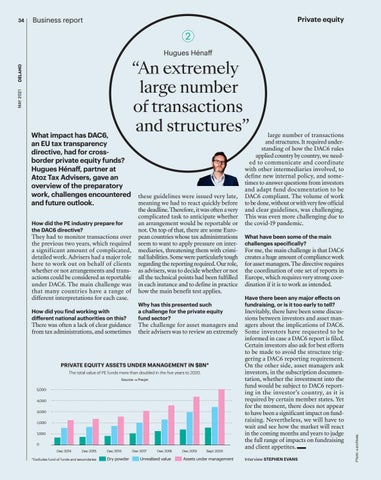
PRIVATE EQUITY ASSETS UNDER MANAGEMENT IN $BN* The total value of PE funds more than doubled in the five years to 2020. Source
Preqin
5,000 4,000 3,000 2,000 1,000 0 Dec 2014
Dec 2015
*Excludes fund of funds and secondaries
Dec 2016
Dry powder
Dec 2017
Dec 2018
Unrealised value
Dec 2019
Sept 2020
Assets under management
large number of transactions and structures. It required understanding of how the DAC6 rules applied country by c ountry, we needed to communicate and c oordinate with other intermediaries involved, to define new internal policy, and sometimes to answer questions from investors and adapt fund documentation to be DAC6 compliant. The volume of work to be done, without or with very few official and clear guidelines, was challenging. This was even more challenging due to the covid-19 pandemic. What have been some of the main challenges specifically? For me, the main challenge is that DAC6 creates a huge amount of compliance work for asset managers. The directive requires the coordination of one set of reports in Europe, which requires very strong coordination if it is to work as intended. Have there been any major effects on fundraising, or is it too early to tell? Inevitably, there have been some discussions between investors and asset managers about the implications of DAC6. Some investors have requested to be informed in case a DAC6 report is filed. Certain investors also ask for best efforts to be made to avoid the structure triggering a DAC6 reporting requirement. On the other side, asset managers ask investors, in the subscription documentation, whether the investment into the fund would be subject to DAC6 reporting in the investor’s country, as it is required by certain member states. Yet for the moment, there does not appear to have been a significant impact on fundraising. Nevertheless, we will have to wait and see how the market will react in the coming months and years to judge the full range of impacts on fundraising and client appetites. Interview STEPHEN EVANS
archives
What impact has DAC6, an EU tax transparency directive, had for crossborder private equity funds? Hugues Hénaff, partner at Atoz Tax Advisers, gave an overview of the preparatory work, challenges encountered and future outlook.
“An extremely large number of transactions and structures”
Photo
MAY 2021
Hugues Hénaff
GETTING THE BEST PRICE FOR THE SALE OF YOUR PROPERTY?
DO NOT RELY ON LUCK!
FREE ESTIMATE*
ENTRUST US WITH YOUR PROPERTY, YOU WILL APPRECIATE THE DIFFERENCE! NOW, 3 ADDRESSES TO PROVIDE YOU WITH THE BEST POSSIBLE GUIDANCE
FARE CITY BRANCH 1 Rue du Verger L-2665 Luxembourg
FARE EAST BRANCH 2, Massewee L-6186 Gonderange
(+352) 26 897 897 - www.fare.lu * Only valid upon signature of an exclusive 8-month mandate.
FARE SOUTH BRANCH 1 Rue de l’Alzette L-4011 Esch-sur-Alzette
36
Private equity
Business report
3
“It’s not a problem for us to find people to work for us,” noted Laurent Hengesch, a founding partner at Ilavska Vuillermoz Capital. He is a rare bird in Luxembourg: a fund manager making investment decisions in the grand duchy. Most funds based in Luxembourg have their p ortfolio managers in major global financial capitals, with the operations here tending to p rovide the infrastructure to make these funds function. Varied operations Many in the local industry are keen to work at the sharp end of this business. After all, assessing projects and taking decisions about which to support is the stuff of TV shows. Hengesch’s fund supports projects as varied as financial technology, anti-drone intrusion systems and a green holiday resort. “There are no more than five firms in Luxembourg taking investment decisions here,” he said. It’s a business that requires a lot of travel, with Ilavska Vuillermoz having bases in Prague and Berlin. But being located in Luxembourg gives them greater access to private and institutional investors located here. “It gives investors more comfort to work with people they know.” Making it happen While the attraction of this front office work is clear, this is not to downplay the sense of achievement to be gained from
Laurent Hengesch Jeffrey Kolbet
working to find solutions to bring investment strategies to life. “It is important that people are made aware how varied and interesting this work is,” said Jeffrey Kolbet, a partner with the law firm Elvinger Hoss Prussen, who specialises in private equity funds. When working with investment managers, “you get an exclusive view on the way they build and implement their investment strategies, and that is both very interesting, but also challenging,” he said. “You are there from the time of the fund’s formation through to completion, and this gives you a view of the full spectrum of activities.” He witnesses first-hand the fundraising process, as he works with investors to negotiate details. There is close cooperation with the fund manager, assisting them as they make their initial acquisitions, monitoring the projects as they mature, and being involved in the final liquidation phase. Multidisciplinary problem solving It is the multidisciplinary aspect of PE that Kolbet finds notably engaging, “particularly if you’re looking to challenge yourself, as it has a blend of finance, business and law,” he noted. It is also an environment that changes continually, such as how market and regulatory pressures have recently driven the sustainable investing agenda. The advent of legislation such as the EU’s Sustainable Finance Disclosure Regulation has required clients to reassess their portfolios and align them with new sustainability standards.
Kolbet said he finds it rewarding helping fund managers explore the different structuring options. “It is important that people are made aware of how varied and interesting this work is, as we need to attract people to enter this growing business area,” he said. Asset management is a tip of the iceberg in terms of private equity fund employment in Luxembourg, with Hengesch noting that they only employ about ten people. Many more are needed in the wider ecosystem to bring these plans into action. “Compare it to Formula 1 racing,” he said. “Sure everyone would like to be the driver, but it’s also very interesting being part of the team making the car work and changing the tyres in record time.” Words STEPHEN EVANS
JOB TITLE EVOLUTION Total staff at private equity and real estate fund firms in Luxembourg rose by 17% between mid-2019 and mid-2020. Here are notable increases and decreases by job title. Source
Private Equity and Real Estate Substance Survey 2020, KPMG Luxembourg
+35% +30% +25% +20% +15% +10% +5% 0 -5% -10% -15% -20%
AIFM conducting officers Asset and portfolio managers Administrative assistants Accountants and financial controllers Tax experts Paralegal experts
Ilavska Vuillermoz Capital, Elvinger Hoss Prussen
Embedded in every business are multiple stories of human ambition and development. Luxembourg-based private equity investment funds help bring these ideas to life. We spoke to two professionals about the attractions of working in this area.
Photos
MAY 2021
Why work in private equity?
For more than 10 years, 99 Advisory has been providing decision makers with its market expertise to meet the increasing demands of strategic, regulatory, managerial and digital transformation.
NURTURING THE FINANCIAL ECOSYTEM TOGETHER We work alongside our clients to modernize their organization and ensure their compliance, thus contributing to a more reliable, sustainable and secure financial ecosystem. www.99-advisory.lu | +352 208 001 21 23
Head to head
38
Boardroom balance MAY 2021
Luxembourg lags behind on board gender equity, with women occupying between 13% and 18% of board roles, according to our two speakers.
Thomas Seale is an independent director in the asset management industry and ILA member
Why are we not yet at 50% gender equity on boards in Luxembourg? THOMAS SEALE Luxembourg has gone from about 4% to 18% in the last 10 years. And in my sector, investment funds, we’ve gone from 16% to 22% [between 2018 and 2020]. To me, the problem is deeper than just women on boards--it is a question of availability of candidates. In my industry, I don’t know of a board of directors that is not looking for women to join the board. VIVIANE REDING My speciality is Europe. And that was also the case 10 years ago, when I was confronted with a problem that women were insufficiently [represented] in business, and on boards. The time you need to grow a woman until she could reach the board is very long. But, if the woman doesn’t have any role models to follow, the time is going to be even longer. That is why we decided to have quota legislation. The reaction
“ I don’t know of a board of directors that is not looking for women to join the board”
was a very controversial debate, which is good because it brought the question to the boards. As a result, the average proportion of women on boards went up from 11% to 28%, but it went up very strongly in countries which made a national law: in France, it is 45%, and Italy 36%, while in Luxembourg, it is 13%, and Cyprus even worse, at 9%. Is there a problem of supply? When I started with my “40% other sex” rule on corporate boards, businesses said there were no women. So, I asked all the leaders of the big business schools, where are your female MBAs? Are there none! “What?”, they answered, “of course we have female MBAs!” That was the beginning of the global board-ready women list... which today presents the CVs of 20,000 MBA-level women with at least 10 years of top management professional experience in 80 countries. So, these women exist worldwide. I don’t know why they shouldn’t exist in Luxembourg either or why you cannot import them, if you do not find them. VR
Are educational choices to blame? TS Finance is a quantitative sector, it’s math and science and engineering, and the fact is that women are very underrepresented in those sectors. If you look at engineering courses in France, 28% [of students] are women and 72% are men. In the US, which I think has advanced a lot, 37% are women and 63% are men. And if I just think about my own experience as a chief executive officer, for 20 years, we had a company of 500 people, so I’ve hired a lot of people. To find women relationship managers, accountants or lawyers was pretty easy, but to find CFOs, CIOs or risk managers was very difficult. VR We know that 60% of university students are female, but they are very often in the “wrong” departments. If I look at the future of our continent, only 17% of Stem students in the universities are women, and only 7% of those enter the
Workplace diversity
working system. In future, I don’t see finance as being the problem. Technology certainly will be. Because technology is a horizontal need, and you cannot enter big boards today if you are technologically ignorant.... What I have seen in my experience is that boards look for people who have a horizontal management capacity, geopolitical understanding and who can know if building up a new facility in country A is a good idea or a bad idea, and how this should be financed and managed.
“ Women are as capable as men, but they are not pushed in the right direction ”
How important is the impact and then slowly grow into the responsiof career interruptions for family? bility for their family, something that their fathers and grandfathers have not TS I think we’ve all seen the McKinsey study where women of childbearing age at all done. There is a change going on. stop and get off the career path. 20-30 The second element is a question of eduyears later, you don’t have that many cation. Women are as talented as men, women in senior, management commit- but they are often not pushed in the right tee roles. That’s the qualification that we direction. We have to influence them typically look at for boards, so I think it’s from an early age. a real problem, but I think that we need TS I think one thing that I would be to think what the reason for it is, and against is quotas or interventions, because then address those reasons. I think that, already in Europe, we have VR When women come out of university, so much regulation and control. I don’t they have the same career level as their think that companies should be used male colleagues. Then, they let go because to implement social policy. I think they become mothers. At top level in pri- that’s the role of government, and of vate business, combining motherhood and democracies. I think mentoring is very career is not an easy thing, I know from useful, I’ve helped set up a mentoring experience because I raised three boys in programme within ILA [the Luxemparallel to my professional engagements. bourg Institute of Directors]. Sometimes, women have more of a To what extent is discrimination problem because of their lack at play here? of experience in senior manVR I am mentoring two women who are agement and I think menspecialists in finance, and it happened toring, can be a great help twice they were the best in a selection, in that area. and a less performing man was chosen. That means it has to do with the mentality: “Oh she is a mother, and she will not be 100% in her job.” TS I was chief executive for 20 years, so, you know, I looked at these problems and Viviane Reding, tried to look at what was the right thing CSV member for the company. If you have a 25-yearof parliament and old woman and a 25-year-old man and former European commissioner who they’re absolutely identical in every way, backed boardroom there might be a tendency to hire the man. quotas I’m not saying that it’s a desirable situation, but it’s the reality. It’s to do with “will that 25-year-old person be more present physically over a 10-year period?” How can we reverse this imbalance? We have to change the mentality. Young men are today becoming fathers, VR
Moderated by JESS BAULDRY Photos ROMAIN GAMBA
39
40
Essay
Working parents in the “next normal” The professional-personal line has blurred since the start of the health crisis. How are working parents coping? And are local employers doing enough to support them?
Words NATALIE A. GERHARDSTEIN Illustration SOFIA AZCONA
Work-life balance
“I was shattered” Rose* is a mother of one who can relate to the “primal scream” first-hand. She had already switched to part-time work before the start of the health crisis in a bid to get a better work-life balance. She considers herself “lucky” that her business was closed at one stage, although her work environment has since a dapted, with the majority of her services now online. Her husband, however, works in retail and was still required to be at the workplace each day. “At the beginning, that was really stressful, because we didn’t know anything about the virus,” Rose says. “He would come home from work every day, put his clothes in the washing machine, go take a shower… I was quite anxious about the possibility of him bringing home something from work [and] infecting us, having our child infected.” She took advantage of the extraordinary family leave at least twice and, while grateful for it, explains, “we didn’t have
any other options. Like a lot of expats, we don’t have family here in Luxembourg... and from the employer side, my boss was not great about it,” although she didn’t add details. But even with the leave, it was difficult to get “time to breathe”, she says. “During the week, I was shattered at the end of every day. By Friday, it was game over.” Rose says she told her husband he’d need to “step up on the weekends” to give her the break she desperately needed, which helped. And, although she still has some anxiety, she admits it’s not as intense now. “I feel we’re at the tail end--maybe that’s just being optimistic--but I see people getting vaccinated, going back to semblance of normal life… that carrot dangling in front of us has made things a lot better.” Debra*, an expat mother of three, also says her anxiety peaked during last spring’s lockdown. Among her thoughts: “If we got sick, would the kids get sick? What if we can’t function? How would they survive for 10 days?” Her own children’s worries about covid-19 only added to that stress. (She admits that today she has a “very different” outlook than she did a year ago.) Part of what helped her cope were personal decisions--increasing her frequency of going running, and the fact that when she started working full-time she had hired cleaning help--“a huge mental game changer,” she adds. Debra and her husband also alternated stints on extraordinary family leave, and she feels lucky to have been in Luxembourg during the pandemic. In her home country (intentionally omitted to protect her privacy), her friends worked full-time while trying to homeschool. “I don’t know how they’ve been functioning,” she adds. Debra also praises her employer for being supportive while she was on the leave. “They were wonderfully respectful and accommodating and understanding. I’m so grateful.” “Parents are exhausted” Kanner-Jugendtelefon (KJT) runs the Elterentelefon (parents’ hotline), and 2020 proved “a rather turbulent and exceptional year for us... in general, calls were significantly more intense,” according to KJT psychologist Aline Hartz. Although there were 10% fewer contacts than in 2019, there was a 32.1% rise in those seeking online help, which Hartz says could be related to the fact that there
“Parents are exhausted and sometimes overburdened” was less privacy at home. Female callers were “disproportionally represented” (130 female callers, 30 male, 1 unknown), and there was a 25% increase in calls lasting more than 30 minutes. The main reasons for the calls were “more conflicts in families, [and] intensity of conflict… parents are exhausted and sometimes overburdened.” More recently, in January 2021, the education ministry conducted a survey among 4,200 parents, 79% of whom confirmed they’d felt particular stress since the start of the health crisis. The reasons? Over half cited “the general atmosphere linked to the health crisis,” and 40% cited “challenges posed by reconciling family and professional life”. “Fertile ground for reflection” With the vaccination programme underway, many organisations are considering what future work arrangements will look like. One notable example is Citigroup, which made headlines when chief exec Jane Fraser launched Zoom-free Fridays. She also designated 28 May as a company-wide “reset day”. On the other hand, that very same week, Goldman Sachs came under scrutiny with staff claims of 18-hour shifts and employee burnout. Despite “Zoom fatigue” and the desire for face-to-face contact, many working parents--Rose and Debra included--have reaped benefits to more flexible working arrangements. There’s less time commuting, more time for family. Debra says that prior to their move, she and her husband were “fairly equal homemakers”, but in Luxembourg, he’s working “60 to 70 hours a week,” which forced her to shoulder extra tasks at home. Sure, his meetings might still run until 9pm--but as he’s working fully from home, Debra has appreciated that he is able to be “present”, using his
MAY 2021
The New York Times in February referred to a “primal scream” working parents in the US were facing, be it due to working from home with kids, rising unemployment or simply being “on the brink” of a breakdown. The publication had also opened up “the primal scream line”, a voicemail service where parents could vent their frustration--or simply scream--during their toughest moments of the pandemic. As one parent said, “I wish I had the energy to scream. All my energy goes into getting through every day, until I can go to sleep… it just feels like failing, every day, at everything I do… I don’t know how to keep doing this. But there isn’t really another option.” As a working parent myself, I’ve felt this same defeat--even if it has eased a bit since the start of the pandemic. I try t aking on additional responsibility at work one week, only to be halted in my tracks the next week, when my daughter’s schooling situation has changed because of yet another covid-19 case. I love my child--and I love my job--but somehow feel guilty, like I’m failing on all fronts as I juggle responsibilities, while trying to sway flexibly each time the wind shifts. I couldn’t help but wonder: were other working parents in Luxembourg experiencing this “primal scream”? And, if so, how could they be better supported?
41
Essay Work-life balance
42
MAY 2021
THREE IDEAS FOR BUSINESSES half-hour breaks to help out with homework or dinner. Law firm Arendt is one such company that has a “generalised flexibility” policy which, while not specifically designed for working parents, undoubtedly helps them. As Isabelle Lebbe, partner in charge of diversity, and human resources director Eidine Bossy explain, “what the health crisis has had a positive impact on is our internal culture, the disappearance of guilt when personal life interferes with [professional] life and an increase in understanding and solidarity. The boundaries between professional and private life have become blurred, especially with teleworking, and each of us has been affected (whether or not we are parents), which has brought us closer together and opened up a dialogue that is beneficial to everyone.” One challenge they see among clients is in the realm of “the right to disconnect”, although they add: “The ground is now fertile for a real in-depth reflection on this subject”. They also express concern in another area. “[We] noted that the crisis has amplified existing imbalances in the private sphere in terms of household management,” Lebbe and Bossy explain. “Supporting diversity remains one of our priorities, and we were concerned to see that unfortunately the majority of parental leave taken during the crisis was taken by mothers and not fathers.” Policies for success Arendt was, in fact, one of eight companies in 2020 to receive the Actions Positives label, which recognises actions to promote equality between men and women at work. Its action plan involved the creation of an internal DNA (Diversity & Inclusion Network at Arendt), comprised of 100 volunteers who proposed innovative ideas. The AP initiative was modernised in September 2020 by the minister of equality between women and men, Taina Bofferding (LSAP). A ministry spokesperson tells Delano that “interest remains positive” and that some of the policies companies can implement which could benefit working parents include flexible working schemes, reduced working hours, stress management training, toolkits on managing remote work or workloads, even “providing anonymous external phone support free of charge for employees needing psychological help”.
Workculturati founder & CEO Christina Clark provides three ideas companies can consider onboarding to support working parents.
1 Permission to vent Launch a confidential, anonymous employee hotline. This can become a vital lifeline for individuals to voice concerns and feel less alone when juggling home and work.
2 The future is hybrid Dedicate one person internally to flexible or hybrid work arrangements and help demystify grey areas between company expectations and employee needs and support.
3 Redefine productivity Experiment with a 4- or 4.5-day workweek, explore Zoom-free Fridays or an all-company well-being day off. Redefine productivity and encourage clear boundaries between being always on and space to switch off. www.workculturati.com
Among the noteworthy achievements made by AP programme participants was the “organisation of web seminars for managers, male and female employees, explaining why parenthood is good for business: being a parent is a job that millions do every day, but business traditionally viewed employees becoming parents as a challenge. To change this idea, a digital life-based training programme was created that harnesses and recognises parenting skills in business; the ‘soft’ skills parents develop, such as empathy, creativity, communication, managing time effectively and leadership, [which] are vital for companies to be successful.” The trust factor Christina Clark, founder & CEO of Workculturati--a company empowering others to foster an authentic, thriving company culture--has similar ideas that organisations can consider onboarding to support working parents (see box above). Her bonus tip? “Gratitude: it costs nothing.” Clark cites a pre-pandemic Harvard University and Wharton study which
showed that productivity was boosted by over 50% when employees received a simple “thank you” from a leader or manager. And while we’re used to expressing gratitude in our personal sphere, it’s less likely in the workplace--even though one of the top reasons employees leave companies is because they feel underappreciated. “The pandemic has highlighted the need to have difficult sociocultural conversations about workplace trust and presenteeism,” Clark adds. “This is pivotal to help establish a new benchmark for social health at work.” She also shared a quote from the book Leaders Eat Last by Simon Sinek. “Trust is like lubrication,” Sinek wrote. “It reduces friction and creates conditions much more conducive to performance.” This echoes Debra’s hopes, too. “What I’m hoping comes from [the pandemic] is trust from employers,” she says. “If employees were good enough to hire, they outshone other candidates, employers should still have trust in their ability to get stuff done.” While she understands the need for “water-cooler moments [and] collaboration”, she hopes companies will rid themselves of the “butt-in-seat-in-cubicle mentality” and opt for a hybrid working model if possible. The level of trust required for working at home during the pandemic, she hopes, will be maintained by employers, but she’s convinced employers will see the return as well. “In turn, we will want to work even harder for them.” *Names have been changed at interviewees’ request
How to recognize sustainably acting companies ? Look out for the Label SuperDrecksKëscht® for your purchases and orders to service providers !
The label stands for: l l l
Waste prevention Protection of ressources Climate protection
more info: Tel. 488sdk_superdreckskescht 2161, SDK- geliefte Klimaschutz www.sdk.lu and on
FIR ENG EKOLOGESCH OFFALLGESTIOUN konform ISO 14024
An acitivity of the SDK and her partners:
“Delano offers some deep thinking and some enjoyable reading alike, witty and kind.” Mirjam Bamberger CEO AXA Luxembourg & AXA Wealth Europe
GET A FREE DELANO SUBSCRIPTION WHILE WORKING FROM HOME
Gusto
44
MAY 2021
Cheers to spring ! It’s time to ring in spring with these cocktail recipes, created by Luxembourg mixologists. 1 Guava spell By Philippe ‘Filoo’ About, Nasty Bar
• • • • •
In a tall glass, smash 2-3 basil leaves. Add 20ml sugar syrup or 1tsp sugar, and 40ml rum. Let infuse. Add crushed ice. Top up with 60ml guava juice and 20ml lime juice. Gently mix with a spoon, decorate with a lime basil leaf. Nasty Bar Dudelange
2 Vodka rhubarb coupe By Adrien Joubert, Lady Jane
• • • • •
Chill a cocktail glass. Mix 40ml vodka, 20ml lemon juice and 15ml rhubarb syrup in a shaker with ice. Strain into pre-chilled glass. Top up with crémant. Garnish with a basil leaf and a couple of sliced strawberries.
Words CORDULA SCHNUER Photos ROMAIN GAMBA
Lady Jane Speakeasy
45
4 By Laura Hanin, Partigiano
• • • •
Fill a lowball or old-fashioned glass with ice. Add 25ml red port wine and 25ml vineyard peach liqueur. Top up with prosecco. Add verbena leaves.
MAY 2021
“Civilisation begins with distillation.”
Port prosecco spritzer
William Faulkner
our home y p b ui
ar
Eq
@partigiano_luxembourg
3 Rhubarb “Paloma” By Michelle Primc, Paname
• • • •
• •
Salt the rim of a highball glass and fill with ice. Add 40ml tequila, mezcal or gin and 40ml rhubarb cordial. Fill up with infused soda, stir gently. To make the cordial, simmer 500ml rhubarb juice with 200g sugar. When cool, add grated zest and juice of three limes. Infuse the soda with fresh herbs, like rosemary, mint, thyme or verbena. For a refreshing, non-alcoholic drink, mix the soda and cordial. @paname_bar
To make expert cocktails at home, you need:
1 Quality spirits You don’t have to opt for the most expensive bottles or even a huge selection, but should invest in quality staples that you like.
2 Ice, ice, baby Whether you add the ice straight to the glass or use it to cool the drink in your shaker, a chilled drink is key. Make bigger cubes to get less dilution as the ice takes longer to melt.
3
Special thanks Mixologists selected with Paperjam Foodzilla
Company Enjoy your cocktail in good company, if needed as a virtual apéro as coronavirus restrictions continue.
Photo
4
Shutterstock
Seasonal ingredients Adapt your drink recipes to include seasonal and local ingredients--good for the palate and the environment.
Welcome to the Club
Business Club
MAY 2021
46
Flashback Your events
In numbers
1,300
The Delano Breakfast Talk invited 2 Francis Carpenter, former CEO of the EIF, who challenged the audience on all three issues of Environmental, Social and Governance (ESG). “The future is optimistic, but it will require all of us to engage with these very important issues.” British Ambassador to Luxembourg, 1 John Marshall, took the opportunity of our 10�6 Finance event to say his farewells. He described his tenure as “five fabulous years in Luxembourg”, during which he oversaw Brexit from the referendum to the full withdrawal. Our panel of judges chose EmailTree, EmoHack and Vingineers as the three winners from the second round of Start-up Stories. Many thanks to our sponsor Startup Luxembourg and LBAN for their contribution. The CEO Cocktails had a different flavour this year. Nevertheless, there was an excellent discussion on what changes we may see in taxes to support state finances offsetting the impact of the lockdown.
COMPANIES The number of companies that are members of the largest business club in Luxembourg.
18,000 MEMBERS
The number of individuals who are part of the vibrantly active Paperjam + Delano Club community with whom you will get to interact.
383
EVENTS
The number of digital and on-site events. Choose from about 400 conferences, training, networking and workshop events each year.
500
“This was fantastic news and a lot of people had been waiting for it for a very long time.” Cathrine Foldberg Møller Simmons and Simmons
HOURS
The number of annual training hours for your employees to develop their hard and soft skills: an additional benefit for you and useful extras for your teams.
3
HOW TO ATTEND PAPERJAM + DELANO CLUB EVENTS ? You’re already a member Please check our website club.paperjam.lu. Select, among all the digital and on-site events listed, the ones you would be interested in, fill in the registration form at the bottom page and register.
You’re not a member yet Please email the Paperjam + Delano Club via club@paperjam.lu and an account manager will be in touch to introduce you to all the perks offered by the largest business club in Luxembourg.
1
47
Programme May/June Tuesday 4 May
MAY 2021
CLUB TALK
ESG: all you need to know about the new regulation TIME 18:30-20:00 Livestream SPONSOR ING Tuesday 18 May CONFERENCE
x
In conversation with Michèle Detaille
2
TIME 11:30-12:30 Livestream SPONSOR ING Tuesday 8 June
6
Start-up Stories Round 3 TIME 18:00-19:00 Livestream
Christian Monjou
SPONSOR Startup Luxembourg
Simon Verjus
PARTNER Luxembourg-City Incubator
Photos
"Digital is both the best and the worst of things: the best when it opens us up to the unknown and allows us to engage with it, the worst when it locks us into consensual mediocrity. "
Sign up on the Paperjam + Delano Club site: club.paperjam.lu
011 BY MIKE K N2 OE DI DI DE
N GE
R
FO UN
48
MAY 2021 EDITION EDITORIAL DIRECTOR
MAY 2021
Mike Koedinger EDITORIAL DEVELOPMENT DIRECTOR
Editorial Phone (+352) 20 70 70-150 E-mail news@delano.lu DESK EDITOR
Aaron Grunwald (-152) JOURNALISTS
Jess Bauldry (-153) Natalie Gerhardstein (-154) Abigail Okorodus (-155) Cordula Schnuer (-163)
Nathalie Reuter EDITOR-IN-CHIEF
Duncan Roberts (-151)
Brand Studio Phone (+352) 20 70 70-300 E-mail regie@maisonmoderne.com DIRECTOR
Youcef Damardji STRATEGIC BUSINESS DEVELOPMENT ADVISOR
COMMUNITY MANAGER
Francis Gasparotto (-301)
Christophe Lemaire
HEAD OF SALES OPERATIONS AND PEOPLE
PROOFREADING & FACTCHECKING
Lionel Scaloni
Pauline Berg Lisa Cacciatore Sarah Lambolez Elena Sebastiani
HEAD OF MEDIA SALES AND SOLUTIONS
PHOTOGRAPHY
MEDIA ADVISORS
Romain Gamba Mike Zenari Matic Zorman
Publisher
Dominique Gouviaux (-338) COMMERCIAL ASSISTANT
Céline Bayle (-303) Nicolas Galtier (-318) Mélanie Juredieu (-317) Virginie Laurent (-322) Aline Puget (-323) Léo Santoro (-335) Mikaël Spezzacatena (-326)
www.maisonmoderne.com Phone (+352) 20 70 70 E-mail publishing@maisonmoderne.com FOUNDER AND CHAIRMAN
Mike Koedinger CEO
Geraldine Knudson ADMINISTRATIVE AND FINANCIAL DIRECTOR
Etienne Velasti Maison Moderne is a partnership between Francis Gasparotto, Mike Koedinger and Etienne Velasti. PUBLISHING DIRECTOR
Mike Koedinger STRATEGIC BUSINESS DEVELOPMENT ADVISOR
Francis Gasparotto DIRECTOR, BUSINESS CLUB
Melanie Delannoy DEPUTY DIRECTOR, BUSINESS CLUB
HEAD OF CONTENT STRATEGY
Ana Wiscour-Conter
Emmanuelle Thivollard
CHIEF DIGITAL OFFICER
CREATIVE DIRECTOR
Jeremy Leslie
Viktor Dick HR MANAGERS
ART DIRECTOR
Anaïs Bouillet/Sylvie Notarnicola
José Carsí
ADMINISTRATIVE MANAGER
LAYOUT
Sylvia Leplang
Sophie Melai (coordination), Juliette Noblot, Chalène Pouthier
DIGITAL PROJECT MANAGER
MANUFACTURING MANAGER
DISTRIBUTION MANAGER
Myriam Morbé
Kévin Thirion
Meryem Alamy
IT MANAGER
Matthew Dixon
To contact staff members
All rights reserved. Any reproduction, or translation, in whole or in part, is prohibited without the prior written consent of the publisher. © MM Publishing and Media S.A. (Luxembourg). Delano™ and Maison Moderne™ are trademarks used under licence by MM Publishing and Media S.A. ISSN 2220-5535
SEND AN E-MAIL TO:
firstname.lastname@maisonmoderne.com WRITE TO
PO Box 728, L-2017 Luxembourg OFFICES
10 and 26 rue des Gaulois, Luxembourg-Bonnevoie
natureOffice.com | DE-261-JYACEBD
Maison Moderne is committed to reducing its ecological footprint. Delano magazine uses CO2 neutral printing, Blauer Engel recycled paper for its cover and FSC® certified sustainable paper for interior pages. Please recycle. Have you finished reading this magazine? Save it, pass it on or recycle it!
In accordance with article 66 of the law of 08.06.2004 on the freedom of expression in the media, the following statement is obligatory “one time per year, in the first edition distributed”. We have decided to publish it each month. The company that publishes Delano is indirectly held, by a stake exceeding 25%, by Mike Koedinger, a publisher registered in Luxembourg. Geraldine Knudson is chartered with general and daily management.
MAY 2021
49
Monthly subscriptions on eshop.maisonmoderne.lu 11 issues/year
Expat Guide
Delano.lu
Published each summer for newcomers
Business, finance, politics and more each day
NEXT EDITION: JULY 2021
The Club
Newsletters
Networking, workshops and a variety of events. Learn more on www.paperjam.lu/club
Sign up at subscription. maisonmoderne.com/en
ECOSYSTEM
Podcasts
Delano Jobs
Listen on www.paperjam.lu/list/podcasts/ delano-newsmakers
Find the latest listings on jobs.delano.lu
Social media
Social @Delano_lu Delano Paperjam + Delano Club
Delano Magazine @Paperjam_Club
Delano Delano_lu Paperjam + Delano Club
Pick’n’mix
50
Money matters
Stefanie Ebsen
Sam Abdi
Magaly Piscarel
CREATIVE DIRECTION FREELANCER & MASTER’S STUDENT
CO-FOUNDER & CEO, SALONKEE
ACCOUNTANT AND DATA PROTECTION OFFICER, FIDUCIAIRE SOCOFISC
FOUNDER & CEO, HAPPYLOCAL.LU
MARKETING & COMMUNICATIONS OFFICER, INFRACHAIN
A good half when living with parents, now with own flat around 10%-20%.
None, if I save it’s for short-term plans, like holidays.
10-15% goes into my savings account each month.
Mortgage and rental.
At the moment, I can’t save anything. My studies are pretty expensive.
Mainly my portfolio, since I’m at the beginning of my career.
Housing.
Definitely monthly rent, now that I have my own flat. Previously, it was loan repayment.
Rent.
I bought an apartment two years ago.
Yes, hopefully in my early 30s, but Luxembourg’s high property prices do not make it easy.
Not yet, but I’d like a community place for digital nomads with a permaculture garden.
As I’m still a student, I leave this for the future.
No.
Be aware of what really matters to you; it’s easier to not spend money on stuff contributing nothing to your happiness.
No secret, just don’t spend or waste it on things you don’t need, and invest it for the long term.
Single most expensive item you’ve ever bought?
Do you have a private pension or life insurance?
I dream of my own place, but not sure buying is an option because I want to stay flexible.
Up to 50%. But I rather prefer investing it than saving it in a bank account.
My laptop and phone. I’m still investing in the basics.
Apartment.
Private pension insurance, but no life insurance yet!
Really think about whether you need something before buying. Often people buy what they don’t need.
My own car.
No.
You can have a quality life without fashion trends, or have fun camping instead of 5-star hotels.
A car, and I think cars are overpriced compared to average incomes.
I bought a house a year ago that needs complete renovation, which hasn’t started because of the pandemic. I hope to move in next year.
I had to buy a life insurance policy when I bought the house. I also have a private pension to earn compound interest. I put aside 10% of my salary into savings, 5% into an investment plan. For travel or expensive things, always compare prices. I bought a drone when I lived in Thailand to document my journey in Asia.
Mike Zenari, Maison Moderne archives, Fiduciaire Socofisc, Romain Gamba, Shutterstock, Clari Massimiliano/Shutterstock.com
Tom Michels
Photos
Kimberly Muse
Secret tip for saving money?
Planning to own home, and when?
What’s your biggest monthly expenditure?
What percentage income do you save per month?
MAY 2021
Five young professionals talk about savings, expenditures and future planning.
plan K
spring on the doorstep
183, Rue de Luxembourg L-8077 Bertrange T. 27 75 86 65 www.luxurydoors.lu
revendeur officiel
Powered by TCPDF (www.tcpdf.org)