cinémathèque
Homage to Finnur Dor Thordarson
Bon appétit
SoirÉe-dÉbat
Fukushima : deux ans après
Essential filmmakers for beginners
Nagisa Oshima Verði ykkur að góðu is a local low budget film made by a group of four people, Finnur Dor Thordarson, Raoul Schmitz, Pall Eyjólfsson and Hrefna Einarsdóttir, who share a similar sense of humour and a passion for film. It was supported by Icelandic theatre group Spuni and friends of Finnur Dor Thordarson, who was tragically killed in an accident in 2011. The film is a black comedy, a post bank crisis caricature of Icelanders in Luxembourg. Its premise is that a popular Icelandic TV dinner show Bon appétit announces that it will shoot in Luxembourg, and the Icelandic community begins to fight to get on the show. ------
Verði ykkur að góðu est une production locale à petit budget, réalisée par quatre personnes : Finnur Dor Thordarson, Raoul Schmitz, Pall Eyjólfsson et Hrefna Einarsdóttir, liés par un même sens de l’humour et une passion pour le cinéma. Le projet était soutenu par la troupe de théâtre islandaise Spuni et des amis de Finnur Dor Thordarson, disparu tragiquement dans un accident survenu en 2011. Le film est une comédie noire, une caricature post-crise bancaire des Islandais au Luxembourg : l’annonce du tournage, au Luxembourg, de l’émission de télévision Bon appétit, très populaire en Islande, déchaîne les passions parmi les membres de la communauté islandaise, prêts à tout pour participer au programme. Black comedy
22/03, 20:30, in Icelandic (st En), in collaboration with Steadyimages and Spuni
FREE
Le réalisateur Alain de Halleux a suivi pendant un an plusieurs familles de la ville de Minamisoma, située à 20 kilomètres de la centrale nucléaire de Fukushima. Son documentaire expose les espoirs et les craintes de ces familles qui vivent aux marges de la zone d’exclusion autour du réacteur. Elles sont aujourd’hui confrontées aux hésitations et aux incertitudes scientifiques des autorités. Sur qui peuvent-elles compter ? Faut-il rester ou partir ? Chaque famille doit décider seule, sous la menace constante d’un nouveau tremblement de terre, d’un nouveau tsunami. La projection sera suivie d’un débat en présence d’Alain de Halleux. ------
Director Alain de Halleux’s film follows a year in the life of a number of families living in Minamisoma, some 20 kilometres from the stricken Fukushima nuclear power plant. The film examines the hopes and fears of these families who live on the edge of the exclusion zone. They now face scientific uncertainty and hesitation by the authorities. On whom can they rely? Should they stay or leave? Each family has to make its own decisions, but they are constantly faced with the threat of a new earthquake, a new tsunami. De Halleux will be at the screening to discuss the film. Documentaire contemporain
11/03, 20:30, en version originale (st Fr), en collaboration avec Gréng Stëftung Lëtzebuerg
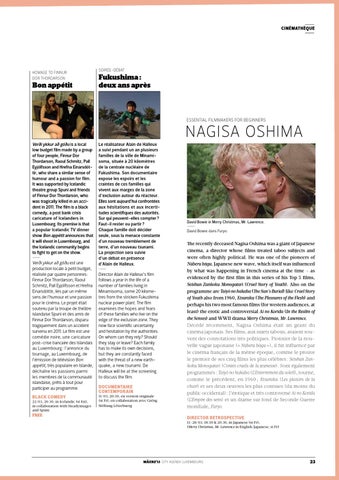
David Bowie in Merry Christmas, Mr. Lawrence. -----David Bowie dans Furyo.
The recently deceased Nagisa Oshima was a giant of Japanese cinema, a director whose films treated taboo subjects and were often highly political. He was one of the pioneers of Nūberu bāgu, Japanese new wave, which itself was influenced by what was happening in French cinema at the time – as evidenced by the first film in this series of his Top 5 films, Seishun Zankoku Monogatari (Cruel Story of Youth). Also on the programme are Taiyô no hakaba (The Sun’s Burial) like Cruel Story of Youth also from 1960, Etsuraku (The Pleasures of the Flesh) and perhaps his two most famous films (for western audiences, at least) the erotic and controversial Ai no Korīda (In the Realm of the Senses) and WWII drama Merry Christmas, Mr. Lawrence. Décédé récemment, Nagisa Oshima était un géant du cinéma japonais. Ses films, aux sujets tabous, avaient souvent des connotations très politiques. Pionnier de la nouvelle vague japonaise (« Nūberu bāgu »), il fut influencé par le cinéma français de la même époque, comme le prouve le premier de ses cinq films les plus célèbres : Seishun Zankoku Monogatari (Contes cruels de la jeunesse). Sont également programmés : Taiyô no hakaba (L’Enterrement du soleil), tourné, comme le précédent, en 1960 ; Etsuraku (Les plaisirs de la chair) et ses deux œuvres les plus connues (du moins du public occidental) : l’érotique et très controversé Ai no Korīda (L’Empire des sens) et un drame sur fond de Seconde Guerre mondiale, Furyo. Director retrospective
11-28/03, 18:30 & 20:30, in Japanese (st Fr), (Merry Christmas, Mr. Lawrence in English/Japanese, st Fr)
mäerz’13 CITY Agenda LUXEMBOURG
23