Part 1 // Articles
and stopped Luxembourgish paramedics at the French and Belgian borders “to prevent them from seeing the awful things that took place on the other side.” The Luxembourg Red Cross, stripped off by the German occupier, was forced to cease nearly all of its activities in December of 1914 and until the end of the war. Only the Missing Enquiry Office continued to operate under the Geneva Cross.
"The story of the Luxembourg Red Cross is rather particular and extremely fascinating" Charles Barthel
Events programme • April 2014: Red Cross Month (as every year) Thousands of volunteers visit homes and companies to collect donations.
New missions After 1918 Luxembourg helped reconstruct Verdun and also helped the “Goutte de lait” milk station and dispensary, set up by the American Vassar Relief Unit to provide children with fresh milk and healthy food. “The ‘Goutte de lait’, to which Luxembourg also gave cows, was later run by the Red Cross,” tells Charles Barthel. However, in the beginning of the 1920’s, the Luxembourg Red Cross was still trying to position itself. “The organisation needed to find out in which areas it could best intervene. The political situation was tense and complicated and Luxembourg had already initiated a number of social improvements. The Red Cross had to move forward with caution.” It soon became clear that the best areas for it to focus on were childcare and the training of nurses. After the First World War there were nearly no trained nurses in Luxembourg and how can you advance if there is no qualified medical staff? A committed Aline Mayrisch, already known for her various achievements before and under the war together with her husband Émile, set up a number of clinics where mothers and mothers-to-be could get free consultations. As the growing industrialisation had delocalised many young women who could no longer count on finding assistance close by, this was of uttermost importance. “Aline Mayrisch is also the one who insisted on training nurses,” explains Charles Barthel. “The Red Cross recruited young women and sent them to schools in Paris or Brussels for three years on scholarships. This was
28
FlYdoscope // 2014 — \1
• 10 May 2014: Red Cross Day Festivities and fundraising events throughout Luxembourg. • 16 May 2014-29 March 2015: Exhibition Help! Hilfe! Au Secours ! The story of the Red Cross recounted at the History Museum of the City of Luxembourg.
completely unheard of at the time! The Red Cross never stopped promoting the importance of having a qualified medical staff and was also at the origin of the maternity being built. Of course nothing of this went unchallenged but through it all, the organisation largely contributed to raising awareness around the issue of public health in a country where a certain political class opposed the creation of a ministry of health for half a century.” With the Second World War came yet a German occupation. The Luxembourg Red Cross was liquidated and attached to the German one, but managed to keep its Missing Persons Enquiry Office running, thus helping locate tens of thousands “displaced people” during this chaotic period. “A ‘Luxembourg Red Cross in France’ headquarter was also created in Montpellier to help refugees and people who had fled the occupier and other sections were set up in Spain and England,” reveals Charles Barthel. The historian is still taken aback by the origins behind this year’s 100th anniversary celebration – not forgoing all that has happened since. For after the Second World War, the hardly hit Luxembourg Red Cross had to face a different world and new challenges. “The
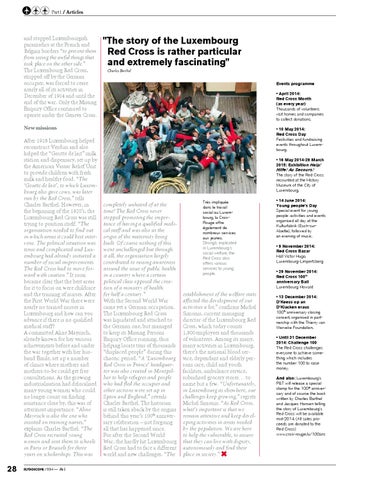
Très impliquée dans le travail social au Luxembourg, la CroixRouge offre également de nombreux services aux jeunes. Strongly implicated in Luxembourg's social welfare, the Red Cross also offers various services to young people.
establishment of the welfare state affected the development of our activities a lot,” confirms Michel Simonis, current managing director of the Luxembourg Red Cross, which today counts 1,900 employees and thousands of volunteers. Among its many, many activities in Luxembourg, there’s the national blood service, dependant and elderly persons care, child and youth facilities, ambulance service, subsidised grocery stores… to name but a few. “Unfortunately, in Luxembourg as elsewhere, our challenges keep growing,” regrets Michel Simonis. “As Red Cross, what’s important is that we remain attentive and keep developing activities in areas needed by the population. We are here to help the vulnerable, to assure that they can live with dignity, autonomously and find their place in society.”.
• 14 June 2014: Young people’s Day Special event for young people: activities and events organised all day at the Kulturfabrik (Esch-surAlzette), followed by an evening of music. • 9 November 2014: Red Cross Bazar Hall Victor Hugo, Luxembourg-Limpertsberg • 29 November 2014: Red Cross 100th anniversary Ball Luxembourg Howald • 13 December 2014: D’Keess op an D’Klacken eraus 100th anniversary closing concert, organised in partnership with the Thierry van Werveke Foundation. • Until 31 December 2014: Challenge 100 The Red Cross challenges everyone to achieve something which includes the number 100 to raise money. And also: Luxembourg’s P&T will release a special stamp for the 100th anniversary and of course the book written by Charles Barthel and Jacques Hansen telling the story of Luxembourg’s Red Cross will be available mid-2014. (All sales proceeds are donated to the Red Cross) www.croix-rouge.lu/100ans