06_56-58_Article_marche_eauOK
22.06.2006
18:35 Uhr
Seite 58
Photo: David Laurent
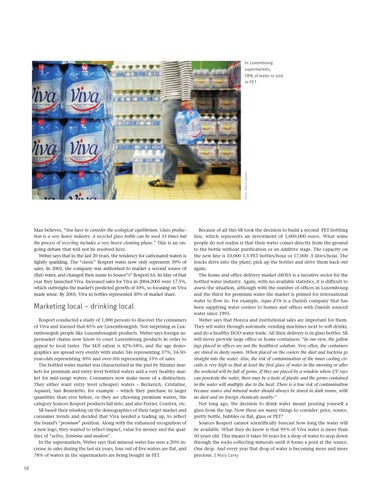
In Luxembourg supermarkets, 78% of water is sold in PET
Max believes, “You have to consider the ecological equilibrium. Glass production is a very heavy industry. A recycled glass bottle can be used 35 times but the process of recycling includes a very heavy cleaning phase.” This is an ongoing debate that will not be resolved here. Weber says that in the last 20 years, the tendency for carbonated waters is lightly sparkling. The “classic” Rosport water now only represents 39% of sales. In 2001, the company was authorised to market a second source of (flat) water, and changed their name to Source”s” Rosport SA. In May of that year they launched Viva. Increased sales for Viva in 2004-2005 were 17.5%, which outweighs the market’s predicted growth of 10%, so focusing on Viva made sense. By 2005, Viva in bottles represented 30% of market share.
Marketing local – drinking local Rosport conducted a study of 1,000 persons to discover the consumers of Viva and learned that 85% are Luxembourgish. Not surprising as Luxembourgish people like Luxembourgish products. Weber says foreign supermarket chains now know to court Luxembourg products in order to appeal to local tastes. The M/F ration is 42%-58%, and the age demographics are spread very evenly with under 34s representing 37%, 34-50year-olds representing 30% and over-50s representing 33% of sales. The bottled water market was characterised in the past by thinner markets for premium and entry level bottled waters and a very healthy market for mid-range waters. Consumers now make more of a distinction. They either want entry level (cheaper) waters – Beckerich, Cristaline, Aquarel, San Benedetto, for example – which they purchase in larger quantities than ever before, or they are choosing premium waters, the category Sources Rosport products fall into, and also Perrier, Contrex, etc. SR based their relooking on the demographics of their target market and consumer trends and decided that Viva needed a trading up, to reflect the brand’s “premium” position. Along with the enhanced recognition of a new logo, they wanted to reflect impact, value for money and the qualities of “active, feminine and modern”. In the supermarkets, Weber says that mineral water has seen a 20% increase in sales during the last six years, four out of five waters are flat, and 78% of waters in the supermarkets are being bought in PET.
58
Because of all this SR took the decision to build a second PET bottling line, which represents an investment of 3,000,000 euros. What some people do not realise is that their water comes directly from the ground to the bottle without purification or an additive stage. The capacity on the new line is 10,000 1.5 PET bottles/hour or 17,000 .5 litres/hour. The trucks drive into the plant, pick up the bottles and drive them back out again. The home and office delivery market (HOD) is a lucrative sector for the bottled water industry. Again, with no available statistics, it is difficult to assess the situation, although with the number of offices in Luxembourg and the thirst for premium water the market is primed for international water to flow in. For example, Aqua d’Or is a Danish company that has been supplying water coolers to homes and offices with Danish sourced water since 1993. Weber says that Horeca and institutional sales are important for them. They sell water through automatic vending machines next to soft drinks, and do a healthy HOD water trade. All their delivery is in glass bottles. SR will never provide large office or home containers: “In our view, the gallon jugs placed in offices are not the healthiest solution. Very often, the containers are stored in dusty rooms. When placed on the coolers the dust and bacteria go straight into the water. Also, the risk of contamination of the inner cooling circuits is very high so that at least the first glass of water in the morning or after the weekend will be full of germs. If they are placed by a window where UV rays can penetrate the water, there may be a taste of plastic and the germs contained in the water will multiply due to the heat. There is a true risk of contamination because source and mineral water should always be stored in dark rooms, with no dust and no foreign chemicals nearby.” Not long ago, the decision to drink water meant pouring yourself a glass from the tap. Now there are many things to consider: price, source, pretty bottle, bubbles or flat, glass or PET? Sources Rosport cannot scientifically forecast how long the water will be available. What they do know is that 95% of Viva water is more than 50 years old. This means it takes 50 years for a drop of water to seep down through the rocks collecting minerals until it forms a pool at the source. One drop. And every year that drop of water is becoming more and more precious. || Mary Carey