© Pauline Darley
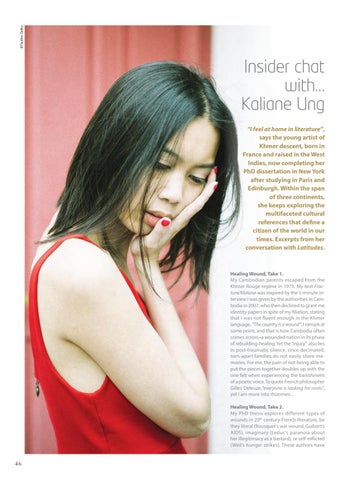
Insider chat with... Kaliane Ung “I feel at home in literature”, says the young artist of Khmer descent, born in France and raised in the West Indies, now completing her PhD dissertation in New York after studying in Paris and Edinburgh. Within the span of three continents, she keeps exploring the multifaceted cultural references that define a citizen of the world in our times. Excerpts from her conversation with Latitudes.
Healing Wound, Take 1. My Cambodian parents escaped from the Khmer Rouge regime in 1975. My text Fracture/Malaise was inspired by the 5-minute interview I was given by the authorities in Cambodia in 2007, who then declined to grant me identity papers in spite of my filiation, stating that I was not fluent enough in the Khmer language. “The country is a wound”, I remark at some point, and that is how Cambodia often comes across–a wounded nation in its phase of rebuilding-healing. Yet the “injury” also lies in post-traumatic silence, since decimated, torn-apart families do not easily share memories. For me, the pain of not being able to put the pieces together doubles up with the one felt when experiencing the banishment of a poetic voice. To quote French philosopher Gilles Deleuze,“everyone is looking for roots”, yet I am more into rhizomes... Healing Wound, Take 2. My PhD thesis explores different types of wounds in 20th century French literature, be they literal (Bousquet’s war wound, Guibert’s AIDS), imaginary (Leduc’s paranoia about her illegitimacy as a bastard), or self-inflicted (Weil’s hunger strikes). These authors have
46