PRS100
The first Brit invasion She Loves You by John Lennon and Paul McCartney (Sony/ATV) The swinging sixties began in earnest as Britain’s budding pop music industry was yet to blossom. Senior management at PRS were voicing fears over the Americanisation of British cultural life, a sentiment which echoed loudly around the whole UK music industry. But within three years the headlines had changed. Leslie Boosey, then chairman of PRS, proudly announced at the society’s 1963 Annual General Meeting that ‘beat groups’ had changed the fortunes of British music - and new PRS members Paul McCartney and John Lennon were leading the charge. John and Paul wrote She Loves You in the early summer of 1963 while on tour with Roy Orbison and Gerry and the Pacemakers. They recorded it in July that year and by September it was number one. It hit the big time across the Atlantic too, kick starting a severe bout of Beatlemania that was to infect the rest of the decade. It was during this time that foundations were cemented for the British music industry we recognise today. The cult of
youth, rock ‘n’ roll, pirate radio, rising demand for music on TV, the brand new album format, a record industry with a licence to print money… all of these things came to define the business for the next five decades. PRS had to undergo massive transformation in response to these revolutionary forces.
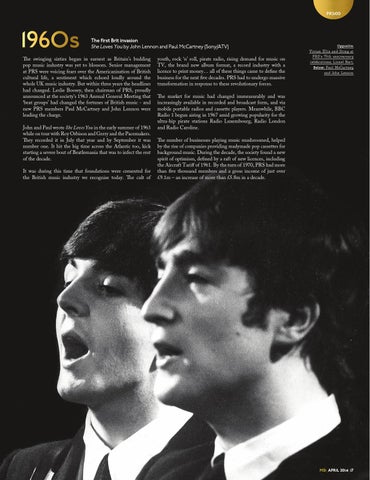
Opposite: Vivian Ellis and Sting at PRS’s 75th anniversary celebrations; Lionel Bart; Below: Paul McCartney and John Lennon
The market for music had changed immeasurably and was increasingly available in recorded and broadcast form, and via mobile portable radios and cassette players. Meanwhile, BBC Radio 1 begun airing in 1967 amid growing popularity for the ultra-hip pirate stations Radio Luxembourg, Radio London and Radio Caroline. The number of businesses playing music mushroomed, helped by the rise of companies providing readymade pop cassettes for background music. During the decade, the society found a new spirit of optimism, defined by a raft of new licences, including the Aircraft Tariff of 1961. By the turn of 1970, PRS had more than five thousand members and a gross income of just over £9.1m – an increase of more than £5.8m in a decade.
M51_APRIL 2014_17