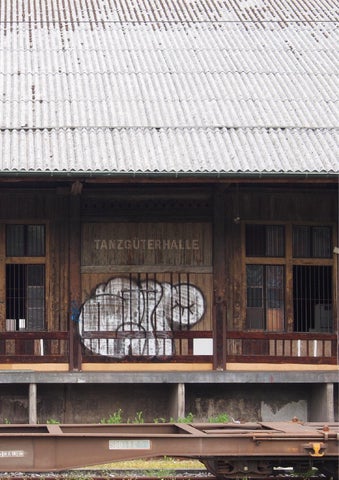
TANZG端terhalle
TanzG端terHalle Urban Intervention in St. Johann
Tutor Imanuel Schipper
Course Director Dr. Stephan Trüby AADipl.
Zürcher Hochschule der Künste Zurich University of the Arts
Ausstellungsgestaltung 2012: Lyubov Jeglova / Natalia Wespi
MAS Spatial Design Leitung: Dr. Stephan Trüby AADipl. Künstl. Assistenz: Alexandra Carambellas.
Weitere Infos: http://spatialdesign.zhdk.ch
2. Obergeschoss (Korridor) Ausstellungsstrasse 60 8005 Zürich
Eloisa Avila Barreiro Evangelina Guerra Lujan Corinne Jordan Attila Morocz Ursula Müller Monelle Schäfer Marion Schneider Barbara Wick Brüggner
Vernissage: Freitag, 1. Juni, 17-22 Uhr 2.-14. Juni, täglich 12-20 Uhr
Academic Associate Alexandra Carambellas
Diplomausstellung 2012
Master of Advanced Studies Programme Spatial Design (MAS) *ehem. MAS Scenography
MAS Spatial Design
TANZG端terhalle Urban Intervention in St. Johann Project by Lyubov Jeglova
Zurich, 2013
Contents I. Tanzgüterhalle ..........................................................................................................................................9 II. Project overview......................................................................................................................................11 III. Theoretical framework ...........................................................................................................................13 IV. Conceptual references ...........................................................................................................................14 1. “Le Bal” - ballroom as a metaphor of the city.......................................................................................14 2. A dance of 3 minutes .........................................................................................................................15 3. A dance floor in the park....................................................................................................................16 4. Conclusions .......................................................................................................................................17 V. Güterhalle, St. Johann ............................................................................................................................18 1. History, present and future ................................................................................................................18 2. Intervention space..............................................................................................................................20 VI. Program of events .................................................................................................................................26 1. Detailed weekly program....................................................................................................................28 VII. Dramaturgy of opening event ...............................................................................................................32 1. Performance concept .........................................................................................................................32 2. Stories ...............................................................................................................................................34 3. Platform for exhibition .......................................................................................................................36 VIII. Epilogue ..............................................................................................................................................37
Illustrations credits ....................................................................................................................................39
9
Tanzg端terhalle A ballroom as a space where people get together and share the joy of dancing. A space where they share with each other their memories, their wishes and visions for the future. The project proposes the reinventing of the G端terhalle in St. Johann as a space for communication. There the various residents of the neighbourhood could bring their stories of where they come from, how they see the neighbourhood, what has changed during time and what they hope for the future. Tanzg端terhalle is a space where one looks back, collects memories, rethinks who he is. It is a space of remembering through dancing, where the identities of different groups of people are reconstructed and together with that the identity of the neighbourhood.
Project overview
11
Project Overview In the following book I present a concept of the project Tanzgüterhalle - an urban intervention in the neighbourhood of St. Johann in Basel. An overview of the theoretical framework is provided based on the theory work that has been carried out prior to the development of the concept of the project. The aim of this is to situate the project within a wider analysis of participatory urban interventions. Further I focus on the conceptual references of the project. These include the film “Le Bal” by Ettore Scola, where I see the space of the ballroom as a metaphor of the city and a dance of three minutes as a metaphor of the way city life could be. Central to me in the film is the communication between people that is taking place in the ballroom, as well as the activity of remembering and going back in time. Then in the conceptual references I look at a conversation with my grandparents that took place in May 2013 in a location that used to serve as a gathering space for many people. This is the very location where they first have met. In this section I attempt to reflect why such gathering places and the activities that took place there are no longer present in our cities. In the end of the conceptual references I summaries my intentions for the urban intervention, which are to create a communication space for the residents of the neighbourhood that would be organized around the activity of remembering through dancing. I explain what kind of space is needed for the latter and point out the location I have chosen, which is the Güterhalle next to the old train station in St. Johann. Next I give an overview of the Güterhalle, which includes a brief history of the building and an outline of the future plans for its use. In this section I also propose how the space of the Güterhalle could be organized in order for it to become a gathering space for the residents of the neighbourhood. As a gathering space the Tanzgüterhalle provides a variety of events based around the activities of dancing and collecting memories. In the program of events I offer a proposal for a weekly program in the Tanzgüterhalle. In the end a dramaturgy of an opening event is presented which is aimed at introducing the residents of the neighbourhood to the new space and the activities that it proposes. The opening event takes the for of a performance, where central is the idea of dancing as a way of moving through time and space. In the epilogue I look at the questions that remain open. They are related to the idea of communication between people and its changing value in our world.
THEORETICAL FRAMEWORK
13
Theoretical Framework First of all I would like to explain why i see the proposed project as an urban intervention. The reason for this is that the space of the Güterhalle and the activities that are to take place there are seen as a metaphor of the city, or how city life could be. It is a space where different people coexist together, without having to deny who they are. It is a space where the complexity of city life is encouraged. And with this the space of the Güterhalle attempts to oppose itself to the monotony that is more and more characteristic for contemporary cities. Based on the theory work, which looks at the ways urban interventions can support community, several aspects that characterise an urban intervention have been identified. They are the following: • influence on the community; • ways of citizens participation; • project visibility; • design object. I have attempted to position my project within the framework of these aspects based on the aims I am trying to achieve with the help of the urban intervention I am proposing. The influence on the community that I am aiming to achieve with the project is to connect citizens, make them more aware of each other; strengthen the bonds between citizens and the city. This I will attempt to achieve by producing knowledge and making people more informed. The common engagement in the form of dancing and remembering are seen to be able to connect different people. The space of the hall together with the support of its lifelines becomes the common goal of many in spite of their differences. Participation of the citizens should be seen as not just passive providing of information, and by saying passive I do not intend to state that the sharing of information and ideas is not important, but rather that I attempt to engage citizens in the co-creation of the space of the ballroom through their action in this space. This can be done by the collective creation of the physical space of the Güterhalle and the subsequent taking care of it or by participating in the dance events, discussions, talks, etc. In addition participants will be asked to share their memories about the neighbourhood as well as the different places they come from. Visibility - the main activities of the the Tanzgüterhalle are proposed to be taking place within the closed space of the hall and therefore will only be visible by the participants. However within the program of events there will be special activities taking place in the urban space. These will be for example walks in the city organized around the idea of collecting memories. Also some of the dance events will happen on the near-by Vogesenplatz. Here I would like to add that the space of the Tanzgüterhalle is considered as a public space, a space for and by the citizens. Finally, the design object in the project is seen as the creation process itself and of course the set of events that would take place in the Güterhalle. The design process will be mainly characterized by the participation of citizens. This process to some extend merges with the events held in the Güterhalle. These events also coproduce the new space of the hall, although they can be viewed as well as independently designed actions. Güterhalle as a new space for the community, as a public facility can be seen as the result of all events that would happen there. Through the above mentioned strategies the project attempts to empower the citizens of St. Johann to take part in the life of the neighbourhood, to be more involved in the activities of the neighbourhood but also be better informed about the place they live in, its history and possible future.
14
CONCEPTUAL REFEreNCE
Conceptual Reference “Le Bal” - ballroom as a metaphor of the city As mentioned already the project suggests of creating a temporary ballroom as a communication space for the people of the neighbourhood. This idea was inspired by Ettore Scola’s film “Le Bal”1 which represents a fifty-year story of French society by way of a ballroom in France and shows how totally different people coexist in one space and the activity that brings them together is the activity of dance. The film moves from one dance number to the next, as the music reflects the political and cultural mood of the times, from the Popular Front of 1936 to the German Occupation during World War II, on to the lightness of the post-war era and the open rebellion of May 1968, and finally closing in the early 1980s. The ballroom is seen in the project as a metaphor of the city. Both the city and the ballroom are spaces that for one or another reason attract people. They are characterized by great difference and disagreement however total strangers find ways to coexist there. The different rhythms of the dances, the different movements, the different moods - all these we can notice also in the life of a city. If we look closer at the movie then we see that throughout the whole film there are characters that remain excluded - they wait to be invited to dance but that never happens, or they are not welcome to the space at all. But nevertheless “undesired” people enter the space of the ballroom to disturb it or maybe to make it even more unique. “Le Bal” also reflects the desire of people to be with someone and not alone. It represents the search for a common soul, a friend. The ballroom is the place where people gather together in moments of happiness and celebrations as well as during moments of difficulties and sorrow. Our cities too attract people for all the above mentioned reasons. The ballroom is also the space where we can follow the change of moods and fashions that people were occupied with throughout time. Likewise the streets in contemporary cities serve as the mirror or these moods and fashions. The big dancing hall is at the same time the space where memories are brought back and dreams for the future envisioned. However there are moments when the life of the ballroom is in decay, when it fails to accomplish its function. Similarly such moments could happen in the city if the urban space becomes monotonous and uniform, when there is no communication between citizens, no discussion. These could be the moments of urban crises, when the city stops functioning as a space where discussion can occur, but rather the discussion in these moments has been silenced. However as in the ballroom thus also in the urban space those moments of crisis are moments of transition. The overcoming of these moments is what gives opportunities for inventiveness, for experiments and new ideas. “Le Bal” shows the ballroom in decay just before the events of ‘68. After and as result of these events the space is revived. It has become once again the gathering space of many people. “Le Bal’s” timeframe runs until the ‘80s. We can only guess what was the destiny of this space afterwords. Was it long a meeting point of many people? With the proposed work I will attempt to question the possibility of the existence of such a space as envisioned in “Le Bal” today. What is needed for such a space to be present? Is the reality of such a space only based on enthusiasm and bravery? Or is it something else? Is the disappearance of such spaces a symptom of our disengagement with city life?
1 Le Bal (1983) - Italian-Franco-Algerian film, director Ettore Scola. More information http://de.wikipedia.org/wiki/Le_Bal_–_Der_ Tanzpalast
CONCEPTUAL REFERENCE
15
A dance of 3 minutes Dance is the main activity in the ballroom. One gets invited to dance by different people. A dance one shares with another person can be considered a smaller part from the whole which constitutes the ballroom. Therefore if the ballroom is considered as a metaphor of the city, then a dance of 3 minutes that takes place in this ballroom can be seen as three minutes as saying “yes” to another person that could be unknown to us and very different from us. However these three minutes are a moment that people spend very close to each other, very intense together without raising any questions on their relationship. The dance of 3 minutes in turn I see as a metaphor of how city life could be. In these three minutes one does not have to deny his culture or integrate into another culture, one does not have to deny his visions and understandings but rather has to be himself and dance. In this way the activity of dancing becomes a common aim which connects people. But also dancing is the activity that takes people on a journey through time and space. This can be seen as in the sense of the movement itself, but also in the way that while dancing people can remember places and activities from the past. While dancing one can go through time and find things from previous decades, or one can go through space and discover things about different places in a neighbourhood, a city, or the world. Through the idea of the ballroom and the dance of 3 minutes I attempt to create an intervention that could co-produce an urban space that permits for the expression of difference and disagreement but at the same time allows for the just “living” together within the space of the ballroom. The intervention should make clear what the differences are that exist in the neighbourhood of St. Johann.
Image 01 Scene from “Le Bal”
16
CONCEPTUAL REFEreNCE
A dance floor in a park Below is a conversation that took place between my grandparents and me on 5th of May 2013 in the park of Naro-Fominsk city. They share their memories about a dance floor in this park – the place where they spent their youth and where they first met each other. VB - Well, she wants to know how we met... I don’t know all this... AB - On the dance floor... Well, there was also the community centre of the silk factory. There they showed movies. VB -There were different workshops there; otherwise it was the dance floor where we went.
VB - What do you think? Only with your granddad?! We were invited. LJ - Well I thought you danced with your husband. VB - Why so with my husband? We were not yet married then. We were a group of friends and everybody invited everybody. There was also the “white” dance that I didn’t like. LJ - What was a “white” dance?
AB - Especially in the summer... everybody was at the park at the dance floor. VB -All new years’ eves and holidays... Oh, and New Year – all youth was celebrating it here.
VB - “White” dance was when ladies were inviting. LJ -And why didn’t you like it? VB - Oh, I just didn’t like it.
AB - During a football match it happened that players hit the ball so hard it went into the nearby pond. And there was no second ball then. It was not like now, when there are tons of them. And then the judge asked somebody from the younger guys to get it out of the pond. For how much? For 3r. That was not so little money back then…
LJ - Probably I would not have liked it also, yes, Jenya? ES - You would not have liked any of these gatherings... LJ -No, if only we had similar dance evenings I think I would have loved it. It is better than now.
LJ - How old were you then? ES - Now you can also dance in the park. VB - I was about 17-18. I was already going to dance then. LJ -And you were allowed to? VB - Of course! Why not? We were many... 5-6 girls gathered. We never went alone, only together. My girlfriend, she lived very close... LJ - And what did you dance? Waltz? VB -Yes, waltz, but not only. There was everything. Foxtrot, tango... LJ -So you mean you knew everything?
LJ - Yeah, but that is totally different. Those are classes and workshops. It is not so much about communication and gathering together. VB - It was our recreation – beautiful dance, nice music. Oh, the music... LJ - Was it life? VB - Of course! We had an orchestra. Life music… We grew up with this music, with good music? Sometimes some things were forbidden, other times not We had our underground music... And now our neighbor – I don’t understand what he is listening to...
VB - Yes! Of course! LJ - Can we go closer to the dance floor? LJ - Who thought you? VB - No one really! In school a bit... There were workshops. Dance workshops and other. School evenings…
LJ - Is everything as it was back then? AB - Well yes. Here you could get your ticket. VB - How much – 20k. – did they cost?
VB - But waltz is our favourite dance with your granddad. Granddad loves it.
AB - 20k., and a ticket for the metro was 5k. It was not that little.
VB - What was the other waltz? AB - Waltz - Boston?
VB - Here is where we danced. Everybody gathered here, but mostly the youth. Over there in the open air cinema we watched movies.
VB - Yes. I did not like this one! I could not dance it. AB - Well, waltz-Boston I learned in ’79, one guy thought me. VB - I did not learn it and did not like it. Your granddad did, and I could not. I was always stumbling… AB - But it was beautiful... VB - Yes, beautiful. All with whom I danced said I was very light. Meaning they did not have to drag me. I could dance quite well. LJ - So you danced with different people?
VB - There was a lot of sculpture in the park, but now it is gone. It was always well taken care of, there were many benches. The older generation came to the dance just to have a look. There were many people who came to look at the dancing youth. Sometimes it was parents. They went for a walk in the park and then together with their children went back home. Nobody came to look at us.
CONCEPTUAL REFERENCE
17
In the end of this conversation I did convince my grandparents to dance for a while on the same dance floor where they first met more than 50 years ago. They still remembered the steps and it felt so natural how they moved. The story of my grandparents is on the one hand an inspiration for the kind of activity I would like to recreate - dancing - but also it is a reference for the type of stories people could share within the space of the ballroom. These could be stories about spaces and together with them activities from the past that do not exist in the same form today - a kind of remembering through dancing. Conclusion As a result of my desire to create a gathering space, where the activity of dancing could take place which would also inspire participants to look back on their life and collect the memories of different places, I faced the question of where it would be possible for such gathering space to be created in the neighbourhood of St. Johann. In the end after another walk in the area of Vogesenplatz and the old train station I noticed the G端terhalle, which became the location for the Tanzg端terhalle. Below I will give a brief overview of the history of the building and the current state of its use.
Image 02 My grandparents on the Dance floor in the park of Naro-fominsk city, 05.05.2013
18
Guterhalle, St. Johann
Güterhalle, St. Johann History, present and future Güterhalle is a building at the train station St. Johann that was first built in 1859 on the site of the Central Train Station in Basel as a goods warehouse. Further in 1899 when the goods freight was outsourced it was moved to its current location. The recent transformation of large parts of St. Johann has also affected the train station area which is changing dramatically. A former goods station now St. Johann station has been converted into a passenger station which holds around 60 trains daily, in front of the station provides the tram lines 1 and 21 connect passengers to the city. Thus the station has received the function of a transport hub. Further development plans are on the way, one of which is to create a passageway that would link the platform of the railway station and Vogesenplatz. To do this the demolition of the Güterhalle would be required. Such a step should however be carefully considered as the hall is characterized by a very finite carpenter work and has a historical value. In recent times attention towards the building was increased due to an exhibition “Hier und Dort” that took place in the hall in 2011. It attracted many of the residents of St. Johann and helped increase the interest towards the Güterhalle. The featured exhibition showed the history of the region of Basel in the 20th century - a hundred years that have changed the region of Basel profoundly.2 2
Markus Vogt, “Güterhalle wird ausrangiert”, http://bazonline.ch/basel/stadt/Gueterhalle-wird-ausrangiert/story/24306676
Image 03, 04 TOP: Plan of vogesenplatz, 1940. Bottom: Contemporary plan of Vogesenplatz
Guterhalle, ST. Johann
Image 05. GUEterhalle, 11.05.2013
19
20
Guterhalle, St. Johann
Intervention space The aim of the proposed intervention is to suggest a type of use of the Güterhalle that can create a communication space for the residents of the neighbourhood and thus suggest an alternative use of the building. Series of events could be held in the building that can include dance, screenings, lectures, discussions, etc. For this reason the space of the Güterhalle will be organized in a way that will allow for different events to take place. The space of the hall is divided in two parts - the dance space on the left as the performative space defined mainly by the activity of dancing; and on the right - the exhibition space which would be defined by the activity of collecting and remembering. In the centre the two parts are united by a bar. To create the performative space the scheme which is presented in “Le Bal” is used, meaning that the space is organized with the help of coffee tables that surround the hall on the perimeter. The tables are considered as the place of encounter, where one waits to be invited for a dance or where a discussion which has been started during a dance can be continued. In addition I see these coffee tables as very personal objects that could also help tell different stories of the people from the neighbourhood. The dance space can be used in different modes: as a cafe; as an “ordinary” dance space and as a space for special events. The scenography of the different modes remains very similar however the space is defined by the actions that are taking place there. The exhibition space is seen as the space were information can be exchanged and knowledge produced. It is the place where the residents can bring their stories from the neighbourhood, from Basel or from other places. They can collect photos of the different places they come from, maps, etc - things that by themselves tell a story. They can also collect images from the neighbourhood to see how it has changed in the course of time. The exhibition space is again organized through the use of wall panels where the different items that have been gathered can be exposed. Additional events can also be held in the exhibition space as for example lectures, talks and movie evenings. The space of the hall is seen as a space of memory, of remembering, which happens through dance. This helps reconstruct the identities of different people or groups of people and together with that the identity of the neighbourhood itself.
Image 06 CROSS SECTION OF GUETERHALLE - dance space
Guterhalle, ST. Johann
Image 07. Guterhalle - Dance space
21
22
Guterhalle, St. Johann
Image 08. top LONG SECTION OF GUETERHALLE
Guterhalle, ST. Johann
Image 09. bottom Plan OF GUETERHALLE with ballroom space
23
24
Guterhalle, St. Johann
Image 10 Exhibition space - variety of uses
Guterhalle, ST. Johann
Image 11. Exhibition space. archive of images
25
26
Program of events
Program of events The space of the Tanzg端terhalle is a space that should allow for different events to take place and different things to happen. The activities that happen in the space are based around two main things: dancing (performative) and remembering, collecting (exhibitional). The program of events features various thematic evenings that are aimed at representing the diversity of the neighbourhood and engaging different residents in various activities. Performative activities include dancing, which would be organized around the music and dances of different times and different places, from which the residents of St. Johann come from. A Sunday dance school will be proposed where residents would have the opportunity to learn various dances. The exhibition activities include the sharing of stories, orally made stories, as well as collecting pictures, photographs, maps of different places and time periods. The activities are intended to provide knowledge both about foreign cultures that are present in the neighbourhood, but also about the neighbourhood itself and the local culture. As an example of a thematic evening could be an Evening of Italian Music & Dance hosted by Gerardo Ariniello - a hairdresser in his late 60s, who has moved to Basel back in the mid 1970s and since has been running his salon on Lothringerstrasse. On the following pages a detailed weekly program is presented showing the proposed activities that are to take place in the Tanzg端terhalle.
Tonight in the Tanzg端terhalle we have an Evening of Italian Music & Dance, with me Gerardo Ariniello!
Image 12. salon de coiffure - gerardo ariniello, lothringerstrasse
Program of events
We will sing for you our all time favourite songs!
Image 13 TANZGuterhalle, - Evening of italian music and dance
27
MONDAY
TUESDAY
Board games evening Start @ 17.00
Stories about places Start @ 17.00
Tanzg端terhalle, Vogesenplatz 17, Basel www.tanz-gueter-halle.com
Tanzg端terhalle, Vogesenplatz 17, Basel www.tanz-gueter-halle.com
FRIDAY
SATURDAY
Music & Dance Start @ 19.00
City Walk Start @ 16.00
Tanzg端terhalle, Vogesenplatz 17, Basel www.tanz-gueter-halle.com
Tanzg端terhalle, Vogesenplatz 17, Basel www.tanz-gueter-halle.com
Music & Dance Start @ 19.00
WEDNESDAY
THURSDAY
Stories about times Start @ 17.00
Movie evening Start @ 19.00
Tanzgüterhalle, Vogesenplatz 17, Basel www.tanz-gueter-halle.com
Tanzgüterhalle, Vogesenplatz 17, Basel www.tanz-gueter-halle.com
SUNDAY
TANZGÜTERHALLE
Dance school All day long
A place to dance through space & time together
Tanzgüterhalle, Vogesenplatz 17, Basel www.tanz-gueter-halle.com
Tanzgüterhalle, Vogesenplatz 17, Basel www.tanz-gueter-halle.com
MONDAY
TUESDAY
Board games evening Start @ 17.00
Stories about places Start @ 17.00
Tanzgüterhalle, Vogesenplatz 17, Basel www.tanz-gueter-halle.com
Tanzgüterhalle, Vogesenplatz 17, Basel www.tanz-gueter-halle.com
Every odd week of the month
Every odd week of the month
Chess with Ernesto N.
Collect stories about places
17.00 - 18.00 - introducing chess to children 18.00 - 21.00 - chess tournaments
We talk, tell stories about the different places of our live, we share images from these places.
Every even week of the month
Every even week of the month
Various board games
Collect stories about St. Johann
Mancala, Go, Chinese Checkers, Ludo, and many others. But also do not forget to bring the games that you would like to share with others.
We talk, tell stories about the different places of St. Johann, we share images from these places.
Foto © Lyubov Jeglova
Foto © Lyubov Jeglova
Foto © www.seniordesign.ch
Foto © Lyubov Jeglova
Every odd week of the month
Every odd week of the month
Music & Dance from different places
Music & Dance from different times
Italian, Swiss, French, German, Turkish, British, etc.
From the 50s, 60s, 70s, 80s, 90s, 00s, etc.
Every even week of the month
Every even week of the month
Music & Dance from different times
Music & Dance from different places
From the 50s, 60s, 70s, 80s, 90s, 00s, etc.
Italian, Swiss, French, German, Turkish, British, etc.
Every week @ 15.00 & 17.00
Every week @ 16.00
Dance Classes
City Walk
According to the evening program
We collect memories about St. Johann by walking the streets of the neighbourhood.
FRIDAY
SATURDAY
Music & Dance Start @ 19.00
City Walk Start @ 16.00
Tanzgüterhalle, Vogesenplatz 17, Basel www.tanz-gueter-halle.com
Tanzgüterhalle, Vogesenplatz 17, Basel www.tanz-gueter-halle.com
Music & Dance Start @ 19.00
WEDNESDAY
THURSDAY
Stories about times Start @ 17.00
Movie evening Start @ 19.00
Tanzgüterhalle, Vogesenplatz 17, Basel www.tanz-gueter-halle.com
Tanzgüterhalle, Vogesenplatz 17, Basel www.tanz-gueter-halle.com
Every odd week of the month
Every odd week of the month
Collect stories about times
Movies from different places
We talk, tell stories about the different times of our live, we share images from these times.
Italian, Swiss, French, German, Turkish, Russian, British, etc.
Every even week of the month
Every even week of the month
Collect stories about St. Johann
Movies from different times
We talk, tell stories about St. Johann in different times. How it was in the 50s, 60s, 70s, etc.
From the 50s, 60s, 70s, 80s, 90s, 00s, and today!
Foto © Stadt Archive Basel
Foto © Pane, Amore e Fantasia
Foto © www.tsekh.ru
Image © Lyubov Jeglova
@ 10.00
Tanzgüterhalle in St. Johann - a space for communication, where the various residents of the neighbourhood share their stories of where they come from, how they see the neighbourhood, what has changed during time and what they hope for the future.
Dance for children @ 14.00
Dance for children @ 16.00
World Dance @ 18.00
Urban Style
Tanzgüterhalle is a space where one looks back, collects memories, rethinks who he is. It is a space of remembering through dancing.
@ 20.00
Contemporary
SUNDAY
TANZGÜTERHALLE
Dance school All day long
A place to dance through space & time together
Tanzgüterhalle, Vogesenplatz 17, Basel www.tanz-gueter-halle.com
Tanzgüterhalle, Vogesenplatz 17, Basel www.tanz-gueter-halle.com
32
dramaturgy of opening event
Dramaturgy of Opening Event In this section I will look at the opening event that is proposed to take place in the Tanzguterhalle. The event aims to introduce residents to the new community space and activities that it offers. It is based on the idea that while dancing one can go through time and space. The event should represent in a compressed way the various activities that would happen in the space of the hall, which include dancing, remembering and collecting. The main goal of the event is to provide an overview of the diversity that exists in the neighbourhood and on this base to create space for communication and debate. The event will consist of two part according to the two suggested parts of the hall space: a performance and a platform for an exhibition. Performance Concept For the performance it is proposed to invite residents of the neighbourhood to share their stories that in one or another way are linked to the life of the neighbourhood. As mentioned in the Conceptual references section these stories should bring spaces, events and activities either from the past or from the future depending on who is telling the story. In this way the stories told from the elder people will bring the past into the present whereas the stories told from the younger people will bring the future into the present. The opening event proposes two types of participants: “the storyteller” and “the listener.” “The listener” encounters “the storyteller” at one of the coffee tables. Each coffee table shows a collection of items (images,
Story 8
Story 2
Story 5
Story 6
Story 1
Story 9
Story 7
Image 14 TANZGuterhalle, opening event - dancing through time and space
Story 3
Story 4
Dramaturgy of opening event
The listener
Image 15 TANZGuterhalle, opening event
The storyteller
33
34
dramaturgy of opening event
photographs, etc) that “the storyteller” has shared. There at the coffee table “the storyteller” tells his personal story. The media through which the stories are transmitted is not direct conversation but audio recording that “the listener” listens to with headphones that are located at every coffee table. The reason to choose this type of media is driven by the desire to emphasise on the content of the story, to make it in a way more hearable and impossible to be interrupted. However it is also important to have the orally spoken story that would remind participants about the very natural method of communication when two people are sitting, looking at each other in the eye and listening and hearing what their narratives are. After hearing the story “the listener” is invited by “the storyteller” for a dance. This dance takes him to the next story - the next moment in time and space. During the event ‘the listener” listens to about 10 stories from different people, which are all in some way linked to the neighbourhood of St. Johann. At the end “the listener” is invited to a dance however no more stories are told. This is the time where the roles of “the storyteller” and “the listener” start to blur, where communication can be continued based on the knowledge that participants have received. Stories The concept of the stories I am proposing is based on the idea of having 10 stories of 10 decades that different people from the neighbourhood share. This again is linked to the idea of “Le Bal” going back in time. However with the stories I would also like to follow the spatial changes that have taken place in the neighbourhood throughout the 20th century and how they might have influenced the life of the people there. I will look at specific city-blocks in the neighbourhood, some of which exist for a long time, others have changed recently. I believe that the physical change of the city inevitably influences the life of the urban space by sometimes attracting new people and with that new stories. Although this could happen also the other way around.
The storyteller
Image 16 TANZGuterhalle, opening event - listening to a story
Dramaturgy of opening event
Story 7 Story 10 Story 9
Story 8
Image 19. ST. JOHANN, 2013
Story 5
Story 6
Story 4
Image 18. ST. JOHANN, APPROX. 1940
Story 1
Story 2
Story 3
Image 17. ST. JOHANN, Approx. 1905
35
36
dramaturgy of opening event
Platform for Exhibition The exhibition of the opening event will present two series of images located opposite to one another. These will be images of St. Johann from various epochs that residents have shared; and images of the various places that some of the residents of the neighbourhood come from. The images are aimed at exposing the cultural diversity that is so present of St. Johann. The exhibition is seen as a starting point for the collection of memories about places and times. It provides a platform that could be further developed by the residents of the neighbourhood, who are invited to share their memories and stories.
St. Johann images of different times
Images of the different places from where residents come from
Image 20. Remembering of places and times
epilogue
37
Epilogue In the end still some questions remain open to me. Having proposed a space for communication I ask myself if people really need to meet and communicate in this way today? Yes, of course they do, as communication can be said to be a core human activity. But then to me comes the question of how actually honest is this communication? What are the reasons that are driving us today to meet others? Recalling a conversation with one of the residents of St. Johann, I remember he said that communication today is lost. Before people were talking on a street corner, exchanging ideas. Today, he said, we do not see that any longer. However does that mean that people do not meet and do not communicate today? I guess communication today is becoming on the one hand more limited - we rarely talk to stranger on the street, so we do not know who they are and where they come from; on the other hand communication is now more and more accessible and diverse with the variety of new media that are present. With the proposed project I attempt to create a space where communication can happen in its most natural way in the form of dance, orally told stories, discussions; where strangers could meet directly or indirectly. With that I wish to produce knowledge about the complexity of people living in the city.
illustrations credits
Illustration Credits
Cover Image - author Image 01 - Still from the film “Le Bal”, director Ettore Scola Image 02 - author Image 03, 04 - Basel Stadt, Geoportal, http://www.stadtplan.bs.ch/geoviewer/ Image 05 to 20 - author Program images: Monday, Tuesday, Saturday, Tanzguterhalle images - author Wednesday image - Stadt Archive Basel Thursday image - Still from the film “Pane, Amore e Fantasia”, director Luigi Comencini Friday image - www.senior-design.ch Saturday image - www.tsekh.ru
39