(manchinery) Research / artistic references Theoretical background and references A series of devices connected by a relationship of cause and effect lends itself to be easily associated with a Goldberg Machine. Instead, the machine in this piece is the assembly of other machines, people and interfaces; whose connections are more based on matters of content, rhythm and motion than cause and effect. Rendering daily scenes of urban life and machines as a series of interconnected elements has been also explored in the City Symphony Films. Following this line, this piece is divided into sections or movements that vary in pace and intensity according to the era in the relationship men-‐machine that they depict. The segmentation by periods of production within the history of capitalism (Henry Ford era/ post-‐ Fordism/ industrialism/Post-‐ industrialism] have been done following Deleuze´s analysis on technology and society; and how the relationship men-‐machines (accordingly to each era respectively) have developed different methods of control and production. In the sections associated to the industrial revolution era, in which cogs, gears and pistons were visible and their functioning was more exposed as evident; the link among elements (screens) is more mechanical. While in the movements that approach methods of production closer to the Information Technologies, in which processors, computers and codes are its key elements, and its way of functioning is less visible. The connection between elements is more digitally triggered. Everything is independent and interconnected at the same time. “ Types of machines are easily matched with each type of society-‐-‐not that machines are determining, but because they express those social forms capable of generating them and using them. The old societies of sovereignty made use of simple machines, levers, pulleys, clocks; but the recent disciplinary societies equipped themselves with machines involving energy, with the passive danger of entropy and the active danger of sabotage; the societies of control operate with machines of a third type, computers ” Gilles Deleuze -‐ Postscript on the societies of control (1992)
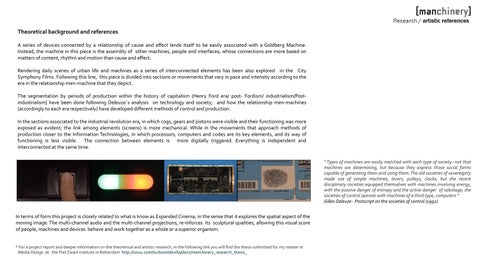
In terms of form this project is closely related to what is know as Expanded Cinema, in the sense that it explores the spatial aspect of the moving image. The multi-‐channel audio and the multi-‐channel projections, re-‐inforces its sculptural qualities, allowing this visual score of people, machines and devices behave and work together as a whole or a superior organism. * For a project report and deeper information on the theoretical and artistic research, in the following link you will find the thesis submitted for my master in Media Design at the Piet Zwart institute in Rotterdam http://issuu.com/luchosoldevilla/docs/manchinery_research_thesis_