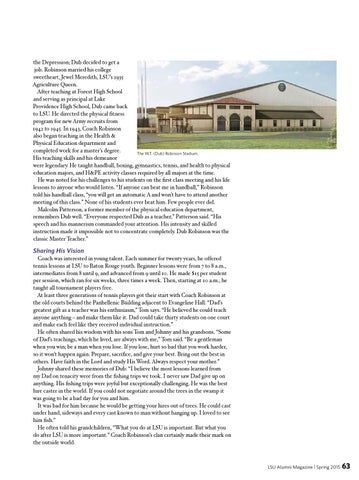
the Depression; Dub decided to get a job. Robinson married his college sweetheart, Jewel Meredith, LSU’s 1935 Agriculture Queen. After teaching at Forest High School and serving as principal at Lake Providence High School, Dub came back to LSU. He directed the physical fitness program for new Army recruits from 1942 to 1945. In 1943, Coach Robinson also began teaching in the Health & Physical Education department and completed work for a master’s degree. The W.T. (Dub) Robinson Stadium. His teaching skills and his demeanor were legendary. He taught handball, boxing, gymnastics, tennis, and health to physical education majors, and H&PE activity classes required by all majors at the time. He was noted for his challenges to his students on the first class meeting and his life lessons to anyone who would listen. “If anyone can beat me in handball,” Robinson told his handball class, “you will get an automatic A and won’t have to attend another meeting of this class.” None of his students ever beat him. Few people ever did. Malcolm Patterson, a former member of the physical education department, remembers Dub well. “Everyone respected Dub as a teacher,” Patterson said. “His speech and his mannerism commanded your attention. His intensity and skilled instruction made it impossible not to concentrate completely. Dub Robinson was the classic Master Teacher.”
Sharing His Vision Coach was interested in young talent. Each summer for twenty years, he offered tennis lessons at LSU to Baton Rouge youth. Beginner lessons were from 7 to 8 a.m., intermediates from 8 until 9, and advanced from 9 until 10. He made $15 per student per session, which ran for six weeks, three times a week. Then, starting at 10 a.m., he taught all tournament players free. At least three generations of tennis players got their start with Coach Robinson at the old courts behind the Panhellenic Building adjacent to Evangeline Hall. “Dad’s greatest gift as a teacher was his enthusiasm,” Tom says. “He believed he could teach anyone anything – and make them like it. Dad could take thirty students on one court and make each feel like they received individual instruction.” He often shared his wisdom with his sons Tom and Johnny and his grandsons. “Some of Dad’s teachings, which he lived, are always with me,” Tom said. “Be a gentleman when you win; be a man when you lose. If you lose, hurt so bad that you work harder, so it won’t happen again. Prepare, sacrifice, and give your best. Bring out the best in others. Have faith in the Lord and study His Word. Always respect your mother.” Johnny shared these memories of Dub: “I believe the most lessons learned from my Dad on tenacity were from the fishing trips we took. I never saw Dad give up on anything. His fishing trips were joyful but exceptionally challenging. He was the best lure caster in the world. If you could not negotiate around the trees in the swamp it was going to be a bad day for you and him. It was bad for him because he would be getting your lures out of trees. He could cast under hand, sideways and every cast known to man without hanging up. I loved to see him fish.” He often told his grandchildren, “What you do at LSU is important. But what you do after LSU is more important.” Coach Robinson’s clan certainly made their mark on the outside world.
LSU Alumni Magazine | Spring 2015
63