William G. Haag
Focus on
FACULTY
LSU and Poverty Point By Ed Cullen
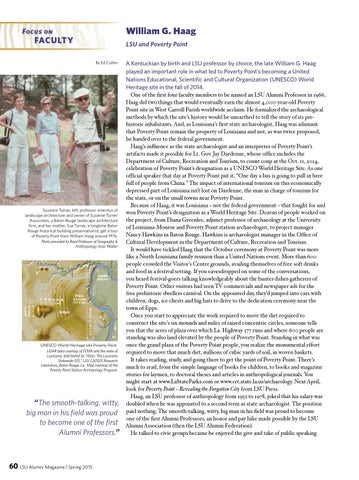
Suzanne Turner, left, professor emeritus of landscape architecture and owner of Suzanne Turner Associates, a Baton Rouge landscape architecture firm, and her mother, Sue Turner, a longtime Baton Rouge historical building preservationist, get a tour of Poverty Point from William Haag around 1976. Photo provided by Boyd Professor of Geography & Anthropology Jesse Walker
UNESCO World Heritage site Poverty Point. LiDAR data courtesy of FEMA and the state of Louisiana; distributed by “Atlas: The Louisiana Statewide GIS,” LSU CADGIS Research Laboratory, Baton Rouge, La. Map courtesy of the Poverty Point Station Archaeology Program.
“The smooth-talking, witty, big man in his field was proud to become one of the first Alumni Professors.”
60 LSU Alumni Magazine | Spring 2015
A Kentuckian by birth and LSU professor by choice, the late William G. Haag played an important role in what led to Poverty Point’s becoming a United Nations Educational, Scientific and Cultural Organization (UNESCO) World Heritage site in the fall of 2014. One of the first four faculty members to be named an LSU Alumni Professor in 1966, Haag did two things that would eventually earn the almost 4,000-year-old Poverty Point site in West Carroll Parish worldwide acclaim. He formalized the archaeological methods by which the site’s history would be unearthed to tell the story of its prehistoric inhabitants. And, as Louisiana’s first state archaeologist, Haag was adamant that Poverty Point remain the property of Louisiana and not, as was twice proposed, be handed over to the federal government. Haag’s influence as the state archaeologist and an interpreter of Poverty Point’s artifacts made it possible for Lt. Gov. Jay Dardenne, whose office includes the Department of Culture, Recreation and Tourism, to count coup at the Oct. 11, 2014, celebration of Poverty Point’s designation as a UNESCO World Heritage Site. As one official speaker that day at Poverty Point put it, “One day a bus is going to pull in here full of people from China.” The impact of international tourism on this economically depressed part of Louisiana isn’t lost on Dardenne, the man in charge of tourism for the state, or on the small towns near Poverty Point. Because of Haag, it was Louisiana – not the federal government – that fought for and won Poverty Point’s designation as a World Heritage Site. Dozens of people worked on the project, from Diana Greenlee, adjunct professor of archaeology at the University of Louisiana-Monroe and Poverty Point station archaeologist, to project manager Nancy Hawkins in Baton Rouge. Hawkins is archaeologist manager in the Office of Cultural Development in the Department of Culture, Recreation and Tourism. It would have tickled Haag that the October ceremony at Poverty Point was more like a North Louisiana family reunion than a United Nations event. More than 600 people crowded the Visitor’s Center grounds, availing themselves of free soft drinks and food in a festival setting. If you eavesdropped on some of the conversations, you heard festival-goers talking knowledgeably about the hunter-fisher-gatherers of Poverty Point. Other visitors had seen TV commercials and newspaper ads for the free prehistoric dwellers carnival. On the appointed day, they’d jumped into cars with children, dogs, ice chests and big hats to drive to the dedication ceremony near the town of Epps. Once you start to appreciate the work required to move the dirt required to construct the site’s six mounds and miles of raised concentric circles, someone tells you that the acres of plaza over which La. Highway 577 runs and where 600 people are standing was also land elevated by the people of Poverty Point. Standing in what was once the grand plaza of the Poverty Point people, you realize the monumental effort required to move that much dirt, millions of cubic yards of soil, in woven baskets. It takes reading, study, and going there to get the point of Poverty Point. There’s much to read, from the simple language of books for children, to books and magazine stories for laymen, to doctoral theses and articles in anthropological journals. You might start at www.LaStateParks.com or www.crt.state.la.us/archaeology. Next April, look for Poverty Point – Revealing the Forgotten City from LSU Press. Haag, an LSU professor of anthropology from 1952 to 1978, joked that his salary was doubled when he was appointed to a second term as state archaeologist. The position paid nothing. The smooth-talking, witty, big man in his field was proud to become one of the first Alumni Professors, an honor and pay hike made possible by the LSU Alumni Association (then the LSU Alumni Federation). He talked to civic groups because he enjoyed the give and take of public speaking