GRAMMAR AND WRITING
I N
E N G L I S H
teacher edition
CONTENTS
Introduction
Welcome to Voyages in English
OV-1
Program Overview How to Use This Program
OV-2 OV-24
PA R T
1 Grammar Sentences Teacher Preparation
Section 1
Sentences
Sentences Statements and Questions Question Words Commands Exclamations Kinds of Sentences Subjects Predicates Combining Subjects and Predicates Combining Sentences Run-on Sentences Sentence Review Sentence Challenge
1.1 1.2 1.3 1.4 1.5 1.6 1.7 1.8 1.9 1.10 1.11
1
Nouns Teacher Preparation
Section 2
Nouns
Nouns Common and Proper Nouns Singular and Plural Nouns More Plural Nouns Irregular Plural Nouns Singular Possessive Nouns Plural Possessive Nouns Irregular Plural Possessive Nouns Collective Nouns Nouns as Subjects Words Used as Nouns and as Verbs Noun Review Noun Challenge
2.1 2.2 2.3 2.4 2.5 2.6 2.7 2.8 2.9 2.10 2.11
1a–1b
2 4 6 8 10 12 14 16 18 20 22 24 26 27a–27b
27 28 30 32 34 36 38 40 42 44 46 48 50 52
Contents • iii
b_4299_TE_G3.indb
~ pg 3 ~
PDF Signoff: Production _______
LoyolaPress.
Design _______
Editorial _______
5/24/16 3:11 PM
Pronouns Teacher Preparation
Section 3
Pronouns
Pronouns Subject Pronouns Object Pronouns Possessive Pronouns Possessive Adjectives Agreement of Pronouns and Verbs I and Me Compound Subjects and Objects Pronoun Review Pronoun Challenge
3.1 3.2 3.3 3.4 3.5 3.6 3.7 3.8
Verbs Teacher Preparation
53a–53b
53 54 56 58 60 62 64 66 68 70 72 73a–73b
Section 4
Verbs
73
Action Verbs Being Verbs Helping Verbs Principal Parts of Verbs Regular and Irregular Verbs Bring, Buy, Come, and Sit Eat, Go, and See Take, Tear, and Write Simple Present Tense Simple Past Tense Future Tense with Will Future Tense with Going To Present Progressive Tense Past Progressive Tense Is and Are, Was and Were Contractions with Not Verb Review Verb Challenge
74 76 78 80 82 84 86 88 90 92 94 96 98 100 102 104 106 108
4.1 4.2 4.3 4.4 4.5 4.6 4.7 4.8 4.9 4.10 4.11 4.12 4.13 4.14 4.15 4.16
Adjectives Teacher Preparation
Section 5
Adjectives
Identifying Adjectives Adjectives Before Nouns Subject Complements Compound Subject Complements Adjectives That Compare Irregular Adjectives That Compare Adjectives That Tell How Many Articles Demonstrative Adjectives Proper Adjectives Nouns Used as Adjectives Adjective Review Adjective Challenge
5.1 5.2 5.3 5.4 5.5 5.6 5.7 5.8 5.9 5.10 5.11
109a–109b
109 110 112 114 116 118 120 122 124 126 128 130 132 134
iv • Contents
b_4299_TE_G3.indb
~ pg 4 ~
PDF Signoff: Production _______
LoyolaPress.
Design _______
Editorial _______
5/24/16 3:11 PM
Adverbs and Conjunctions Teacher Preparation
Section 6
Adverbs and Conjunctions
Adverbs Adverbs That Tell When or How Often Adverbs That Tell Where Adverbs That Tell How Negative Words Good and Well To, Too, and Two Their and There Coordinating Conjunctions Adverb and Conjunction Review Adverb and Conjunction Challenge
6.1 6.2 6.3 6.4 6.5 6.6 6.7 6.8 6.9
135a–135b
135 136 138 140 142 144 146 148 150 152 154 156
Punctuation and Capitalization Teacher Preparation 157a–157b
Section 7
Punctuation and Capitalization
End Punctuation Capitalization Abbreviations Personal Titles and Initials Titles of Books and Poems Commas in a Series Commas in Direct Address Commas in Compound Sentences Apostrophes Addresses Direct Quotations Punctuation and Capitalization Review Punctuation and Capitalization Challenge
7.1 7.2 7.3 7.4 7.5 7.6 7.7 7.8 7.9 7.10 7.11
Diagramming Teacher Preparation
Section 8
Diagramming
Subjects and Predicates Possessives Adjectives Adverbs Adjectives as Subject Complements Compound Subjects Compound Predicates Compound Subject Complements Compound Sentences Diagramming Practice More Diagramming Practice Diagramming Review Diagramming Challenge
8.1 8.2 8.3 8.4 8.5 8.6 8.7 8.8 8.9 8.10 8.11
157 158 160 162 164 166 168 170 172 174 176 178 180 182 183a–183b
183 184 186 188 190 192 194 196 198 200 202 204 206 208
Contents • v
b_4299_TE_G3.indb
~ pg 5 ~
PDF Signoff: Production _______
LoyolaPress.
Design _______
Editorial _______
5/24/16 3:11 PM
PA R T
Written and Oral 2 Communication Personal Narratives Teacher Preparation
Chapter 1 Personal Narratives
Lesson Lesson Lesson Lesson Lesson Lesson
1 2 3 4 5 6
210
What Makes a Good Personal Narrative? Beginning, Middle, and Ending Writing Skills: Strong Verbs Word Study: Colorful Adjectives Study Skills: Dictionary Speaking and Listening Skills: Oral Personal Narratives Writer’s Workshop: Personal Narratives Rubrics
212 216 220 224 228 232 236 247y–247z
How-to Articles Teacher Preparation
248a–248b
Chapter 2 How-to Articles
Lesson Lesson Lesson Lesson Lesson Lesson
1 2 3 4 5 6
248
What Makes a Good How-to Article? Parts of a How-to Article Study Skills: Dictionary Meanings Writing Skills: The Four Kinds of Sentences Word Study: Compound Words Speaking and Listening Skills: How-to Talks Writer’s Workshop: How-to Articles Rubrics
250 254 258 262 266 270 274 285y–285z
Descriptions Teacher Preparation
286a–286b
Chapter 3 Descriptions
Lesson Lesson Lesson Lesson Lesson Lesson
1 2 3 4 5 6
Lesson Lesson Lesson Lesson Lesson Lesson
1 2 3 4 5 6
286
What Makes a Good Description? Writing a Description Writing Skills: Sensory Words Study Skills: Five-Senses Chart Word Study: Synonyms Speaking and Listening Skills: Oral Descriptions Writer’s Workshop: Descriptions Rubrics
288 292 296 300 304 308 312 323y–323z
Personal Letters Teacher Preparation
324a–324b
Chapter 4 Personal Letters
210a–210b
324
What Makes a Good Personal Letter? 326 The Body of a Personal Letter 330 Literacy Skills: Personal E-Mails 334 Writing Skills: Compound Subjects 338 Word Study: Antonyms 342 Speaking and Listening Skills: Telephone Conversations 346 Writer’s Workshop: Personal Letters 350 Rubrics 361y–361z
vi • Contents
b_4299_TE_G3.indb
~ pg 6 ~
PDF Signoff: Production _______
LoyolaPress.
Design _______
Editorial _______
5/24/16 3:12 PM
Book Reports Teacher Preparation
362a–362b
Chapter 5 Book Reports
Lesson Lesson Lesson Lesson Lesson Lesson
1 2 3 4 5 6
362
What Makes a Good Book Report? Character and Plot Study Skills: Parts of a Book Writing Skills: Compound Predicates Word Study: Prefixes Speaking and Listening Skills: Oral Book Reports Writer’s Workshop: Book Reports Rubrics
364 368 372 376 380 384 388 399y–399z
Persuasive Writing Teacher Preparation
400a–400b
Chapter 6 Persuasive Writing
Lesson Lesson Lesson Lesson Lesson Lesson
1 2 3 4 5 6
400
What Makes Good Persuasive Writing? Beginning, Middle, and Ending Study Skills: Idea Webs Writing Skills: Compound Sentences Word Study: Suffixes Speaking and Listening Skills: Persuasive Speeches Writer’s Workshop: Persuasive Writing Rubrics
402 406 410 414 418 422 426 437y–437z
Creative Writing: Realistic Fiction Teacher Preparation
438a–438b
Chapter 7 Creative Writing: Realistic Fiction
Lesson Lesson Lesson Lesson Lesson Lesson
1 2 3 4 5 6
What Makes Good Realistic Fiction? Characters Writing Skills: Dialogue Word Study: Contractions Writing Poetry: Lines That Rhyme Speaking and Listening Skills: Skits Writer’s Workshop: Realistic Fiction Rubrics
440 444 448 452 456 460 464 475y–475z
Research Reports Teacher Preparation
476a–476b
Chapter 8 Research Reports
Lesson Lesson Lesson Lesson Lesson Lesson
1 2 3 4 5 6
438
476
What Makes a Good Research Report? Facts and Notes Study Skills: Library Skills Writing Skills: Revising Sentences Word Study: Homophones Speaking and Listening Skills: Oral Biographies Writer’s Workshop: Research Reports Rubrics
Common Proofreading Marks
478 482 486 490 494 498 502 513y–513z
514
Contents • vii
b_4299_TE_G3.indb
~ pg 7 ~
PDF Signoff: Production _______
LoyolaPress.
Design _______
Editorial _______
5/24/16 3:12 PM
PA R T
3 Bonus Chapters Expository Writing Teacher Preparation
516a–516b
Chapter 9 Expository Writing
Lesson Lesson Lesson Lesson Lesson Lesson
1 2 3 4 5 6
516
What Makes Good Expository Writing? Linking Words Writing Skills: Sentence Types Word Study: Clues to Word Meaning Study Skills: Digital References Speaking and Listening Skills: Presenting a Topic Writer’s Workshop: Expository Writing Rubrics
518 522 526 530 534 538 542 553y–553z
Biographical Writing Teacher Preparation
554a–554b
Chapter 10 Biographical Writing
Lesson Lesson Lesson Lesson Lesson Lesson
1 2 3 4 5 6
554
What Makes a Good Biographical Essay? Chronological Order Study Skills: Time Lines Writing Skills: Using Abstract Nouns Word Study: Expressing Meaning Speaking and Listening Skills: Conduct an Interview Writer’s Workshop: Biographical Essay Rubrics
556 560 564 568 572 576 580 591y–591z
Poetry Teacher Preparation
592a–592b
Chapter 11 Poetry
Lesson Lesson Lesson Lesson Lesson Lesson
1 2 3 4 5 6
592
What Makes Good Poetry? Elements of Poetry Writing Skills: Matching Sentence Parts Word Study: Using Adjectives and Adverbs Study Skills: Spelling Patterns Speaking and Listening Skills: Poetry Reading Writer’s Workshop: Poetry Rubrics
594 598 602 606 610 614 618 629y–629z
Writing Traits
630
Grammar and Mechanics Handbook
631
Index
647
Acknowledgments
654
Scope and Sequence
T-657
Common Core State Standards Correlations
T-670
viii • Contents
b_4299_TE_G3.indb
~ pg 8 ~
PDF Signoff: Production _______
LoyolaPress.
Design _______
Editorial _______
5/24/16 3:12 PM
SECTION PLANNER
1
Sentences SECTION FOCUS • Subjects and predicates • Statements and questions • Question words
GRAMMAR FOR GROWN-UPS
• Commands
Understanding Sentences
• Exclamations
A sentence consists of several parts of speech organized into a meaningful pattern that expresses a complete thought. Every sentence has two basic parts: the subject, or the explicit or implicit person, place, or thing talked about, and the predicate, what the subject is, has, or does.
• Kinds of sentences • Subjects • Predicates • Combining subjects and predicates • Combining sentences • Run-on sentences
A declarative sentence makes a statement and ends with a period.
Sebastian walked. An interrogative sentence asks a question and ends with a question mark.
Did Sebastian walk?
SUPPORT MATERIALS Practice Book Daily Maintenance, pages 1–4 Grammar, pages 5–16 Assessment Book Section 1 Assessment, pages 1–4 Loyola Press Online Assessment System Writing Chapter 1, Personal Narratives Customizable Lesson Plans www.voyagesinenglish.com
An exclamatory sentence expresses strong emotion and ends with an exclamation point.
I can’t believe Sebastian walked! An imperative sentence gives a command and ends with a period.
Walk, Sebastian. In an imperative sentence the subject you is often implied and not stated explicitly.
Walk. Subjects can be combined.
Mary and Juana sit together. Predicates also can be combined.
Robert hopped and jumped.
CONNECT WITH LITERATURE Consider using the following titles throughout the section to illustrate the grammar concept:
Alexander and the Terrible, Horrible, No Good, Very Bad Day by Judith Viorst Leonardo, the Terrible Monster by Mo Willems Miss Nelson Is Missing! by Harry Allard
Occasionally, two complete sentences are combined incorrectly into a run-on sentence.
The sun came up it was a new day. A run-on sentence can be corrected by adding a comma and a coordinating conjunction.
The sun came up, and it was a new day.
“
The words of the world want to make sentences.
”
—Gaston Bachelard
www.voyagesinenglish.com • Sentences • 1a
SECTION PLANNER
Sentences
1
COMMON ERRORS
ASK AN EXPERT
Identifying Fragments
Real Situations, Real Solutions
Some developing writers write sentence fragments rather than complete sentences. This error occurs because young writers often forget that all sentences must have a subject and a predicate. ERROR: Many children. CORRECT: Many children play soccer.
Grammar Geezer At a Complete Loss Some of my students write “sentences” with neither a subject nor a predicate. How can I help them turn these fragments into complete sentences? Fragmented, Joyce in Jersey
ERROR: The frightened tiger. CORRECT: The frightened tiger is hiding.
As students revise their writing, remind them to check each sentence for a predicate, a word or phrase that tells what something is or does.
SENTENCE DIAGRAMMING You may wish to teach sentences in the context of diagramming. Review these examples. Then refer to the Diagramming section.
Joyce Re: At a Complete Loss Write on the board several fragments. Ask students the following questions: Who is this about? What did it/he/ she/they do? Work with the class to fill in missing information so that with every example, students can answer the questions above. Remind students that they should be able to provide the necessary information with every sentence in their own writing. Defragmenting, one sentence at a time, Grammar Geezer
You ran.
You subject
ran Grammar Geek I need you to help me.
verb
My students consistently misuse me and I when writing personal narratives. How can I help them? It is I, Maria K.
Did you run?
you
Did run
subject
verb
Display this visual. Use I as a subject. I like bananas. Use I second when you are talking about two people. James and I went fishing.
Run!
(you)
Run
implied subject
verb
1b • Section 1
Maria Re: I need you to help me.
Use me in the predicate. She gave me the ball. Use me second when you are talking about two people. Harry told Joey and me the joke.
Review it often with students, from the first week of school to the last. From me but not I, Grammar Geek
PART
1
GRAMMAR SE
CTION
1 Sentences 1.1
Sentences 2
1.2
Statements and Questions 4
1.3
Question Words 6
1.4
Commands 8
1.5
Exclamations 10
1.6
Kinds of Sentences
1.7
Subjects 14
1.8
Predicates 16
1.9
Combining Subjects and Predicates
1.10
Combining Sentences 20
1.11
Run-on Sentences 22
12
18
Sentence Review 24 Sentence Challenge 26
1
1.1
Sentences
OBJECTIVES • To identify complete thoughts as sentences • To construct complete sentences
DAILY MAINTENANCE Assign Practice Book page 1, Section 1.1. After students finish, 1. Give immediate feedback. 2. Review concepts as needed. 3. Model the correct answer. Pages 4–5 of the Answer Key contain tips for Daily Maintenance.
WARM-UP
TEACH
PRACTICE
Display a photograph or poster. Ask volunteers to describe what they see and how they feel. Write on the board students’ words, phrases, and sentences. Have a volunteer read aloud about sentences. Tell students that a subject is a noun and a predicate tells what the noun is, has, or does. Challenge students to identify which of their responses to the photograph or poster have a subject and a predicate and are sentences and which are not. Circle the complete sentences as students identify them.
EXERCISE 1 Have volunteers read aloud each item, tell if it is a sentence, and explain why or why not. EXERCISE 2 Explain that the phrases in the first column are subjects and those in the second column are predicates. Invite volunteers to read aloud each subject with several predicates, choose one predicate, and tell why it makes the most sense.
Write the following subjects and predicates on note cards: SUBJECTS PREDICATES Bill and José
has more boys than girls.
The girls
take turns cooking dinner.
Our class
are good friends.
Mom and Dad
plays soccer.
Chloe
like to swim.
1.1
Sentences A sentence is a group of words that expresses a complete thought. Every sentence has a subject and a predicate. The subject names a person, a place, or a thing. The predicate tells what the subject is or does. It expresses an action or a state of being.
Have partners make complete sentences and read aloud the sentences to each other.
S U B J EC T
P R E D I C AT E
The pretzels
were hard and salty.
Emma
ate two pretzels.
My friends and I
liked the pretzels.
The bag of pretzels
is now empty.
To find the subject, ask yourself who or what is doing something or being some way? To find the predicate, ask what is the subject doing or how is the subject being? To find a sentence, make sure there is a subject and a predicate.
Read from a piece of writing that the class is currently reading. Emphasize that complete sentences provide complete thoughts.
Which of these word groups are sentences? A
The tall apple trees
B
The apple tastes good
C
My sister picked apples
D
Were left in the bowl
You are right if you said that B and C are sentences. Each one expresses a complete thought. Each has a subject and a predicate. A and D are not sentences. They do not express complete thoughts. A doesn’t have a predicate. D doesn’t have a subject. EXERCISE 1 Tell which of these word groups
are sentences. Tell which are not sentences. 1. Our class enjoyed its visit to the zoo 2. A huge gray elephant 3. Eating food from a bucket 4. A cub is a baby lion
2
2 • Section 1.1
•
Section 1.1
EXERCISE 3 Have partners complete the exercise. Invite students to read aloud their sentences.
ASSESS
TEACHING OPTIONS
Note which students had difficulty identifying and constructing complete sentences. Assign Practice Book page 5 for further practice.
APPLY APPLY IT NOW Remind students that each of their sentences must include a subject and a predicate. Have partners exchange sentences and check that each has a subject and a predicate. Students should demonstrate the ability to identify and construct complete sentences.
WRITING CONNECTION
Use pages 210–211 of the Writing portion of the book. Be sure to point out complete sentences in the literature excerpt and the student model.
Reteach On a large poster board, copy a paragraph from a text that students have read. Cover parts of sentences with sticky notes so that only incomplete word groups remain. Slowly read the paragraph aloud. Ask students whether they had trouble understanding what you read. Have them explain their answers. Confirm that some of the sentences are incomplete and did not express complete thoughts. Remove the sticky notes and read the sentences aloud to illustrate that they are now sentences.
Meeting Individual Needs
5. 6. 7. 8. 9. 10. 11. 12.
Auditory Assign partners to describe their favorite games or sports to each other. Remind students to speak in complete sentences. Tell students to listen closely to each other’s descriptions. If one partner expresses an incomplete thought, encourage the partners to discuss how to make the thought complete.
The lion was chewing a bone We couldn’t count the leopard’s spots The giraffe’s long legs The keeper fed the seals Swimming under the water I liked the monkeys best
Meeting Individual Needs
We enjoyed the striped zebras Were swinging from branch to branch
Challenge Have students choose an article from an age-appropriate magazine. Ask students to copy five sentences from the article. Then have students draw a vertical line to separate the subject and predicate in each sentence. Challenge students to use either the subject or predicate from each sentence to write a new sentence.
EXERCISE 2 Match each group of words in
Column A with a group of words in Column B to make a sentence. Column A 1. At the circus, clowns 2. Eight brown horses
Column B
a. galloped around the ring. b. wore funny costumes.
3. Several acrobats
c. raised its trunk.
4. A baby elephant
d. walked on their hands.
EXERCISE 3 These groups of words
are not sentences. Add subjects or predicates to make them sentences. 1. went to the zoo last week 2. saw a tall giraffe 3. some children 4. counted the penguins on the rocks 5. gave the seals food 6. dove into the water after the food 7. slept on a rock 8. workers at the zoo 9. roared and walked back and forth 10. the chimps 11. laughed at the monkeys 12. studied a map of the zoo
Diagram It! To practice these concepts in the context of diagramming, turn to Section 8.1.
APPLY IT NOW Write a sentence about each. A. dolphins
D. popcorn
B. tigers
E. monkeys
Common Core Standards CCSS.ELA.L.3.Ia CCSS.ELA.L.3.2
Imagine you are at the zoo. Choose three of these topics.
C. crowd Sentences
•
3
www.voyagesinenglish.com • Sentences • 3
1.2
Statements and Questions
OBJECTIVES • To identify and write statements • To identify and write questions • To distinguish between statements and questions
DAILY MAINTENANCE Assign Practice Book page 1, Section 1.2. After students finish, 1. Give immediate feedback. 2. Review concepts as needed. 3. Model the correct answer. Pages 4–5 of the Answer Key contain tips for Daily Maintenance.
PRACTICE EXERCISE 1 Have students read aloud their responses. Have the rest of the class tell which sentences end with a period and which end with a question mark. EXERCISE 2 Ask students what clues in a sentence help to identify it as a question. Explain that a verb like do or does or a question word (who, what, when, where, why, or how) at the beginning of a sentence indicates that it is a question.
WARM-UP Have partners interview each other about a person, a hobby, or an event. At the end of the activity, ask students to describe the difference between questions and statements. Have volunteers write on the board their questions and responses. Encourage students to tell how the punctuation is different for each kind of sentence.
1.2
EXERCISE 4 Explain that students will use the words in parentheses to begin their sentences. Remind students to end each sentence with a period. EXERCISE 5 Ask volunteers to read aloud their questions out of order. Have other students choose the best answer for each question.
Statements and Questions A sentence begins with a capital letter and ends with a punctuation mark. Some sentences tell things. A telling sentence is called a statement. A statement ends with a period ( . ). There are many animals in the zoo. The lions are sleeping under a tree.
Some sentences ask things. An asking sentence is called a question. A question ends with a question mark (?).
Read from a piece of writing that the class is currently reading. Emphasize the difference between statements and questions.
Do you like to go to the zoo? What do the lions eat?
EXERCISE 1 Match each question in Column A with an
answer in Column B. Then rewrite them. Add question marks at the end of questions. Add periods at the end of statements. Column A 1. What is your favorite animal 2. When do you go to the zoo
TEACH Explain that questions and statements are different types of sentences. Point out that whether a sentence makes a statement or asks a question, it still must have a subject and a predicate, and it must express a complete thought. Review the use of a capital letter at the beginning of both types of sentences. Invite a volunteer to read aloud about statements and questions. Ask students to identify the subject and the predicate in each example sentence.
Column B
a. I go there in the summer b. I like snakes the best
3. Where do you see snakes
c. Only the zookeeper feeds them
4. Who feeds the animals
d. I see them at the reptile house
EXERCISE 2 Rewrite the sentences. Add
periods at the end of statements. Add question marks at the end of questions. 1. Many people work at a zoo 2. What does a zoo veterinarian do 3. Veterinarians take care of sick animals 4. Do zookeepers feed the animals 5. They feed the animals and clean the cages 6. How do volunteers help at a zoo 7. Some volunteers lead tour groups through the zoo 8. Would you like to be a zookeeper
4
4 • Section 1.2
EXERCISE 3 Have students rewrite the sentence parts, adding the correct punctuation. As students read aloud their responses, have volunteers tell which sentences are statements and which are questions.
•
Section 1.2
APPLY
ASSESS
APPLY IT NOW Help students brainstorm topics for sentences. Check that students have correctly used beginning capital letters, periods, and question marks. Students should demonstrate the ability to distinguish between statements and questions.
Note which students had difficulty identifying or distinguishing between statements and questions. Assign Practice Book page 6 for further practice.
TEACHING OPTIONS
WRITING CONNECTION
Use pages 212–213 of the Writing portion of the book.
Ask volunteers to read aloud the first, second, and third questions. (She wasn’t sinking, so why would I?)
Reteach Display a colorful poster or picture. Arrange the class in two groups—an Asking Group and a Telling Group. Have a student in the Asking Group ask a question about the picture. Then have a student in the Telling Group answer the question with a complete sentence. Have students in both groups tell what end punctuation to use. If time allows, switch the groups so students have a chance to form both types of sentences.
English-Language Learners Place a large question mark in one corner of the room and a large period in another corner. Read aloud a series of statements and questions. Have students walk to the appropriate corner to identify whether the sentence is a statement or a question.
EXERCISE 3 Make statements or questions by matching
the words in Column A with the words in Column B. Column B
Column A
1. 2. 3. 4.
How many uses Many people A lot of food Peanut shells
a. b. c. d.
Cooperative Learning
can be used to make kitty litter. enjoy peanut butter.
Have students work in small groups to choose a topic. Challenge each student to write a question about the topic. Have students review and correct all the questions. Then have groups exchange questions. Allow time for students to research answers to the questions. Have students write statements that answer the questions. Encourage students to present their research to the group that wrote the questions.
are there for peanuts? contains peanuts.
EXERCISE 4 Write a complete sentence to
answer each question. Begin with My or I as shown after each question. Put a period at the end of each sentence. EXAMPLE
Do you like corn on the cob? (I) I like corn on the cob.
1. How old are you? (I) 2. Do you have any brothers or sisters? (I) 3. 4. 5. 6.
What is your favorite sport or activity? (My) What is your favorite kind of ice cream? (My) Do you like baseball? (I) Do you have a pet? (I)
7. How do you get to school? (I)
Common Core Standards
8. What is your favorite holiday? (My)
CCSS.ELA.L.3.Ii CCSS.ELA.L.3.2
EXERCISE 5 Write a question for each
answer. Make sure your question is a complete sentence. Begin each question with What do you. Put a question mark at the end. 1. I eat apples for snacks. 2. I put my books in my backpack. 3. I have pencils and paper in my desk. 4. I do my homework after school.
APPLY IT NOW Write four sentences about yourself. Tell about these things. The sentences may be statements or questions. 1. your favorite TV show 2. a good book you’ve read 3. a food you like
Find the third question on page 211.
4. a food you dislike Sentences
•
5
www.voyagesinenglish.com • Sentences • 5
1.3
Question Words Write the following on the board:
OBJECTIVE
Who asks about a person
• To identify and use the question words who, what, when, where, why, and how.
What asks about a thing
DAILY MAINTENANCE Assign Practice Book page 1, Section 1.3. After students finish, 1. Give immediate feedback. 2. Review concepts as needed. 3. Model the correct answer. Pages 4–5 of the Answer Key contain tips for Daily Maintenance.
PRACTICE EXERCISES 1 AND 2 Review the information on the board. Remind students to begin each question word with a capital letter. Discuss the answers with the class.
When asks about a time Where asks about a place Why asks the reason How asks in what way
Have students ask questions using these words. Keep this information on the board for the remainder of the lesson.
EXERCISE 3 When students have completed the exercise, invite volunteers to read aloud their questions and identify the question words.
WARM-UP Have students form a circle to play a game using the question words who, what, when, where, why, and how. Begin the game by asking a question using a question word. Have the student next to you answer the question and ask a question using a different question word. Continue around the circle until all students have had a chance to answer and ask a question, and all the question words have been used at least two times.
1.3
Question Words A question—a sentence that asks for information—often starts with a question word. Some question words are who, what, when, where, why, and how. Who is the president of the United States? What did the president say in the speech? When was the president elected? Where does the president live? Why is a president elected for four years? How do we elect a president?
Read from a piece of writing that the class is currently reading. Emphasize the question words.
EXERCISE 1 Read each statement. Complete the question
after each statement. Use who, what, when, where, why, or how. 1. The president lives in the White House. lives in the White House? 2. The White House is located at 1600 Pennsylvania Avenue. is the White House located?
TEACH
3. The first wedding at the White House was in 1812. was the first wedding held in the White House?
Read aloud about question words. Use the following questions to discuss a book or story the class recently read:
4. Central heating was installed in the White House in 1835. was installed in the White House in 1835? 5. The White House needed to be repaired because it was in bad condition. did the White House need to be repaired? 6. By fixing only the inside of the building around 1950, workers kept its original look. did workers keep its original look? 7. George Washington chose where the White House would be built. chose where the White House would be built?
What was the name of the book? Who are the main characters? Where do the characters live? When does the story take place? Why did the main character do those things?
8. The White House burned down in 1814. did the White House burn down?
How does the story end?
George Washington
6
6 • Section 1.3
•
Section 1.3
Have students discuss the search terms they used to find answers to their four questions.
APPLY APPLY IT NOW Brainstorm other well-known places that students might be curious about. List on the board these places and the question words who, what, when, where, why, and how. When students have finished, have them share their questions. Check that students have applied each word to the correct type of question and information. Students should demonstrate the ability to use questions words.
ASSESS Note which students had difficulty identifying and using question words. Assign Practice Book page 7 for further practice.
WRITING CONNECTION
Use pages 214–215 of the Writing portion of the book.
TEACHING OPTIONS Reteach Write on sentence strips questions using the words who, what, when, where, why, and how. Cut the question words apart from the strips. Place the question words into six stacks, according to word. Distribute the other strips to the class. Have each student read aloud the partial question he or she received. Tell students to pair their questions with the correct question words. Ask volunteers to read aloud their completed questions.
English-Language Learners Write on the board the question words who, what, when, where, why, and how. Ask simple questions for each word and have students answer them. Encourage students to identify the purpose of each question word—to ask about a person, a thing, a time, a place, a reason, or a way in which something happened.
EXERCISE 2 Complete the questions with question words.
Then match the questions in Column A with the answers in Column B. Column B
Column A
1.
year was the White House named?
2.
named the White
b. You can write your member of Congress for tickets.
is it called the White
c. It is called the White House because of its color.
House?
3. House?
4.
a. Theodore Roosevelt named the White House.
can you get tickets to visit the White House?
Meeting Individual Needs Interpersonal Share with students that news reporters use the question words who, what, when, where, why, and how to get information. Ask each student to write six questions, one for each question word, that students could ask their classmates. Have partners take turns asking and answering the questions.
d. It was named in 1901.
EXERCISE 3 Write a question for each statement.
Begin with the word or words given in parentheses. Put a question mark at the end of each question. EXAMPLE
The Vice President lives at Number One Observatory Circle. (Where does) Where does the Vice President live?
1. The president and the Cabinet meet in the Cabinet Room. (Where do) 2. John Adams and Abigail Adams were the first residents of the White House. (Who)
Common Core Standards
3. The White House was first called the President’s House. (What was)
CCSS.ELA.L.3.Ii CCSS.ELA.L.3.2
4. First Lady Abigail Fillmore started a library in the White House in 1850. (When did) 5. Presidents entertain important guests by holding state dinners. (How do) 6. Theodore Roosevelt hung moose heads in the State Dining Room. (What did) 7. Theodore Roosevelt built the West Wing. (Who) 8. The Oval Office was built in 1909. (When was) 9. The president’s staff works in the West Wing. (Who) 10. President Franklin D. Roosevelt named his Scottish terrier Fala, a Scottish word. (What did)
Think of a famous place, such as the George Washington Memorial, the Statue of Liberty, or the National Air and Space Museum. What would you like to know about that place? Write four questions. Use who, what, where, when, why, or how.
▲
With an adult, research your famous place online.
APPLY IT NOW
Sentences
•
7
www.voyagesinenglish.com • Sentences • 7
1.4
Commands
OBJECTIVES • To identify and write sentences that give commands • To use the correct punctuation with a command
DAILY MAINTENANCE Assign Practice Book page 2, Section 1.4. After students finish, 1. Give immediate feedback. 2. Review concepts as needed. 3. Model the correct answer. Pages 4–5 of the Answer Key contain tips for Daily Maintenance.
WARM-UP Invite students to play a quick game of Simon Says. Remind students that they must follow your commands only when you say “Simon says.” Use commands such as these or make up some of your own: Stand up. Sit down. Turn around. Clap your hands. Touch your toes. At the end of the game, write some of the commands on the board. Ask students to tell what is similar about each sentence. Read from a piece of writing that the class is currently reading. Emphasize sentences that give commands.
PRACTICE EXERCISE 1 Complete this exercise as a class. Have volunteers read aloud each sentence and tell whether it is a command. Reread the sentences that are not commands. Encourage students to tell if those sentences are questions or statements. EXERCISE 2 Remind students that in a command the subject you is generally not stated. After students have rewritten the sentences so that each sentence gives a command, have volunteers
1.4
read their sentences aloud. Ask the rest of the class to check their answers. Discuss any sentences that differ. EXERCISE 3 Before students begin the exercise, read and discuss each scene to be sure they understand it. Have students share their completed commands in small groups. Monitor the groups to make sure students have constructed their sentences correctly.
Commands Some sentences tell people what to do. These sentences are called commands. Directions for playing a game are examples of commands. Take your turn. Select a card. Roll the number cube.
Start
Go to the next green square.
The subject of a command is you. The subject is not stated in most commands. A command ends with a period ( . ). When you give a command, it is polite to use a person’s name and please.
t rt ta StaSr
Please do your homework, Katy. Open the window, please.
TEACH
Please have a seat right there. Follow me, please.
Have volunteers read aloud about commands. Then ask students to compare the examples in the text with the commands you used in Simon Says. Point out that the subject you is missing in all the sentences. Ask students to tell what else is similar. Tell students that each sentence begins with an action word such as stand, sit, or turn. Encourage students to think about commands that they hear throughout a school day. (Open your books. Stand in a straight line. Raise your hand.)
Which of these sentences are commands? Have some juice, Gilly.
B
He finished the song.
C
Unwrap your gift.
D
Please blow out the candles.
E
Are we going to play games?
Start
You are right if you said that A, C, and D are commands. They tell someone what to do. Sentence B is a statement. Sentence E is a question. EXERCISE 1 Tell which of these sentences are commands.
1. I want to make bananas on a stick. 2. Do you have the recipe? 3. Please hand it to me, Brad.
8
8 • Section 1.4
A
•
Section 1.4
APPLY
ASSESS
APPLY IT NOW Tell students that the game can be a sport, a board game, a classroom game, or another game they enjoy. To add a little mystery, let students omit the name of the game. Ask volunteers to read aloud their directions. Have students guess the game. Students should demonstrate the ability to identify, write, and correctly punctuate commands.
Note which students had difficulty writing and correctly punctuating commands. Assign Practice Book page 8 for further practice.
TEACHING OPTIONS
WRITING CONNECTION
Use pages 216–217 of the Writing portion of the book.
Reteach Have students sing and play the Hokey Pokey. Then write some of the commands on the board.
Put your right foot in. Take your right foot out. Put your right foot in and shake it all about. Read aloud each sentence. Ask students to explain why the sentences are commands. Emphasize that each sentence tells someone what to do. Encourage students to write other commands for the Hokey Pokey. Write students’ responses on the board.
Guide students to the directions on this page. Point out that the subject of the commands is you, but is not stated.
Meeting Individual Needs Extra Support Explain that students are already familiar with many types of commands, such as those in TV commercials and in everyday life. Point out, for example, that the word stop on a traffic sign is a command. Challenge students to supply other one-word commands, such as go, turn, run, and help. Write these on the board. Have students explain the command that is given or what is requested by each word.
4. I need a banana, a flat stick, honey, and granola. 5. First, peel the banana. 6. 7. 8. 9. 10.
Then cut it in half. Next, I need to put each half on a stick. Finally, roll the banana in honey and granola. Yum! It tastes good. Please give me a piece.
EXERCISE 2 Change each sentence into a command. EXAMPLE
You can learn how fast water evaporates from a fruit. Learn how fast water evaporates from a fruit.
Curriculum Connection
1. You need to get three apples, a balance scale, and some weights.
Connect to Art Remind students that art projects have instructions that appear in the form of commands. Encourage students to write instructions for an art project that they enjoy. Tell students to write their sentences as commands. Collect students’ art instructions and combine them into a class book.
2. You have to leave one apple whole. 3. You should peel one apple. 4. You have to cut the third apple into slices. 5. You should leave the three apples out on the table. 6. You need to weigh the apples every day for a week. 7. You will find out how much water evaporates. 8. You can try the experiment with other kinds of fruit. EXERCISE 3 Write two commands for each
of these scenes. Remember to start each sentence with a capital letter and end it with a period. 1. You are the owner of a pet store. Tell a
Common Core Standards
customer how to care for a pet.
2. You are an art teacher. Tell the class how to draw a house. 3. You are a crossing guard. Tell the younger children how to cross the street safely.
APPLY IT NOW
CCSS.ELA.L.3.Ii CCSS.ELA.L.3.2c CCSS.ELA.L.3.2
Think of a game you like to play. Write four directions
Find a command on this page.
for playing the game. Use commands. Sentences
•
9
www.voyagesinenglish.com • Sentences • 9
1.5
Exclamations
OBJECTIVES • To identify and write sentences that are exclamations • To use an exclamation point at the end of an exclamation
DAILY MAINTENANCE Assign Practice Book page 2, Section 1.5. After students finish, 1. Give immediate feedback. 2. Review concepts as needed. 3. Model the correct answer. Pages 4–5 of the Answer Key contain tips for Daily Maintenance.
WARM-UP Write several high-interest topics on note cards (A Snow Day, A New Baby in the Family, A Surprise Party, Winning the Soccer Championship). Have small groups choose a note card and discuss how they might feel in these situations. Ask students to share what they might say if they were to describe the event to a friend or family member. Encourage students to use sentences that express excitement, surprise, curiosity, and happiness.
PRACTICE EXERCISE 1 Read aloud each sentence. Ask volunteers to tell what emotion is being expressed in each sentence. Point out that more than one emotion may be correct. Ask students to tell what is similar about each sentence. (They all end with exclamation points.) EXERCISE 2 Read aloud each sentence. Ask students to think about the emotion that might be expressed in each sentence. Then have students write each sentence with the correct punctuation marks. Ask students to tell which
1.5
Exclamations Some sentences express strong or sudden emotion. These sentences are called exclamations. Exclamations express feelings such as wonder, respect, surprise, happiness, worry, or fear. What a lovely butterfly that is! How noisy the parrots are! Those tangled vines look like snakes!
An exclamation ends with an exclamation point (!). Which of these sentences are exclamations? A
What lives in the rain forest
B
Mammals such as monkeys and jaguars live there
C
How amazing this rain forest is
D
Wow, I’d love to live there
E
Name two animals that live in the rain forest
You are right if you said that sentences C and D are exclamations. Each shows strong emotion. Sentence A is a question. Sentence B is a statement. Sentence E is a command.
TEACH
10 • Section 1.5
EXERCISE 3 Read aloud the example statement and the two exclamations beginning with How and What. Explain that students need to write only one exclamation for each statement. Point out that students will need to rearrange the words in the sentences as in the example. Tell students to circle either How or What in each sentence.
Boa constrictor
Read from a piece of writing that the class is currently reading. Emphasize the exclamations.
Have volunteers read aloud the information about exclamations. Ask students to name clues that help determine which sentences are exclamations. (The sentences end with exclamation points. Sentences express sudden or strong emotions.) Point out that it is the emotion that determines the end punctuation because some exclamatory sentences may simply be statements if they are not expressed with special emotion.
sentences are exclamations. For sentences that are not exclamations, ask students what punctuation they chose and why.
EXERCISE 1 What emotions do these exclamations express?
More than one answer may be correct. 1. Wow, many plants and animals live in rain forests! 2. How beautiful the butterflies are! 3. Oh no, rain forests are disappearing rapidly! 4. Yikes, every second we lose an area the size of two football fields! 5. Great, many groups are trying to save the rain forests! 6. What important work they do! 7. How strange some rain forest animals are! 8. Gosh, rain forests are really hot and humid places!
10
•
Section 1.5
APPLY
ASSESS
APPLY IT NOW Tell students to write sentences that clearly demonstrate an understanding of exclamations. As you review the original sentences, encourage students to explain the emotions expressed by their exclamations. Students should demonstrate the ability to write and punctuate exclamations correctly.
Note which students had difficulty identifying and writing exclamations. Assign Practice Book page 9 for further practice.
TEACHING OPTIONS
WRITING CONNECTION
Use pages 218–219 of the Writing portion of the book.
What a tall building that is! We won! The milk is spilling! I see lightning!
Tell what punctuation marks the other sentences need. 1. What a magical place the rain forest is 2. Please stay on the path 3. Kapok trees can grow to be 150 feet tall 4. Oh, snakes really scare me 5. Did you see that butterfly flutter 6. How colorful the flowers are 7. Can you hear the chirping birds 8. We must save the rain forest 9. Hurry, it’s starting to rain 10. Do you have an extra umbrella 11. Ouch, I tripped on a root 12. Please help me up 13. Wow, I don’t ever want to leave the rain forest 14. We have to visit the rain forest again soon
In a separate column, list these emotions: fear, awe, curiosity, worry, and joy. Discuss each sentence and the emotion that is expressed. Assign each sentence to a volunteer. Have each volunteer choose one of the emotions listed and read his or her sentence aloud, expressing the chosen emotion. If students are having difficulty matching the emotions with each sentence, take a few minutes to discuss each emotion.
Meeting Individual Needs
Toucan
Extra Support Provide students with the following list of words that indicate feelings: worried, happy, joyful, miserable, sad, fearful, disappointed, excited, relieved. Ask students to act out or say sentences that convey each emotion. Write their sentences on the board, calling attention to the exclamation points.
Cooperative Learning
EXERCISE 3 Change these statements to exclamations. Use
the word How or What to begin each sentence. Use the correct punctuation mark at the end of each sentence. This bird is colorful. How colorful this bird is! What a colorful bird this is!
1. These rocks are heavy. 2. The lizard is fierce. 3. Sophia quickly ran down the path. 4. It is very hot.
Write the following exclamations on the board.
What a strange bug that is!
EXERCISE 2 Tell which sentences need exclamation points.
EXAMPLE
Reteach
APPLY IT NOW
5. This is an old tree. 6. That monkey looks happy.
Think of three things that caused you to have strong
7. This part of the forest is dark. 8. These flowers have large petals.
feelings. Write a statement describing the situation and an exclamation for your reaction. Example: I aced the math test. I’m so happy! Sentences
•
11
Provide students with copies of magazines and picture books. Have partners find photos or illustrations that show people expressing different emotions. Ask students to write an exclamation for each photo or illustration. Encourage partners to share their pictures and exclamations with the class. Ask the class to identify what emotion each sentence expresses.
Common Core Standards CCSS.ELA.L.3.Ii CCSS.ELA.L.3.2 CCSS.ELA.L.3.3a
www.voyagesinenglish.com • Sentences • 11
1.6
Kinds of Sentences
OBJECTIVE • To identify the four types of sentences—statements, questions, commands, and exclamations
DAILY MAINTENANCE Assign Practice Book page 2, Section 1.6. After students finish, 1. Give immediate feedback. 2. Review concepts as needed. 3. Model the correct answer. Pages 4–5 of the Answer Key contain tips for Daily Maintenance.
WARM-UP Write statements, questions, commands, and exclamations on note cards. Have small groups play Sentence Swap. Give each group a stack of eight cards with a variety of sentence types. Have one student choose a card, read it aloud, tell what kind of sentence it is, and change the sentence into a different sentence type. Direct students to read aloud each sentence with the proper expression so that other students can tell which kind of sentence is being read.
Read aloud the first paragraph and the chart. Point out that the chart shows the characteristics of each sentence type and which end mark goes with each type. Then ask a volunteer to read aloud the remaining text. Discuss each example sentence and ask students to give other examples for each type of sentence.
PRACTICE EXERCISE 1 Read aloud each sentence. Ask students to tell if each sentence is a statement, a question, a command, or an exclamation.
1.6
EXERCISE 3 Explain that students will write two types of sentences for each item. Remind students to use the correct punctuation mark for each sentence type and to begin each sentence with a capital letter. Have students complete the exercise independently. Then ask them to exchange papers with a partner to compare and correct their work.
Kinds of Sentences
KIND OF SENTENCE
W H AT I T D O E S
END MARK
Statement
Tells something
Period (.)
Question
Asks something
Question mark (?)
Command
Gives direction
Period (.)
Exclamation
Expresses strong Exclamation point (!) or sudden emotion
Each of these four sentences is a different kind of sentence. Can you name what kind each is? A
Do you like cake
B
Chocolate comes from cocoa beans
C
Mix the batter
D
What a delicious cake you made
You’re right if you said sentence A is a question. It asks something. Sentence B is a statement. It tells about something (chocolate). Sentence C is a command. It tells what to do. Sentence D is an exclamation. It expresses a strong emotion (joy).
TEACH Write on the board the following sentences: We are going to the beach.
EXERCISE 1 Tell what kind each of the following
sentences is. 1. Do you like to cook? 2. I sometimes help my parents in the kitchen.
What fun it will be! Watch out for the waves.
3. What kinds of things do you do?
Where would you like to go?
12 • Section 1.6
EXERCISE 2 Tell students to refer to the chart on page 12 as they complete this exercise. Ask volunteers to share their responses with the class.
What are the four kinds of sentences? A sentence can be a statement, a question, a command, or an exclamation. Let’s review them.
Read from a piece of writing that the class is currently reading. Emphasize the different kinds of sentences.
Have students read aloud the sentences. Ask students to identify the different sentence types (statement, exclamation, command, question). Encourage students to give reasons for their responses.
Encourage students to tell what clues they used to decide.
4. Carolina, help me mix the dough. 5. How wonderful the bread tastes! 6. Wash the dishes, James. 7. Don’t eat all the bread. 8. Mom’s bread is better than store bread. Cacao tree
12
•
Section 1.6
Cocoa beans come from the fruit of the cacao tree.
You may wish to suggest searchable recipe sites.
APPLY APPLY IT NOW Suggest that students refer to the chart on page 12. Encourage them to consider what is special about each type of sentence as they write. As you review their sentences, check that students can explain or describe each type. Students should demonstrate the ability to write four kinds of sentences.
ASSESS Note which students had difficulty identifying and writing the four types of sentences— statements, questions, commands, and exclamations. Assign Practice Book pages 10–11 for further practice.
WRITING CONNECTION
Use pages 220–221 of the Writing portion of the book.
EXERCISE 2 Tell what kind of
sentence each of the following is. Tell what punctuation mark is needed at the end of each sentence. 1. I like to make cookies 2. Do we have chocolate chips 3. We have all the ingredients 4. What hard work stirring the dough is 5. Don’t touch the hot stove 6. When will the cookies be done 7. How good the cookies smell 8. Please share the cookies with your sister
TEACHING OPTIONS Reteach Create a large idea web on a sheet of poster board. In the center rectangle, write Four Kinds of Sentences. In the four outer rectangles, write statement, question, command, and exclamation. Have students look through classroom books to find examples of each sentence type. Add the sentences to the chart in the appropriate boxes. Ask students to tell how the sentences in each rectangle are similar.
Meeting Individual Needs Intrapersonal Direct students to read through their journals to find examples of statements, questions, commands, and exclamations. Ask students to identify each sentence type by marking statements with an S, questions with a Q, commands with a C, and exclamations with an E.
Meeting Individual Needs Interpersonal Tell students that when they talk to their family and friends, they should be polite by asking questions and expressing interest. Have students work with partners to practice these polite language habits as students exchange ideas or experiences.
EXERCISE 3 Change each sentence to make it into
a statement, a question, a command, or an exclamation. 1. The banana bread is in 6. Put away the clean dishes. the oven. a. Question b. Command
2. Wash your hands. a. Statement b. Question
3. Can you eat that huge slice?
Common Core Standards
a. Question
CCSS.ELA.L.3.Ii CCSS.ELA.L.3.2
b. Statement
7. Can you set the table? a. Command b. Statement 8. Can you bake bread? a. Statement
a. Command
b. Command
b. Exclamation
4. Is it a delicious treat? a. Exclamation b. Statement 5. The dishes are in the dishwasher.
APPLY IT NOW
a. Question
You want to tell a friend how to make pancakes. Write four
b. Command
end each sentence.
▲
With an adult, find a pancake recipe online.
sentences, one of each type. Use the correct punctuation to
Sentences
•
13
www.voyagesinenglish.com • Sentences • 13
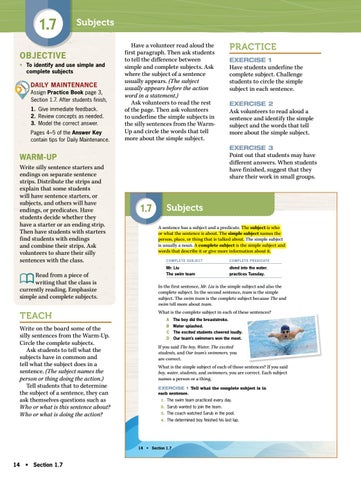
1.7
Subjects
OBJECTIVE • To identify and use simple and complete subjects
DAILY MAINTENANCE Assign Practice Book page 3, Section 1.7. After students finish, 1. Give immediate feedback. 2. Review concepts as needed. 3. Model the correct answer. Pages 4–5 of the Answer Key contain tips for Daily Maintenance.
Have a volunteer read aloud the first paragraph. Then ask students to tell the difference between simple and complete subjects. Ask where the subject of a sentence usually appears. (The subject usually appears before the action word in a statement.) Ask volunteers to read the rest of the page. Then ask volunteers to underline the simple subjects in the silly sentences from the WarmUp and circle the words that tell more about the simple subject.
1.7
EXERCISE 2 Ask volunteers to read aloud a sentence and identify the simple subject and the words that tell more about the simple subject.
Subjects A sentence has a subject and a predicate. The subject is who or what the sentence is about. The simple subject names the person, place, or thing that is talked about. The simple subject is usually a noun. A complete subject is the simple subject and words that describe it or give more information about it.
Read from a piece of writing that the class is currently reading. Emphasize simple and complete subjects.
C O M P L E T E S U B J EC T
C O M P L E T E P R E D I C AT E
Mr. Liu
dived into the water.
The swim team
practices Tuesday.
In the first sentence, Mr. Liu is the simple subject and also the complete subject. In the second sentence, team is the simple subject. The swim team is the complete subject because The and swim tell more about team. What is the complete subject in each of these sentences?
TEACH Write on the board some of the silly sentences from the Warm-Up. Circle the complete subjects. Ask students to tell what the subjects have in common and tell what the subject does in a sentence. (The subject names the person or thing doing the action.) Tell students that to determine the subject of a sentence, they can ask themselves questions such as Who or what is this sentence about? Who or what is doing the action?
A
The boy did the breaststroke.
B
Water splashed.
C
The excited students cheered loudly.
D
Our team’s swimmers won the meet.
If you said The boy, Water, The excited students, and Our team’s swimmers, you are correct. What is the simple subject of each of those sentences? If you said boy, water, students, and swimmers, you are correct. Each subject names a person or a thing. EXERCISE 1 Tell what the complete subject is in
each sentence. 1. The swim team practiced every day. 2. Sarub wanted to join the team. 3. The coach watched Sarub in the pool. 4. The determined boy finished his last lap.
14
14 • Section 1.7
EXERCISE 1 Have students underline the complete subject. Challenge students to circle the simple subject in each sentence.
EXERCISE 3 Point out that students may have different answers. When students have finished, suggest that they share their work in small groups.
WARM-UP Write silly sentence starters and endings on separate sentence strips. Distribute the strips and explain that some students will have sentence starters, or subjects, and others will have endings, or predicates. Have students decide whether they have a starter or an ending strip. Then have students with starters find students with endings and combine their strips. Ask volunteers to share their silly sentences with the class.
PRACTICE
•
Section 1.7
APPLY
ASSESS
APPLY IT NOW
Note which students had difficulty identifying and using simple and complete subjects. Assign Practice Book page 12 for further practice.
Brainstorm things that students might see at a swimming pool. Write their ideas on the board. Encourage students to use these ideas—or any others they come up with—to write their sentences. Remind students to underline the complete subject of each sentence. Students should demonstrate the ability to identify and use simple and complete subjects.
TEACHING OPTIONS
WRITING CONNECTION
Use pages 222–223 of the Writing portion of the book.
Guide students to find the simple subject (Some) and the complete subject (Some of the best times of my life).
Write on note cards words that can be used as subjects. Place the cards in a bag. You may wish to have students write subjects also. Make one card for each student in the class. Pass around the bag and have each student take a card. Direct each student to write a sentence that uses the word on his or her card as the subject. Have students write their sentences on the board and read them to the class. Ask the rest of the class to listen closely and identify the subjects as sentences are read.
Curriculum Connection Direct students to choose a topic that they are studying in another subject and write four sentences about that topic. Encourage students to underline the complete subject of each sentence. You may wish to have students create information posters to go with the sentences. Display students’ posters around the room.
5. Other swimmers patted him on the back. 6. The team members welcomed him. 7. 8. 9. 10.
Reteach
Athletes need to train for meets. The crowd roared for our team. Our team won!
Meeting Individual Needs
A win always feels good.
Extra Support Share with students that another way to identify the subject of a sentence is first to find the action word. Write the following sentence on the board:
EXERCISE 2 Tell what the complete subject is in each
sentence. Then tell what the simple subject is. 1. My brother swims every day. 2. Luke belongs to the swim team. 3. The coach chose my brother for the team. 4. The team practices in the morning. 5. The swimmers can swim very fast. 6. Meets take place every month. 7. The best swimmers go to the meets. 8. Many spectators watch the meets. 9. The people cheer the swimmers along. 10. All the winners receive a lot of applause.
Swimmers splashed in the shallow water. Have students name the action word (splashed). Ask who or what splashed. (Swimmers). Point out that Swimmers is the subject of the sentence.
EXERCISE 3 Finish each sentence with a
complete subject. EXAMPLE
My friend clapped for the other team.
1.
led the cheer.
2. 3.
finished in first place.
4. 5. 6.
looked nervous.
Common Core Standards CCSS.ELA.L.3.I.a CCSS.ELA.L.3.2
blew a whistle. was too close to call. swam two laps of the pool.
APPLY IT NOW Imagine that you are at a swimming pool. Write five sentences that describe what you see. Underline the complete subjects.
Find the complete subject in the first sentence of the page 214 excerpt.
Example: The children paddle in the shallow pool. Sentences
•
15
www.voyagesinenglish.com • Sentences • 15
1.8
Predicates
OBJECTIVE • To identify and use simple and complete predicates
DAILY MAINTENANCE Assign Practice Book page 3, Section 1.8. After students finish, 1. Give immediate feedback. 2. Review concepts as needed. 3. Model the correct answer. Pages 4–5 of the Answer Key contain tips for Daily Maintenance.
WARM-UP Help students brainstorm a list of sports, games, or other active things they like to do (soccer, basketball, video games, running, playing tag). Write each suggestion on a note card and distribute them. Ask each student to write two sentences about the activity. Have volunteers read aloud their sentences and identify the action word and the words that tell more about the action word.
volunteers read aloud the rest of the page. Ask students to point out the simple predicate (the verb) and complete predicate (the verb and the words that describe it) for the sentences on the board.
PRACTICE EXERCISE 1 Direct students to read each sentence and identify the complete predicate. Ask volunteers to identify the simple predicate in each sentence and to tell what words describe it.
1.8
Predicates
C O M P L E T E S U B J EC T
C O M P L E T E P R E D I C AT E
The twins
cleaned their room.
Kate
folded all the laundry.
In the first sentence, cleaned is the simple predicate. In the second sentence, folded is the simple predicate.
TEACH
What is the complete predicate in each of these sentences?
Write on the board the following sentences starters. Our family
A
Mom dusted the shelves.
B
Dad and Joseph washed the dishes.
C
Maggie put her toys away.
D
The house looked nice.
If you said dusted the shelves, washed the dishes, put her toys away, and looked nice, you are correct.
The school basketball team The class hamster
16 • Section 1.8
EXERCISE 3 Remind students that the predicate tells what the subject is or does. After students have completed the exercise, ask volunteers to share their answers with the class. Point out the variety of predicates possible for each subject.
A sentence has a subject and a predicate. The predicate tells what the subject is or does. The simple predicate is a verb, which is the word or words that express an action or a state of being. A complete predicate is the simple predicate and any words that describe it.
Read from a piece of writing that the class is currently reading. Emphasize predicates.
Ask if the groups of words are complete sentences (no). Ask what needs to be added to make them complete sentences (an action word). Encourage students to complete each sentence with an action word and write their responses on the board. Read aloud the first paragraph. Then have students identify the subject and predicate of each sentence on the board. Have
EXERCISE 2 Have partners work together to identify the complete and simple predicate in each sentence. Remind students that they may find it helpful first to identify the subject of each sentence and then look for the predicate. Have volunteers read aloud their answers.
What is the simple predicate of each of these sentences? You are correct if you said dusted, washed, put, and looked. These words tell what the subjects are or do. EXERCISE 1 Tell what the complete predicate is in
each sentence. 1. Luis helps at home. 2. His dad gives him a list of chores. 3. Luis’s sister has jobs too.
16
•
Section 1.8
APPLY
ASSESS
APPLY IT NOW Suggest that students write about chores that they do in the classroom or at home. Remind students that each sentence must include a predicate to convey a complete thought. Students should demonstrate the ability to identify and use simple and complete predicates.
Note which students had difficulty identifying and using simple and complete predicates. Assign Practice Book page 13 for further practice.
TEACHING OPTIONS
WRITING CONNECTION
Use pages 224–225 of the Writing portion of the book.
Reteach Write sentences on sentence strips. Cut the strips apart, separating the subjects and the predicates. Mix up the strips and place them in a bag. Then invite students to sort the strips into two piles—one for subjects and one for predicates. Have each student choose a strip, read it aloud, and tell whether it is a subject or a predicate. Encourage students to explain their responses. When students have identified all the subjects and predicates, have them make complete sentences by matching the subjects and predicates.
Meeting Individual Needs Intrapersonal Ask students to identify predicates as they read newspapers, books, stories, or textbooks. Encourage students to write interesting and exciting action words in their journals. Explain that students should refer to their lists when they are writing to help make their writing more interesting.
4. She makes the beds. 5. The vacuum cleaner broke. 6. 7. 8. 9. 10.
Mom fixed it. Luis dusts the furniture. He finds coins under the couch sometimes. The house smells of lemons. The family cleans every week.
English-Language Learners
EXERCISE 2 Tell what the complete predicate
is in each sentence. Then tell what the simple predicate is. 1. Luis’s sister cleans her room every week. 2. Mom vacuums the rugs. 3. Luis sweeps the floor. 4. The house looks wonderful. 5. The children wash the car with their dad on the weekend. 6. Dad mows the lawn. 7. All the family members work in the garden. 8. The neighbors talk to the family. 9. Many vegetables grow in the garden. 10. The family picks tomatoes in August.
Make a list of action verbs with students. You may wish to use words such as run, eat, talk, write, jump, and sit. Encourage students to act out each verb and say what they are doing. Then have students write complete sentences using all the action words.
EXERCISE 3 Finish each
Common Core Standards
sentence with a complete predicate. EXAMPLE
1. I 2. We
CCSS.ELA.L.3.Ia CCSS.ELA.L.3.Ii CCSS.ELA.L.3.2
I take out the trash.
. .
3. Grandmother 4. My friends 5. The neighbors 6. Our kitchen
. . . .
APPLY IT NOW Do you help with chores? Write five sentences about what you do. Underline the complete predicates. Example: I wash windows. Sentences
•
17
www.voyagesinenglish.com • Sentences • 17
1.9
Combining Subjects and Predicates
OBJECTIVE • To construct sentences by combining subjects or predicates
DAILY MAINTENANCE Assign Practice Book page 3, Section 1.9. After students finish, 1. Give immediate feedback. 2. Review concepts as needed. 3. Model the correct answer. Pages 4–5 of the Answer Key contain tips for Daily Maintenance.
information about combining subjects and predicates. Then have volunteers apply what they read to combine the sentences on the board. I like to read and write mystery stories. Matt and Kezia went to the ball game.
Challenge students to suggest sentences with compound subjects or compound predicates.
WARM-UP Write on the board the following sentences:
PRACTICE EXERCISE 1 Have students complete the exercise independently. Then ask volunteers to write the sentences on the board. Discuss how the predicates were combined. EXERCISE 2 Explain that sometimes when two single subjects are combined, the predicate may have to change. Write these sentences on the board and read them aloud: The pot is hot. The pan is hot. The pot and pan are hot. Have partners share their combined sentences with the class.
I dance and sing. Gabriela and I dance.
Ask volunteers to say a sentence modeled after the first sentence on the board. (I run and swim.) Then ask if anyone in the class also enjoys one or more of the activities and have that person say a sentence modeled on the second sentence on the board. (Jenny and I swim.)
1.9
Combining Subjects and Predicates Two or more sentences in a paragraph may give information about the same subject. When this happens, you can often use the subject once and combine the predicates to make a single, smoother sentence. Two predicates joined by and, but, or or are called a compound predicate. My tabby cat sits in the sun. My tabby cat purrs softly.
These sentences give information about the same subject—My tabby cat. The predicates, however, are different—sits in the sun and purrs softly. The two sentences can be made into one sentence by using the subject only once and combining the two predicates with the word and.
Read from a piece of writing that the class is currently reading. Emphasize the compound subjects and predicates.
My tabby cat sits in the sun and purrs softly.
You can also combine two sentences when they have different subjects but the same predicate. My tabby cat plays with string. My kitten plays with string.
TEACH
These sentences have the same predicate—plays with string. They have different subjects, however—My tabby cat and My kitten. They can be combined by connecting the two subjects with and and by using the predicate only once. Two subjects joined by and or or are called a compound subject.
Write on the board the following sentences: I like to read mystery stories.
My tabby cat and my kitten play with string.
I like to write mystery stories.
EXERCISE 1 Combine the predicates to make
one sentence. 1. The dogs barked. The dogs howled. 2. The doctor petted Rex. The doctor spoke quietly. 3. Rex looked sick. Rex rested his head on his paws. 4. The dog looked out of its cage. The dog barked at the cat. 5. The vet examined Rex. The vet gave him a shot. 6. Rex barked. Rex put his head down.
Matt went to the ball game. Kezia went to the ball game.
Ask volunteers to read aloud the sentences. Guide students to see how the sentences can be rewritten to be more interesting— both to read and to hear. After students share ideas, invite volunteers to read aloud the 18 • Section 1.9
18
•
Section 1.9
EXERCISES 3 & 4 Have students complete the exercises independently. Invite students to share their completed sentences with the class.
APPLY APPLY IT NOW Read aloud the list of words. Help students realize that the subjects are things and the predicates are actions. Ask students which subjects and predicates listed have something in common. After students complete the exercise, ask them to share their sentences with the class. Students should demonstrate the ability to
construct sentences by combining subjects or predicates.
TEACHING OPTIONS Reteach
ASSESS Note which students had difficulty constructing sentences by combining subjects or predicates. Assign Practice Book page 14 for further practice.
WRITING CONNECTION
Use pages 226–227 of the Writing portion of the book.
Show students pairs of items that are similar, such as a book and a notebook or a pencil and a marker. Ask students to make up sentences that have these items as their combined subjects. (A book and a notebook fell on the floor.) Write students’ sentences on the board. Have students underline the combined subjects in the sentences. Then ask students to choose one object from each pair to write a sentence with a combined predicate. (The book fell and hit Jen’s foot.) Write students’ sentences on the board, and have students underline the combined predicates.
Cooperative Learning Have students work with partners. Tell one partner to write on a sheet of paper two related things, or subjects (dog and cat, brother and sister). Tell the other student to write on a sheet of paper two actions, or predicates (tripped and fell, ate and drank). Direct the partners to exchange papers and each write a sentence with the compound terms he or she received. Suggest that partners discuss their sentences and write additional sentences with those terms.
EXERCISE 2 Combine the subjects to make one sentence.
1. Rex was sick. Sparky was sick. 2. Mom took Rex to the vet. I took Rex to the vet. 3. Two dogs were in the waiting room. Two cats were in the waiting room. 4. A boy held a big cage. A girl held a big cage. 5. Dr. Smith gave Rex a treat. I gave Rex a treat. 6. The vet looked at Rex. The vet’s assistant looked at Rex. 7. 8. 9. 10.
The medicine helped Rex. Rest helped Rex. The vet checked on Rex. I checked on Rex. His treats pleased Rex. His new toy pleased Rex. The vet felt happy about Rex. I felt happy about Rex.
Meeting Individual Needs
EXERCISE 3 Write complete
sentences with these compound subjects. 1. Veterinarians and vets’ assistants . 2. Animal shelters and rescue groups . 3. Cats and dogs . 4. Food and water . 5. Gerbils and hamsters . 6. Canaries and parrots .
EXERCISE 4 Write complete sentences
with these compound predicates. 1. examine animals and give them medicine.
2. 3. 4.
feed the animals and clean their cages. walk and feed the dog every day. jumped onto the chair and fell asleep.
5.
flew to its perch and chirped.
6.
ran to the door and barked.
APPLY IT NOW Use some of the words below to help you write two sentences. Each sentence should have two subjects or two predicates. Subjects: dog
cat
parrot Predicates: growl purr
canary bark hiss
chew chatter
sing fly
perch lick
chirp sleep Sentences
Challenge Encourage students to use combined subjects and predicates to write a short personal narrative. Suggest topics such as A Trip to the Zoo, My First Airplane Ride, or The First Day of School. Allow students to share their completed work with the class. Invite students to identify sentences with combined subjects and/or predicates.
Diagram It! To practice these concepts in the context of diagramming, turn to Sections 8.6 and 8.7.
Common Core Standards •
19
CCSS.ELA.L.3.Ii
www.voyagesinenglish.com • Sentences • 19
1.10
Combining Sentences
OBJECTIVE • To combine sentences
DAILY MAINTENANCE
Have volunteers read aloud about combining sentences. Then ask students to tell how they might combine the sentences on the board.
Assign Practice Book page 4, Section 1.10. After students finish,
Lightning flashed, and thunder boomed.
1. Give immediate feedback. 2. Review concepts as needed. 3. Model the correct answer.
The kicker scored, but we lost the game.
Pages 4–5 of the Answer Key contain tips for Daily Maintenance.
WARM-UP Write funny sentences on sentence strips. Put the strips in a bag. Have partners choose sentence strips and act out the sentences individually. (Ethan stood on tippy toes. Tara tapped her nose.) Ask a third student to combine the two sentences into one sentence and write it on the board. (Ethan stood on tippy toes, and Tara tapped her nose.) Have students act out the combined sentence. Ask the class what was added to the sentences to make one sentence. Continue as time allows.
Ask students to tell the changes that were made to combine the sentences. (A comma was added and the words and and but were added.)
1.10
EXERCISE 1 Tell students first to decide which sentences go together. Check students’ sentences to make sure each sentence includes a comma. EXERCISE 2 Ask volunteers to read aloud their sentences as you write them on the board. Have students identify the changes that were made to combine the sentences. EXERCISE 3 Ask partners to share their completed sentences with another pair of students.
Combining Sentences Several short sentences in a row can be boring to read. Putting short sentences together into longer sentences can make your writing more interesting. To combine two short sentences into one longer sentence, add a comma followed by and, but, or or. Two short sentences joined this way form a compound sentence. Two sentences:
Father read softly. The children listened.
Read from a piece of writing that the class is currently reading. Emphasize the combined sentences.
Compound sentence:
Father read softly, and the children listened.
Two sentences:
Jim passes the library. Amy doesn’t pass it.
Compound sentence:
Jim passes the library, but Amy doesn’t pass it.
TEACH
What two sentences were combined to make this compound sentence?
Review what students have learned about sentences. Remind students that sentences must be complete thoughts and must contain both a subject and a predicate. Reinforce that sentences can be combined to make writing more interesting. Write the following sentences on the board and read them aloud.
I’ll study music, or maybe I’ll play ball instead.
The first word in the second part of the compound sentence does not begin with a capital letter unless it is I or the name of a person or place. For example, in the compound sentence above, maybe does not start with a capital letter. EXERCISE 1 Match each sentence in Column A with a
related sentence in Column B to make a compound sentence. Column A
Lightning flashed. Thunder boomed. The kicker scored. We lost the game.
•
Column B
1. Nonfiction books have facts, but
a. people today still like to tell or read them.
2. Biographies are stories of people’s lives, and
b. fiction books are made up. c. they are nonfiction books.
3. Adventure stories have lots of action, and
d. the action is often scary.
4. Folktales are old, but 20
20 • Section 1.10
PRACTICE
Section 1.10
APPLY
ASSESS
APPLY IT NOW Have students name books that they have read recently. Write the book titles on the board. You might also ask students to provide brief summaries. Then have students write the sentences about their books. Have students read aloud their sentences and tell which sentences can be combined. Then have students read aloud their combined sentences and point out how the sentences were combined. Students should demonstrate the ability to combine sentences.
Note which students had difficulty understanding how to combine sentences. Assign Practice Book page 15 for further practice.
TEACHING OPTIONS
WRITING CONNECTION
Use pages 228-229 of the Writing portion of the book.
Reteach Write on the board the following sentences:
We were walking down the quiet street. Something strange happened during our science experiment. The house was scary. Read each sentence aloud and ask students how they would combine it with another sentence to continue telling a story. Have students tell exactly what they would add to the sentence, including punctuation and connecting words such as and, but, and or. Write on the board the combined sentences. Have volunteers read aloud the sentences.
Meeting Individual Needs EXERCISE 2 Combine each pair of short sentences with a
Auditory Provide partners with sentences that can be combined. Ask partners to take turns reading aloud their sentences. Then have students write a combined sentence. Have partners read aloud the combined sentences. Ask students to tell the differences between the separate sentences and the combined sentence.
comma and the word and or but to form a compound sentence. 1. This book has many pages. I read it in a week. 2. Alex read Super Fudge. The funny story about two brothers made him laugh.
3. The mystery was exciting. Brigitte couldn’t stop reading it. 4. Katie likes horses. She would enjoy The Black Stallion. 5. Rosa likes reading mysteries. Cam Jansen is one of her favorite characters. 6. Charlotte’s Web is a classic. I haven’t read it yet. 7. The character Charlotte is a spider. She helps a pig. 8. Beverly Cleary created the funny character Ramona. I haven’t read any books with Ramona.
Diagram It!
9. I saw a book with the funny title How to Eat Fried Worms. I wanted to read it.
To practice these concepts in the context of diagramming, turn to Section 8.9.
10. In a series of novels, Pippi Longstocking lives with a horse and a monkey. She doesn’t live with her parents. EXERCISE 3 Complete the following to make
compound sentences. Remember to include and, but, or or. 1. I might read a mystery, . 2. The novel was long, . 3. The story was interesting, . 4. The biography was about Jackie Robinson, . 5. I saw a film of the story, . 6. I found an exciting adventure book, . 7. I have a book of folktales, . 8. The library has a section of fiction books, .
9. Writers come to the library, 10. The library is my favorite place,
Common Core Standards CCSS.ELA.L.3.Ii CCSS.ELA.L.3.2a CCSS.ELA.L.3.1h
APPLY IT NOW
Think about a book you
. .
have read. Write four short sentences about that book. Then combine two short sentences into one compound sentence. Sentences
•
21
www.voyagesinenglish.com • Sentences • 21
1.11
Run-on Sentences
OBJECTIVES • To identify run-on sentences • To correct run-on sentences
DAILY MAINTENANCE Assign Practice Book page 4, Section 1.11. After students finish, 1. Give immediate feedback. 2. Review concepts as needed. 3. Model the correct answer. Pages 4–5 of the Answer Key contain tips for Daily Maintenance.
PRACTICE EXERCISE 1 Invite volunteers to read aloud each item and to determine whether it is a run-on. If it is, have them identify the two complete sentences in the run-on sentence.
EXERCISE 3 Have students read aloud the runon sentences three times, inserting and, but, and or. Discuss which connector makes the most sense and why.
EXERCISE 2 Ask volunteers to read aloud each sentence. Have students tell how to correctly combine the sentences. Encourage students to explain their responses.
EXERCISE 4 Have students complete this exercise independently. Ask students to exchange papers with a partner and discuss their corrections. Remind students to check for correct punctuation and capitalization.
WARM-UP Have students tell a story about a bad day at school. Begin with this sentence: I knew it was going to be a bad day when I woke up late. Ask students to continue the story. Write students’ sentences to continue the story, putting only commas between each addition. Keep adding their sentences until they notice what you are doing. Stop and discuss what is wrong with the way you are writing the story. Invite volunteers to make corrections so that the story is written with correct punctuation and capitalization.
1.11
A run-on sentence is one in which two or more sentences are put together without the proper connector. Run-on sentences sometimes happen because two complete sentences are separated with only a comma. A run-on is fixed easily by adding and, but, or or after the comma to make a compound sentence. Run-on sentence: It rained, I wanted to play outside. Compound sentence: It rained, but I wanted to play outside.
Which sentence is a run-on?
Read from a piece of writing that the class is currently reading. Emphasize that run-on sentences do not appear in good writing.
A
The sun came out, and I went outside.
B
I have a raincoat, it is yellow.
C
My umbrella is large. It keeps me dry.
You are right if you said B. Sentence B has two complete sentences run together and joined by only a comma. Sentence A is two sentences linked together with a comma followed by the word and. Sentence A is correct because both the comma and the word and are included.
TEACH Have volunteers read aloud the information about run-on sentences. Discuss how to identify run-on sentences and how to correct them. Invite students to write some run-on sentences on the board. Have volunteers rewrite the sentences correctly.
C is correct because there are two separate sentences that have proper punctuation. Each sentence ends with a period. EXERCISE 1 Tell whether each sentence is a run-on or a
correctly combined sentence. 1. Rain clouds rolled in, the sky turned dark. 2. The teacher looked out the window, she frowned. 3. The children must stay inside for recess, and they are sad. 4. There is more to do outside, it is more fun. 5. Most students play kickball, but some play basketball. 6. It’s not raining hard, we have raincoats.
22
22 • Section 1.11
Run-on Sentences
•
Section 1.11
APPLY
ASSESS
APPLY IT NOW Suggest that students first identify the four sentences. Then have students rewrite the sentences, adding the correct connectors and punctuation. Ask students to return the original sentences and the rewritten sentences to their partners and discuss their work. Students should demonstrate the ability to identify and correct runon sentences.
Note which students had difficulty understanding how to identify and correct run-on sentences. Assign Practice Book page 16 for further practice.
TEACHING OPTIONS
WRITING CONNECTION
Use pages 230–231 of the Writing portion of the book.
Reteach Write run-on sentences on sentence strips. Also, write commas and the words and, but, and or on strips as well. Ask students to determine whether each sentence is a run-on. Then ask students for suggestions to correct the run-ons. Have students cut apart the sentence strips where the connectors should go. Then have students add a connector to each sentence. Read aloud the sentences. Discuss how the sentences read more smoothly when the run-ons have been corrected.
Curriculum Connections Display a poster, a photograph, or an illustration containing many details. Invite students to name the details they see and to express their ideas about the picture. Write students’ ideas on the board as quickly as possible, creating run-on sentences as you write. Read students’ ideas back to them and ask what they notice. Confirm that you have written run-on sentences. Ask the class to help you correct them.
7. You will get wet, you might catch cold. 8. It will be sunny tomorrow, and we will go outside. 9. I like sunny days best, Eric likes rainy days. 10. Eric likes cold days, and he doesn’t like warm days. EXERCISE 2 Rewrite these run-on
sentences. Add and, but, or or to make compound sentences. 1. The day was hot, we decided to go to the beach. 2. The beach was crowded, some people were
Meeting Individual Needs
sitting under umbrellas.
3. We wore hats, we put on sunscreen.
Intrapersonal Have students look through their journals or other writing for run-on sentences they may have written earlier. Tell any student who finds a run-on to write it on a sheet of paper and to write a corrected sentence below it. Check students’ sentences to make sure they have rewritten the run-ons correctly.
4. The water was cold, we still went swimming. 5. We played catch in the water, we played tag. 6. The lifeguard watched the swimmers, we felt safe. 7. We enjoyed the water, we had a great time at the beach. 8. We were tired, we were happy with our day. EXERCISE 3 Rewrite the run-on sentences
in Exercise 1 as compound sentences.
EXERCISE 4 Choose one group of
run-on sentences. Then rewrite them as compound sentences. A. The thunder clapped loudly, it shook the house, the little boy began to cry, his mom said it was only a storm, he didn’t like the dark, she turned on a lamp, the boy fell asleep, the light kept his brother awake.
B. There was a big storm, the lights went out, trees had fallen, they had brought down the electrical wires, Dad made a fire in the fireplace, we played cards near the fire. We expected the lights to come on soon, they didn’t come on until morning.
Common Core Standards APPLY IT NOW
CCSS.ELA.L.3.Ih CCSS.ELA.L.3.Ii
Think about what you did this morning. Write four sentences without any punctuation or connectors. Exchange papers with a partner. Then add correct punctuation and connectors to make the sentences complete. Sentences
•
23
www.voyagesinenglish.com • Sentences • 23
1
Sentence Review
ASSESS Use the Sentence Review as homework, as a practice test, or as an informal assessment. Following are some options for use.
Homework
Practice Test
You may wish to assign one group the odd items and another group the even items. When you next meet, review the correct answers as a group. Be sure to model how to arrive at the correct answer.
Use the Sentence Review as a diagnostic tool. Assign the entire review or only specific sections. After students have finished, identify which concepts require more attention. Reteach concepts as necessary.
1
Sentence Review 1.1 Tell which of these word groups are sentences. Tell which are not sentences.
1. Swimming with fins 2. A snorkel lets divers breathe 3. The snorkel sticks up out of the water 4. A cool way to see fish 5. Snorkeling is easy to learn 1.2 Rewrite the sentences. Add a period or a question mark to the end of each sentence.
6. Ana likes to dance 7. Her parents are teaching her dances from Guatemala 8. Do you know how to dance 9. When did you learn to dance 10. Square dancing is an American folk dance
Find the question word in each sentence. 1.3
11. Who is going to the party? 12. What are you going to wear? 13. Where is Owen’s house? 14. Why is he having a party? 15. When does it start?
1.4 Tell whether each sentence is a statement, a question, or a command. Then rewrite each sentence. Add a period or a question mark to the end of each sentence.
16. Please go shopping with me 17. I need juice and eggs 18. Where did I put my wallet 19. Bring me my keys 20. Thanks for your help 1.5 Rewrite the sentences. Add a question mark or an exclamation point to the end of each sentence.
21. Wow, I’m finally tall enough to ride the roller coaster 22. Do you want to ride with me 23. What an amazing view 24. Hang on tight 25. When does the park close 1.6 Tell whether each sentence is a statement, a question, a command, or an exclamation. Then tell what punctuation mark is needed at the end of each sentence.
26. Where is the newspaper 27. Please hand it to me 28. Wow, what a terrific article 29. My mom likes to read the city news first 30. What a great photo
24
24 • Sentence Review
•
Sentence Review
Informal Assessment
WRITING CONNECTION
Use pages 232–233 of the Writing portion of the book.
Use the review as preparation for the formal assessment. Count the review as a portion of the grade. Have students work to find the correct answers and use their corrected review as a study guide for the formal assessment.
TEACHING OPTIONS Reteach Tell students they will be playing Sentence Scavenger Hunt. Have students reread a story or magazine article that they have previously read. Tell students you will give them 10 minutes to find as many different kinds of sentences as they can. Have students keep a tally of statements, questions, commands, exclamations, and combined sentences. Encourage students to share the sentences they found and to identify the kind of sentence.
Meeting Individual Needs
1.7 Tell what the complete subject is in each sentence. Tell what the simple subject is.
31. My aunt is a vegetarian. 32. A vegetarian is someone who doesn’t eat meat. 33. Sara doesn’t eat beef, poultry, or fish. 34. Good food is important for everyone. 35. Sara’s diet includes vegetables and tofu.
44. My sister took a class. My sister bought some tools. 45. We polish our bikes. We decorate our bikes. 1.10 Combine each pair of sentences with a comma and the word and, but, or or to form a compound sentence.
46. My family went to Colorado. We tried skiing.
48. I could take the chairlift up the hill. I could use the rope tow.
36. My parents own a business.
49. I was nervous. The instructor helped me feel better.
37. They make cowboy boots. 38. My mom selects the leather. 39. My dad creates the designs for the boots. 40. I have several pairs of these beautiful boots. 1.9 Combine the subjects or predicates to make one sentence.
Common Core Standards
47. I took a lesson. My parents already knew how to ski.
Tell what the complete predicate is in each sentence. Tell what the simple predicate is. 1.8
Challenge Give students a few days to be Sentence Sleuths. Have students compile lists of interesting sentences they find at home, at school, on signs, or any other places. Remind students to look for sentences that combine subjects and predicates and run-on sentences. At the end of the allotted time, have students share their sentences and tell what kind of sentences were found. If students found any incorrect sentences, ask how to correct them.
CCSS.ELA.L.3.Ia CCSS.ELA.L.3.Ih CCSS.ELA.L.3.Ii
50. I finished the lesson. I skied down a hill by myself. 1.11 Tell whether each sentence is a run-on or a correctly combined sentence. Rewrite the run-ons to make them correct.
51. We bought apples, Grandma sliced them.
41. Ernesto rides bikes. Michael rides bikes.
52. I walked to the park, I saw Grandpa.
42. We rode to the bike shop. We looked at helmets.
53. I watched him play chess, and I asked if I could play.
43. The bike shop sells bikes. The bike shop repairs bikes.
54. We went home, Grandma had an apple pie ready.
Go to www.voyagesinenglish.com for more activities. Sentences
•
Encourage students to further review sentences, using the additional practice and games at www.voyagesinenglish.com.
25
www.voyagesinenglish.com • Sentences • 25
1
Sentence Challenge
ASSESS Encourage students to read the paragraph twice before answering the questions independently. If students have difficulty with any questions, remind them that they should refer to the section that teaches the skill. This activity can be completed by individuals, by small groups, or by the class as a whole.
After you have reviewed sentences, administer the Section 1 Assessment on pages 1–4 in the Assessment Book, or create a customized test with the optional Loyola Press Online Assessment System.
1
WRITING CONNECTION
Use pages 234–235 of the Writing portion of the book. Students can complete a formal personal narrative using the Writer’s Workshop on pages 236– 247.
Sentence Challenge Read the paragraph and answer the questions. 1. Do you like snow? 2. All the kids in my building love snow. 3. Most of the adults hate snow. 4. Last year we had 24 inches of snow in one day! 5. People shoveled snow all day. 6. The city plowed the streets and salted the sidewalks. 7. Then it got really cold! 8. Everything froze, and we all stayed inside. 9. What do you think happened next? 10. In a few days, the sun came out, and most of the snow melted. 11. The storm was a real challenge. 12. What a big adventure we had!
1. What kind of sentence is sentence 1? 2. What kind of sentence is sentence 2? 3. Why is sentence 3 a statement? 4. What is the subject in sentence 5? 5. What is the complete predicate in sentence 5? 6. What kind of sentence is sentence 7? 7. What is the punctuation mark in sentence 7 called? 8. What two sentences were combined in sentence 8? 9. Which word is the question word in sentence 9? 10. What is the complete subject in sentence 11? 11. What kind of sentence is sentence 12? 12. What sentence has a compound predicate? 13. What sentences are compound sentences? 14. What is the simple subject in sentence 6? 15. What is the simple subject in sentence 11?
26
26 • Sentence Challenge
•
Sentence Challenge
PART
WRITTEN AND ORAL COMMUNICATION
2
Chapters 1
Personal Narratives
2
How-to Articles
3
Descriptions 286
4
Personal Letters
5
Book Reports
6
Persuasive Writing
7
Creative Writing: Realistic Fiction
8
Research Reports 476
210
248
324
362 400 438
209
Personal Narratives CHAPTER FOCUS LESSON 1: What Makes a Good Personal Narrative? LESSON 2: Beginning, Middle, and Ending • GRAMMAR: Sentences • WRITING SKILLS: Strong Verbs • WORD STUDY: Colorful Adjectives • STUDY SKILLS: Dictionary
WHAT IS A PERSONAL NARRATIVE? Personal narratives are about significant events in writers’ lives. The writer of a good personal narrative knows how to let his or her personality shine through by the use of humor, phrasing, dialogue, or a combination of these. Good personal narratives use natural language that does not seem stiff or contrived. A good personal narrative includes the following:
• SPEAKING AND LISTENING SKILLS: Oral Personal Narratives
■■ A topic relating to a real event in the writer’s life ■■ A first-person point of view ■■ A structure that includes an engaging introduction,
• WRITER’S WORKSHOP: Personal Narratives
■■ A coherent organization that uses chronological order,
a cohesive body, and a satisfying conclusion flows logically, and excludes unnecessary details
SUPPORT MATERIALS
■■ Strong verbs and colorful adjectives ■■ A voice that allows the narrator’s personality to come through
Practice Book Writing, pages 132–136 Assessment Book Chapter 1 Writing Skills, pages 39–40 Personal Narrative Writing Prompt, pages 41–42
Use the following titles to offer your students examples of well-crafted personal narratives:
Cal Ripken, Jr.: Play Ball! by Gail Herman, Cal Ripken, and Mike Bryan Water Buffalo Days by Huynh Quang Nhuong When I Was Young in the Mountains by Cynthia Rylant
Rubrics Student, page 247y Teacher, page 247z Loyola Press Online Assessment System Grammar Section 1, pages 1–26 Customizable Lesson Plans www.voyagesinenglish.com
“
Sometimes you can tell a large story with a tiny subject.
210a • Chapter 1
”
—Eliot Porter
CHAPTER PLANNER
Personal Narratives
1
WRITER’S WORKSHOP TIPS
SCORING RUBRIC
Follow these ideas and tips to help you and your class get the most out of the Writer’s Workshop:
Personal Narrative
• Review the traits of good writing. Use the chart on the inside back cover of the student and teacher editions. • Encourage students to keep a journal to record important or interesting personal experiences. • Invite students to bring in family photos or drawings of favorite family events. • Fill your classroom library with autobiographies and novels written in the first person.
Point Values 0 = not evident 1 = minimal evidence of mastery 2 = evidence of development toward mastery 3 = strong evidence of mastery 4 = outstanding evidence of mastery
Ideas topic relating to a real event events in time order
Organization
• Bring in songs that tell a first-person narrative.
a beginning
• Bring in podcasts or recordings of personal narratives from public radio programs, the library, or the Internet.
a middle
• Have partners interview each other about significant life events. Tell students that the questions can prompt ideas for developing their personal narratives. • Show documentaries of children or adults telling their own stories.
POINTS
an ending
Voice the writer’s point of view, using I, me, we, and us
Word Choice colorful adjectives time words
• Have students create time lines of their personal narratives.
Sentence Fluency
• Invite columnists or memoirists to speak to the class about why and how they publish their own stories.
Conventions
strong verbs
correct grammar and usage correct spelling
CONNECT WITH GRAMMAR
correct punctuation and capitalization
Presentation
Throughout the Writer’s Workshop, look for opportunities to integrate sentences with writing personal narratives.
neatness
■■ During the drafting stage, encourage students to use
photos or illustrations
statements, questions, commands, and exclamations in their personal narratives.
consistent margins and spacing
Additional Items
■■ During the copyediting stage, have students read aloud and combine sentences to improve sentence fluency.
■■ During the proofreading stage, have students make sure each sentence has a subject and a predicate.
Total Full-sized, reproducible rubrics can be found at the end of this chapter.
■■ Have students identify and correct run-on sentences.
www.voyagesinenglish.com • Personal Narratives • 210b
1
Personal Narratives
INTRODUCING THE GENRE
Tell students they will learn about personal narratives in this chapter. Write the following sentence on the board: Each student will have a personal copy of the book.
Ask the following question: What do you think the word personal means? (It means “ individual,” or “ belonging to someone.”) Then tell students that narrative means “story.” Explain that if you asked
Water Buffalo Days The excerpts in Chapter 1 introduce students to relevant examples of personal narratives. Water Buffalo Days is a strong example of a personal narrative because it does the following: • Tells a true story about the writer
the question What did you do last weekend? their answer would be a personal narrative. Introduce the following characteristics of a personal narrative:
• A personal narrative is a true
story about the writer. • A personal narrative is told from the writer’s point of view. • A personal narrative has a beginning, a middle, and an ending. • The events are described in the order in which they happened.
READING THE LITERATURE EXCERPT Have a student read aloud the excerpt. Ask volunteers to point out reasons why this piece is a personal narrative. Ask students to name similar pieces they have read or heard.
Personal Narratives LiNK
• Is told from the writer’s point of view
Water Buffalo Days Growing Up in Vietnam by Huynh Quang Nhuong
• Has a clear beginning—the writer’s birth
I was born in the central highlands of Vietnam in a small hamlet on a riverbank that had a deep jungle on one side and a chain of high mountains on the other . . . . Like all farmers’ children in the hamlet, I started working at the age of six. I helped look after the family herd of water buffaloes. Someone always had to be with the herd, because no matter how carefully water buffaloes were trained, they were always ready to nibble young rice plants when no one was looking.
As students encounter the different examples throughout the chapter, be sure to point out characteristics of personal narratives. You may wish to have students identify kinds of sentences, subjects and predicates, and combined sentences in the literature excerpts.
> In Water Buffalo Days, a man recounts his childhood in Vietnam, a country in Southeast Asia. Water Buffalo Days has many characteristics of a personal narrative. It is a true story, told from the writer’s point of view, and it tells about events in the order they happen.
210
210 • Chapter 1
READING THE STUDENT MODEL Explain that the story on page 211 is about Melissa and Charlotte. Write the names on the board. Have a volunteer read aloud the model. Ask who is telling the story (Charlotte). Ask what words in the story help the reader know that Charlotte is telling the story (I, me). Ask a volunteer to read what he or she thinks is the beginning of the story (It all started when…). Remind students that the topic is what the story is about. Ask students to tell what the topic of
this story is (how Charlotte got stuck in and rescued from the mud). Read aloud the entire personal narrative. Ask students to tell the order of events in the story. As students identify the events, list them on the board. Ask students what might happen if the events were told out of order. (The story would not make sense.) Emphasize the importance of putting events in the order they happened.
by Charlotte Eaton
Scavenger Hunt Have small groups search the classroom and the library for examples of personal narratives. Remind students to look for stories about events that really happened to the writers. Suggest that students look for the words I, me, and my to be sure the story is about the person who wrote it.
For Tomorrow
CHAPTER
Bad, Bad Mud
TEACHING OPTIONS
1
Have students find an example of a personal narrative. Explain that personal narratives can be stories, letters, and newspaper or magazine articles. Point out that an e-mail can even be a personal narrative if it has the right characteristics. Tell students they should be prepared to share what they have found during the next class. Bring in your own example of a personal narrative to share.
Common Core Standards
WALK some good advice: DON’T I come to you today with outside, g lkin wa re when Melissa and I we IN MUD! It all started . We rain the of r fea ts, rain jackets, and no with umbrellas, rain boo t. ugh least that’s what we tho were set for anything. At e?” “Sure,” I said. we go into the cow pastur Then Melissa asked, “Can There before us was barn and came to a halt. the of e edg the to ran We pping for?” I said, a said, “W hat are you sto liss Me d. mu of full e tur a pas stuck. I promise.” t follow me. You won’t get jus ok, “Lo , said e Sh !” “MUD s pounding. A little she was off. My heart wa no, or yes say ld cou I Before over again. ing, “Don’t do it” over and voice in my head kept say pasture. She wasn’t cow and deeper into the Melissa was going deeper to myself. So I took said just a bunch of dirt, I It’s I? uld wo y wh so g, sinkin the pasture, actually, re I was in the middle of the and r, the ano n the p, one ste so bad.” elissa,” I said. “This isn’t standing there in mud. “M y, mud. I was sinking Thick, cold, gooey, water ? ling fee I am at wh it, Wa e was pushing and pulling ns out. I felt like someon as fast as a lightbulb bur for help. ing true! I started yelling me under. My fear was com at my problem was. wh e running over to see cam and me rd hea a liss Me k, pull me out!” She sucking me under!” “Q uic is und gro he “T a, liss I told Me ning. We both boots, but the mud was win tugged and tugged at my p. started screaming for hel ha came to nie and my cousin Natas Jen er sist my , Finally . Out I ahold of me and all pulled the rescue. They grabbed brella ained. I stepped on my um popped, but my boots rem ck and out. My feet were now bla and then pulled my boots dash, barely back on and made a mad freezing. I put my boots , I was out of the gate. I said touching the ground, and d and I’m out!” “Melissa, score one for mu
CCSS.ELA.L.3.3
211
www.voyagesinenglish.com • Personal Narratives • 211
1.1
What Makes a Good Personal Narrative?
OBJECTIVE • To recognize the characteristics of a personal narrative
WARM-UP READ, LISTEN, SPEAK Read aloud the personal narrative you brought in for yesterday’s For Tomorrow homework. Point out the characteristics of a personal narrative in your example. Have small groups share their personal narratives. Challenge students to explain how they know their examples are personal narratives.
Have a volunteer read aloud the section Time Order. Ask students to suggest sentences using each time word. Emphasize that telling a story in the order it happened makes the story easier to understand.
ACTIVITY B Ask students to tell the events of the student model. Write them on the board. Then have small groups complete the activity. Invite volunteers to present and explain their comic strips.
PRACTICE
ACTIVITY C Have a volunteer read aloud the personal narrative. Then ask volunteers to read aloud and to answer each question.
ACTIVITY A Have partners complete the activity. Encourage students to share their answers with the class. Compare the interesting details students mentioned in their answers.
GRAMMAR CONNECTION
Take this opportunity to talk about sentences that are statements and questions. You may wish to have students point out sentences that are statements and questions in their Read, Listen, Speak examples.
LESSON
1
TEACH
What Makes a Good Personal Narrative? The story on page 211 is about Melissa and Charlotte’s muddy adventure. Because Charlotte tells this true story about herself, it is a personal narrative. The interesting details of the events, people, and things make this personal narrative fun to read. A well-written personal narrative has the following things.
Invite a volunteer to read aloud the opening paragraph. Then have volunteers read aloud the second paragraph and the section Topic. Challenge students to name topics for personal narratives they might write. Read aloud the first paragraph of the section Point of View. Have students turn to page 211 and count the occurrences of the word I. Ask students why they think the writer uses the word I instead of her name (because the writer is writing about herself). Then read aloud the second paragraph. Ask students to say sentences using the words listed. Tell students to remember to use these words when they write personal narratives.
Topic What is the topic of a personal narrative? The topic of a personal narrative is you, the writer. A personal narrative might be about something that you did or something that happened to you. It might also tell how you feel about something. A personal narrative can be about almost anything, but it should be a true story. When you write a personal narrative, you should tell what happened just as you remember it.
Point of View Personal narratives are always told from the writer’s point of view. Did you notice how Charlotte is always part of the story? Go back and count the number of times you see the word I. The words I, we, me, us, my, and our signal that you might be reading a personal narrative. When the audience reads these words, they know the story is told from the writer’s point of view.
Time Order When you write a personal narrative, tell about the events in the order that they happened. Use time words such as first, next, after that, then, finally, and last to show how one event comes after another.
212
212 • Chapter 1
Personal Narratives
•
Chapter 1
APPLY
ASSESS
TEACHING OPTIONS
Writer’s Corner
Note which students had difficulty understanding the characteristics of a personal narrative. Use the Reteach option with those students who need additional reinforcement.
Reteach
Explain that students will be choosing topics to write their own personal narratives. Help students brainstorm possible topics such as A Scary Night, My First Day of School, The Best Birthday Ever. Challenge students to draw three pictures that show the beginning, middle, and ending of their stories. Invite volunteers to share their work. Students should demonstrate the ability to recognize the characteristics of a personal narrative.
Have students develop a checklist of the characteristics of a personal narrative. Ask students to find words and phrases on pages 212–213 to use in their checklist. Some examples are topic, point of view, beginning, middle, ending, and time order. Then give students a personal narrative to read. Ask them to check off each item on their checklist as they find it in the personal narrative.
Getting Ready for School Have students draw comic strips showing what they do to get ready for school each morning. Remind students to make sure all the frames are in the correct order. Challenge students to write under each frame one sentence that describes the picture. Display students’ work in the classroom.
ACTIVITY A Read the personal narrative “Bad, Bad Mud” on page 211. Work with a partner to answer the following questions.
For Tomorrow
1. What is the topic? 2. What interesting details are included? 3. What words in the story tell you that it is a personal narrative? 4. What words in the story show the order that the events happened?
Have students ask an adult family member to share a personal narrative from his or her life. Tell students to write the events of the story in order. Remind students to bring their notes to the next class. Obtain a narrative from a friend or family member and bring in your list of events to share.
ACTIVITY B Work in groups to draw a comic strip of “Bad, Bad Mud.” The pictures in the comic strip should follow the order of the story. Then write a sentence about what is happening in each picture. ACTIVITY C Read this excerpt from a personal narrative. Then answer the questions.
Common Core Standards
Clubhouse Surprise
CCSS.ELA.W.3.3 CCSS.ELA.W.3.3c
My friends and I thought it would be fun to build a clubhouse. First, we chose a secret spot in the back of my yard. We put boards on the ground under a big, old pine tree. We were sure no one could see us hidden under the branches. But then we were surprised when a little skunk waddled into the clubhouse.
1. What words show the point of view? 2. What is the topic? 3. What interesting details are there in the story? 4. What words show the order of the story?
Writer’s Corner Think about a personal narrative that you would like to write. Then write a sentence that tells the topic. Personal Narratives
•
213
www.voyagesinenglish.com • Personal Narratives • 213
1.1
What Makes a Good Personal Narrative?
WARM-UP
PRACTICE
READ, LISTEN, SPEAK Read aloud the personal narrative from yesterday’s For Tomorrow homework. Discuss how your story reflects the characteristics of a personal narrative. Have small groups share their personal narratives. Ask students to listen for the topic, point of view, and order of events in the story. Discuss how each story exemplifies the personal narrative genre.
ACTIVITY D Ask volunteers to name words that might be clues to which topics would make good personal narratives. Then complete the activity as a class.
GRAMMAR CONNECTION
Take this opportunity to talk about question words. You may wish to have students point out any question words in their Read, Listen, Speak examples.
TEACH Review topic, point of view, and time order. Ask a volunteer to explain what a topic is. Invite students to give examples of topics for personal narratives. List their suggestions on the board. Ask volunteers to name words that signal to the reader that the story is told from the writer’s point of view (I, me, my, our, we). Invite volunteers to use each word in a sentence that they might find in a personal narrative about one of the topics listed on the board. Ask a volunteer to explain why time order is important in a personal narrative.
completed narratives. Allow several students to read aloud so that the class can hear that different answers might make the story a little different, but they are still correct. Have students tell why they chose each time word.
ACTIVITY E Have students complete the activity independently. Then have students work with partners to share and discuss their answers.
ACTIVITY G Have students complete the activity with partners. Encourage students to copy the sentences onto separate slips of paper and then to put the sentences in the correct order. Invite volunteers to write on the board the sentences in the correct order.
ACTIVITY F Have students complete the activity independently. Then ask volunteers to read aloud their
Water Buffalo Days
LiNK
Some of the best times of my life were spent roaming the rice field, riding on the young buffalo’s back . . . . The calf ’s time was not yet in demand, so we were free to explore all the nooks and corners of the field or leisurely catch all kinds of living creatures for food or for fun. Huynh Quang Nhuong
ACTIVITY D Read the following topics. Which ones are good topics for personal narratives? Why?
1. 2. 3. 4.
teaching your dog to wave
5. 6. 7. 8. 9.
our winter camping trip
the day I got lost at the mall grandma and I go skating what I want to be when I grow up how to ride a horse my favorite character in a book the life of a famous person the day I met my best friend
10. how I learned to ride a bike ACTIVITY E Each sentence comes from a personal narrative, but the time words are missing. Complete each sentence with a time word from the word box to show when things happened. More than one answer may be correct. after
before
during
finally
first
then
today
until
when
while
1. I cleaned my room, I went to the park. 2. I could smell breakfast cooking I woke up.
Ask a volunteer to read aloud the excerpt from Water Buffalo Days. Ask students to tell what characteristics identify this excerpt as a personal narrative.
3. I played my soccer game, I put on my shin guards. 4. will be the first day of my summer vacation. 5. Those people would not stop talking the movie. 6.
we ate dinner, we went outside.
7. I never went fishing one day last June. 8. Tommy says he can snap his fingers singing “Row, Row, Row Your Boat.” 9. I worked and worked, and I finished the jigsaw puzzle. 10. We bought our tickets for the movie, we bought popcorn.
214
214 • Chapter 1
•
Chapter 1
APPLY
ASSESS
TEACHING OPTIONS
Writer’s Corner
Note which students had difficulty with topics, point of view, and time order in personal narratives. Use the Reteach option with those students who need additional reinforcement. Practice Book page 132 provides additional work with personal narratives.
Reteach
Remind students to state the topic at the beginning of their narrative. Point out that they should tell the story from their own point of view and put the events in the correct order. Have students share their narratives in small groups. Allow time for groups to discuss each story. Students should demonstrate the ability to use topics, point of view, and time order in constructing a personal narrative.
Recall the Read, Listen, Speak activity at the beginning of the lesson. Work with students to develop a list of the things you did during that activity. Write the list on the board. Then invite students to put each step in the correct order. (1. We sat in groups. 2. We shared the stories we found. 3. We talked about topics and time order.)
What If This Happened? Challenge small groups to rewrite the events of the model on page 211. Ask students to keep the same characters but to change the setting, dialogue, and events. Ask students to role-play the events of their new stories.
For Tomorrow Tell students to list in order three things they will do after school today. Bring in your own list to share.
ACTIVITY F Complete the personal narrative with the time words from the word box. More than one answer may be correct. after that
finally
first
next
then
An Easy Choice
Common Core Standards
It was going to be a special day. My parents and I had decided to adopt a cat from a local animal shelter.
CCSS.ELA.W.3.2a CCSS.ELA.W.3.3 CCSS.ELA.W.3.3c
At the shelter we told the volunteers that we were looking for a cat. (1) , they gave us a form to fill out. (2) , the volunteers took us to a room with several cats. Some were playing in the center of the room, and some were sleeping on shelves in the wall. I just stood and looked around. (3) took a piece of string out of my pocket and begin to twirl it. A little calico cat came up to me. She batted the string with her paw. I knelt down. She kept hitting the string. Slowly I petted the back of her head. She started to purr loudly. (4) she rubbed her body against my leg. (5) , I knew that this was the cat for me. Cali (short for calico), has become a member of the family. She is sitting on my lap as I write this. ACTIVITY G Here is a personal narrative. The order of the sentences is mixed up. Put the sentences in the correct order.
1. He picked me up. 2. I was having fun until I reached the top of a hill. 3. I tried to steer, but I was going too fast. 4. I never went near that hill again. 5. Zoom, I flew down the hill! 6. A man ran to help me.
Writer’s Corner Tell a personal narrative about a pet or other animal
7. One Saturday I went for a ride on my new bike.
to a partner. Use time words.
8. I hit the curb and tumbled over the handlebars.
in the correct order. Have
Be sure you tell the narrative
your partner write the time words you used. Personal Narratives
•
215
www.voyagesinenglish.com • Personal Narratives • 215
1.2
Beginning, Middle, and Ending
OBJECTIVES • To identify the beginning, the middle, and the ending of a personal narrative • To understand the function of a title
WARM-UP READ, LISTEN, SPEAK Share your list of after-school activities from yesterday’s For Tomorrow homework. Ask small groups to share their lists. Invite students to tell stories using the events from their lists in the correct time order.
Discuss the importance of including enough details in the middle so that the reader gets a clear picture of the events. Explain that missing details can make the middle confusing. Ask volunteers to read aloud the section Ending. Remind students that at the end of “Bad, Bad Mud,” the narrator is rescued by Jennie and Natasha. Explain that a strong ending wraps up the details of the story and emphasizes the importance of the story.
PRACTICE ACTIVITY A Invite partners to complete the activity. When students have finished, ask volunteers to share their answers. ACTIVITY B Have students reread the personal narrative “An Easy Choice” on page 215. Then have them write the answers to the questions. Invite volunteers to share their answers with the class.
GRAMMAR CONNECTION
Take this opportunity to talk about commands. You may wish to have students write commands from some of the sentences in their Read, Listen, Speak examples.
LESSON
2
TEACH Read aloud the opening paragraph. Then invite volunteers to read aloud the section Beginning. Ask students what it means that a good beginning grabs your attention. Have students turn to page 211. Ask a volunteer to identify the beginning of the student model and to explain how the beginning gives readers a hint of what the story will be about. Invite volunteers to read the first two paragraphs of the section Middle. Explain that in the model on page 211, the middle of the story is the part where the narrator sinks and gets stuck in the mud. Then have volunteers read aloud the rest of the section.
Beginning, Middle, and Ending A personal narrative is a story. Because it is a story, it should have a beginning, a middle, and an ending.
Beginning The beginning of a personal narrative tells the reader what the story is about. A good beginning grabs the reader’s attention and makes the reader want to read more. The beginning of the story is also where you let the reader know why you’re telling the story. For example, the beginning of a narrative might say, “Let me tell you the funny story about how I learned to ride a bike.” The reader will be interested because everyone wants to read a funny story.
Middle The middle of a narrative is important because this is where you tell the story. The middle is usually the longest part of a narrative. The middle tells the events in the order they happened. It also has details that help the reader paint a picture in his or her mind about what happens. You need to think carefully about all the parts of the story. Be sure the middle includes everything important to your story so that the reader doesn’t get mixed up. Suppose you were telling a story about learning to ride a bike. While you were learning, the bike tipped over and you scraped
216
216 • Chapter 1
Personal Narratives
•
Chapter 1
APPLY Writer’s Corner
Tell students they will write a beginning for a personal narrative of their own. Encourage students to write a strong beginning that grabs the reader’s attention and makes the reader want to continue reading their story. Then have students complete the activity independently. Invite volunteers to share their story beginnings with the class. Students should demonstrate the ability to write a beginning for a personal narrative.
Remind students that the subject is what or who the sentence is about.
ASSESS Note which students had difficulty writing beginnings for personal narratives. Use the Reteach option with those students who need additional reinforcement.
Reteach Have students select several personal narratives from the school or classroom library. Invite volunteers to read aloud the first few sentences of each story. Ask students to tell what makes the beginnings interesting and why they would want to continue reading the story. Invite students to predict what they think might happen in the middle of each story.
Writing Squads Have students work in groups of three to complete this activity. Ask each student to write on a note card a topic for a personal narrative. Then have students trade note cards with another student. Direct students to write a beginning sentence for the topic on the card. Then have students trade cards again and write on the card three events that might happen in the middle of the story. Have students trade the cards again and write an ending to the story. Encourage students to read aloud the cards and discuss their work.
your knee. The reader would want to know what you were doing before and after your bike tipped over. The reader would also want to know why the bike tipped over. Did it hit a big rock, or did it slide in a puddle of water?
Ending The ending tells how the story comes out. A good ending might leave readers with a smile or a new idea to think about. The ending can tell something you learned or how you felt about what happened. The ending is where you tell the reader what the story means to you and why the story is important. Suppose you are telling about a time that your baseball team won a game. The middle of the narrative might tell about all the time you spent practicing. The ending might tell how proud you were that your hard work helped win the game.
For Tomorrow Have students write at least two sentences of a beginning for a personal narrative about something that happened today. Tell students to be prepared to share what they wrote. Bring in your own sentences to share.
Common Core Standards
ACTIVITY A Answer the questions about the personal narrative “Bad, Bad Mud” on page 211.
CCSS.ELA.W.3.3 CCSS.ELA.W.3.3a CCSS.ELA.W.3.3d
1. Which paragraph is the beginning? 2. Which paragraphs are the middle? 3. What are some details in the personal narrative? 4. Which paragraph is the ending? ACTIVITY B Answer the questions about the personal narrative “An Easy Choice” on page 215.
1. Which paragraph is the beginning? What information is in that paragraph? 2. What information is in the middle paragraphs? 3. Do you think that the ending is interesting? Why or why not? ▲
Circle the subject in both sentences.
TEACHING OPTIONS
Writer’s Corner Write two sentences that begin a personal narrative about a family trip, a school field trip, or a vacation. Save your work. Personal Narratives
•
217
www.voyagesinenglish.com • Personal Narratives • 217
1.2
Beginning, Middle, and Ending
WARM-UP
PRACTICE
READ, LISTEN, SPEAK Read the beginning sentences of your personal narrative from yesterday’s For Tomorrow homework. Then have students in small groups share their story beginnings. Encourage students to tell what grabs their attention from each beginning. Have them discuss what might be included in the middle of each story.
ACTIVITY C Have partners complete the activity. When students have finished, encourage volunteers to share their answers with the class. Discuss whether all the information is correctly placed on the chart.
GRAMMAR CONNECTION
ACTIVITY D Have students complete this activity independently. Tell students to write at least one
sentence explaining each of their choices. When students have finished, invite volunteers to share their answers with the class. ACTIVITY E Suggest that students write a list of interesting details and then write sentences using the details. Encourage students who chose the same part to compare their sentences.
Take this opportunity to talk about exclamations. You may wish to have students point out any exclamations in their Read, Listen, Speak examples.
TEACH Write on the board as column headings Beginning, Middle and Ending. Review each of these parts of a personal narrative. Then ask the following questions:
• What does a beginning do? • What might be an example of a beginning?
• Why is the middle important? • What does a writer include in
Water Buffalo Days
LiNK
It was very tiring to walk in the mud, so I rode on the calf ’s back when I wanted to catch land lobsters. When I spotted a nest, I poured salt water into it, and the land lobsters jumped out like crazy. Huynh Quang Nhuong
The title should give readers a hint about what the story is about. A funny or an interesting title can make people want to read your narrative. ACTIVITY C Read this personal narrative. Copy the chart below. Then use your own words to fill in the chart. Use the information in the chart to think of a title for the narrative.
What a horrible morning! My pet snake, Snerdly, was missing. Where could he be?
the middle? • What does an ending do? • What might be an example of an ending?
First, I looked in the living room. I checked under the couch and behind the cushions. I thought I heard soft, shooshing noises, but I couldn’t find my little snake. After that, I looked in the hall closet. I saw something long and slithery behind the coats. Was it Snerdly? No, it was just some ribbon.
Write students’ responses on the board in the appropriate column. Invite a volunteer to read aloud the section Title. Then ask volunteers to make up titles for narratives and have the class describe what each story could be about.
Then I went to the laundry room. There was Snerdly, fast asleep on top of the warm dryer. I’ve never been so happy to see him!
Title Topic
Discuss the title Water Buffalo Days. Ask students what the title tells about the story and how it is reflected in the excerpt.
Beginning Middle Ending
218
218 • Chapter 1
Title
•
Chapter 1
APPLY
ASSESS
TEACHING OPTIONS
Writer’s Corner
Note which students had difficulty identifying beginnings, middles, endings, and titles. Use the Reteach option with those students who need additional reinforcement. Practice Book page 133 provides additional work with the beginning, middle, ending, and title of a personal narrative.
Reteach
Review the answers to the questions about the middle of a personal narrative from Teach. Give students time to write three sentences to include in the middle of their personal narratives. Have students share their sentences in small groups. Students should demonstrate the ability to write a middle for a personal narrative.
Help students recall the first day of school. Have students write the headings Beginning, Middle, and Ending on a sheet of paper. Ask students to write details that describe each part of their day. Then have students write a title they might use if they were to write this narrative. Have students discuss the details from their charts and the titles. Ask students to explain why they chose the details and the title.
My Life as an Animal Encourage students to name their favorite animals. Write a list on the board as students suggest the animals. Challenge students to pretend they are one of the animals and to write at least one sentence each for the beginning, the middle, and the ending of a brief narrative about their daily life as that animal. Then ask students to write an appropriate title for the narrative. Invite volunteers to share what they wrote with the class.
ACTIVITY D Below are parts of personal narratives. Which parts are they? Tell which part of a personal narrative they come from: the beginning, the middle, or the ending. Explain your answers.
1. Just then the roaring of the wind stopped. Was the tornado over? Dad crept up the stairs. He looked out the back door. He saw something and ran back down into the basement really fast. 2. Everyone asks how I got such a strange first name. The story of my name began a long time ago when my mom was a little girl.
For Tomorrow Have students choose three personal narrative parts from Activity D. Ask them to write titles for each part. Tell students to be prepared to share their work during the next class. Bring in three titles to share.
3. It was such a hard way to learn that words can really hurt a person’s feelings. After what happened to me, I’ll never again say mean things about someone just to get a laugh. 4. Things were going fine. I was walking in time to the music. I was holding my basket of flowers and smiling. But when I heard our dog barking outside, I forgot everything I had practiced.
Common Core Standards CCSS.ELA.W.3.2a CCSS.ELA.W.3.3 CCSS.ELA.W.3.3c
5. I want to tell you about the first time I rode a roller coaster. It was not a good idea to have a lunch of three chili dogs before climbing aboard. 6. I enjoyed all the applause. I can’t believe I was ever nervous about going on the stage. Now I’m planning to try out for the lead in the next school play. ACTIVITY E Work with a partner. Choose one of the parts from a personal narrative in Activity D. Think of ideas for the two missing parts. Make up interesting details. Share your ideas for the personal narrative with the class.
Writer’s Corner Look at the sentences you wrote for the previous Writer’s Corner. Then write three sentences for the middle of your personal narrative. Save your work. Personal Narratives
•
219
www.voyagesinenglish.com • Personal Narratives • 219
1.3
WRITING SKILLS Strong Verbs
OBJECTIVE • To identify and use strong verbs
WARM-UP READ, LISTEN, SPEAK Read aloud the items you chose and the titles you wrote for yesterday’s For Tomorrow homework. Have students read aloud their personal narrative parts and share their titles. Challenge students to decide whether the titles are appropriate.
Ask volunteers to read aloud the rest of the page. Invite volunteers to describe the picture they have in their minds when they read the second sentence of each example. Ask volunteers to demonstrate the action of each strong verb. Explain that using strong verbs helps a reader see something the way that the writer pictures it.
PRACTICE ACTIVITY A Have students work in small groups. Encourage them to describe the pictures each verb creates and tell which verb is stronger. Invite volunteers to share their answers with the class. Invite volunteers to read aloud the excerpt from Water Buffalo Days. Ask students to point out the verbs in the excerpt. Then have students tell which are strong verbs (stretch, gazed) and why they are strong.
GRAMMAR CONNECTION
Take this opportunity to talk about kinds of sentences. You may wish to have students point out kinds of sentences in the personal narratives they chose for their Read, Listen, Speak examples.
LESSON
3
TEACH
Strong Verbs A verb is often the action word in a sentence. It tells what the subject does. In this sentence Mia is the subject. The verb jumped tells what Mia did.
Read aloud the first paragraph and the example sentence, and write the sentence on the board. Invite a volunteer to circle the verb in the sentence and to demonstrate the action. Have volunteers read aloud the next paragraph and the two example sentences. Ask a volunteer to answer the question. Then have a volunteer read aloud the paragraph following the example sentences. Tell students that the mouse might move in other ways. Write on the board the word went. Invite volunteers to name stronger verbs for went (crept, darted). List their suggestions on the board. Read the sentence aloud several times, using the suggested words. Ask students to picture the mouse’s actions as each sentence is being read.
Mia jumped off the diving board.
Some action verbs are stronger than others. They can tell the reader more clearly what the subject does. Use strong verbs when you write. Strong verbs make clear pictures in the reader’s mind. Which of these sentences creates a clearer picture in your mind? The mouse went into its hole. The mouse ran into its hole.
Ran is a stronger verb than went because it tells how the mouse moved. Went is a weaker verb because it tells only that the mouse did move. Ran makes a clearer picture in the reader’s mind than went does. Read the following pairs of sentences. In each pair the second sentence uses a stronger verb or verbs than the first sentence does. I asked my brother to teach me. I begged my brother to teach me. I went off the skateboard as soon as I got on. I tumbled off the skateboard as soon as I stepped on.
With a little practice, your writing will soon be full of strong, clear verbs.
220
220 • Chapter 1
Writing Skills
•
Chapter 1
APPLY
ASSESS
TEACHING OPTIONS
Writer’s Corner
Note which students had difficulty writing endings and using strong verbs. Use the Reteach option with those students who need additional reinforcement.
Reteach
Remind students what a good ending should do for a personal narrative. (It should tell how the story comes out and tell the reader what the story means to the writer.) Suggest that students use strong verbs throughout their personal narratives. Students should demonstrate an understanding of the importance of endings in personal narratives.
Make two columns on the board. Label one column Verbs and the other Strong Verbs. Ask students to work together to identify a verb in the model on page 211. Have students place the verb in one of the two categories. Accept any answer students can justify. Repeat the activity with other verbs from the model.
Strong Verbs Charades Write on separate slips of paper simple action verbs that students can role-play.
run jump
ACTIVITY A Which sentence in each pair has the stronger verb or verbs? Explain why.
1. a. The dog walked down the street. b. The dog trotted down the street. 2. a. Celia cleaned her dog before the show. b. Celia bathed her dog before the show. 3. a. Jason was late, so he hurried to the bus stop. b. Jason was late, so he went to the bus stop. 4. a. People come to the beach to see the sunset.
walk
Water Buffalo Days
LiNK
Sometimes . . . I would just stretch myself on the calf ’s back and let him carry me where he liked. I gazed at the sky and forgot everything around me. I felt as if the sky moved, but not the calf and I. Huynh Quang Nhuong
b. People drive to the beach to gaze at the sunset. 5. a. Emma whispered softly into her dog’s ear. b. Emma talked softly into her dog’s ear. 6. a. Shawn made a model ship out of toothpicks. b. Shawn built a model ship out of toothpicks. 7. a. The snake slithered away from the campfire. b. The snake moved away from the campfire. 8. a. A kangaroo hopped behind the hill. b. A kangaroo went behind the hill. 9. a. The class did the school project on time.
Invite each student to choose a slip of paper. Have students in small groups take turns role-playing their action, using detailed or exaggerated physical movements. As each student role-plays his or her action, tell the group to list strong verbs for that action. Encourage students to use a thesaurus to find strong verbs.
For Tomorrow Ask students to choose three verbs from this lesson. Have students list two strong verbs for each verb that they choose. Tell students to be prepared to share their work. Bring in your own strong verbs to share.
b. The class finished the school project on time. 10. a. Is it too cold to go across the river?
Common Core Standards
b. Is it too cold to wade across the river?
CCSS.ELA.W.3.2a CCSS.ELA.W.3.3 CCSS.ELA.W.3.3c
Writer’s Corner Look at the beginning and middle that you wrote in previous Writer’s Corners. Then write a two-sentence ending. Tell the reader what the story means to you. Personal Narratives
•
221
www.voyagesinenglish.com • Personal Narratives • 221
1.3
WRITING SKILLS Strong Verbs
WARM-UP
PRACTICE
READ, LISTEN, SPEAK Read aloud your list of verbs from yesterday’s For Tomorrow homework. Explain why you chose those particular verbs and how you chose stronger verbs. Then have small groups share their verbs. Challenge students to choose one strong verb from another student’s list and use it in a sentence.
ACTIVITY B Complete this activity as a class. Ask volunteers to brainstorm strong verbs for each answer and write them on the board.
GRAMMAR CONNECTION Take this opportunity to talk about subjects. You may wish to have students point out subjects in their Read, Listen, Speak sentences.
ACTIVITY C Discuss what students know about the animals in the activity. Then have students complete the activity independently. When students have finished, have them discuss the differences in the meaning of each sentence as the verb changes.
ACTIVITY D Have partners complete this activity. When students have finished, ask volunteers to share their answers with the class. Ask students to justify their word choices. Then ask students to suggest alternative strong verbs for each sentence. ACTIVITY E Have students complete the activity independently. Then ask volunteers to read aloud their completed paragraphs. Have volunteers identify the strong verbs in each paragraph and write them on the board.
TEACH Discuss why students should use strong verbs when they write. (Strong verbs create clear pictures in readers’ minds.) Then write on the board the following verbs:
ACTIVITY B Read the following sentences. Replace each underlined verb with a stronger verb.
1. I went down the hill on my new sled. 2. 3. 4. 5. 6. 7. 8. 9. 10.
went asked go
Ask students to give examples of stronger verbs that might be used to replace the verbs on the board. Have students write their responses on the board. Then ask volunteers to use each word in a sentence.
I go to school on the bus every day. The penguin walked toward me. I looked at the rows of colorful sneakers in the window. Our cat likes his cat food. My little brother looked everywhere for his shoe. We put one block on top of the other. Leandro put his sister into the crib. We go the same way to the gym every time. The dish broke into tiny pieces.
ACTIVITY C Read each set of sentences. How does the verb in each sentence create a different picture? Add two more sentences to each set. Use strong verbs to show other actions the animals might do.
1. The dragon snorts. The dragon breathes. The dragon sneezes. 2. The eagle flies. The eagle soars. The eagle swoops. 3. The rabbit hopped. The rabbit leaped. The rabbit jumped. 4. The horse strutted. The horse galloped. The horse ran. 5. The cat meows. The cat hisses. The cat purrs.
222
222 • Chapter 1
•
Chapter 1
APPLY
ASSESS
TEACHING OPTIONS
Writer’s Corner
Note which students had difficulty using strong verbs in their personal narratives. Use the Reteach option with those students who need additional reinforcement. Practice Book page 134 provides additional work using strong verbs.
Reteach
Ask volunteers to read aloud sentences from their personal narratives and point out the strong verbs. Challenge students to suggest other strong verbs for each sentence. Students should demonstrate the ability to use strong verbs in a personal narrative.
Describe an exciting event that has happened to you. When you have finished, ask students if they could visualize the experience that you described based on the words you used. Invite students to draw pictures of the event and list strong verbs that describe each picture. Then ask students to retell the event, using the strong verbs and the pictures.
I Can See It All Now Play a radio sportscast for students. Explain that it is important for radio announcers to use strong verbs when describing a game because the audience cannot see the action. Have students list verbs that the announcers use. Then ask students to role-play each action being described. ACTIVITY D Choose a verb from the word box to complete each sentence. Use each verb only once. dialed
roamed
sprayed
leaped
limped
swim
peered
sold
spun
barked
drives
flew
1. The volleyball 2. Some alligators Dad
above the water’s surface. at the mail carrier.
to his office every day.
Spiders Dean
webs under the eaves.
Common Core Standards
four subscriptions last week.
Wild buffalo once I
Ask students to search a fiction book for strong verbs. Tell students to list five strong verbs. Remind students to bring their lists to class tomorrow. Bring in your own list of strong verbs to share.
through the air.
3. The dogs 4. 5. 6. 7. 8.
For Tomorrow
across the Great Plains.
CCSS.ELA.W.3.3 CCSS.ELA.W.3.3c CCSS.ELA.W.3.5
Toby on my cell phone.
9. The skunk its startled enemies. 10. She from the barge. 11. With a twisted ankle, Tad away from the field. 12. The tigers
on hot days.
ACTIVITY E Write strong verbs for each blank to complete the paragraph. The fans as the players onto the field. The cheerleaders as they up and down. Music through the stadium. Everyone when the game ended.
Writer’s Corner Look at the beginning, middle, and ending that you wrote in previous Writer’s Corners. Replace the verbs with strong verbs to help paint a picture in the reader’s mind. Personal Narratives
•
223
www.voyagesinenglish.com • Personal Narratives • 223
1.4
WORD STUDY Colorful Adjectives
OBJECTIVE • To understand and use colorful adjectives
WARM-UP READ, LISTEN, SPEAK Read aloud the verb list you brought in and discuss why you thought the words were good examples of strong verbs. Model using the words to tell a brief story. Have students share their student lists in small groups. Direct students to use five verbs to write a story. Have groups share their stories with the class.
PRACTICE ACTIVITY A Have volunteers read aloud each set of adjectives. Then have students determine which items contain more colorful adjectives. Ask them to explain why their choices are more colorful. ACTIVITY B Have students complete the activity independently. Suggest that students picture each sentence in their minds before deciding which adjective is more colorful. When students have finished, invite them to explain why they chose each adjective.
ACTIVITY C As a class, brainstorm a list of adjectives that describe a park. Invite students to write on the board their suggestions for each item. Then have students complete the second part of the activity with a partner. Ask volunteers to share their most colorful adjectives with the class and to use those adjectives in sentences. Have a volunteer read aloud the excerpt from Water Buffalo Days. Ask students to point out the colorful adjectives (valuable, strong, fierce, patient). Have students substitute other words for these adjectives as they read aloud the sentences.
GRAMMAR CONNECTION
Take this opportunity to talk about predicates. You may wish to have students point out predicates in their Read, Listen, Speak stories.
TEACH Ask a volunteer to read aloud the title of the lesson. Tell students that an adjective is a word that describes a noun and that a noun is the name of a person, place, or thing. Explain that colorful means “full of color.” Tell students that colorful can also mean “interesting” or “descriptive.” Then read aloud the first paragraph and the example sentences. Have students role-play what an oak grove might look like if a gentle wind was blowing. Then have them role-play what the grove would look like if there was a fierce wind. Point out that the colorful adjectives in the example sentences change a reader’s picture of the oak grove. Read aloud the second paragraph. Ask volunteers to answer the questions. Have volunteers read aloud the rest of the page. Invite students to brainstorm a list of other colorful adjectives to replace those in the example sentences. 224 • Chapter 1
LESSON
4
Word Study
Colorful Adjectives Adjectives are words that tell something about nouns. Colorful adjectives are like strong verbs. They can paint clear pictures in the reader’s mind. A gentle wind blew through the oak grove. A fierce wind blew through the oak grove.
The adjectives gentle and fierce both tell something about the wind. Which kind of wind blows harder—a gentle wind or a fierce one? How is the picture that gentle makes in your mind different from the picture that fierce makes? Colorful adjectives make clearer pictures. a nice, cute puppy a wrinkled, black puppy
Which set of adjectives makes a clearer picture—nice and cute or wrinkled and black? Adjectives like nice and cute are not exact. Many people have different ideas about what is nice or cute. Wrinkled and black are colorful, exact adjectives. Good writers put just one idea in the reader’s mind. That idea is the one they are writing about. ACTIVITY A Which set of adjectives makes a clearer picture? Explain why.
1. a sweet, little kitten 2. 3. 4. 5.
224
•
a tiny, playful kitten
a steep, winding road
a long, narrow road
slender, golden stalks
thin, yellow stalks
a large, bright fire
a gigantic, glowing, orange fire
a tall, steel skyscraper
a towering, glass skyscraper
Chapter 1
APPLY
ASSESS
TEACHING OPTIONS
Writer’s Corner
Note which students had difficulty identifying and using colorful adjectives. Use the Reteach option with those students who need additional reinforcement.
Reteach
Before students begin, ask these questions:
• What does the object look like? • What does it feel like? • Does it make a noise? • Does it have a smell? Encourage students to use their responses to describe the object. Have volunteers share their descriptions with the class without naming the object. Have students guess what classroom object is being described. Students should demonstrate the ability to identify and use colorful adjectives.
ACTIVITY B Which sentence in each pair has a more colorful adjective? Give reasons for your answer.
1. a. The big boat sailed on the lake. b. The huge boat sailed on the lake. 2. a. I bit into a good apple. b. I bit into a crispy apple. 3. a. Will you wear your worn jeans? b. Will you wear your old jeans? 4. a. That dog has stinky breath. b. That dog has bad breath. 5. a. Ryan had a great time yesterday.
Picture Words
Water Buffalo Days
LiNK
My father dreamed of a bull that could be a valuable worker and a strong fighter at the same time. It was possible to have such a combination in an animal that had a fierce father from the mountains and a patient mother from the lowlands. Huynh Quang Nhuong
b. Ryan had a thrilling time yesterday. 6. a. Aunt Jane gave me a yummy treat. b. Aunt Jane gave me a nice treat.
ACTIVITY C Describe a park. Write two adjectives for each noun.
1. 2.
trees
3. 4.
picnic tables
5.
squirrels
pond
6.
room
7.
desks
8. 9. 10.
windows floor lights
Give students copies of a simple children’s poem that describes nature. Read aloud the poem. Ask students to identify the colorful adjectives in the poem. Allow students time to draw pictures that the poem communicates. Encourage students to focus on one word or image from the poem. When students have finished drawing, invite volunteers to share their pictures and to name the words that inspired their pictures.
For Tomorrow Ask students to write two sentences describing an object in their home. Have students include two or more colorful adjectives in each sentence. Tell students to bring their work to the next class. Bring in your own sentences using colorful adjectives to describe something in your home.
Common Core Standards CCSS.ELA.W.3.3 CCSS.ELA.W.3.3a CCSS.ELA.W.3.5
flowers
Describe your classroom. Write two adjectives for each noun.
Have students choose an adjective such as little, good, or pretty. Assign partners a letter from the alphabet. Ask partners to identify three colorful adjectives that begin with their assigned letter to replace the original adjective. Suggest that students use a children’s dictionary or thesaurus to search for words. Help students understand that there are many alternatives to common adjectives.
Water buffalo working in rice paddies in Vietnam
Writer’s Corner Write three sentences to describe an object in your classroom. Use three colorful adjectives. Personal Narratives
•
225
www.voyagesinenglish.com • Personal Narratives • 225
1.4
WORD STUDY Colorful Adjectives
WARM-UP
PRACTICE
READ, LISTEN, SPEAK Read aloud your sentences using colorful adjectives from yesterday’s For Tomorrow homework. Ask students if they were able to see a picture of the object in their minds. Identify the colorful adjectives that helped to picture the object. Then ask students to share their sentences in small groups. Have groups discuss how these adjectives make the writing more interesting. Ask students to suggest additional words that might be used in all their sentences.
ACTIVITY D Direct students to rewrite each sentence with colorful adjectives. Have students share their sentences with the class. Ask students to tell how the colorful adjectives change the sentence.
ACTIVITY F Clarify that students should choose one adjective for each blank from those in the lists below. When students have finished their paragraphs, invite volunteers to share their work. Then discuss how each adjective creates a picture of the room for the reader.
ACTIVITY E Complete the first sentence as a class. Then have students complete the activity with partners. When students have finished, invite volunteers to share with the class their most descriptive sentences.
ACTIVITY G Have volunteers tell about the kind of day they wish to describe. Some suggestions might be windy and cold, sunny and warm, or cloudy and cool. Have students complete the activity independently. Then
GRAMMAR CONNECTION
Take this opportunity to talk about combining subjects and predicates. You may wish to have students use compound subjects and predicates in their Read, Listen, Speak examples.
ACTIVITY D Replace each underlined adjective with a colorful adjective from the word box. terrified
1. 2. 3. 4.
TEACH Ask students what a colorful adjective is (an adjective that brings a clear picture to the reader’s mind). Write on the board the following sentence pairs:
hilarious
packed
The scared rabbit bolted into the trees. I couldn’t find a seat in the crowded theater. We laughed at the funny movie. Wheat grows on the large plain.
ACTIVITY E Add a colorful adjective to tell something about each underlined noun.
1. Balloons floated in the air. 2. The puppy played with the children. 3. Rain poured from the clouds. 4. The girl picked a bunch of flowers.
Casey built a bright fire. Casey built a crackling fire.
5. We ate yogurt for a snack after practice. 6. Kwame got a suit and shoes for his birthday.
We had good tacos for dinner. We had tasty tacos for dinner.
7. Dad likes to try foods from many countries. 8. The museum was built in 1898, and the library went up in 1909.
Look at that gigantic elephant! Look at that big elephant!
9. The pig that Shannon raised weighed nearly 1,000 pounds.
Ask volunteers to circle the adjective in each sentence pair that is more colorful. Discuss how the circled words change the meaning of the less colorful sentences. Remind students that writers use colorful adjectives to put a clear idea in the reader’s mind.
10. Tara decided to have her hair cut. 11. We saw the White House on our trip. 12. Where did the rabbit go? 13. The actor shouted her lines to the crowd. 14. Frank wanted to see that movie. 15. I watched the sun set over the river.
226
226 • Chapter 1
vast
•
Chapter 1
ask volunteers to share their completed paragraphs with the class.
APPLY Writer’s Corner
Work with one group to model the process for students. Then allow time for each group to write adjectives and use them in a story. Have groups share their stories with one another. Students should demonstrate the ability to use colorful adjectives.
ASSESS
TEACHING OPTIONS
Note which students had difficulty using colorful adjectives. Use the Reteach option with those students who need additional reinforcement. Practice Book page 135 provides additional work with colorful adjectives.
Reteach
Writing Together Ask students to suggest animals that people could see in a zoo. Write their suggestions on the board. Then have small groups each choose an animal. Tell students to work together to write a short narrative about what might happen if the animal escaped from the zoo. Remind students to use colorful adjectives. When students have finished, invite volunteers to read aloud or role-play their narratives.
ACTIVITY F Add colorful adjectives to the paragraph about a room. Use the list after the paragraph to help you. The way the room you describe looks, feels, and even smells will depend on which adjective you choose. I walked slowly into the (1) rested on the (3) , (4) table was a (5) chair. A (6) chair on the (7) floor. (8) (9) window. I shut the (10) of the room.
1. stuffy 2. 3. 4. 5. 6. 7. 8. 9. 10.
dark
Have students review the student model on page 211. Ask students to find and list the adjectives from the narrative. Then ask students to decide where a more colorful adjective might be used. Have students share their new versions of the narrative. Remind students to consider whether each adjective provides a clear picture for the reader.
room. (2) flowers table in the corner. Next to the book was lying by the light streamed through the curtains and strolled out
For Tomorrow Ask students to copy three sentences from a fiction book. Have students add colorful adjectives to their sentences. Bring in your own sentences to share.
small
Colorful
Drooping
Fake
old
shaky
polished
broken
dusty
white
velvet
wooden
soft
torn
new
thick
spotless
tile
sticky
Golden
Bright
Dim
cracked
large
open
dirty
heavy
red
Common Core Standards CCSS.ELA.W.3.3 CCSS.ELA.W.3.3a CCSS.ELA.W.3.5
ACTIVITY G Write colorful adjectives to complete the paragraph. It was a day. clouds moved across the sky. The trees swayed in the wind. Then a rain began to fall on the grass. I got on my bicycle and rode home.
Writer’s Corner Work in groups to use adjectives to tell a story. Write an adjective on a slip of paper. Place the slips in a box. Each person chooses a slip and uses the adjective on it in a sentence. When your group has used all the adjectives, the story is done. Personal Narratives
•
227
www.voyagesinenglish.com • Personal Narratives • 227
1.5
STUDY SKILLS Dictionary
OBJECTIVE • To use alphabetical order and guide words to find words in a dictionary
WARM-UP READ, LISTEN, SPEAK Read aloud the sentences that you chose for yesterday’s For Tomorrow homework. Model the activity by writing on the board one of the sentences. Explain how you thought you could improve the sentence by using a more colorful adjective. Write your edited sentence on the board. Have small groups share their sentences. Allow time for students to discuss how the colorful adjectives helped to create pictures in their minds.
GRAMMAR CONNECTION
Take this opportunity to talk about combining sentences. You may wish to have students combine sentences in their Read, Listen, Speak examples.
Ask students to alphabetize the words. Explain that each letter of the alphabet has a section in the dictionary. Emphasize that the entries within that section are listed in alphabetical order, using the letters that come second, third, and so on.
PRACTICE ACTIVITY A Complete the first item with the class. Then allow students to complete the activity independently. Invite volunteers to write their answers on the board.
LESSON
5
228 • Chapter 1
ACTIVITY C Allow partners to complete the activity. Ask volunteers to share the words they unscrambled. Challenge students to name other words that might be listed in the dictionary near each unscrambled word.
Study Skills
Dictionary Do you know what an English horn is? What about a joist? Every day we read words that we may not know. A dictionary is a book or a website we use to look up these kinds of words. A dictionary contains words and their meanings. In a dictionary you can find these things:
TEACH Read aloud the first paragraph. Ask students if they know what an English horn and a joist are (a woodwind instrument and support beam). Have a volunteer read aloud the second paragraph and bulleted list. Then read aloud the sample dictionary entry. Challenge students to match each part of the sample entry to one of the bulleted items. Read aloud the next paragraph. Ask students to name the three parts of a dictionary entry and to read aloud the entry word, pronunciation, and definitions. Invite a volunteer to explain the meaning of alphabetical order. Then invite a volunteer to read aloud the section Alphabetical Order. Write on the board the words account, absolute, and accept.
ACTIVITY B Allow students to work with partners to complete the activity. Have volunteers write their alphabetical lists on the board.
•
how words are spelled
•
the way words are pronounced
•
what words mean
A
B
C
quest (kwest) 1. A hunt or search [a quest for gold] 2. A journey in search of adventure [the quests of medieval knights]
A. Entry word B. Pronunciation C. Word definition(s)
Each word listed in a dictionary is called an entry word. The entry word is followed by the pronunciation and the definition of the word. The pronunciation is the way to say the word correctly. The definition is what the word means. Many words have more than one definition.
Alphabetical Order Entry words are listed in alphabetical order. When more than one word begins with the same letter, the words are alphabetized by the second letter. When more than one word begins with the same two letters, the words are alphabetized by the third letter. What order would the words account, absolute, and accept be in?
228
•
Chapter 1
Provide a link to an online student dictionary. Tell students that online dictionaries have a search function so that finding a word doesn’t require using guide words. Point out that some online dictionaries have audio of a word’s pronunciation and that some have a column for browsing nearby entries.
APPLY Writer’s Corner
Have a volunteer read aloud the sentence containing the word fierce. Have students guess at the meaning of the word. Then have them look up the word and copy the definition. Ask students to compare the definition with their guess. Point out that fierce is a colorful adjective. Students should demonstrate the ability to locate words in a dictionary.
ASSESS Note which students had difficulty alphabetizing words. Use the Reteach option with those students who need additional reinforcement.
1. s, v, y, t 2. k, h, i, j 3. r, t, e, o 4. n, l, g, q 5. f, k, d, b 6. m, c, h, i 7. w, m, q, r 8. j, t, h, k ACTIVITY B Put each list of words in alphabetical order.
1. space planet rocket moon
3. Earth enormous explore encounter
2. Saturn Jupiter Mars Pluto
4. astronaut asteroid adventure atmosphere
2. mfil rofu wlfe aflg
4. roup trpo moep cophr
Write on the board a list of 20 words from a recent reading or spelling lesson. Have students write the letters of the alphabet on a sheet of paper in a vertical list. Tell students to look at the first letter of each word and to write each word next to that letter on the list. Explain that if two or more words begin with the same letter, then students should look at the second letters to put those words in the correct order. Have students write their alphabetized lists on another sheet of paper. Review the correctly alphabetized list.
A Name Game
For Tomorrow Ask students to make a list of 10 toys, games, or books they have at home. Challenge students to alphabetize their lists. Bring in your own list to share.
Common Core Standards
ACTIVITY C Rewrite the scrambled letters to make a word. Then put the words in each list in alphabetical order.
3. tset het doat ite
Reteach
Ask students to write their first names on the board. Have students determine whose name is first alphabetically. Then erase that student’s name from the board and have that student stand in front of the classroom. Have students determine the next name that comes alphabetically. Ask that student to stand next to the first student. Continue until all students are standing in line in alphabetical order, from left to right, according to their names.
ACTIVITY A Put each group of letters in alphabetical order.
1. yocp tac tosc enac
TEACHING OPTIONS
Writer’s Corner
CCSS.ELA.L.3.2g CCSS.ELA.L.3.4 CCSS.ELA.L.3.4d
Reread the excerpt from
Water Buffalo Days on page 225. Then look up
fierce in a dictionary. Write the definition. How does the meaning of the word change your understanding
▲
With an adult, explore an online dictionary.
of the excerpt? Personal Narratives
•
229
www.voyagesinenglish.com • Personal Narratives • 229
1.5
STUDY SKILLS Dictionary
WARM-UP
PRACTICE
READ, LISTEN, SPEAK Write on the board your list of toys, books, or games from yesterday’s For Tomorrow homework. Model for students how you alphabetized the first five items on the list. Ask students to alphabetize the rest of your list. Then have volunteers share their lists. Ask students to check one another’s lists for correct alphabetical order.
ACTIVITY D Have students use a dictionary to complete the activity in small groups. Encourage groups to share their answers with the class.
GRAMMAR CONNECTION
ACTIVITY F Have students work with partners to complete this activity. Invite
Take this opportunity to talk about run-on sentences. You may wish to have students check for and revise run-on sentences in classroom books.
ACTIVITY E Have students complete this activity with partners. Write the guide words on the board and invite volunteers to write their answers below the guide words.
students to share their answers with the class. ACTIVITY G Have partners complete this activity. When students have finished, have them look up their answers in a dictionary and check that each answer appears alphabetically between the two guide words in each item. Ask a volunteer to explain why the guide words in the activity are different from the guide words in students’ dictionaries.
TEACH Guide Words
Help students find the first page of the section in a dictionary that lists words that begin with the letter t. Tell students to find the word tabby on that page and to read the entry. Ask a volunteer to explain what tabby means. Read aloud the first paragraph of the section Guide Words. Help students find the entry for the word tiger in their dictionaries. Invite a volunteer to read aloud the entry. Ask volunteers to name the first and last entries on the page on which the word tiger appears. Then have students read aloud the guide words at the top of the page. Read aloud the rest of the section. Then write the word calico on the board. Have a volunteer read aloud the first step. Have students complete that step as they search for the word calico. Repeat this process with the remaining steps until all students have found the entry. Ask a volunteer to tell what calico means.
To save time when you’re looking up a word in a dictionary, you can use guide words. Guide words tell the first and last words found on a dictionary page. The guide words are located at the top corner of the page. When you look for a word in a dictionary, you should follow these steps. Decide whether the word can be found at the beginning, middle, or end of the dictionary. (Think of where the first letter of the word comes in the alphabet.)
2.
Look at the guide words at the top of the pages.
3.
Decide whether you can find the word between the two guide words.
4.
Fawn-colored lark
If so, look for the word on that page.
ACTIVITY D Where in the dictionary would you find the following words—toward the beginning, the middle, or the end?
1. batter 2. staff 3. maiden
5. afghan 6. lark 7. vine
9. exile 10. undo 11. rural
4. dowel
8. jump
12. cinder
ACTIVITY E Below are three sets of guide words with a page number for each. Tell the page number where you would find each word. linger—list 430
230
230 • Chapter 1
1.
•
listen—liven 431
liver—loan 432
1. liter
4. lisp
7. lint
2. load 3. livery
5. little 6. lipstick
8. lizard 9. lip
Chapter 1
APPLY
ASSESS
TEACHING OPTIONS
Writer’s Corner
Note which students had difficulty using guide words in dictionaries. Use the Reteach option with those students who need additional reinforcement. Practice Book page 136 provides additional work with using dictionaries.
Reteach
Ask students to complete this activity independently. Then have volunteers share their answers. Challenge students to choose an unfamiliar word on the page and to read aloud the definitions. Students should demonstrate the ability to use guide words in a dictionary. Have students look up the word hamlet in a classroom or an online dictionary.
Have students write pairs of dictionary guide words on note cards, one pair per card. Then ask students to write on separate note cards individual words that can be found on pages with those guide words. Have students lay out on a table the note cards with guide words. Ask students first to alphabetize the word cards and then to place those words under the correct pair of guide words. Ask students to check their work by using a dictionary.
Learning While Reading Encourage students to look up words they don’t know as they read. Provide books that are two or three levels above students’ reading level. Tell students to find a difficult word in the book. Have them look up the word in a dictionary, using guide words. Have students record the definition. Invite students to share with the class the word they chose and what it means. Then have them read aloud the original sentence that uses the word.
ACTIVITY F Tell if each word comes before, after, or between each pair of guide words.
1. 2. 3. 4.
Word
Guide Words
double
door—dove
rug
ruby—rule
gravel
grasp—gull
spruce
sponge—square
5. power 6. watch 7. kitchen
practice—praise
8. normal
nomad—noon
wallet—warmth knife—koala
9. 10. 11. 12.
Word
Guide Words
movie
multiply—mumps
electric
elbow—empty
shave
sharpen—sheepdog
latitude
larva—lateral
13. bowl 14. profile 15. certain
bought—bow probe—produce
For Tomorrow
ceremony— chairperson
Tell students to ask a family member to list for them three difficult words. Ask students to look up the words in a dictionary and write each word and its definition. Bring in your own three words and definitions to share.
ACTIVITY G Write a word that comes between each of the following pairs of guide words.
1. land—life
4. crawl—crusade
2. shallow—sky
5. pack—penny
3. background—balance
6. train—trout
Common Core Standards
Writer’s Corner
CCSS.ELA.L.3.2g CCSS.ELA.L.3.4 CCSS.ELA.L.3.4d
Use a dictionary to find where your first name would appear if it were an entry word. Write Nomad and camels in the Sahara
the entry word just before and just after where your name would appear. Then write the guide words for that
What does hamlet mean in the page 210 excerpt?
page of the dictionary. Personal Narratives
•
231
www.voyagesinenglish.com • Personal Narratives • 231
1.6
SPEAKING AND LISTENING SKILLS Oral Personal Narratives
OBJECTIVES • To identify the characteristics of an oral personal narrative • To write and practice an oral personal narrative • To practice speaking and listening skills
WARM-UP READ, LISTEN, SPEAK Write on the board the three difficult words you chose for yesterday’s For Tomorrow homework. Tell students how you found the words in the dictionary, and read aloud the definition for each word. You may wish to write on the board the definitions and guide words for one of the words as you model. Have students share their homework with a partner and check each other’s work, using a dictionary. Invite volunteers to share their words with the class.
Have volunteers read aloud the section Get Ready. Encourage students to mention topics for personal narratives that they might enjoy telling. Review the characteristics of a personal narrative. (It is a true story of something that happened to the writer. It is told from the writer’s point of view. It has a beginning, a middle, an ending, and a title. Events are told in the order that they happened.) Invite volunteers to read aloud the section Plan Your Story. Challenge students to talk about the characteristics of each part of an oral personal narrative.
LESSON
6
ACTIVITY A Have students write their sentences independently. Encourage students to write beginning sentences that tell the audience what their chosen topic is. Then have students read their sentences to a partner. Ask students to suggest other ways their partners could say the same thing. ACTIVITY B Have students form small groups and take turns reading the sentences, using the appropriate feelings.
Speaking and Listening Skills
Oral Personal Narratives An oral personal narrative is a story about you. You tell personal narratives every day. Have you ever told your family about your day? Have you ever told a friend about learning to ride a bike? These are personal narratives.
GRAMMAR CONNECTION
Take this opportunity to review sentences. You may wish to have students write sentences using the words from their Read, Listen, Speak examples.
Get Ready Telling a story to the class can be like telling a story to your friends. Try to choose a story that your classmates would like. It can be about almost anything, but it should be true. Just like stories that you write, oral personal narratives use time words to show the order that things happened. Personal narratives are told from your point of view. A good personal narrative should also include something that you learned or how you felt. You should share what you learned or how you felt with your audience.
TEACH Invite a volunteer to read aloud the first paragraph. Discuss brief personal narratives students have told to a friend or family member recently (something that happened on the playground, a friend’s birthday party students attended).
Plan Your Story Just like a personal narrative that you write, a personal narrative that you tell has a title, a beginning, a middle, and an ending. A good beginning opens the story and gives the audience a clue about what they will find out. The middle is the main part of your story. It tells what happened in the order the events took place. The ending finishes your story. It tells what you learned or how you felt. Many endings give listeners something extra to think about. An ending might show a new way to think about something.
232
232 • Chapter 1
PRACTICE
•
Chapter 1
APPLY
ASSESS
TEACHING OPTIONS
Speaker’s Corner
Note which students had difficulty understanding the characteristics of an oral personal narrative. Use the Reteach option with those students who need additional reinforcement.
Reteach
Have students meet with partners to share their ideas. Encourage students to summarize the story they want to tell. Ask students to discuss engaging ways to begin their oral personal narratives. Students should demonstrate the ability to choose an appropriate topic for an oral personal narrative.
Tell students an engaging story about yourself. Be sure to incorporate the points given in the sections Get Ready and Plan Your Story. When you have finished, discuss the story. Work with students to develop a checklist of characteristics of an oral personal narrative by referring to the story you told and the information in the lesson.
Ask a Friend Ask students to write a topic for an oral personal narrative by using the ideas in Activity A or by coming up with topics of their own. Then have students summarize for partners the story they want to tell. When students have finished, tell them to ask their partners one question about the story they heard. Explain that the question can be about something that confused them or about some part of the story they are curious to know more about. Explain that listener feedback can help a speaker tell the story more clearly or focus on the most interesting parts of the story.
ACTIVITY A Choose two of these ideas and write a beginning sentence for each. Read aloud the sentences to a partner.
1. Saturday fun 2. My first time to . . . 3. 4. 5. 6. 7. 8. 9.
A special trip An accident A pet gets into trouble
For Tomorrow
My last birthday A big success
Have students practice their speaking skills by telling their families a story of something that happened to them at school or after school. Practice telling a story of your own.
A dream I’ve had A scary experience
ACTIVITY B Read aloud the following sentences from personal narratives. Use the feelings given in parentheses.
1. I had never had an experience as scary as this before, or ever again. (frightened)
Common Core Standards
2. My aunt Sarah was coming to stay with us for a visit. (happy) 3. 4. 5. 6.
CCSS.ELA.SL.3.1 CCSS.ELA.SL.3.2
The day our dog Max was lost was a day I won’t forget. (sad) It was another rainy day—the third in a row. (disappointment) So I learned the hard way that I should always lock my bike. (sad) My dad announced one Saturday morning that we were going ice-skating, which we had never done before. (surprise)
7. I always put away my homework in a special folder after I finish it. I never want to repeat the experience I had last fall. (determination) 8. Harry is my best friend, and we do lots of things together. (happy)
Speaker’s Corner Think of an idea for an oral personal narrative. You can use an idea you had during this chapter or a new idea. Write your idea and save it. Personal Narratives
•
233
www.voyagesinenglish.com • Personal Narratives • 233
1.6
SPEAKING AND LISTENING SKILLS Oral Personal Narratives
WARM-UP READ, LISTEN, SPEAK Tell students you are going to tell a story about something that happened yesterday at school. Model telling an oral personal narrative as students were asked to do in yesterday’s For Tomorrow homework. Ask students to listen for the beginning, middle, and ending of your story. Have students share their own stories in small groups. Encourage students to discuss how telling the story to their family first may have changed the way they told their story in class.
Point out that if students do not listen carefully, they might miss part of the story and not understand what happens in the ending.
PRACTICE ACTIVITY C Have students draw their pictures independently. Invite partners to share their pictures and describe what is happening in each picture. ACTIVITY D Have students complete this activity independently. When students have finished, have
partners share their pictures. Tell students to cover the sentences they wrote for each picture and to describe to their partner what is happening. Direct students to describe all three pictures and then share the sentences they wrote. ACTIVITY E Have students practice their oral personal narratives with a partner. Encourage students to give feedback that is positive and shows interest in the story. Invite volunteers to present their oral personal narratives to the class.
TEACH Invite a volunteer to read aloud the first paragraph of the section Write and Practice. Help students understand that even though students may know their story by heart, they might want to use note cards to help remember all the parts and to keep the parts in order. Read the second paragraph aloud. Ask students to name skills that they can improve through practice (playing the piano, hitting a baseball, working math problems). Tell students that the more times they practice telling an oral personal narrative, the better they will remember the story. Point out that a partner can help by telling a speaker whether he or she is talking clearly, loudly, and slowly enough and if anything is hard to understand. Have volunteers read aloud the section Present. Tell students that using their voices or acting out parts of the story can make it more exciting, scary, or funny. Provide an example of a gesture added to a story, such as a karate chop for a story about the first day at karate class. Invite volunteers to read aloud the section Listen. Ask volunteers to tell ways to be good listeners.
Write and Practice Write your personal narrative on note cards. Write the beginning on the first card. Write the middle on two or three cards. Write the ending on the last card. Practice your personal narrative by telling it aloud. First, tell it aloud to yourself in front of a mirror. Then tell it to a partner. Ask your partner to tell you any parts of your story that were confusing or too long. Fix those parts. Ask your partner for help on how to tell your story better. For example, should you speak louder or slower?
Present Here are some tips for presenting your story. Look at the audience as much as you can. Move your eyes from person to person.
•
Speak up so everyone can hear you, but do not shout.
•
Use your voice, your face, and your body movements to share the feelings the people in your story were showing.
•
Be sure to breathe when you tell your story.
Listen Listening to a speaker is almost as important as telling the story. Here are some tips for listening to your classmates when they tell their stories.
234
234 • Chapter 1
•
•
•
Look at the speaker. Try not to move your arms or legs or tap your feet.
•
Picture in your mind what the speaker is talking about. Think about how the story will end.
•
Save your questions until the speaker has finished.
Chapter 1
APPLY
ASSESS
TEACHING OPTIONS
Speaker’s Corner
Note which students had difficulty presenting an oral personal narrative or practicing listening skills. Use the Reteach option with those students who need additional reinforcement. After you have reviewed Lessons 3–5, administer the Writing Skills Assessment on pages 39–40 in the Assessment Book. This test is also available on the optional Loyola Press Online Assessment System.
Reteach
Have students complete this activity with a partner. Remind students to offer encouragement to their partners. Emphasize that their comments should be constructive and positive. Students should demonstrate the ability to present an oral personal narrative and practice listening skills.
Invite students to post their podcasts to a classroom web page or blog. You may wish to send the link to other students or to parents.
Ask students to choose a personal narrative they wrote previously in this chapter. Have partners suggest different gestures and voices to use while telling the story aloud. Encourage students to write ideas they think would work. Have students practice telling their story aloud, using the ideas they wrote. Encourage students to practice listening skills and generate one question and one constructive comment for their partners.
A Wolf’s Story Read aloud or retell for students the story “The Three Little Pigs.” Challenge students to imagine that they are the wolf and that they are telling some wolf friends later about what happened in the story. Have students write notes and practice their story with a partner. As students work, be sure that they have adopted the wolf’s point of view for their oral personal narrative. Encourage them to be animated and to incorporate the tips on pages 234. Invite volunteers to tell the story to the class.
ACTIVITY C Use the idea for a personal narrative that you wrote in the Speaker’s Corner on page 233. Ask yourself what happened. Think about the order that things happened. Then draw a set of pictures. Draw one picture for each thing that happened. Think about what the people in your story said. Write what they said in “word balloons” above each person. Leave some space to write about your pictures at the top of your paper. Save your work.
Common Core Standards CCSS.ELA.SL.3.1 CCSS.ELA.SL.3.1b CCSS.ELA.SL.3.1c
ACTIVITY D Take the set of pictures you drew for Activity C. Write a sentence that tells what happens in each picture. ACTIVITY E Practice your oral personal narrative. Ask a family member or a classmate to give you ideas to help make your story better. Tell your story to the class.
Speaker’s Corner Listen to a classmate’s oral personal narrative. Write anything that you like or that you think is funny. Think about ways the speaker could make the story better. Share your notes with the speaker. Remember to make positive suggestions for improvement.
▲
Record a podcast of your personal narrative for review.
Personal Narratives
•
235
www.voyagesinenglish.com • Personal Narratives • 235
1
WRITER’S WORKSHOP Personal Narratives Encourage students to
OBJECTIVES • To choose a topic for a personal narrative • To use pictures to storyboard events in a personal narrative
PREWRITING AND DRAFTING Explain that students will begin writing a personal narrative. Tell students that they will follow a writing process that has seven steps. Have students turn to the inside back cover of their books. Review the traits of good writing. Refer to this chart as needed. The chart is also printed on the inside back cover of your edition. Invite volunteers to read aloud the opening paragraph. Encourage volunteers to answer the questions. Then review the following about a personal narrative:
Ideas articulate their ideas
clearly. Explain that their topic should be focused, not vague (My first piano lesson, as opposed to Learning to play the piano). Choosing a Topic Ask students why it might be a good idea for Ivan to come up with more than one topic. (If he makes a list of topics, Ivan can choose the best one.) Invite volunteers to read aloud the first paragraph. Then have volunteers read aloud the topics on Ivan’s list. Ask students which topic they would most like to read about. Encourage
Prewriting
Prewriting and Drafting The story you tell in a personal narrative can be about anything that has happened to you, as long as it is true. Has something funny happened to you? Do you remember a time when you learned an important lesson? These things can be topics for personal narratives.
Prewriting Ivan was assigned to write a personal narrative for class. Before he could start writing, he needed an idea. He took time to do Ideas some prewriting. Ivan knew that this was the time when he could plan out the ideas that would go into his narrative.
Tell students that the first step in the writing process is prewriting. Explain that prewriting is the time when they will choose a topic, explore their ideas, and make a plan for their writing. Have a volunteer read aloud this section. Ask students to name ways that Ivan might find an idea for a personal narrative topic (browsing a scrapbook or family photo album, talking to family members about memories).
Choosing a Topic Ivan remembered that the topic of his personal narrative should be something that happened to him. He sat in a quiet place and began to think about a topic. However, Ivan didn’t know where to begin. So he made a list to help him choose a topic. Here is part of Ivan’s list.
Possible Topics a trip I’ll never forget—the time I visited Uncle Max in Florida I’ve never laughed so hard—when my older sister Isabel and I pretended to be monkeys an experience with an animal—when I was scared of dogs but became friends with Britney’s dog, Shadow my proudest moment—when my painting won the district art contest Ivan decided to write about becoming friends with the dog, Shadow. He thought this would be a good topic because it was about how he overcame a fear.
236
236 • Chapter 1
Read aloud this section and the list of topic ideas. Explain that writers often write best when writing about important experiences. Encourage students to write all the topics that come to mind while reading the list.
Writer’s Workshop
• A personal narrative tells a
true story of something that happened to the writer. • It is told from the point of view of the writer, using words such as I, me, my, and we. • It tells events in the order that they happened, using time words such as first, next, then, and finally. • It includes a beginning, a middle, an ending, and a title.
students to explain what interests them about the topic. Invite a volunteer to read aloud the last paragraph. Ask students what might be interesting about the topic Ivan chose. Guide students to understand that most people are afraid of something and that they often like to learn about how another person overcame a fear.
•
Chapter 1
Allow students time to generate a list of topics. Have students circle the topic they are most excited to write about. Invite volunteers to share their topics with the class. Storyboarding Have volunteers read aloud this section. Ask students how storyboarding might help Ivan plan his personal narrative. (Storyboarding helps him see the story, remember details, determine the major events, and order the events.) Challenge students to guess what might happen in Ivan’s story based on the pictures he drew.
Remind
TEACHING OPTIONS
Organization students
to relay the events in the order in which they happened and to take their time in explaining each event.
Teaching Tip
Read aloud this section. Encourage students to close their eyes and recall the story they have decided to write about. Tell students to decide on three events that show what happened in their story. Then have students draw a picture of each event. When students have finished, ask volunteers to share their work with the class.
Some students may benefit from rereading the personal narrative on page 211. Others might enjoy retelling the story or performing it as a skit. Use the model to review the characteristics of a personal narrative.
Writer’s Road Map To reinforce the seven steps of the writing process in the Writer’s Workshop, make a poster with each of the seven steps listed.
1. Prewriting 2. Drafting 3. Content Editing 4. Revising
Personal Narratives Prewriting
Your Turn
Drafting
Use the following list to help you think of ideas for your personal narrative. List your ideas, and then circle the topic that you are the most excited to write about. Remember that the topics have to be about something that really happened to you. • a trip I’ll never forget • I’ve never laughed so hard • an experience with an animal • my proudest moment • an event I’ll never forget • my biggest surprise • the hardest thing I ever did • the most excited I’ve ever been
Content Editing Revising Copyediting
6. Proofreading 7. Publishing Cut out paper in the shape of an arrow and attach tape to the back. Use the poster and arrow to track which step of the writing process students are working on.
Common Core Standards CCSS.ELA.W.3.3 CCSS.ELA.W.3.3a CCSS.ELA.W.3.10
Proofreading
Storyboarding
Publishing
Now that Ivan had a topic, he started to plan for his first draft. Ivan drew Organization pictures of three major events from his topic. After he drew each picture, he wrote a sentence about what was happening in each one. In Ivan’s first picture, he drew himself sitting at his desk next to the dog and its owner. The second picture showed Ivan watching Shadow kick his legs while dreaming. The third picture showed Shadow using Ivan’s foot as a pillow. Ivan knew that personal narratives were written in time order. He drew the pictures and wrote the sentences in the order they happened.
5. Copyediting
Your Turn Think about the three most important events that happened during the story you have chosen to tell. Draw each event on its own sheet of paper. Write a sentence about the picture at the bottom of the sheet. Then put the pictures in the order that the story happened.
Personal Narratives
•
237
www.voyagesinenglish.com • Personal Narratives • 237
1
WRITER’S WORKSHOP Personal Narratives
OBJECTIVE • To draft a personal narrative
Drafting Explain that drafting is the time when writers first put their ideas into sentences and paragraphs. Tell students that a draft is a writer’s first try at writing a personal narrative. Explain that writers use the rest of the steps in the writing process to make their first drafts better.
Invite a volunteer to read aloud the first paragraph. Ask a volunteer to explain what a draft is (a piece of writing that the writer is still improving). Have volunteers read aloud Ivan’s draft. Turn back to page 237 and review what Ivan drew for each of his pictures when he was storyboarding. Challenge students to tell which sentences in Ivan’s draft go with each picture. (Shadow slept under Britney’s desk. He was on his side, and he kicked his legs. Shadow was using my foot as a pillow!)
Discuss Ivan’s draft by asking the following questions:
• What part is the beginning, the middle, and the ending? • How does the beginning grab your attention? • What did Ivan learn at the end of the story? • How can you tell the events were put in the order they happened?
Invite volunteers to read aloud the last paragraph of the section. Ask students to name words in Ivan’s draft that show it is a story that happened to him (I, me, my). Ask
Drafting It was now time for Ivan to write a draft. First, he wrote the beginning. It told what his narrative was going to be about. Then Ivan used his pictures to help him write the middle. He finished with an ending that told how his story turned out. Here is Ivan’s draft.
When I was three years old, I was biten by a German shepherd. The bite made me scared of big dogs, but I’m not anymore. It all changed last year when Britney was in my class. She is blind. Brings her helper dog. His name is Shadow, and he is a German Shepherd. When I saw him, I was so scared! One day Ivan sat next to Britney and Shadow. It was the day everybody had to give a speech about the state they studied. Mine was Iowa. Shadow slept under Britney’s desk. I looked at him. He was on his side, and he kicked his legs. He must have been dreaming. he didn’t look as scary when he was asleep. I felt something on my foot. I looked under my desk. Shadow was using my foot as a pillow! He must have liked me and trusted me. I am still a little nervous when I meet new dogs, but I am not as scared as before. Thanks, Shadow
238
238 • Chapter 1
•
Chapter 1
students why Ivan left extra space between the lines of his draft (to make room to write changes later). Point out that as Ivan wrote his draft, he concentrated on telling the whole story in time order. Read aloud the first paragraph. Remind students that as they write their beginnings, they should be sure to tell what the narrative is about. Read aloud the bulleted items. Suggest that students put the pictures they drew during prewriting in time order and use the pictures to
help write the middle of their drafts. Review time words, and remind students that using time words will help to keep events in order. Allow time for students to write their drafts. As students work, encourage them to use strong verbs and colorful adjectives. Remind students to think of an interesting title for their personal narrative.
TEACHING OPTIONS Title Partner Have partners share their topics and pictures. Encourage students to use their pictures to summarize for their partners the story they want to write. Then challenge students to write three possible titles for their partners’ narratives.
Common Core Standards CCSS.ELA.W.3.3 CCSS.ELA.W.3.3a CCSS.ELA.W.3.10
Personal Narratives Your Turn
Drafting Content Editing Revising Copyediting Proofreading
Now you will write a draft of a personal narrative. • Write your personal narrative from your point of view. Use words such as I, me, and we. • Make sure your draft has a beginning. Tell the reader what the narrative will be about in the beginning. • Write the middle of the draft. The middle is where you tell the story. Write the story in the order that it happened. Use the pictures you drew in storyboarding to help. • Don’t forget to tell in the ending how the story turned out. You might also want to tell why the story is important to you.
Prewriting
While Ivan wrote, he tried to use what his class had talked about. He knew that he had to use his own point of view. He also knew that he had to write the narrative in the order it happened. He gave the story a beginning, a middle, and an ending. Ivan left extra space between lines so that he had room to make changes later.
Publishing
Personal Narratives
•
239
www.voyagesinenglish.com • Personal Narratives • 239
1
EDITOR’S WORKSHOP Personal Narratives
OBJECTIVE • To edit a first draft for content
CONTENT EDITING Invite volunteers to read aloud the first two paragraphs. Tell students that they are going to work with partners to complete the next step of the writing process, which is content editing. Explain that content editing is making sure the ideas in their story make sense. Discuss why students think writers might ask another person to read their drafts. (A new reader can tell whether the story is confusing and whether information is missing.)
Have volunteers read aloud the Content Editor’s Checklist. Ask students to explain what each question asks. Point out that a checklist like this helps a writer look for mistakes that are often made when writing a personal narrative. Read aloud the two paragraphs that follow the checklist. Discuss how to give positive feedback. Encourage volunteers to role-play comments they might make about a partner’s work. Remind students to think about their partners’ feelings when talking about one another’s work. Read aloud Sal’s comments one by one and discuss them with students. Point out that Sal’s
comments are helpful ideas for how to make the writing better, but they are said in a kind way. Have students compare Sal’s comments with the questions on the Content Editor’s Checklist. Challenge students to use the checklist to find something that Sal missed. (Ivan’s narrative does not have a title.) Ask students to imagine that Ivan asked for their comments. Encourage volunteers to suggest what they might say to Ivan. Have a volunteer read aloud the last paragraph of this section. Explain that Sal made good comments but that Ivan will decide what changes to make.
Editor’s Workshop Content Editing Now that Ivan had a draft, he wanted to make it better. He knew that he could if he edited the content. Content editors make sure the writing and the ideas make sense. They also check that the writing stays on the topic. Ivan thought it would be a good idea to ask a friend to content edit his personal narrative. He asked Sal. Sal was in the class with Ivan and Britney. He knew about Shadow. Sal used the Content Editor’s Checklist below.
Sal read Ivan’s personal narrative a few times. He used the Content Editor’s Checklist to help him. Sal wrote his ideas for making Ivan’s draft better. When he was finished, he had a meeting with Ivan. Sal first told Ivan what he liked about the personal narrative. Sal liked how the narrative was told in time order. Nothing happened out of place. He also liked how Ivan was honest with his feelings. Then Sal told Ivan these ideas: • The writing gets off the topic when you talk about the state reports.
Content Editor’s Checklist Does the writing stay on the topic? Is the story told from the writer’s point of view? Are the events described in time order? Are time words used to explain the order? Does the story have a title, a beginning, a middle, and an ending?
240
240 • Chapter 1
•
Chapter 1
• You used your name instead of the word I at the start of the second paragraph. • Maybe you could use some time words to show the order. The second paragraph doesn’t tell how much time took place between the different things that happened. • I had trouble understanding where the middle stopped and the ending started.
Read aloud the first bulleted item. Tell students to read one question at a time from the checklist and then to check their drafts to answer the question. Have them continue until they have checked their drafts against all the questions. When students have finished, read aloud the other bulleted items. Choose a volunteer, and demonstrate how to have a peer conference with a classmate. Start your comments by saying positive things about the writing. Talk about how to state comments so that they are positive and polite. Then have partners read and edit each other’s work. Encourage students to listen
to their partners’ ideas because they are reading the narrative the way other readers will. Tell students to think about which of their partners’ suggestions they might use.
Writer’s Tip As students work,
remind them to use considerate language. Tell them to think about how they would want comments to be phrased and to use a tone that they would appreciate.
TEACHING OPTIONS English-Language Learners Some English-language learners may feel more comfortable with their speaking ability than with their writing ability. Invite students who share the same language or the same Englishlanguage level to work together. Encourage them to provide one another with help and support during the prewriting, drafting, and content editing stages.
Common Core Standards CCSS.ELA.W.3.3 CCSS.ELA.W.3.3a CCSS.ELA.W.3.10
Personal Narratives Prewriting
Ivan thanked Sal for his help. Ivan wasn’t sure if he was going to use all of Sal’s ideas. He wanted to take time to think about how to use the ideas to make his narrative better.
Drafting Content Editing
Your Turn
Revising
• Read your first draft. Use the Content Editor’s Checklist to help you improve the draft. • Work with a partner and read each other’s narratives. Pay attention to only one question from the checklist at a time. Take notes about your partner’s draft. Then take turns talking about each other’s drafts. • Write your partner’s ideas about your draft. Think about each one. The personal narrative is made up of your own ideas. Make the changes that seem right to you.
Copyediting Proofreading Publishing
Writer’s Tip When meeting with your partner about his or her draft, remember to start with something you liked.
Personal Narratives
•
241
www.voyagesinenglish.com • Personal Narratives • 241
1
WRITER’S WORKSHOP Personal Narratives
OBJECTIVE • To revise a personal narrative
REVISING Tell students that when writers revise their writing, they change it to make it better. Explain that some changes are the writer’s own ideas, and some changes come from suggestions that other readers have made. Ask students to look over Ivan’s revised draft. Point out that Ivan left extra space and used a different pencil color to mark his changes so that they would be easy to see. Tell students that Ivan used proofreading marks to write his changes. Explain that proofreading marks are a kind of code and that each mark means something. Ask students to look at the chart of proofreading marks on page 245.
Help students understand the purpose of each proofreading mark by writing on the board examples of usage. Challenge students to name ways that they could remember what each symbol means. (The symbol for delete looks like the words might be thrown away. The symbol for a capital letter looks like it is making the letter taller.) Encourage students to use proofreading marks when they are making changes to their work. Ask students to tell what changes Ivan made with his proofreading marks.
Read aloud the sentences following Ivan’s draft and the bulleted list.
• The information on state
speeches is not necessary to telling the story. • Personal narratives are told from the narrator’s point of view. • He added A little later. • He made two paragraphs out of the second paragraph. • It told that Shadow and he became friends.
Writer’s Workshop Revising This is how Ivan revised his draft.
Scared of Shadow
When I was three years old, I was biten by a German shepherd. The bite made me scared of big dogs, but I’m not anymore. It all changed last year when Britney was in my class. She is blind. Brings her helper first
dog. His name is Shadow, and he is a German Shepherd. When I saw him, I was so scared! I
One day Ivan sat next to Britney and Shadow. It was the day everybody had to give a speech about the state they studied. Mine was Iowa. Shadow slept under Britney’s desk. I looked at him. He was on his side, and he kicked his legs. He must have been dreaming. he didn’t A little later,
Then
look as scary when he was asleep. I felt something on my foot. I looked
That’s how Shadow and I became friends.
under my desk. Shadow was using my foot as a pillow! He must have liked me and trusted me. I am still a little nervous when I meet new dogs, but I am not as scared as before. Thanks, Shadow
242
242 • Chapter 1
•
Chapter 1
Ask a volunteer to read aloud the last paragraph. Point out that even after Ivan used Sal’s ideas, Ivan kept looking for ways to improve his draft and discovered on his own that he needed to write a title. Ask students why they think Sal didn’t notice the missing title. Tell students that
Voice in a personal
narrative, it is important to let their personality come through their writing. Ask them to identify where in Ivan’s personal narrative they hear his voice coming through.
Have a volunteer read aloud this section. Encourage students to use proofreading marks to help make changes on their draft. Remind students to consider the comments from their partner and to use the Content Editor’s Checklist to help make their changes.
Have volunteers read aloud each sentence in the first paragraph and identify the incomplete sentence (Brings her helper dog). Remind students that a complete sentence has a subject and predicate. Ask what is missing from the incomplete sentence (a subject).
TEACHING OPTIONS What Does It All Mean? Remind students that the ending of a personal narrative might tell what a writer learned or how he or she felt. Help students check their endings to see whether they are sharing a lesson. Suggest that students write a sentence about what they learned if they think that one would improve their personal narrative.
Common Core Standards CCSS.ELA.W.3.3 CCSS.ELA.W.3.3a CCSS.ELA.W.3.10
Personal Narratives
Content Editing
• He changed Ivan to I at the start of the second paragraph. Why?
Use your ideas and the ideas from your partner to revise your draft. Take your time making your draft better. Then look at the Content Editor’s Checklist again. See if you can answer yes to each question.
Drafting
• He agreed with Sal that he got off the topic. There was no need to tell his readers what was happening in school that day. Do you agree? Why or why not?
Your Turn
Prewriting
Here are some of the things that Ivan did to improve his personal narrative.
• Ivan agreed that the middle and ending ran together. What did he do to fix this?
Proofreading
As Ivan looked at his paper again, he saw that he had forgotten to add a title. He tried to think of a catchy title. He decided to use Voice Scared of Shadow. Ivan thought it was a good title because people are sometimes scared of shadows. He was scared of Shadow, the dog.
Copyediting
• Ivan added a new sentence. What did it tell?
Ivan found that he had an incomplete sentence. Can you find it? (Hint: It is in the first paragraph.)
Revising
• What did Ivan add to show how much time passed between the actions?
Publishing
Personal Narratives
•
243
www.voyagesinenglish.com • Personal Narratives • 243
1
EDITOR’S WORKSHOP Personal Narratives
OBJECTIVE • To copyedit and proofread a personal narrative
COPYEDITING AND PROOFREADING Ask students to explain what revising is (making the ideas in a piece of writing clearer and better). Explain that the next step in the writing process is called copyediting. Tell students that in copyediting, writers and editors make sure the words and sentences are strong and correct.
Copyediting Invite a volunteer to read aloud the first paragraph. Discuss how a checklist might help Ivan when copyediting. (It can help him identify mistakes often made when writing a personal narrative.) Tell students Sentence that sentence Fluency fluency is how the writing sounds. To improve sentence fluency, tell students that it is helpful to read aloud as they copyedit. Ask volunteers to read aloud the Copyeditor’s Checklist and tell what it means to use strong verbs and colorful adjectives. Ask for examples of sentences that use strong verbs and colorful adjectives. Guide students to understand that the first two questions on the Copyeditor’s Checklist are about sentences. Point out that the last two questions are about words.
students to explain why napped and peeked are more effective than slept and looked. Ask students why Ivan might change one use of the word scary to frightening. Have students match these three revisions to the items on the Copyeditor’s Checklist. Ask students whether they think Ivan’s revisions made his draft better. Read aloud this section. Ask students to think about the verbs and adjectives they choose and whether their choices help the reader better understand the story. Review the checklist and tell students to answer each question about their drafts. Allow time for
244 • Chapter 1
Writer’s Tip Explain the
importance of checking for one type of mistake at a time to avoid missing something students might want to change.
Proofreading Point out the proofreading marks that appear on page 245. Explain that students should use these marks while proofreading their drafts. Invite volunteers to read aloud the first paragraph. Point out that Ivan asked Nate to read his draft
Editor’s Workshop Copyediting and Proofreading Copyediting Ivan knew that his ideas made more sense now. He also knew that he could make his personal narrative Sentence Fluency even better by copyediting it. When you copyedit you check that all the sentences work. You also check if you used all the words correctly. Ivan used this checklist to copyedit his personal narrative. Ivan wanted to use stronger verbs. Since Shadow was sleeping in Word Choice the middle of the day, Ivan used napped. Ivan remembered how he was afraid to look at Shadow. He changed looked to peeked.
Copyeditor’s Checklist Are all the sentences complete sentences? Do the sentences make sense one after the other?
Tell students Word Choice that word choice brings their writing to life by using sensory language to create a vivid picture for readers. Invite a volunteer to read aloud the rest of this section. Ask
students to copyedit and make changes to their drafts.
Are there strong verbs? Are there colorful adjectives?
244
•
Chapter 1
Ivan also thought that he used scared or scary too often. He decided to use the word frightening.
Your Turn Now it’s your turn to copyedit your personal narrative. You might add stronger verbs. Make sure the new words you use don’t change the meaning of the sentence.
Writer’s Tip Be sure to look for only one type of mistake at a time.
Proofreading Ivan decided to ask his friend Nate to proofread his draft. Look at the checklist that both Ivan and Nate used. Nate found one misspelled word. He also found a sentence that Conventions didn’t start with a capital letter and one that didn’t end with a punctuation mark. Can you find these three errors in Ivan’s draft?
because Nate had not read the draft before. Tell students that a new reader often catches additional mistakes because he or she is reading the story for the first time. Explain that sometimes when writers are fixing their writing, they accidentally make new mistakes.
two paragraphs. Have students locate the misspelled word (biten). Ask a volunteer to use a dictionary to find the correct spelling (bitten). Guide students to find the mistakes. (The missing capitalization is in the second paragraph, and the last sentence has no punctuation mark.)
Tell students
Read aloud this section. Remind students to check for one kind of mistake at a time. When students have finished, have them give their drafts to a partner. Invite partners to proofread one another’s drafts. Remind students to use a different pencil color as they work.
Conventions that writing
conventions include spelling, punctuation, capitalization, and grammar.
Read aloud the Proofreader’s Checklist. Then invite a volunteer to read aloud the last
Personal Narratives
Are all the words spelled correctly?
Are proper nouns capitalized?
Your Turn Use the Proofreader’s Checklist to proofread your draft. Then ask a partner to use the checklist to check your work.
Spell-Check Backward Explain that one way to check writing for misspelled words is to read backward from right to left, one word at a time. Help students begin by pointing at and checking the last word in a personal narrative. Tell students that they should point at and check each word, moving backward through the narrative.
Common Core Standards CCSS.ELA.W.3.3 CCSS.ELA.W.3.3a CCSS.ELA.W.3.10
Proofreading
COMMON PROOFREADING MARKS Meaning
As students copyedit, they may have questions about when to use strong verbs or colorful adjectives. Work individually with students to determine whether the word substitutions they have in mind make the writing stronger and to check whether the substitutions unnecessarily change the meaning of the sentence.
Copyediting
Have you checked to be sure that no new mistakes were made?
Symbol
Getting Advice
Revising
Does each sentence end with the correct punctuation mark?
Content Editing
Is the first word of each sentence capitalized?
Drafting
Are the paragraphs indented?
Ivan found a capitalization problem too. He saw that he capitalized shepherd one of two times he used the word. Ivan looked in the dictionary and found that German shepherd was correct.
Prewriting
Proofreader’s Checklist
TEACHING OPTIONS
Example over. Begin a new
close up space
close u p space
insert
students think
delete, omit
that the the book
make lowercase
Mathematics
reverse letters
revesre letters
capitalize
washington
add quotation marks
I am, I said
add period
Marta drank tea
Personal Narratives
Publishing
begin new paragraph
•
245
www.voyagesinenglish.com • Personal Narratives • 245
1
WRITER’S WORKSHOP Personal Narratives
OBJECTIVE • To publish a personal narrative
PUBLISHING Tell students that publishing happens when writers decide to share their work with an audience. Explain that for students, publishing could be sharing work by handing it in to a teacher or by reading it aloud to the class. Invite a volunteer to read aloud the opening paragraph. Then have students read aloud Ivan’s finished
personal narrative. Encourage volunteers to comment on Ivan’s story. Ask students why Ivan might have chosen to draw Shadow sleeping on Ivan’s foot as the picture to share with his story. Tell students
Presentation that no
matter how they decide to publish their writing, presentation matters. Explain that presentation is the look of a piece of writing. Point out that it includes neatness as well as consistent margins and spacing. Explain that it also includes visuals, such as photos or illustrations.
Have volunteers read aloud the many ways students might publish their personal narratives. Then ask students to name other ways they could publish their work (letting their parents read it, putting it in a scrapbook, posting the work on a bulletin board). Read aloud this section. Suggest that students use the Proofreader’s Checklist again when they have finished just to make sure they did not make any mistakes.
Writer’s Workshop Publishing Ivan carefully typed the final draft of his personal narrative. He slowly added the proofreading changes. Ivan knew that publishing is sharing
Presentation
work with an audience. Ivan drew a picture and shared the picture and narrative with the class. The picture was of Shadow sleeping on Ivan’s foot.
Scared of Shadow When I was three years old, I was bitten by a German shepherd. The bite made me scared of big dogs, but I’m not anymore. It all changed last year when Britney was in my class. She is blind and brings her helper dog. His name is Shadow, and he is a German shepherd. When I first saw him, I was so scared! One day I sat next to Britney and Shadow. Shadow napped under Britney’s desk. I peeked at him. He was on his side, and he kicked his legs. He must have been dreaming. He didn’t look as frightening when he was asleep. A little later I felt something on my foot. Then I looked under my desk. Shadow was using my foot as a pillow! That’s how Shadow and I became friends. He must have liked me and trusted me. I am still a little nervous when I meet new dogs, but I am not as scared as before. Thanks, Shadow!
246
246 • Chapter 1
•
Chapter 1
Have students make a final copy of their personal narratives. As students work, encourage them to write or type carefully and to reread each sentence to make sure they do not make any new mistakes. Allow time for students to draw pictures to accompany their personal narratives. When students have finished, encourage volunteers to share their narratives and drawings with the class. Remind students of the speaking and listening tips in Lesson 6.
ASSESS
TEACHING OPTIONS
Have students assess their finished personal narrative using the reproducible Student Self-Assessment on page 247y. A separate Personal Narrative Scoring Rubric can be found on page 247z for you to use to evaluate their work. Plan to spend tomorrow doing a formal assessment. Administer the Personal Narrative Writing Prompt on Assessment Book pages 41–42.
Journal Jottings Encourage students to keep notes in a writing journal about ideas for further personal narratives. Explain that many professional writers keep journals to jot down ideas, stories, and things that happen. Tell students that if they write about something that happens to them, such as an exciting family trip or a funny moment, right after it happens, they can remember more about the story. Explain that a journal is also a personal space for writings that no one else will read, so students don’t have to worry about writing perfectly.
Portfolio Opportunity Personal Narratives
Content Editing Revising
Have your class book on hand for Parents’ Night. You might wish to present it as a slideshow or a video.
• Make a final copy of your personal narrative. You can use a pencil and paper or a computer. Include the proofreading corrections. • Take plenty of time finishing your work. You are going to share it with your audience. Be careful not to make any new mistakes while writing or typing.
Drafting
Create a classroom book. Include classmates’ photos, drawings, or other souvenirs of their experience.
Your Turn
Prewriting
Eventually, a professional writer submits his or her personal narrative to a magazine or book publisher. Whenever you publish your work, your goal is to share your thoughts and experiences with other people. There are many ways you can publish your personal narrative.
Copyediting
Make a classroom newsletter. Use a digital camera to add photos of your classmates.
Common Core Standards CCSS.ELA.W.3.3 CCSS.ELA.W.3.3a CCSS.ELA.W.3.10
Proofreading
Post it to a website that publishes student writing. Work with an adult to find an appropriate site.
Have students begin keeping a portfolio of their finished drafts from the Writer’s Workshops throughout the year. Distribute folders or have students use their own. Ask them to decorate their folders any way they choose. Point out that a portfolio will help students track their writing progress through the year.
Publishing
Draw one part of your story on a separate sheet of paper. Then play a guessing game. Put all the narratives on one bulletin board and all the pictures on another board. Have everyone read the narratives and try to match each picture to its story.
Personal Narratives
•
247
www.voyagesinenglish.com • Personal Narratives • 247
1
STUDENT SELF-ASSESSMENT
Name Date
Personal Narrative Ideas Do I write about a real event in my life?
YES
NO
Do I tell the events in time order? Organization Does the narrative have a beginning? Does the narrative have a middle? Does the narrative have an ending? Voice Do I use the words I, me, we, and us? Word Choice Do I use colorful adjectives? Do I use time words? Sentence Fluency Do my sentences include strong verbs? Conventions Do I use correct grammar? Do I use correct spelling? Do I use correct punctuation and capitalization? Presentation Is my paper neat? Do I use the same margins and spacing throughout? Do I include photos or illustrations? Additional Items
©
Voyages in English Grade 3
247y • Chapter 1
www.voyagesinenglish.com
1
TEACHER’S SCORING RUBRIC POINT VALUES
Name
0 1 2 3 4
Date Score
= = = = =
not evident minimal evidence of mastery evidence of development toward mastery strong evidence of mastery outstanding evidence of mastery
Personal Narrative Ideas topic relating a real event
POINTS
events in time order Organization a beginning a middle an ending Voice the writer’s point of view, using I, me, we, and us Word Choice colorful adjectives time words Sentence Fluency strong verbs Conventions correct grammar and usage correct spelling correct punctuation and capitalization Presentation neatness consistent margins and spacing photos or illustrations Additional Items
©
Total
Voyages in English Grade 3
www.voyagesinenglish.com
www.voyagesinenglish.com • Personal Narratives • 247z