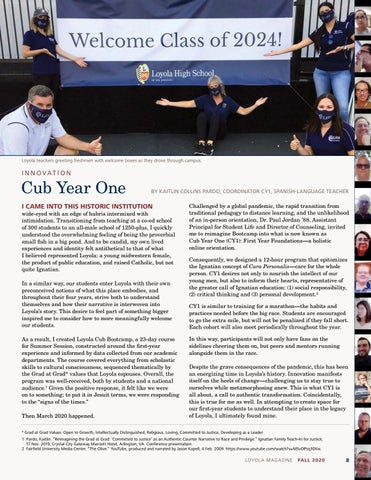
Loyola teachers greeting freshmen with welcome boxes as they drove through campus.
I N N OVAT I O N
Cub Year One
BY KAITLIN COLLINS PARDO, COORDINATOR CY1, SPANISH-LANGUAGE TEACHER
I CAME INTO THIS HISTORIC INSTITUTION wide-eyed with an edge of hubris intermixed with intimidation. Transitioning from teaching at a co-ed school of 300 students to an all-male school of 1250-plus, I quickly understood the overwhelming feeling of being the proverbial small fish in a big pond. And to be candid, my own lived experiences and identity felt antithetical to that of what I believed represented Loyola: a young midwestern female, the product of public education, and raised Catholic, but not quite Ignatian. In a similar way, our students enter Loyola with their own preconceived notions of what this place embodies, and throughout their four years, strive both to understand themselves and how their narrative is interwoven into Loyola’s story. This desire to feel part of something bigger inspired me to consider how to more meaningfully welcome our students. As a result, I created Loyola Cub Bootcamp, a 23-day course for Summer Session, constructed around the first-year experience and informed by data collected from our academic departments. The course covered everything from scholastic skills to cultural consciousness, sequenced thematically by the Grad at Grad* values that Loyola espouses. Overall, the program was well-received, both by students and a national audience.1 Given the positive response, it felt like we were on to something; to put it in Jesuit terms, we were responding to the “signs of the times.” Then March 2020 happened.
Challenged by a global pandemic, the rapid transition from traditional pedagogy to distance learning, and the unlikelihood of an in-person orientation, Dr. Paul Jordan ’88, Assistant Principal for Student Life and Director of Counseling, invited me to reimagine Bootcamp into what is now known as Cub Year One (CY1): First Year Foundations—a holistic online orientation. Consequently, we designed a 12-hour program that epitomizes the Ignatian concept of Cura Personalis—care for the whole person. CY1 desires not only to nourish the intellect of our young men, but also to inform their hearts, representative of the greater call of Ignatian education: (1) social responsibility, (2) critical thinking and (3) personal development.2 CY1 is similar to training for a marathon—the habits and practices needed before the big race. Students are encouraged to go the extra mile, but will not be penalized if they fall short. Each cohort will also meet periodically throughout the year. In this way, participants will not only have fans on the sidelines cheering them on, but peers and mentors running alongside them in the race. Despite the grave consequences of the pandemic, this has been an energizing time in Loyola’s history. Innovation manifests itself on the heels of change—challenging us to stay true to ourselves while metamorphosing anew. This is what CY1 is all about, a call to authentic transformation. Coincidentally, this is true for me as well. In attempting to create space for our first-year students to understand their place in the legacy of Loyola, I ultimately found mine.
* Grad at Grad Values: Open to Growth, Intellectually Distinguished, Religious, Loving, Committed to Justice, Developing as a Leader 1 Pardo, Kaitlin. “Reimagining the Grad at Grad: ’Committed to Justice’ as an Authentic Counter Narrative to Race and Privilege.” Ignatian Family Teach-In for Justice, 17 Nov. 2019, Crystal City Gateway Marriott Hotel, Arlington, VA. Conference presentation. 2 Fairfield University Media Center. “The Olive.” YouTube, produced and narrated by Jason Kapell, 4 Feb. 2009. https://www.youtube.com/watch?v=MSvOPtq30Xw.
LOYOL A MAG A ZINE
FALL 2020
8