Taylor Mali Speaks His Mind to a Rapt Audience
P
ERFORMANCE poet Taylor Mali delivered one of the most universally celebrated Loomis Chaffee convocations of the last decade when he presented his spoken-word poetry to the school in April. Students and faculty alike responded with laughter, tears, and awe to Mr. Mali’s poetry and gripping performance style, and the LC Bookstore sold out of his books by noon.
Mr. Mali, a veteran of the HBO series Def Poetry Jam, has won the National Poetry Slam championship four times. He is the author of three books of poetry, The Last Time As We Are (Write Bloody Books, 2009), What Learning Leaves (Hanover, 2002), and his most recent book, What Teachers Make. A former teacher and an advocate for the teaching profession, his spoken-word performance “What Teachers Make” attracted more than six million YouTube views. Mr. Mali’s visit to Loomis Chaffee was made possible by the Hubbard Speakers Series and the Ralph M. Shulansky ’45 Lecture Fund. His convocation performance opened with “How Falling in Love Is Like Owning a Dog,” a humorous poem that showcases his talent for play on words: “Is love good all the time? No! No! Love can be bad. Bad, love, bad! Very bad love. Love makes messes. Love leaves you little surprises here and there. Love needs lots of cleaning up after.” His poems elicited a full range of emotions from the audience, and he closed his performance with the moving and inspirational poem “Tony Steinberg: Brave Seventh Grade Viking Warrior,” based on a true experience Mr. Mali faced during his teaching years at the Brown-
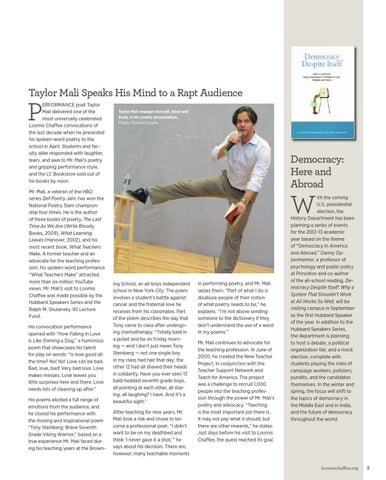
Taylor Mali engages himself, mind and body, in his poetry presentation. Photo: Patricia Cousins
Democracy: Here and Abroad
W ing School, an all-boys independent school in New York City. The poem involves a student’s battle against cancer and the fraternal love he receives from his classmates. Part of the poem describes the day that Tony came to class after undergoing chemotherapy: “Totally bald in a jacket and tie on Friday morning — and I don’t just mean Tony Steinberg — not one single boy in my class had hair that day; the other 12 had all shaved their heads in solidarity. Have you ever seen 13 bald-headed seventh grade boys, all pointing at each other, all staring, all laughing? I have. And it’s a beautiful sight.” After teaching for nine years, Mr. Mali took a risk and chose to become a professional poet. “I didn’t want to be on my deathbed and think ‘I never gave it a shot,’” he says about his decision. There are, however, many teachable moments
in performing poetry, and Mr. Mali seizes them. “Part of what I do is disabuse people of their notion of what poetry needs to be,” he explains. “I’m not above sending someone to the dictionary if they don’t understand the use of a word in my poems.” Mr. Mali continues to advocate for the teaching profession. In June of 2000, he created the New Teacher Project, in conjunction with the Teacher Support Network and Teach for America. The project was a challenge to recruit 1,000 people into the teaching profession through the power of Mr. Mali’s poetry and advocacy. “Teaching is the most important job there is. It may not pay what it should, but there are other rewards,” he states. Just days before his visit to Loomis Chaffee, the quest reached its goal.
ith the coming U.S. presidential election, the History Department has been planning a series of events for the 2012–13 academic year based on the theme of “Democracy in America and Abroad.” Danny Oppenheimer, a professor of psychology and public policy at Princeton and co-author of the all-school reading, Democracy Despite Itself: Why a System That Shouldn’t Work at All Works So Well, will be visiting campus in September as the first Hubbard Speaker of the year. In addition to the Hubbard Speakers Series, the department is planning to host a debate, a political organization fair, and a mock election, complete with students playing the roles of campaign workers, pollsters, pundits, and the candidates themselves. In the winter and spring, the focus will shift to the topics of democracy in the Middle East and in India, and the future of democracy throughout the world.
loomischaffee.org | 5