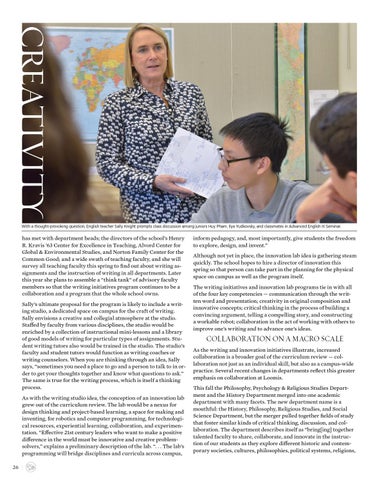
CREATIVITY With a thought-provoking question, English teacher Sally Knight prompts class discussion among juniors Huy Pham, Ilya Yudkovsky, and classmates in Advanced English III Seminar.
has met with department heads; the directors of the school’s Henry R. Kravis ’63 Center for Excellence in Teaching, Alvord Center for Global & Environmental Studies, and Norton Family Center for the Common Good; and a wide swath of teaching faculty, and she will survey all teaching faculty this spring to find out about writing assignments and the instruction of writing in all departments. Later this year she plans to assemble a “think tank” of advisory faculty members so that the writing initiatives program continues to be a collaboration and a program that the whole school owns. Sally’s ultimate proposal for the program is likely to include a writing studio, a dedicated space on campus for the craft of writing. Sally envisions a creative and collegial atmosphere at the studio. Staffed by faculty from various disciplines, the studio would be enriched by a collection of instructional mini-lessons and a library of good models of writing for particular types of assignments. Student writing tutors also would be trained in the studio. The studio’s faculty and student tutors would function as writing coaches or writing counselors. When you are thinking through an idea, Sally says, “sometimes you need a place to go and a person to talk to in order to get your thoughts together and know what questions to ask.” The same is true for the writing process, which is itself a thinking process. As with the writing studio idea, the conception of an innovation lab grew out of the curriculum review. The lab would be a nexus for design thinking and project-based learning, a space for making and inventing, for robotics and computer programming, for technological resources, experiential learning, collaboration, and experimentation. “Effective 21st century leaders who want to make a positive difference in the world must be innovative and creative problemsolvers,” explains a preliminary description of the lab. “. . . The lab’s programming will bridge disciplines and curricula across campus, 26 |
inform pedagogy, and, most importantly, give students the freedom to explore, design, and invent.” Although not yet in place, the innovation lab idea is gathering steam quickly. The school hopes to hire a director of innovation this spring so that person can take part in the planning for the physical space on campus as well as the program itself. The writing initiatives and innovation lab programs tie in with all of the four key competencies — communication through the written word and presentation; creativity in original composition and innovative concepts; critical thinking in the process of building a convincing argument, telling a compelling story, and constructing a workable robot; collaboration in the act of working with others to improve one’s writing and to advance one’s ideas.
COLLABORATION ON A MACRO SCALE As the writing and innovation initiatives illustrate, increased collaboration is a broader goal of the curriculum review — collaboration not just as an individual skill, but also as a campus-wide practice. Several recent changes in departments reflect this greater emphasis on collaboration at Loomis. This fall the Philosophy, Psychology & Religious Studies Department and the History Department merged into one academic department with many facets. The new department name is a mouthful: the History, Philosophy, Religious Studies, and Social Science Department, but the merger pulled together fields of study that foster similar kinds of critical thinking, discussion, and collaboration. The department describes itself as “bring[ing] together talented faculty to share, collaborate, and innovate in the instruction of our students as they explore different historic and contemporary societies, cultures, philosophies, political systems, religions,