




When my brothers and I were young and we’d done something we shouldn’t have, we knew we had breached an important line between being ‘in trouble’ and ‘being in big trouble’ when the situation was escalated from my mom to my dad. The funny thing was, the amount of trouble we were in and my dad’s volume were always an inverted relationship. The bigger the issue, the quieter—and closer—he got. And boy did we listen closely. He led with a quiet, intentional voice that made a deep impact.
This wasn’t just when we were in trouble. He’s done so in all facets of his life, generously participating in his community and church without expectation or recognition.
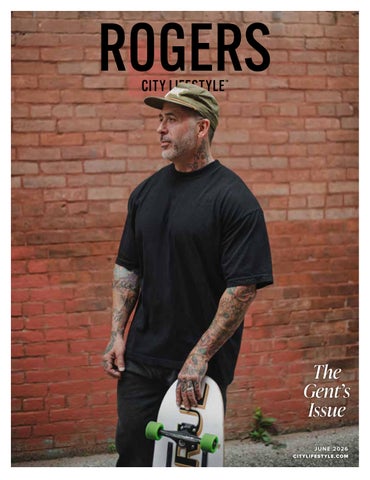
This month’s issue is to celebrate the men and fathers in our community. In honesty, it’s an important time to celebrate gentlemen. The right kind of gentlemen.
Young men and boys across America and in our community are being inundated with loud voices from podcasts and podiums telling them what a man is supposed to be. How a man should dress, what a man should drive, how a man should view and treat others, how a man should participate in society. And so often, these spotlights and platforms are being given to dangerous voices reaching ears eager for direction.
So what are we to do? Shy away? Find our own podiums and podcasts to speak from which to speak more loudly? Shout down the harmful voices?
I can’t say I think so. As a father of a young boy myself, I think I’ll take my dad’s approach. Because when voices are intentional and quiet, we’re forced to listen more closely.
Please understand, this issue is not about celebrating men for the sake of being men. This issue is about celebrating a few very specific men in our community who are choosing to lead with quiet intentionality. Men who lead in their spheres with generosity and integrity.
These pages in the June Gentleman’s issue are reserved for those who quietly set the example of what it means to treat others with kindness and give back to the community without expectation or recognition, lending a much needed soft voice to eager ears.
To those men I say, here’s to you.
WYATT LAYMAN, PUBLISHER @ROGERSCITYLIFESTYLE
June 2026
PUBLISHER
Wyatt Layman | wyatt.layman@citylifestyle.com
MANAGING EDITOR
Michelle Bazis | michelle.bazis@citylifestyle.com
ACCOUNT MANAGER
Alexis Roach | alexis.roach@citylifestyle.com
PUBLISHER ASSISTANT
Jennifer Purifoy | jennifer.purifoy@citylifestyle.com
SOCIAL MEDIA COORDINATOR
Claire McFarland | claire.mcfarland@citylifestyle.com
CONTRIBUTING WRITER
Wyatt Layman
CONTRIBUTING PHOTOGRAPHER
Garret Layman
CEO Steven Schowengerdt
President Matthew Perry
COO David Stetler
CRO Jamie Pentz
CoS Janeane Thompson
AD DESIGNER Matthew Endersbe
LAYOUT DESIGNER Meredith Wilson
QUALITY CONTROL SPECIALIST Brandy Thomas











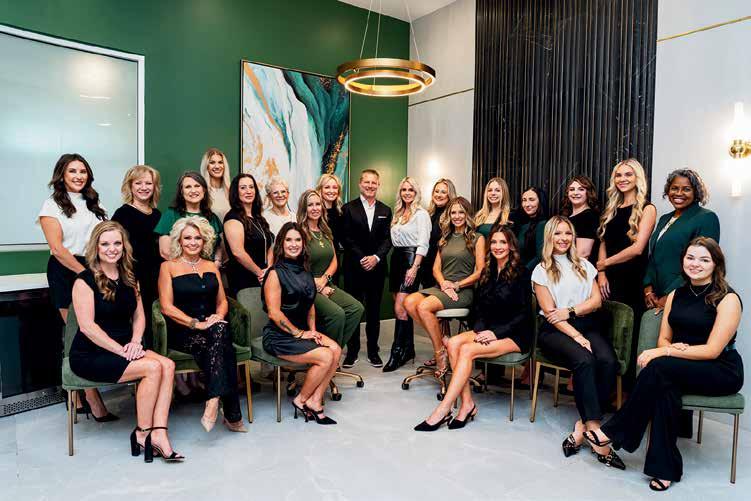






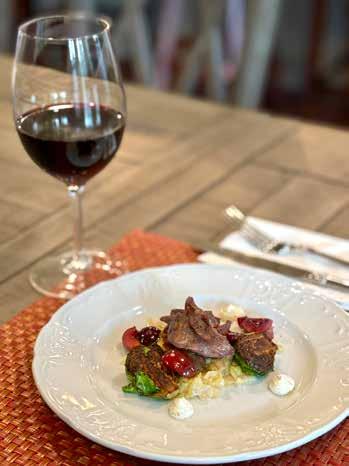
From elegant six-course tasting menus to relaxed, family-style meals, Executive Chef Kevin McCombs of House Cured Culinary will customize your dream menu and take your gathering to the next level. Every detail is handled — from shopping to cleanup — while the full menu is prepared fresh onsite, creating an experience to remember. Focus on your guests — we’ll take care of the rest.














At Premier Dermatology, Aesthetics & Wellness, we believe wellness is about more than appearance — it starts with understanding your body from within. Our DEXA Body Composition Scans provide advanced insight into your body composition, helping you better understand your health with precision and clarity.
This advanced technology goes far beyond a traditional scale or BMI. A DEXA scan provides an in-depth look at your muscle mass, body fat distribution, and bone density, helping you and your provider uncover how your lifestyle, nutrition, and metabolism are truly impacting your health.
Whether you’re working toward a healthier weight, improving metabolic function, or simply wanting to track your fitness progress more precisely, the DEXA Body Composition Scans offer powerful insights to help you reach your goals.


Lasang Pinoy NWA is proud to be recognized in Best of NWA with Gold for Best Asian Restaurant and Best Karaoke, and Silver for Best Lunch Spot and Best New Restaurant. These honors reflect the support of the Northwest Arkansas community and our commitment to delivering bold Filipino flavors, memorable experiences, and a space where guests feel at home.

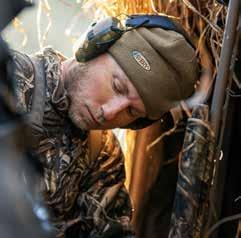
Trading the hustle for time, memories, and the simple love of being afield
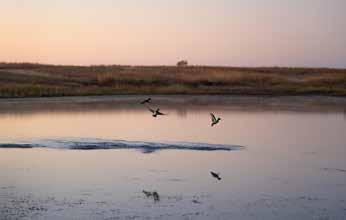
Growing up in the rural, Missouri Ozarks, duck hunting was a labor of love—heavy emphasis on labor. It meant beyond early mornings, driving hours to stand in the draw line, breaking ice and, on more than one occasion, finding out the hard way that there was a leak in my waders.
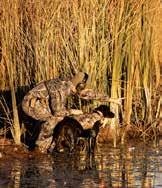
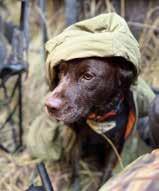
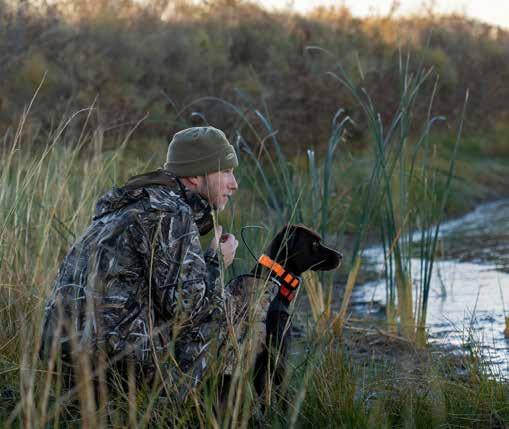
Those were the days when I was still somewhere between hunter stage 2 and 3—caring more about the success of the hunt than the experience. Now, I find myself at the other end of the spectrum, called The Sportsman Stage. At this point in my life, it’s about time spent with my family. It’s about time watching my dogs work. And in several years, if he’d like, it will be about time spent afield with my own son.
During a trip to Stuart Ranch near Waurika, Oklahoma last year, my dad, brothers, and I were able to find that community, enjoy an incredible hunt, and relax together along the way. The man
responsible for giving us that opportunity, Clay Forst, represents the 6th generation of the Stuart family to run the ranch. He sees his role as the steward of a gift from God for others to come enjoy. Forst said, “Once you’re here, we’re going to give you the best experience we can and treat you like family.”
That’s exactly how it felt. We chatted with our guides like they had been friends forever. We ate food worthy of an upscale restaurant but served with an unpretentious family warmth. We played billiards and cards. And sure, we harvested our limits of ducks.
But the memories that stand out don’t have anything to do with pulling a trigger. It’s the moments before, after, and in between with family that come to mind.
Duck hunting with my family and friends is something I love. Stuart Ranch made sure I left the labor at home.
“
Once you’re here, we’re going to give you the best experience we can and treat you like family.












AN EXCERPT FROM EPISODE 6 OF SHARE THE LIFESTYLE, A CITY LIFESTYLE PODCAST
Photographer: Brittany Dawn Short
Creative Director: Jen Birn
Stylist: Stephanie Coultress O’Neill
Location: Hotel Saint Cecilia, Austin, TX
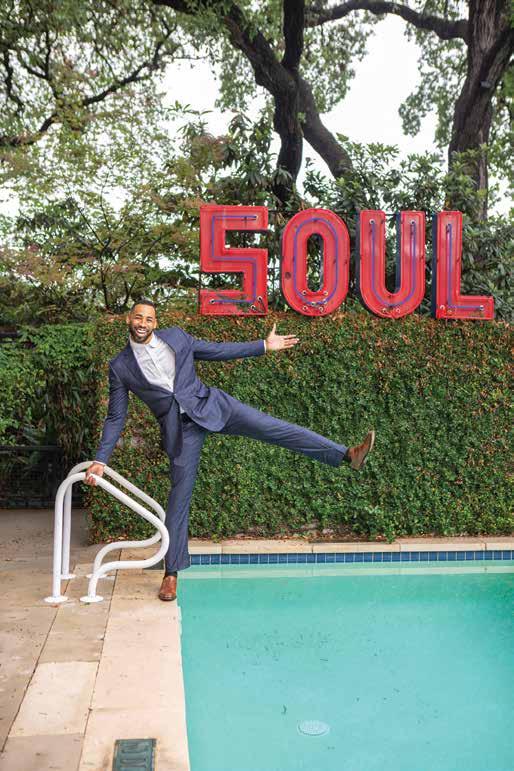
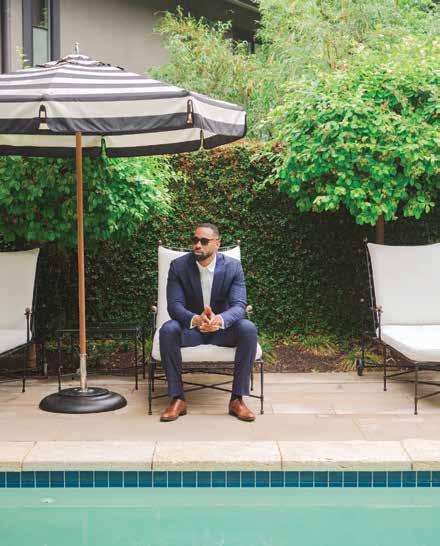
MIKE JOHNSON HAS BUILT HIS LIFE AROUND ONE QUIETLY RADICAL IDEA: THE STANDARD YOU SET PRIVATELY IS THE ONLY ONE THAT MATTERS.
After eight years in the Air Force, a celebrated run on national television, and a health crisis abroad that sent him deep into supply chains and ingredient certifications most founders never touch, the result is Oshun — a luxury ritual brand built on provenance you can trace and integrity you can verify. In an exclusive conversation for the Share the Lifestyle podcast, Mike shares what it actually takes to build something worth putting your name on. Read the highlights below, then scan the QR code for the full episode.
Q: YOU BECAME A FAN FAVORITE ON THE BACHELORETTE AND THEN LEFT THE SPOTLIGHT. YOU MOVED TO MEXICO, LEARNED SPANISH, THEN COSTA RICA, AND BUILT A COMPANY. WHAT DID THAT EXPERIENCE TEACH YOU ABOUT HUMAN BEHAVIOR?
A: “If you’re a good person going in, that shows. If you’re not, that shows too. I also learned that people form this parasocial relationship with you — they assume things about you. When all actuality, different circumstances bring out different parts of who you are. I was on TV trying to find love. The kindness people were showing after felt a bit fake, because they wanted to be a part of something that isn’t who I am individually, but a part of what they saw on TV. And so I had to get away from everybody and everything and the noise.”
“Too many people have prayed for me. So I’ve got to get up and do the walking.”
— Mike Johnson

Q: YOU JOINED THE AIR FORCE RIGHT OUT OF COMMUNITY COLLEGE. WHAT WERE YOU ACTUALLY RUNNING TOWARD?
A: “There was something in me that was saying: I’m not living up to my full potential. I was being a follower. My uncle said, ‘What’s going to make you become an adult the fastest?’ I said, obviously, the military. The Air Force broadened my thought process more than anything. We’re so caught up in our own perception — when you learn to understand different people’s perspectives, it adds to you in so many ways.”
Q: WITH OSHUN, YOU OWN YOUR MANUFACTURING, YOU EMPLOY A CHEMIST, EVERY PRODUCT HAS A BATCH NUMBER TRACEABLE TO ITS ORIGIN DATE. WHY DID YOU DECIDE TO GO THAT DEEP WITH THE BRAND?
A: “The EU bans 1,100 ingredients in personal care products. The U.S. bans nine. That’s my starting point. Oftentimes, it might be the same ingredient, but it comes from a place where it doesn’t have the highest purity. And 60% of what we put on our skin is absorbed. Every product Oshun makes carries a batch number that goes back to the exact day it was created — I can show you every single supplier, the date, the origin. I own more than one part of the supply chain because that’s the only way I can stand behind what’s in the bottle.”
This conversation is just the beginning. Mike goes deeper into why he’s buying land up north, the family in the Philippines who prayed over his factory floor, and what he’d tell every person ready to stop performing and start building. Scan the QR code for the full, exclusive City Lifestyle interview on the Share the Lifestyle podcast.







BY MICHELLE BAZIS
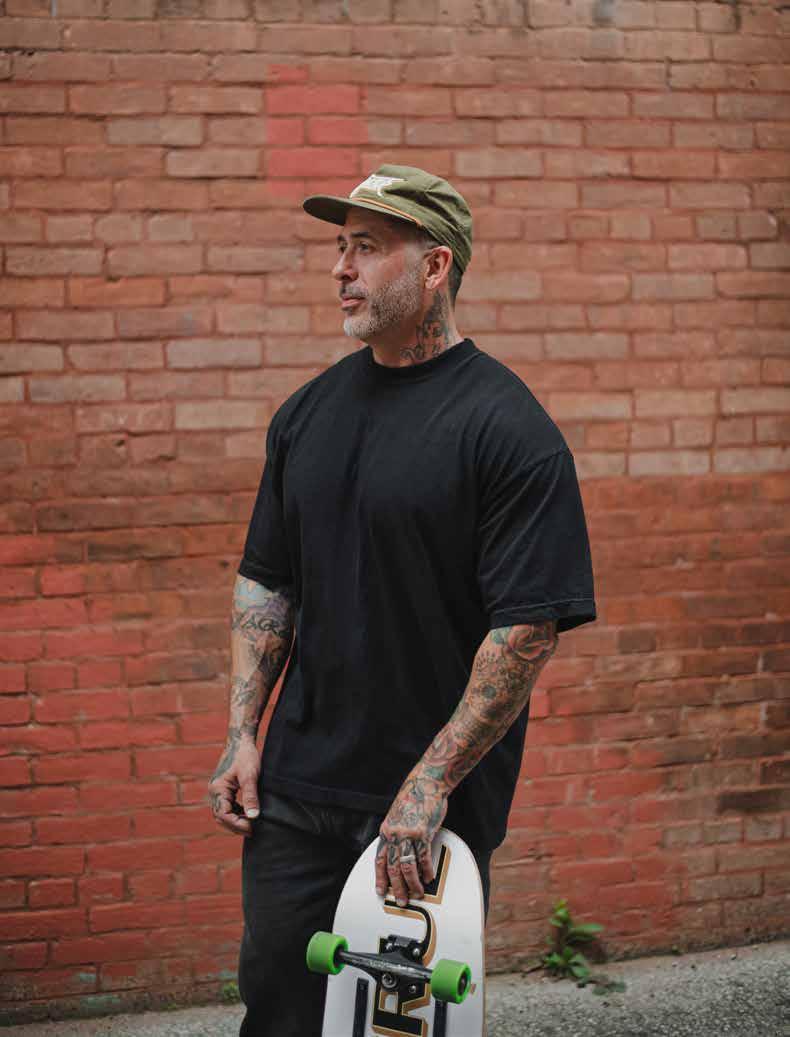
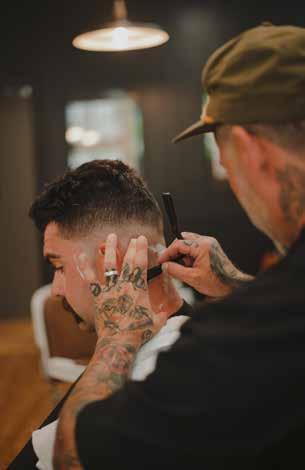
WHY TWO GUYS FROM TEXAS BROUGHT BIKE, BOARD AND BARBER SHOP CULTURE TO DOWNTOWN ROGERS
In a town known for its commitment to movement and craftsmanship, Stay True has become a genuine sanctuary for those looking to stay rooted in the passions that define them.
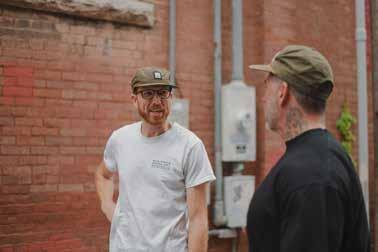
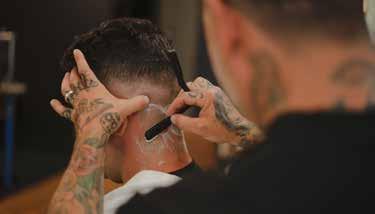
The vision for this distinctive hub belongs to co-owners Brandan Licatino and Kevin McAllister, two Texas natives whose journeys led them to Northwest Arkansas. Licatino, a Master Barber, has been honing his craft since the age of 18, beginning his career in 1998. “I got my first clippers when I was 13. I started doing my own hair, then my friends,” Licatino recalls. After barely graduating high school, it was his parents who encouraged him to pursue a career in barbering; a path that would eventually lead to a successful Houston barbershop, Cutthroat, which he ran for a decade.
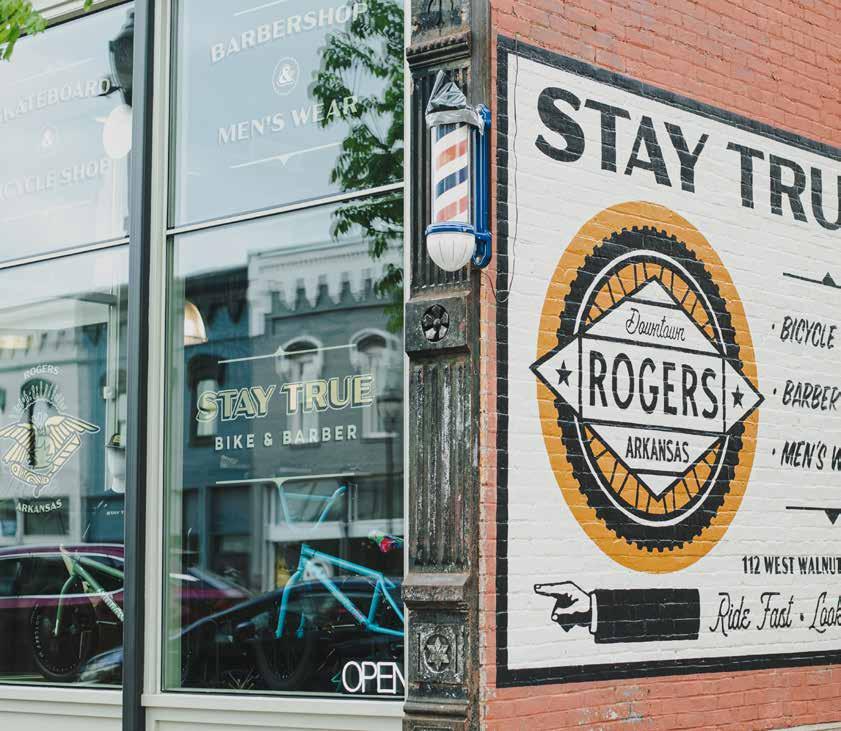
Meanwhile, McAllister, owner of the commercial contracting company Salt Group, first met Licatino in 2010 during the early days of Cutthroat. After ten years and three locations, Licatino sold his Houston business and moved his family to Northwest Arkansas. As fate would have it, McAllister and his wife had been living in the Fayetteville area since 2018. “Brandan got my number when he was visiting to ride bikes,” McAllister said. “I grew up working in surf and skate shops in Galveston, so after he moved up here, he asked if I wanted to open a shop,” McAllister said.
The concept for Stay True is a slight departure from what Licatino had created with Cutthroat. Recognizing a natural synergy between
his profession and his past, merging barber shop and bike shop culture just made sense, especially for their ideal location in Downtown Rogers. “My parents opened a bike shop when I was a kid, so I have a lot of really good childhood memories of the shop,” he says. “It was a place you could go and hang out; Barber shops are like that, too, so I thought it made sense to mix the two.”
Choosing the space for Stay True was a conscious decision driven by a desire for authenticity. Licatino says Downtown Rogers, with its working-class history and artistic energy, is “on par with who they are and what they like. It’s a unique place for us. It has a lot of soul, a lot of character.”
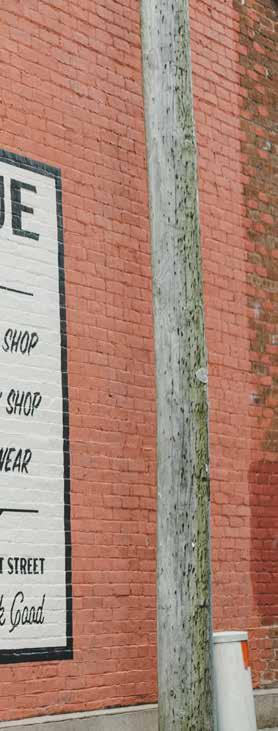
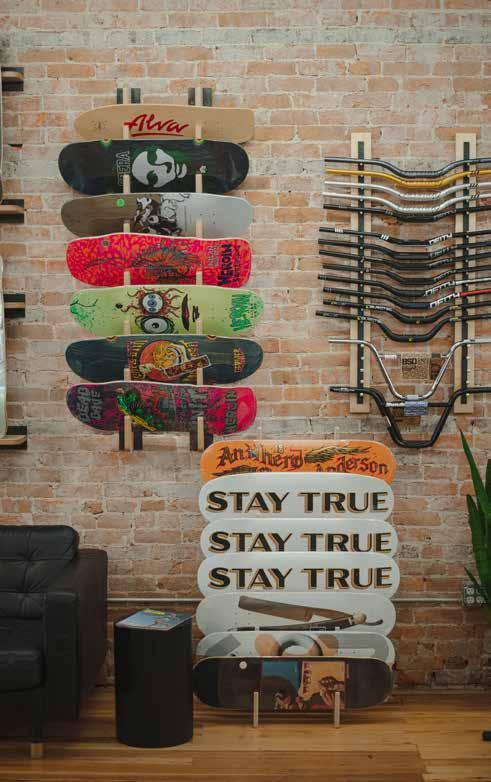
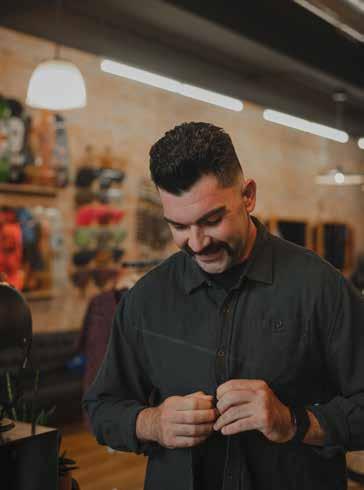
That commitment required resilience, as the building they selected was essentially a shell. “It took a while to get the space, but we didn’t give up. We were resilient,” Licatino notes. McAllister leveraged his construction expertise, helping with the overhaul. “The building didn’t have a roof,” McAllister explains. “We had to put in the ceiling and redo the floors. We took the plaster off the walls and put the bathroom in the back. I did a lot of the woodwork and retail racks.”
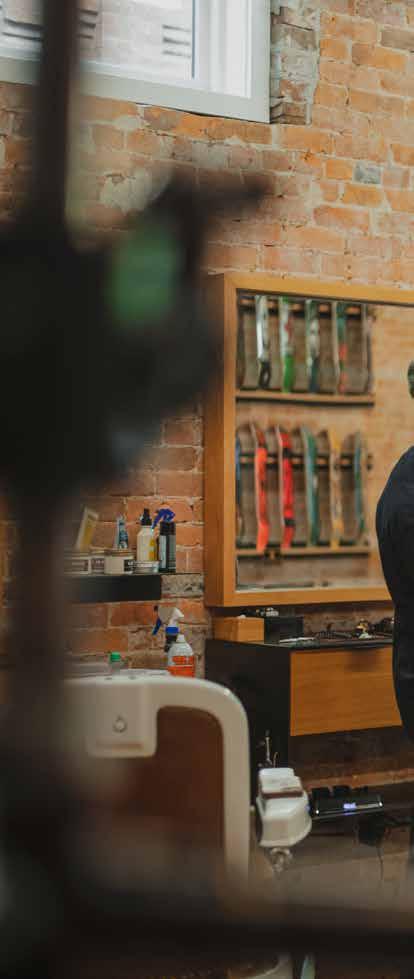
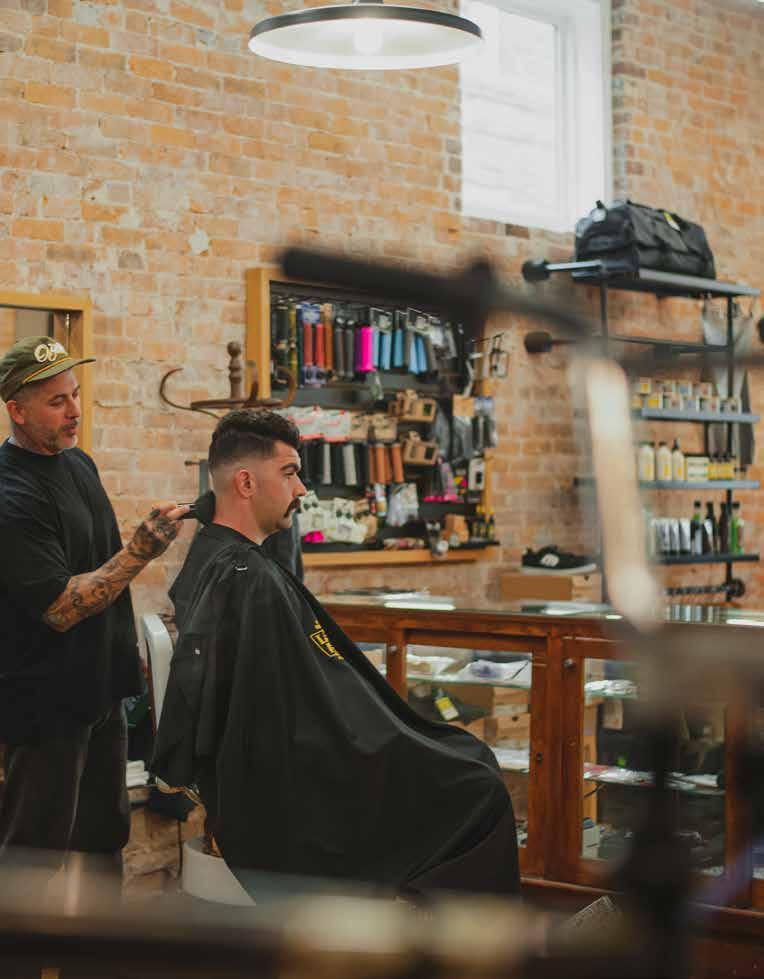
The resulting aesthetic is a masterclass in elegant, elevated industrial design—a space that feels both gritty and refined. It features an exquisite mix of exposed raw materials, vintage finds, and sleek modern lines.
Ultimately, Stay True is defined by an emphasis on style and service across all its offerings. The three subcultures—bike, skate, and barbering—share an intrinsic focus on aesthetics. “The components are more stylized, that’s why we like it,” Licatino explains. “The graphics have always been about art. All of that goes hand-in-hand, and with barbering, it’s just about style.”
Unlike the ubiquitous mountain biking presence in Bentonville, Stay True carved out a niche by specializing in BMX. “There’s not as much MTB traffic as there is in Bentonville,” says McAllister. “Other shops are sending people to us when they have customers
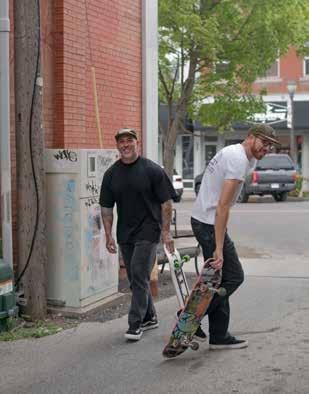
“OUR SHOP IS A REMINDER TO STAY TRUE TO YOUR PASSIONS AND THE HOBBIES THAT KEEP US ROOTED THROUGHOUT THE JOURNEY OF LIFE.”
with BMX needs… we can specialize in BMX, which works because it’s what we love.” This specialization allows them to curate a unique selection that caters to their passion, filling a specific need in the Northwest Arkansas cycling scene.
Beyond the meticulous design and specialized products, the essential core of the Stay True ethos is human connection, which manifests in two critical ways: a reminder to play and a space for authentic conversation.
“A lot of guys hit a certain age, and they think they can’t ride or skateboard anymore; that they’re too grown up to enjoy these things,” Licatino observes. “Our shop is a reminder to stay true to your passions and the hobbies that keep us rooted throughout the journey of life.”
For the master barber, the chair itself offers a unique form of therapy. “A barber shop is one place where a man can come and have a good quality conversation with another man without judgment,” Licatino states. He believes the simple act of human connection provides a comfort that helps clients open up.
“There have been times in my life when I’ve needed that space or connection, and haven’t always gotten that,” Licatino shared. “It’s hard to convey how important that part of the job is.”
When asked about the future of Stay True, both men were adamant about focusing on Rogers locals and serving them where they are. “I’ve had multiple shops, I’ve managed a bunch of staff. That’s not what we’re trying to accomplish with this,” Licatino confirms. “Stay True is here to serve the people of Rogers; a place they can belong and call their own.”


















ARTICLE BY NICCI LAVINE
The bluegrass state of Kentucky with the Appalachian Mountains is indisputably known as the Mecca of bourbon and the location of America’s only Bourbon Trail.
The Kentucky Bourbon Trail, established in 1999, is dotted with a total of 37 distilleries scattered throughout the regions of Louisville, Western Kentucky, Bardstown, Lexington and North Kentucky.
For bourbon aficionados and road trip lovers alike, the trail promises scenic country drives, historic architecture, and an abundance of restaurants and tasting rooms with some distilleries spanning more than 100 miles apart.
The most popular bourbon distillery locations one might expect to see along the trail are: Angel’s Envy, Maker’s Mark, Michter’s, Wild Turkey, Heaven Hill, Lux Row, Old Forester, Four Roses, Evan Williams, Bulleit, and Jim Beam.
Within each distillery and on its grounds, bourbon lovers can expect to find a variety of bourbon price points, flavor profiles, distilling and aging techniques, and historical points of interest. Each location offers a variety of tour options: some focusing on the chemistry of bourbon distillation, the art of tasting, the barrel charring process, or the rich (and checkered) history of bourbon’s origins.
One constant seems to remain—most Kentucky distilleries cannot broach the topic of their favorite drink without also offering a glimpse of its history. The name “bourbon” hails from the original Bourbon County, which was a region carved from a portion of the Fayette County of Virginia in 1785. The county, which belonged to the then-brand-new state of Kentucky, was named in honor of the French House of Bourbon to show gratitude to King Louis XVI for his vital assistance during the American Revolutionary War.
Prior to its exodus from the region, loads of white oak barrels cut from the forests of Arkansas were first branded with the Bourbon County label. The county logo branded on the barrels soon gave way to its shorthand references: Bourbon. The rest is, quite literally, history.
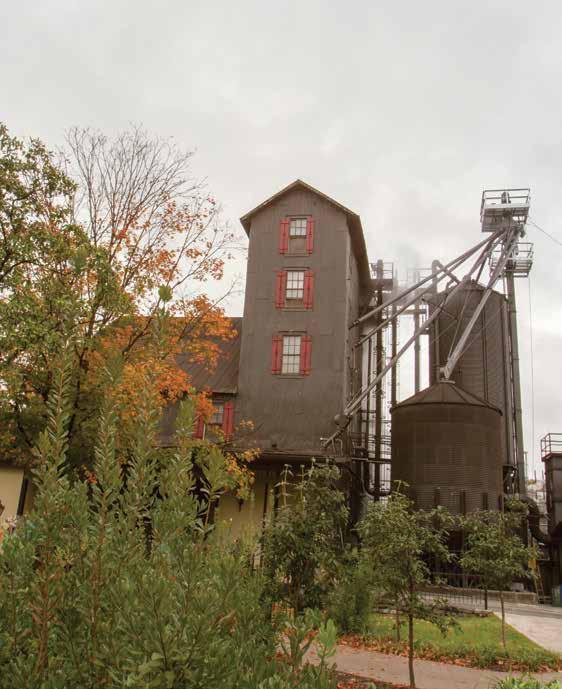
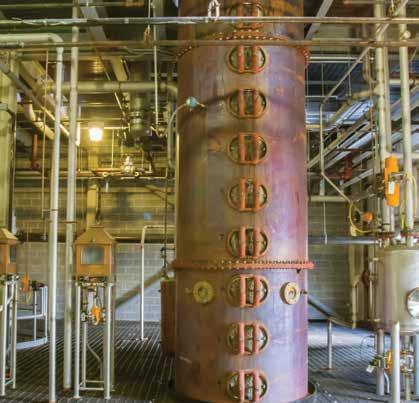
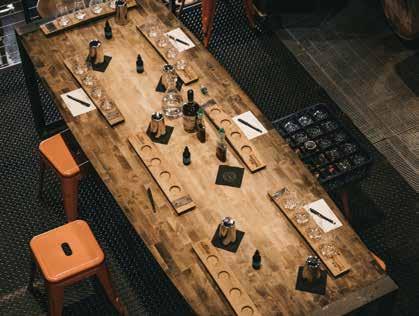
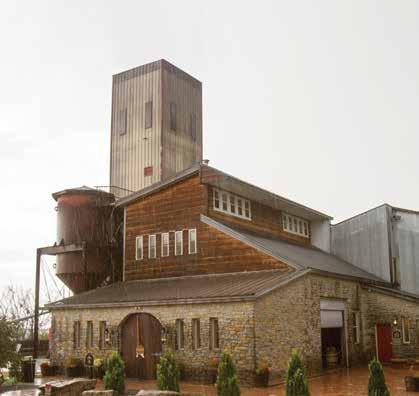
The oldest operational distillery in Kentucky is Maker’s Mark, which began distilling in 1805 and has since been recognized as a National Historic Landmark. In 1964, a Congressional Resolution declared bourbon to be an indigenous product of the United States. This distinction renders bourbon as the official American Spirit. To be recognized as a bourbon, a spirit must meet specific and strict requirements set forth by law. In fact, bourbon distillation marks one of America’s very first examples of a consumer protection law with the establishment of the “Bottled-in-Bond” Act in 1897 (The Bottled-in-Bond designation have bourbon standards which supersede those of single-malt Scotch).
All bourbon starts as what distillers refer to as White Lightning—an uncolored, unaged, and unflavored whiskey. During the distillation process, the liquid must not supersede a proof of 160, and must not supersede a proof of 125 at the time it’s poured into barrels to begin the aging process. All bourbon must be aged in new, charred, white oak barrels for a minimum of two years before it is finally bottled at 80 proof or higher. No other dyes or flavors may be introduced into the distilling or aging process if a bourbon is to retain its namesake.
Even though 95% of bourbon is distilled in Kentucky, bourbon does not need to be distilled in the state to be considered authentic. Most bourbon was historically made in Kentucky due to its geography. The rich source of limestone in Kentucky earth acts as a natural aquifer, purifying the water and removing the more peaty flavors one would find in spirits distilled with earthier water quality, such as Scotch. The varied temperatures, humidity levels, and weather patterns in the Kentucky region cause the white oak barrels to contrast and swell. This unique aging process gives bourbon its signature amber hue as well as its sweet and dynamic flavor.
While the tour itinerary is flexible enough to have many starting points, the official “start” of the trail can be found at the Kentucky Bourbon Trail Welcome Center located at the Frazier Museum on Historic Whiskey Row in downtown Louisville. The destinations along the trail can be planned a number of ways: by distillery, by region, or by organized tour itinerary. Some distillery locations are packed as tightly as an 8-mile radius, with the average tour lasting about 90 minutes.
For those who want to travel off the beaten path, several famous distilleries in the area do not appear on the official Kentucky Bourbon Trail list. One of the more famous of these is the Buffalo Trace Distillery, responsible for distilling bourbon of that name as well as the more rare and sought-after bottles of Blanton’s and E.H. Taylor. The Buffalo Trace distillery is located on a national landmark and offers free tastings, as well as Ghost tours for those who are interested in a different kind of spirit.
For a complete list of distilleries, tour schedules, tour booking details, and frequently asked questions, visit KYBourbonTrail.com