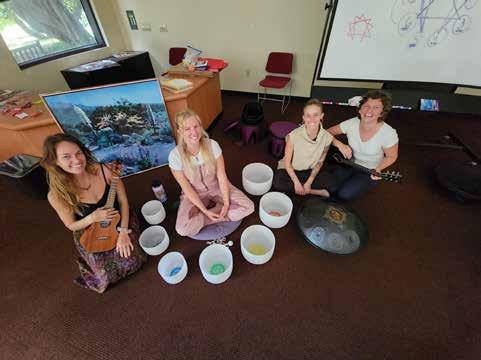
At Sofia University, psychology is more than a discipline it ’ s a calling
With programs grounded in whole-person, transpersonal education, we offer an integrative learning experience that combines academic rigor with personal transformation
Whether you ' re pursuing a MA in Counseling Psychology, MA or PhD in Transpersonal Psychology, or one of our specialty certificates, you’ll explore human potential, healing, and consciousness through a deeply experiential lens
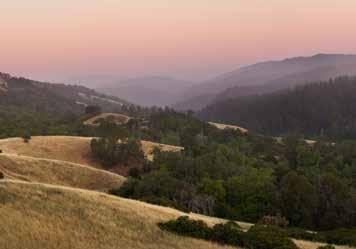
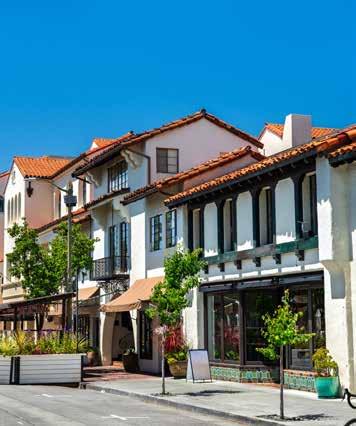
Convenient Palo Alto Campus
Learn more: www.sofia.edu
Contact: admissions@sofia.edu
Good news happening right in your neighborhood.
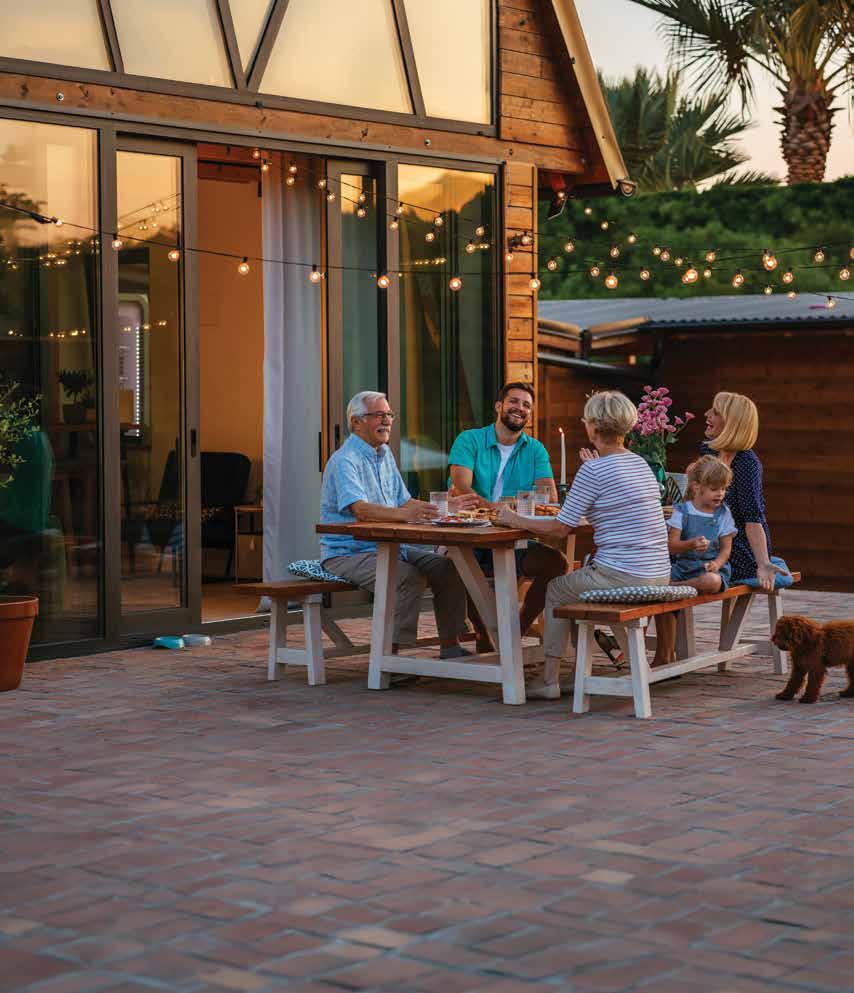
For 25 years, your Palo Alto neighbors have trusted American Vision Windows to do something deceptively simple: get it right. The right windows for the architecture. The right installation, often in a single day. The right experience, from the first consultation to the final walkthrough.
What makes the difference? American Vision Windows is 100% employee-owned, which means every person who walks into your home has a personal stake in your satisfaction. Not a contractor. Not a crew passing through. An owner.
Over one million windows installed across California. A reputation built one homeowner at a time.
DOORS YOU USUALLY PASS
This summer, I went on a small adventure I didn't expect to find in my own town.
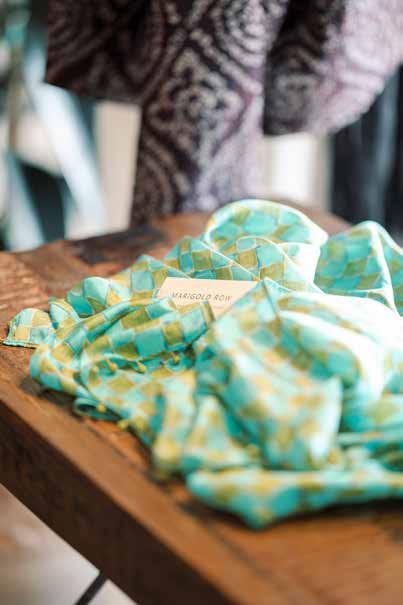
A friend told me to stop by Marigold Row, the textile shop over on the Town & Country side of El Camino. It’s funny because I actually used to work at Antoine’s Cookie Shop right next door, so I had walked past it for two full years without ever going in. The morning I finally did, I was pleasantly surprised by how beautifully curated the space was. I just stood there running my hands over silks and asking questions about a place I’d never been. By the time I left, it felt like I’d gotten to take a whole trip without ever leaving Palo Alto.
I think a lot of us forget just how much there is to uncover right here. We get so caught up in the daily rush that we look right past the things that make a place interesting. Like the shops along University Avenue you’ve walked by a thousand times since moving here. If you actually stop and step inside, the people behind the counter have the exact kinds of stories that turn a normal afternoon into a bit of an adventure.
It's a season for opening doors you usually pass.
In this issue, you'll meet Anita Mehta at Marigold Row, you'll see how Cynthia Spence drew a one-story farmhouse around a heritage oak the family refused to lose, and you'll hear about my standing route through town for the friend who visits now and then.
So go take a small adventure of your own. Walk into the shop you've never tried. Drive to the dock you've never seen. Hike the trail nobody told you about. July is the month!
Learn how to start your own publication at citylifestyle.com/franchise.
Proverbs 3:5-6
business monthly
Kalos Health DEXA
Kalos Health marks a year on Forest Avenue in July. The six-minute DEXA scan measures body fat, lean muscle by region, visceral fat, and bone density. Their four-week program pairs a scan with personalized training and nutrition plans. Intro scan $149, HSA and FSA eligible.
Scan to read more
After the May Vote, the Backyard Plans Start
On May 12, Palo Alto's City Council adopted a revised accessory dwelling unit ordinance and directed staff to study both larger ADUs and a path to sell them separately from the main residence. Acton ADU, founded by Stan Acton in 1990 and based in Campbell, has been a Bay Area builder for over thirty years. Their Build-Ready line is a pre-designed series of site-built backyard homes that shortens the design and permit timeline.
AI Alignment Meets Transpersonal
Sofia University, founded in 1975 as the California Institute of Transpersonal Psychology, has appointed Dr. Gordon Montgomery as the inaugural Marshall Chair for AI Alignment and Consciousness Research. The chair, funded by philanthropist Tim Marshall, pairs Sofia's transpersonal lineage with the questions Silicon Valley is asking right now. Summer quarter begins July 6 on the East Meadow Circle campus. Registration opened in late May.
Photography Courtesy of Kalos Health
Photography Courtesy of Sofia University
Photography Courtesy of Acton ADU
ARTICLE BY KALI KASPRZYK
PHOTOGRAPHY BY JANIE JONES
MAKEUP BY MIKAYLA CRANE
The 10% Target Mindset
Jen Cohen ON THE PRACTICE OF ASKING FOR WHAT YOU WANT
Winnipeg in the winter, and a 17-year-old waits 45 minutes in the cold for Keanu Reeves. Her fingers are numb. She is not there for an autograph. She is there to ask him to appear in her audition tape for MuchMusic, Canada’s MTV. When he finally agrees, she writes her number on a gum wrapper with a borrowed lip liner.
He calls days later.
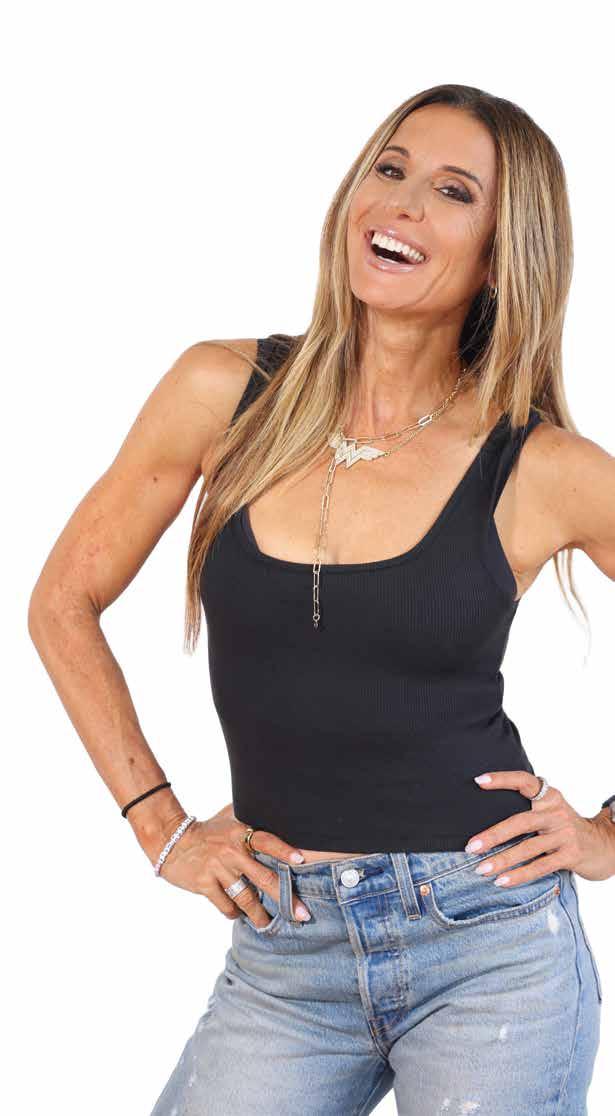
That 17-year-old was Jen Cohen — fitness expert, host of the Habits & Hustle podcast, and best-selling author. She has built a career on the premise her frostbitten afternoon proved. She calls the practice the 10% Target: 10 attempts at whatever you want most in life.
The premise is simple. Most people never make one attempt. Almost nobody makes two. The math works in favor of the person who keeps going.
The top-rated Habits & Hustle podcast has logged hundreds of conversations with high performers and the people who study what the body does to the mind. Her TEDx talk, The Secret to Getting Anything You Want in Life, has traveled widely inside Fortune 500 sales-training rooms. On the Share the Lifestyle podcast, Cohen sits down to share the working rules that are the foundation of her latest book, Bigger, Better, Bolder.
“You have to be the CEO of your own life.”
FEATURING JEN COHEN
Discover the full 10% Target Mindset framework.
1 2
MAKE TEN ATTEMPTS
The door opens, or another door does. The unmade attempt and the refused one leave you in the same place — except one of them teaches you something.
STACK THE DECK
Cohen frames her habits as a wager: How do I stack the deck so I win more than I lose? The workout happens first, and the food decisions follow. The email follow-up gets sent, and the answer arrives. The choices compound in a single direction.
3
DISCIPLINE IS A PRACTICED SKILL, NOT AN INHERITANCE
No one is born with it. The people who look disciplined are running a routine they have rehearsed long enough that it no longer feels like effort. The reps are the skill. Miss them, and the skill fades, the same as any other.
4
SELF-TALK ONLY WORKS WHEN THE BODY BACKS IT UP
Confidence does not arrive by repeating the word. It arrives after the body has done the thing — the workout finished, the cold walk endured, the email sent. The mind takes its cues from what the body proves it can do. Talk follows action, not the other way around.
5
NEVER MISS A MONDAY
The first decision sets the slope of the rest. Skip the Monday workout, and the rest of the week tends to follow. Hold the line on Monday, and the slope tilts the other way.
FROM NEW DEHLI TO PALO ALTO
Twenty years of Indian textiles. Three years of
PHOTOGRAPHY BY KARINA PEMBERTON
Marigold Row.
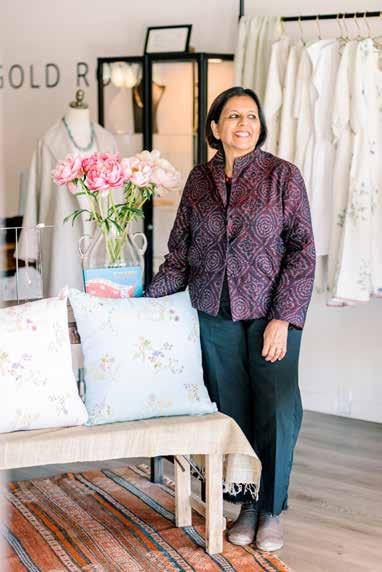
At Marigold Row, a shop on the Town & Country side of El Camino, Anita Mehta is unfolding a piece of cloth that someone in a village outside Kolkata stitched together by hand.
She runs a finger along a seam where two older fabrics have been joined. The technique is called Kantha, the Indian habit of refusing to throw a good cloth away. A grandmother’s sari starts to wear through. Two layers are laid against each other, stitched together by hand, and the mending becomes the design.
Anita has been sourcing this work for twenty years, mostly wholesale, selling scarves into museum gift shops and other retailers around the country. The Harvard Art Museum shop is one of them. The retail shop on El Camino is three years old.
She grew up in New Delhi watching her mother shop for saris. Her mother knew India’s weaving villages by craft: Jamdani in one town, Ikat in another, an embroidery technique somewhere else. Whenever she traveled, she came back with a sari from the region.
“It was like growing up in a school of how to understand and appreciate quality products.”
Anita came to the United States as a student, expecting to return. She met her husband and stayed. She travels back to India every year.
In her first years here, she would read the made-in-India tags in department stores. The fabric was ordinary. The cuts were uninspired. She wondered why apparel made from finer Indian textiles was not what made it here.
The wholesale began in 2008: hand-loomed cotton, silk, and linen scarves, from the same towns her mother used to come
"It was like growing up in a school of how to understand and appreciate quality products."
home from. The retail shop is the more recent story. She opened it to put the regional work in front of people. In a wholesale catalog the threads look flat. On the rod by the window, they show what they are.
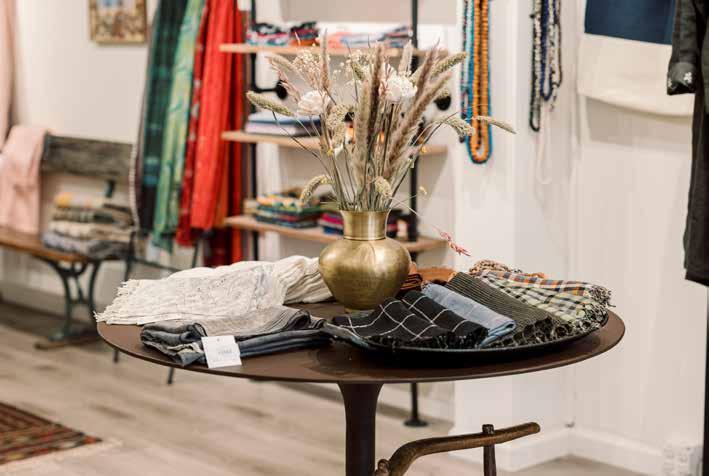
The work of the shop is bridging two visual cultures. Indian textiles run on vibrant color, intricate weaves, and detailed embroidery. Palo Alto runs on quieter palettes and minimal silhouettes. Finding the middle is the daily work: keeping the regional technique, softening the color, letting the silhouette stay Western.
Natural fabric is the rule of the store. Cotton, silk, linen, wool. Polyester does not come in. Anita is firm on this: synthetic doesn’t breathe against the skin, and it ends up in landfills rather than closets.
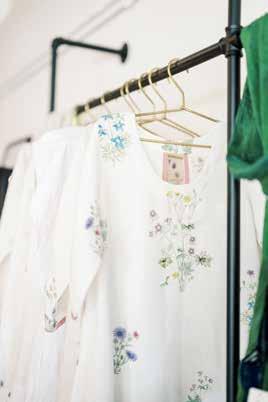
She pulls another piece off a rod. The dyeing was done by hand: each section tied off, dunked into color, untied to show the white the dye never
reached. Tie-dye that is actually tied. The dress with the silver threads is on a different rod, the silver coated onto silk filament and woven into the linen warp. It is the store’s most popular piece.
The Google reviews are five stars. Customers say they came in for a present and left with something they couldn’t find anywhere else, and the shop runs on that idea.
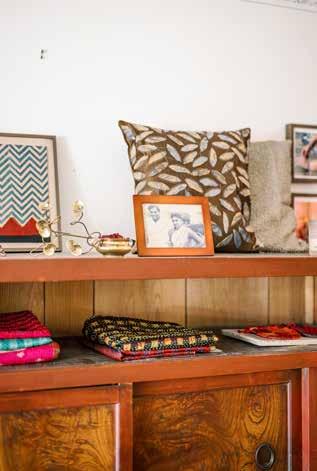
A photograph of her mother and father sits in the shop. Her mother was the inspiration, the teacher, the guide.
Marigold Row sources from all over India. The fabrics are woven on a handloom, hand tie-dyed, or hand embroidered. None of it is shipped in by accident. Someone in a remote village or a bustling metropolis did the work, and a woman in Palo Alto, oceans away, decided it was worth carrying across.
THE HOUSE AROUND THE OAK
A Saratoga rebuild that left the tree standing.
PHOTOGRAPHY
BY
DREW KELLY
A couple in Saratoga had a half-acre lot with a protected oak tree on it, and four grown daughters. They were ready to rebuild the house. Every architect they consulted drew a two-story plan, the standard answer when a heritage tree on the lot forces a builder vertical. Cynthia Spence Design
looked at the same lot and proposed something different: a one-story modern farmhouse that wraps around the tree instead of climbing above it.
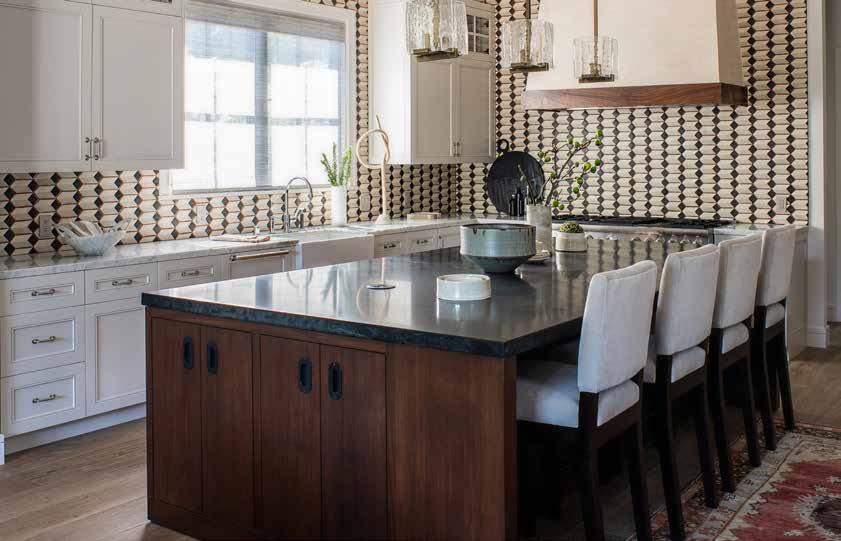
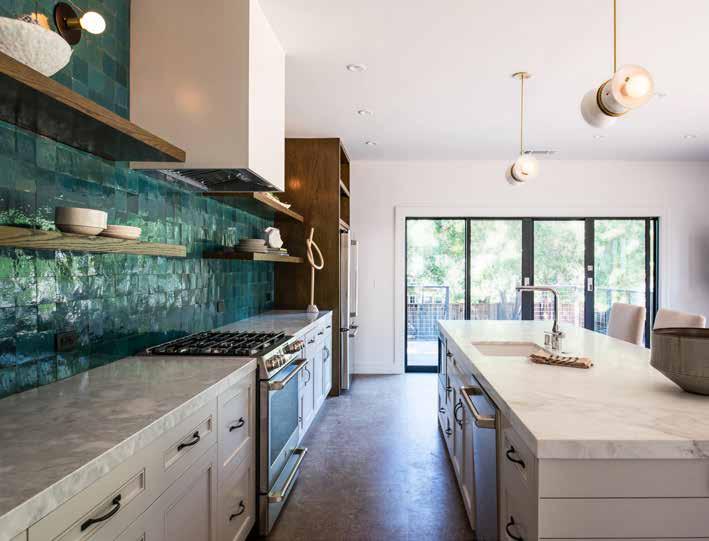
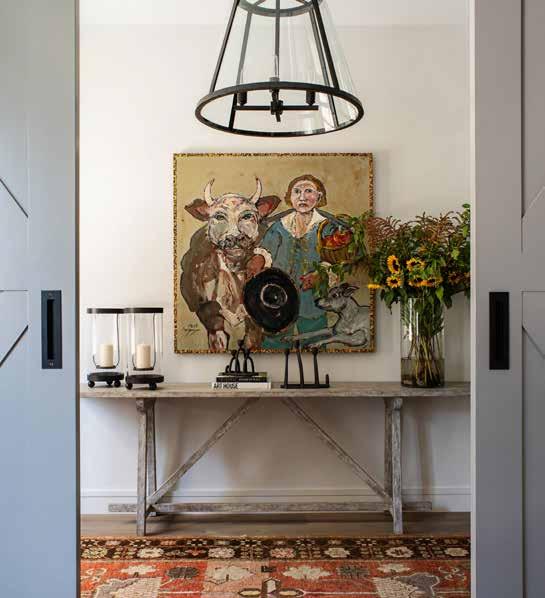
The firm ran every phase of the project, from the first permit to the last decor decision. Cynthia Spence Design’s services list reads like a project bill of materials: space planning and design, new-build oversight, whole-house installation, architectural detailing, tile-slab-and-stone design, cabinetry layout, lighting plans, window treatments, and art consultation. It is the kind of scope most firms split among four or five separate vendors. Spence runs it under one roof, with one signature on every decision. That structure shows up in the work. A house with this many compounded decisions tends to feel composed by committee. The Saratoga farmhouse does not.
The brief was bigger than the tree. The clients are part of a large extended family that gathers often, and the floor plan answers that fact directly. Rooms run together. Many of the doorways open onto a deck. A great portion of the house is ADA compliant, designed
to keep older family members comfortable on the days when the whole family is in town.
The rest of the home runs neutral and sophisticated, with color held in the furnishings and the tile, where it can change when a season calls for it. The pool house, set apart from the main building, takes the only big chromatic move: a blue tile that reads as water.
Taken together, the decisions all bend in the same direction. The plan keeps the tree at the center of the lot, an organizational choice most architects on the site did not reach for. A deck pulls rooms outward when the gathering needs more room than the rooms can hold on their own. ADA compliance lets older relatives stay in the rooms instead of being routed around them. The fixed parts of the palette stay quiet so the parts that wear color can be swapped out across seasons. Each decision moves load from the family that uses the house to the house that holds them. Most spaces ask their inhabitants to perform. The Saratoga house asks them to settle in.
Cynthia Spence opened the firm after a career in marketing and management for Fortune 100 brands. She has
"Home should be a retreat from the noise and bustle of the world, a comfortable place to both disconnect and reconnect."
been doing design work for twenty years, across residential and commercial projects from San Francisco through the South Bay, including a home in Palo Alto. Her aesthetic runs toward rich neutrals and texture, and she has said it draws on the California landscape she grew up in. Her marketing background is visible in how the firm presents itself. Her design background is what runs through a finished house. The firm’s tagline is mindful design for soulful spaces. The longer version, in her own writing, is that “through design and intuition, any room can become a sanctuary.”
The Reimagined Farmhouse is the longer version of that sentence. The oak still stands at the lot’s center, with the house drawn around it. In summer, the deck pulls the rooms outward. The pool house holds the only loud color in the building. The most telling fact comes at the end of the project page. After the rebuild, all four daughters moved home. The house that started as a couple’s rebuild ended up holding a family the size of the one that gathers in it. A building does not always get to do that. This one was drawn for it from the start.
THIS IS WHERE I TAKE HER
Ellie's standing list, for the friend who comes once a year.
I have friends from all over the world who come to visit me in Palo Alto. This is mostly because I’m such an advocate for the Bay! Over the years, I’ve built a perfect little running itinerary for when someone’s in town. It’s less a list than a route.
WHERE WE START.
Blue Bottle on University on a Saturday morning. I grab a matcha and we sit outside on the patio to catch up.
A WALK WORTH TAKING.
Gamble Garden on Waverley. It’s a gorgeous historic spot with acres of roses that is so peaceful in the morning.
A SCENIC DRIVE.
Out Page Mill to Foothills Nature Preserve. It has over a thousand acres of open grassland with a hidden redwood grove at the back.
AN AFTERNOON STOP.
Rabbit Rabbit Cream in the Stanford Shopping Center for the hojicha soft serve. The cones are small, so we usually just get two.
WHERE WE END AT SUNSET.
The Stanford Cactus Garden. It’s a massive, historic garden that gets an incredible July light I can’t even describe. DINNER.
Oklava on University Avenue. The flatbread, the small plates that keep coming, the kind of table you close down with mint tea.
If my friends leave already planning their next trip back, I know I did my job.
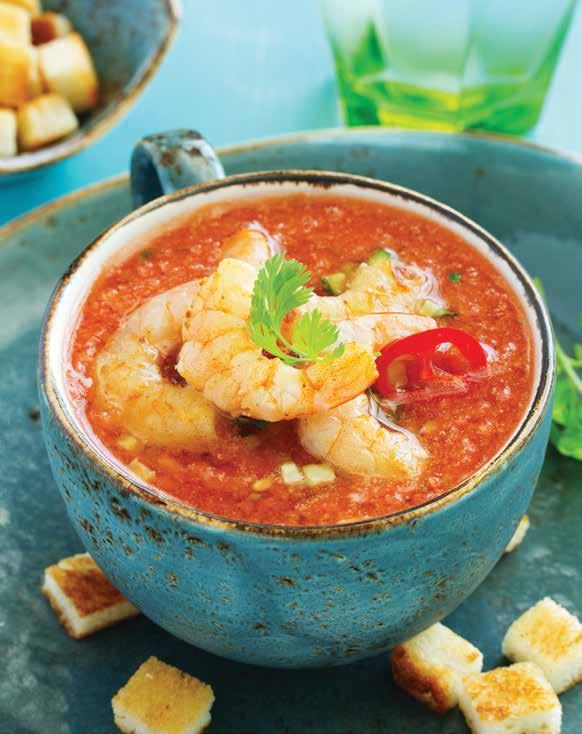
Summer Seafood Gazpacho
ARTICLE BY ALYSSA LAVY, MS, RD, CDN
A REFRESHING, CHILLED, SUMMER FORWARD SOUP THAT PACKS IN PROTEIN AND FIBER!
This summer seafood gazpacho screams summer and is the perfect, refreshing meal, snack or appetizer to beat the heat - whether you’re entertaining or enjoying a quiet meal with family. It’s packed with some of the season’s most flavorful produce and provides satisfying fiber and protein to help keep you feeling full, while still being light enough to enjoy on the hottest of summer days. Plus, there is no need to turn on the oven or the stove, keeping your kitchen (and you) cool as a cucumber! You can enjoy this chilled soup as is, or add toppings like chopped jalapeños, cilantro, or creme fraiche and scoop it up with tortilla chips!
Ingredients: (yields ~8 C gazpacho)
• 8 large tomatoes
• 1 large cucumber
• 2 cloves garlic
• 1 small sweet onion
• 1 jalapeño pepper
• ½ tsp hot sauce
• 3 Tbsp lemon juice
• 2 Tbsp extra virgin olive oil
• 1 Tbsp red wine vinegar
• 1 ¼ tsp kosher salt
• ½ tsp ground black pepper
• 2 Tbsp parsley (fresh or dried)
• 8 oz lump crab meat
• 8 oz cooked shrimp, chilled (about 8-12 large shrimp)
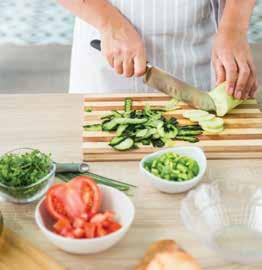
1. Cut tomatoes into large chunks, approximately 6-8 pieces each. Set aside.
2. Slice cucumber into thick slices. Set aside.
3. Mince garlic. Set aside.
4. Chop onion into medium sized pieces. Set aside.
5. Slice jalapeño pepper in half, lengthwise. Remove seeds if you prefer less heat. Chop jalapeño pepper and set aside.
6. Add tomatoes to large food processor. You may need to add about half of the tomatoes, pulse for a few seconds and then add the remaining tomatoes depending on the size of your food processor. Pulse tomatoes until chunky and slightly pureed. You will continue to puree the tomatoes once the additional ingredients are added, so do not pulse until completely smooth.
7. Add remaining vegetables (cucumber, garlic, onion, jalapeño pepper) to food processor with the tomatoes. Add hot sauce, lemon juice, extra virgin olive oil, red wine vinegar, salt, pepper and parsley. Replace the lid and pulse to desired consistency – the gazpacho should be pureed, but still somewhat chunky and not completely smooth.
Alyssa Lavy, MS, RD, CDN, CPT is a registered dietitian, personal trainer and mom of 2. She earned her Bachelor of Science in Exercise Science from The George Washington University and her Master of Science in Nutrition and Exercise Physiology from Teachers College Columbia University, where she also completed her dietetic internship. She has been an ACSM certified personal trainer for over a decade. Alyssa is the owner of Alyssa Lavy Nutrition & Wellness, a wellness brand offering nutrition communications, program development and consulting services for individuals and corporations.
Website: alyssalavy.com Instagram: @alyssalavyrd
8. Store in an airtight container and chill in the fridge for at least one hour before serving. If not serving right away, this gazpacho can be made in advance and stored in the fridge overnight or for a few days until ready to serve. If making this gazpacho in advance, purchase fresh seafood or thaw frozen within 1 day of serving to keep seafood fresh and store seafood separately, only adding when ready to serve. When ready to serve, chop the shrimp and add approximately 1-2 oz chopped shrimp and ~1 oz crab meat to each bowl. You can add optional toppings, such as chopped cilantro, chopped jalapeños, tortilla chips, creme fraiche and an additional sprinkle of parsley, if preferred. Enjoy!
Note: This gazpacho can be stored in the fridge in an airtight container for up for 4 days, without the seafood. Store seafood separately and add when ready to consume.
UNPLUG HAVE FUN! &
ARTICLE BY PAM REID | PHOTOGRAPHY PROVIDED
Summertime is the best time for kids to disconnect and enjoy being outdoors.
Long, long ago, in a time before technology, children entertained themselves and played endlessly with nothing more than ... wait for it ... their imagination. They played outdoors for hours with friends, balls, jump ropes, buckets, chalk, bicycles, you name it! The level of creativity saw no limits in the minds of these children. While some families have plans for getaway vacations, there are those planning to stay home and scrambling for things their children can do. We’d like to share some ideas that don’t include technology or cost a boat load of money for that matter. The benefits of spending time outdoors and unplugged outweigh complaints about temperature or those annoying creepy crawlers. The added bonus is that many outdoor games secretly teach life skills. Technology is used only to confirm game rules.
Ready or not, it’s time to play! A day - or two or three - full of outdoor games will invoke a trip down memory lane for some adults, or a “this is great” thought for others. In either case, playing these games has tremendous benefits - young people can fully embrace human connection, get a break from the instant gratification associated with technical devices and social media, and enjoy some good wholesome, age-appropriate fun. Many adults admit they played many of their favorite childhood games well into their teen years, and still others say they relish in a good game of dodgeball or tug of war today. This list is not all-inclusive, but it certainly gets the games started!
“READY OR NOT, IT’S TIME TO PLAY!”
CHILDHOOD GAMES
TUG OF WAR - contest between two teams at opposite ends of a rope; each team trying to drag the other across a center line.
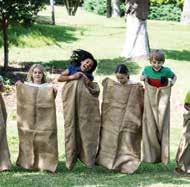
SACK RACE - stand in your sack, hold on to the top of your sack and hop as fast as you can to the finish line!
FREEZE TAG - each player freezes when tagged and can be unfrozen only by a player who is not yet frozen. Game ends when all players are frozen.
RED LIGHT GREEN LIGHT - shout “green light” and all players run towards you, shout “yellow light” and they are allowed to walk, but when “red light” is shouted, they must stop and freeze. If player moves at “red light”, they go back to start line.
MUSICAL CHAIRS - walk to music around a group of chairs containing one chair fewer than number of players, and rush to sit down when music stops. The player left standing in each round is eliminated.
KICK THE CAN - find players in their hiding spots and put them in “jail”. Once a player is “jailed” the only way to be freed is for another player to beat the “IT” person to the can and kick it.
DODGEBALL - team sport in which players on two teams try to throw balls and hit opponents, while avoid being hit themselves. Consider water balloons instead of balls on a hot day.
There are more great outdoor games. Get unplugged and get outside!
KOOB S T O TAKEYOU AWAY
I ASKED MY EXPAT AND TRAVEL-SAVVY FRIENDS TO RECOMMEND BOOKS TO TAKE ME FAR AWAY. HERE YOU GO!
ARTICLE BY SUE G. COLLINS
Blue Latitudes
BY TONY HORWITZ
Blue Latitudes: Boldly Going Where Captain Cook Has Gone Before. The Pulitzer Prize–winning journalist travels to various parts of the world, following in the footsteps of explorer James Cook.
The Island of Missing Trees
BY ELIF
SHAFAK
It is 1974 on the island of Cyprus. Two teenagers, from opposite sides of a divided land, meet at a tavern in the city they both call home. The tavern is the only place that Kostas, who is Greek and Christian, and Defne, who is Turkish and Muslim, can meet, in secret, hidden beneath the blackened beams from which hang garlands of garlic, chili peppers and wild herbs. This is where one can find the best food in town, the best music, the best wine. But there is something else to the place: it makes one forget, even if for just a few hours, the world outside and its immoderate sorrows.
The Corfu Trilogy
BY GERALD DURRELL
Three classic tales of childhood on an island paradise - My Family and Other Animals, Birds, Beasts and Relatives and The
Garden of the Gods by Gerald Durrell - are available in a single edition for the first time in The Corfu Trilogy
Just before the Second World War the Durrell family decamped to the glorious, sun-soaked island of Corfu, where the youngest of the four children, ten-year-old Gerald, discovered his passion for animals: toads and tortoises, bats and butterflies, scorpions and octopuses. Through glorious silver-green olive groves and across brilliant-white beaches Gerry pursued his obsession . . . causing hilarity and mayhem in his ever-tolerant family.
Cutting for Stone
BY ABRAHAM VERGHESE
Cutting for Stone is a novel written by Ethiopian-born, Indian-American medical doctor and author Abraham Verghese. It is a saga of twin brothers, orphaned by their mother’s death at their births and forsaken by their father.
The Museum of Innocence
BY ORHAN PAMUK
The author is a Nobel-laureate Turkish novelist. The book, set in Istanbul between 1975 and 1984, is an account of the love story between the wealthy businessman Kemal and a poorer distant relative of his, Füsun.
Birdwatching Made Simple
EXPERT TIPS TO MAKE BACKYARD BIRDING A FASCINATING AND PEACEFUL PART OF YOUR LIFE.
ARTICLE BY MARSHALL ZWEIG
PHOTOGRAPHY PROVIDED
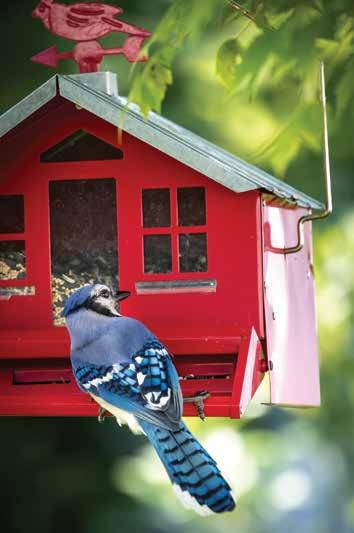
Thinking of putting up a bird feeder? You’re not alone. Backyard birding is the second most popular hobby in the U.S.—right behind gardening. Bob Gors of Wild Birds Unlimited in Macomb, MI, shares expert tips to help you get started—and get results.
START WITH THE RIGHT SETUP
If you’re new to bird feeding, don’t overcomplicate it. Bob recommends starting with a tray feeder, either pole-mounted or hung. “It’s accessible to the widest range of birds,” he says, “and it lets you experiment with different seed blends.”
Before setting up, take a look at your yard. Birds prefer to feed near trees or shrubs where they can perch and scan for predators. “If your yard is wide open, it’s going to be harder to attract them,” Bob notes.
Quick Tip: Place your feeder about 15 feet from trees or shrubs to give birds a safe place to wait their turn.
CHOOSE THE RIGHT SEED—AND SKIP THE FILLERS
Not all bird seed is created equal. Bob advises avoiding blends with fillers like milo, wheat, or oats. “Those are agricultural leftovers. Most birds won’t eat them.”
Each Wild Birds Unlimited store owner customizes their seed blends, based on the birds in each store’s specific area. Their blends contain no fillers—just high-quality ingredients birds actually eat. They’re available in no-mess varieties—no shells, no waste. “With standard seed, up to 40% of the weight of the bag is shells,” Bob says. “No-mess is 100 percent pure bird food.”
Quick Tip: Choose fresh, unscented, unflavored seed. Birds don’t need additives—just what they’d eat in nature. Check the ingredients on the bag: sunflower should be the first ingredient—since it’s the seed most birds love.
IT’S REMAINED PART OF THEIR LIVES: ONE COUPLE TOLD BOB THEY STILL START EVERY MORNING ON THE PORCH WITH COFFEE AND BIRDSONG. “IT BECAME A RITUAL THAT
KEEP UNWANTED GUESTS AWAY
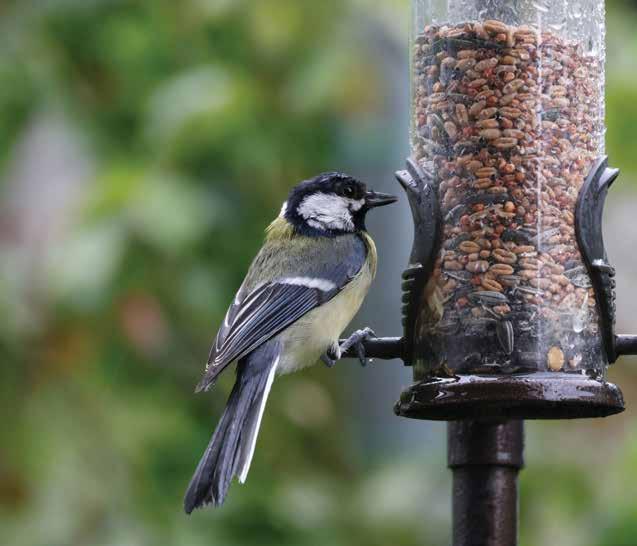
Squirrels causing trouble? Try safflower seed. “It tastes bitter to squirrels but attracts cardinals, grosbeaks, titmice, nuthatches and chickadees,” Bob says. Hot pepper blends also work—birds can’t taste the heat, but mammals can.
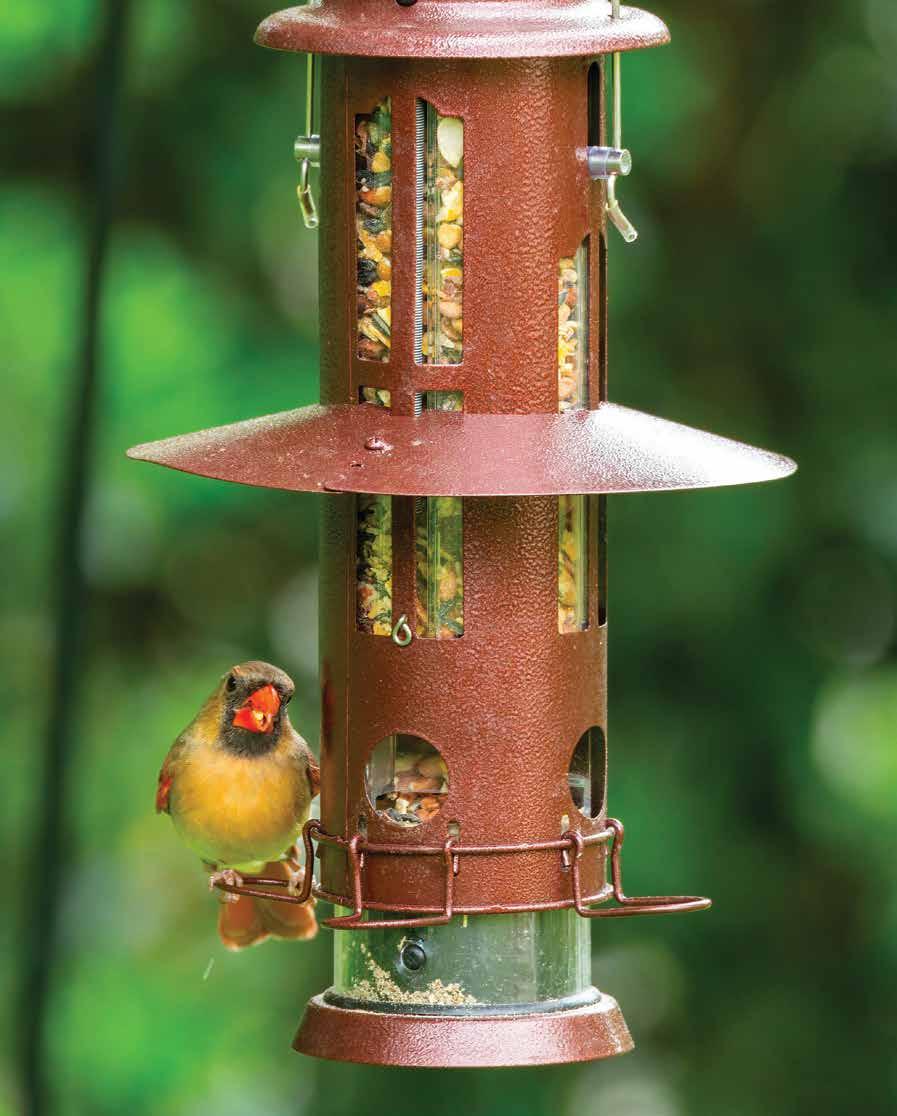
To deter large birds like starlings, Bob recommends using a cage around tube feeders to limit access. Tube feeders with small perches help discourage bigger birds. For tidier feeding, seed cylinders— compressed seed—are a great low-mess option.
Quick Tip: “Start simple,” Bob advises. “Watch what’s happening in your yard, then adjust as needed.” Unlike loose seed, cylinders make the birds work harder—and give you longer-lasting views of the birds.
SPOT BIRD BEHAVIOR (AND BACKYARD DRAMA)
Once your feeder’s up, the show begins.
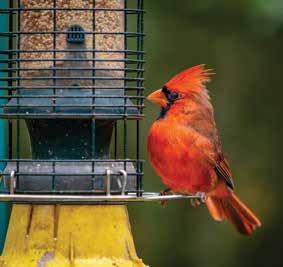
“Different species act differently,” Bob explains. “Cardinals are typically the first and last birds of the day to the feeder. Male hummingbirds are very territorial and will defend ‘their’ feeder. Chickadees come to the feeder in a flash; they have a grab-and-go strategy. “In our backyard, orioles and bluebirds battle over live mealworms,” he adds. “The female bluebird often holds her ground.”
Quick Tip: You don’t need to track every species. “Just sit back with a cup of coffee and watch,” Bob says. “You’ll start noticing more than you’d expect.” CONTINUED >
SEASONAL CHANGES TO EXPECT
Feeder activity increases in summer, thanks to fledglings. “By July, your bird population has basically doubled,” Bob says. At the same time, some favorites— like male orioles—start their fall migration as early as July.
One common myth? That goldfinches leave in winter. “They stay put,” Bob says. “But the males molt into drab-colored feathers, so people often don’t recognize them.”
Quick Tip: Keep feeding in winter. “Some of the best bird watching happens in the colder months—different species of birds visit us in the winter.”
HOW TO ATTRACT SPECIFIC BIRDS
Want cardinals? Use tray feeders or tube feeders with U-shaped perches. “They’re heavier birds,” Bob says. “Standard tube feeders are hard for them to use.”
Hoping for bluebirds? They prefer parklike settings. If your yard fits, try a nesting box with a 1.5-inch entrance, and offer live mealworms far away from the nest box.
Hummingbirds? Stick to sugar water— no red dye needed. “And expect a show,” Bob adds. “Males are fiercely territorial at the feeder.”
Wild Birds Unlimited carries feeders tailored to specific birds, but Bob and his team focus on fit. “We ask about your yard, your goals, and guide you from there.”
Quick Tip: Not sure what birds are in your area? Ask your local Wild Birds Unlimited shop.
WHY BIRD WATCHING STICKS
Bob says many customers started birding during the pandemic—and never stopped. “They looked out the window and realized something was there,” he says. It’s remained part of their lives: one couple told Bob they still start every morning on the porch with coffee and birdsong. “It became a ritual that many people now cherish,” Bob says.
For expert help making bird watching your ritual, stop by Wild Birds Unlimited in your area or visit wbu.com.
TAKE YOUR NEXT VACATION WITH EFFORTLESS FLAIR
YOU WORK HARD ALL YEAR—YOUR VACATION STYLE SHOULD FEEL CINEMATIC, EFFORTLESS, AND UNMISTAKABLY MAIN CHARACTER.
ARTICLE BY COURTNEY STONE SMITH PHOTOGRAPHY PROVIDED
Effortless vacation style isn’t about having the perfect outfit for every moment—it’s about having the right foundation to make every moment look intentional. When you know how to build a capsule travel wardrobe, you’ll avoid agonizing over what to wear and spend more time actually enjoying your getaway, all while looking like you have a personal stylist tucked in your carry-on.
Here’s your go-to list for this season’s travels:
1. THE EFFORTLESS STATEMENT SET
A coordinated two-piece (linen, silk, or cotton) that transitions from day to night. Sets are easy to wear, photograph, and offers effortless ways to look put together. Bonus: you can mix and match the pieces with other items that you pack. I would recommend packing multiple sets to make it even easier to mix and match. For both men and women, simply focus on neutrals and, if you want to add color, make sure it coordinates well with other items in your luggage.
2. THE MOOD-ALTERING PIECE
A sweeping dress in a bold print or luscious fabric that makes you feel sensual, grounded, and free. Find something that moves with you and captures light beautifully. This is your dreamy piece— flowy fabrics with movement that captures the eye and works for any kind of event.
3. THE LUXE FLAT OR SCULPTURAL SANDAL
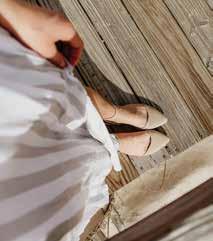
Find footwear that balances style and comfort. Look for interesting shapes or materials (like leather with architectural cutouts or metallic finishes). More than shoes—they’re anchors for adventure, grounding your aesthetic wherever you land. This goes the same for men. Your footwear can also make an impact through the braided details of your sandals or the canvas of a casual slip-on loafer.
4. THE TRANSITIONAL THIRD PIECE
Think: kimono, over-sized linen blazer, a lightweight duster, or a gauzy button-down left open. This is your layering hero that adds polish without effort. It’s an aura amplifier that instantly makes your outfit feel styled and intentional.
5. INTERESTING AND IMPACTFUL SUNGLASSES
Sunglasses with personality is a must. They could be over-sized, cat-eye, or tinted lenses that feel more like “cinematic escape” than “just functional.” Because you’re not sightseeing—you’re starring in your own travel film.
6. A SCULPTURAL CARRYALL
A bag that holds your essentials but looks like art— think woven textures, unique shapes, or buttery leather. Practicality meets poetry. You deserve a vessel that carries your dreams...and your SPF.
7. SIGNATURE SCENT OR TRAVEL CANDLE
Pack travel-sized fragrance or a tiny candle that evokes your essence or complements the location. Scent is meant to ignite memories and set the tone— infuse your travels with an olfactory signature.
8. ACCESSORIES WITH A STORY
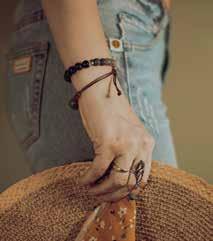
A few intentional pieces such as a ring from a market you found during your travels, a layered necklace that serves as an easy throw-on, or a straw hat to protect your face from the sun (even if it’s a cooler climate, because remember, safety first: don’t get burnt).
TUESDAYS IN JULY
Twilight Concert Series
events
A SELECTION OF UPCOMING LOCAL EVENTS
Mitchell Park or Rinconada Park | 6:30 PM
The free Tuesday concert series runs through July at neighborhood parks. Bring a picnic and a blanket. Food trucks on site.
THURSDAYS IN JULY
Cantor Arts Center — Thursdays Open Late
Cantor Arts Center, 328 Lomita Dr, Stanford | 8:00 PM
The Cantor stays open until eight on Thursday evenings through summer. Free admission, special exhibitions rotating, the late hour when the museum is almost empty.
SATURDAYS IN JULY
Downtown Palo Alto Farmers Market
Gilman St & Hamilton Ave | 8:00 AM
The Saturday farmers market runs through summer at full peach-and-tomato season. Local growers, baked goods, flowers.
SUNDAYS IN JULY
Bol Park Donkey Visits
Bol Park, 3590 Laguna Ave. | 10:00 AM
Buddy and April, the Bol Park donkeys, are visited every Sunday morning by Barron Park Donkeys volunteers. Free, kid-friendly, an hour with two donkeys. The donkeys are the legacy of Cornelis Bol, the Dutch physicist who taught at Stanford.
JULY 4TH
Fourth of July Summer Festival + Chili Cook-Off
Mitchell Park, 600 E. Meadow Dr | 11:00 AM
Palo Alto’s annual Independence Day festival returns to Mitchell Park. Twenty-plus local cooks compete in the chili cook-off, with live music, kids’ activities, and food trucks across the park lawn. Free admission, family-coded, a Mitchell Park tradition for decades.
JULY 15TH
Music@Menlo Chamber Music Festival
Menlo School campus, 50 Valparaiso Ave, Atherton | 6:30 PM
Music@Menlo opens its summer chamber music festival in mid-July, founded by David Finckel and Wu Han. World-class roster, Chamber Music Institute for emerging musicians, concerts across the Menlo School campus. Tickets at musicatmenlo.org.